
Shrimp
Symbolism, Meaning & Spirit Animal
A shrimp is a small, swimming crustacean with a long body and ten legs, found in oceans and fresh water and eaten around the world. Shrimp symbolizes adaptability, hidden nourishment, resilience, and the quick protective instinct to retreat and return.
By Sidian M.S. Jones, personal mythologistHow these pages are made
The Symbolism & Meaning of Shrimp
Shrimp meaning begins with a body that works close to the substrate. Many shrimp graze algae, sift organic particles, scavenge remains, or pick food from surfaces while larger animals pass overhead. Some hunt at night, some emerge with the tide, and some spend daylight tucked into cracks, burrows, or vegetation. Their life is not a march toward visibility. It is a practice of noticing what is available, taking enough, and staying mobile in a crowded world.
That makes Shrimp an archetype of resourcefulness without spectacle. It does not promise that life will give you ideal materials. It shows an animal making use of scraps, films, particles, and tiny openings. Nourishment can be found in the overlooked corner, the unglamorous job, the conversation no one else thinks to have. Shrimp does not make poverty beautiful, but it recognizes the intelligence required to keep living when abundance is unevenly distributed.
The tide may ebb and flow, but life persists in the undercurrent: find your rhythm, find your peace.
Its 
Shrimp also moves by 
Because it is small, sensitive, and often hidden, Shrimp can speak to a life whose importance is easy to underestimate. A person carrying it may notice mood, texture, timing, and the first change in a room before anyone names the danger. The gift is precise responsiveness. The risk is making concealment into an identity. Shrimp asks for a return, not a permanent disappearance: hide when the water turns hostile, then come back to feed, connect, and grow.
Shrimp as a Spirit Animal, Totem & Power Animal
When Shrimp arrives as a spirit animal, totem, or power animal, it often appears without grandeur. You may notice it in a meal, a tide pool, a childhood memory, an aquarium, or the sudden movement of a nearly transparent body. Its 
Having Shrimp as yours can mean that your power works through sensitivity and timing. You read the water before committing yourself. You notice who is taking more than their share, where nourishment is collecting, and when a conversation has become unsafe. Your antennae may be social rather than literal, but the pattern is physical: information reaches you through faint changes, and you respond before the whole environment declares itself.
Shrimp asks you to respect retreat as a useful movement. A shrimp can spring backward faster than it can make a dignified forward entrance. If you carry this archetype, leaving a bad room, pausing a negotiation, changing a route, or declining exposure may be the intelligent act. The power is not in hiding forever. It is in knowing that survival preserves the possibility of return. A retreat that brings you back with more information is not defeat.
This archetype also arrives around molting seasons. You may be changing a role, belief, relationship pattern, or protective habit that once fit tightly. The old shell cannot stretch with you, yet the new one begins soft. Shrimp as a power animal asks you not to demand immediate hardness from yourself. Protect the vulnerable interval. Keep your circle close. Let growth happen before displaying the finished version.
As a totem, Shrimp can describe a family or community identity built through coastal work, modest means, shared food, or practical endurance. It honors the people who make a living from what others overlook and who know that a tide changes the whole field at once. As a spirit animal, it may guide attention toward hidden systems and small forms of life. As an archetype, it becomes a pattern you can carry anywhere: nourish what is near, sense the current, withdraw quickly from harm, and return when the water permits.
The danger is turning modesty into self-erasure. You may begin calling every need excessive and every disappearance wise. Shrimp does not ask you to become negligible. It asks you to remain alive enough to grow, feed, molt, and move among others. Its power is quiet, but quiet is not the same as absent.
Which of these is also you?
Collect 8 to make a mythos.
These archetypes were chosen because you are reading about Shrimp.
Shrimp in Mythology & Folklore: Where the Symbolism Comes From
In Japanese custom, shrimp carry one of the clearest traditional meanings attached to the animal. Their curved bodies resemble the bent backs of old people, and their long feelers suggest long white hair. The word ebi can also be written with characters meaning “sea elder.” For that reason, shrimp appear in osechi ryori, the carefully arranged foods served at New Year, as a wish for a long life. The shell and red color add festivity, but the bent body does the main symbolic work: age is pictured not as an abstraction, but as a body that has endured enough years to bow.
That same dish can carry a second wish. In Japanese food symbolism, shrimp are associated with longevity, prosperity, and the continuation of a household. They are not usually honored because they dominate the sea. Their appeal is almost the opposite. A small animal becomes an emblem of a life extended through persistence, eaten at the threshold of a new year. Shrimp also appear in Japanese visual culture, including ukiyo-e, netsuke, ceramics, and celebratory food decoration, where their whiskers and hooked shape make them instantly recognizable signs of age and good fortune.
Chinese folk symbolism takes a different route. Shrimp are served at New Year banquets and wedding meals as auspicious food, and Cantonese cooking often uses har, the Cantonese word for shrimp, in dishes associated with happiness and lively celebration. Mandarin xia can evoke the sound of laughter in wordplay, though the exact pun depends on dialect and context. Chinese artists have also made shrimp a serious subject. Qi Baishi’s ink paintings of shrimp are famous for making a few spare strokes suggest transparency, movement, and life beneath water. In that setting, the creature is not only a banquet omen. It becomes a study in economy: a nearly invisible body made present by a precise gesture.
These traditions do not all make the same claim. Japanese New Year symbolism looks at the shrimp’s bent form and sees old age reached honorably. Chinese celebratory usage tends to emphasize happiness, abundance, and social pleasure, while literati painting can value delicacy and technical restraint. One reading faces the end of a long life; another turns toward laughter and the fullness of a 
Outside East Asia, shrimp have often remained food, bait, trade goods, or local ecological knowledge rather than a widely fixed mythic emblem. Indigenous coastal peoples have long known particular shrimp and their seasons, but a general pan-Indigenous “shrimp meaning” would flatten distinct nations and places into an 




Shrimp and Its Relationships With Other Archetypes

Flamingo
“Flamingos eat shrimp like me, and the color in our shells turns their feathers pink.”
Flamingos get their pink from carotenoid pigments in the algae and small crustaceans they eat, including brine shrimp, and their color fades without them. Flamingo shows how much of Shrimp's hidden nourishment ends up visible in someone else, the small thing that colors a whole flock.
Visit Flamingo
Coral
“On the reef I set up a cleaning station, and big fish open their mouths for me.”
Cleaner shrimp live on coral reefs and pick parasites and dead tissue from fish, which visit their stations and hold still, some predators even letting the shrimp work inside their mouths. Coral and Shrimp together describe a person who stays small and is trusted anyway, because they are useful to everyone around them.
Visit Coral
Thunder
“My kind of claw snaps a bubble so loud that wartime sonar crews heard our colonies crackling.”
Snapping shrimp close a claw so fast that a collapsing bubble makes a sharp crack and a brief flash of light, and dense colonies made a crackle that confused submarine sonar in the Second World War. Thunder gives Shrimp a surprising voice, a reminder that a creature known for retreating can still make itself heard.
Visit Thunder
Fish
“A goby keeps watch at my door while I dig, and I keep one antenna on it.”
Some snapping shrimp share burrows with goby fish: the shrimp, whose eyesight is poor, digs and maintains the burrow, and the goby stands guard and signals danger with a flick of its tail. Fish and Shrimp together describe a partnership where each covers the other's weakness, and both retreat together at the first warning.
Visit Fish
Shell
“I outgrow my shell and step out soft, then hide until the new one hardens.”
Shrimp grow by molting, shedding the old shell and staying vulnerable until a new one hardens, which is when they are most likely to hide. Shell and Shrimp together belong to a person who grows in stages and needs a quiet retreat each time, then comes back out larger.
Visit Shell
Shrimp also keeps company with the ocean: Coral, Jellyfish, Nautilus, Puffin, Seal and Walrus, among thirty-three others of the ocean.

Shrimp in Dreams: Meaning & Interpretation
Dreaming of shrimp often brings attention to what survives beneath the obvious surface. A shrimp feeds among sand, silt, rock, algae, and discarded matter, sensing food and danger through a world that may look empty from above. The dream may therefore arrive when you are gathering small resources, reading a difficult atmosphere, or finding nourishment in work others overlook. It can point to a modest appetite that keeps you alive rather than a grand desire that announces itself.
The dream is doing more than handing you a symbol. It is adjusting your scale. You may be measuring yourself against large demands, while your actual strength lies in quick responses, flexible habits, and the ability to use what is available. Because many shrimp hide or freeze when threatened, the dream can also examine the difference between protective concealment and disappearing from your own life. Its feeling matters: a lively shrimp may invite curiosity, while one trapped in a tank may show that safety has become confinement.
Shrimp darting through clear water may mark a welcome return of appetite, play, or movement after a period of uncertainty. Shrimp gathered in a tide pool can suggest a small community of needs and relationships that quietly sustains you. Eating shrimp at a bright table may echo Japanese or Chinese celebratory associations with longevity, laughter, and a future being welcomed with other people.
Shrimp buried in mud may warn that useful information is being missed because you are searching only where things look clean. A shrimp shedding its shell can portray a vulnerable transition: growth is underway, but protection is temporarily thin. Shrimp trapped in a net, bowl, or aquarium may begin with a promise of security and end as a question about whether shelter still permits movement. A dead or foul-smelling shrimp often points less to death itself than to nourishment, money, or an obligation that has spoiled while remaining unattended.
Shrimp: Positive & Negative Meanings
Positive Meanings
- Finds nourishment in overlooked places
- Responds quickly to changing conditions
- Uses retreat as intelligent protection
- Grows through repeated cycles of renewal
- Offers care without demanding attention
- Adapts without losing basic survival instincts
- Notices subtle social and environmental signals
Negative Meanings
- Can confuse smallness with safety
- May retreat before danger is real
- Risks making invisibility into an identity
- Can survive on too little for too long
- May treat every transition as an emergency
- Can mistake constant flexibility for rootedness
- May hide needs behind modesty

The Shadow of Shrimp
The shadow of Shrimp appears when protection becomes a permanent habitat. A person may live in the mental equivalent of a crevice, emerging only to gather enough approval, money, food, or affection to retreat again. Because Shrimp can survive on small portions and overlooked material, the shadow may even feel virtuous. Wanting little can conceal the fear of asking for what would actually sustain a larger life.
Retreat is useful when a predator is near. It becomes shadow when every disagreement smells like danger. The person carrying this pattern may reverse out of opportunities, conversations, intimacy, or visibility before anyone has threatened them. They may call this adaptability while their world steadily narrows. Sensitivity then loses its accuracy. Instead of detecting real changes in the water, it treats every ripple as a net.
Molting offers another dark edge. Growth requires leaving a shell, but a person can shed identities compulsively, abandoning commitments whenever discomfort arrives. The new self remains soft because it never stays anywhere long enough to harden through experience. Shrimp’s healing is not a demand to become armored. It is the ability to tell the difference between a shell that has become too tight and a structure that still protects essential life.
The shadow begins to loosen when concealment serves a return. Smallness can remain a scale, not a verdict. The person can take nourishment seriously, name the actual threat, and let a safe environment be visible as safe. Then the backward spring becomes one movement in a cycle rather than the whole story.
How Did You End Up at Shrimp?
Who benefited when I stayed small in the shallows, fed quietly on what was left behind, and made no demand on the people watching from above?
Which witness saw me freeze beneath the sand when danger came, and what did you decide my hiding meant instead of asking what I sensed?
After I slipped backward from the net once, what did you conclude about yourself, and where have you mistaken one escape for proof you can never surface?
What are you keeping yourself safe from now by retreating into silt, shell, or silence, and is that threat still moving through your water?
Has Shrimp turned up in your life, in a dream, a moment, a person? Put it on your page and join its kin, or tell the first story and take the Top Active seat.


 Written by Warren,
for you alone
A reading by Warren
What Shrimp means for you
This page says what the Shrimp means. Warren can tell you why it is showing up for you, now.
Shrimp: Frequently Asked Questions
- What does Shrimp symbolize?
- Shrimp meaning begins with a body that works close to the substrate. Many shrimp graze algae, sift organic particles, scavenge remains, or pick food from surfaces while larger animals pass overhead.
- What is the spiritual meaning of Shrimp?
- When Shrimp arrives as a spirit animal, totem, or power animal, it often appears without grandeur. You may notice it in a meal, a tide pool, a childhood memory, an aquarium, or the sudden movement of a nearly transparent body.
- What does Shrimp represent?
- In Japanese custom, shrimp carry one of the clearest traditional meanings attached to the animal. Their curved bodies resemble the bent backs of old people, and their long feelers suggest long white hair.
- What does it mean to dream about Shrimp?
- Dreaming of shrimp often brings attention to what survives beneath the obvious surface. A shrimp feeds among sand, silt, rock, algae, and discarded matter, sensing food and danger through a world that may look empty from above.
- What is the shadow side of Shrimp?
- The shadow of Shrimp appears when protection becomes a permanent habitat. A person may live in the mental equivalent of a crevice, emerging only to gather enough approval, money, food, or affection to retreat again.
- What are the positive and negative meanings of Shrimp?
- Finds nourishment in overlooked places. Can confuse smallness with safety.
- What does a Shrimp tattoo mean?
- Often, a person wears a Shrimp to honor quiet survival, a family’s coastal connection, or growth that happened out of public view. Some choose it for humor and humility, while others use its small, armored body to mark recovery without making a grand declaration.
Characteristics of Shrimp
- Color:
- gray
- Covering:
- shelled
- Form:
- many-legged
- Size:
- tiny
- Kind:
- crustacean
- Diet:
- omnivore
- Active when:
- cathemeral
- Habitat:
- ocean, wetland
- Element:
- water
Shrimp combine a segmented external skeleton with a body built for constant adjustment. Their antennae and sensory hairs detect chemical and mechanical changes in the water, while their swimmerets move water over the body and, in many species, carry eggs. Many can reverse rapidly with a flex of the abdomen, and some change sex during their life cycle. The result is an animal whose delicate appearance conceals unusually responsive engineering.
Get the next one
Essays on personal mythology, archetypes, and the stories we tell ourselves.
Take Shrimp home
Printed to order and shipped to you. Please allow a few extra days for production.
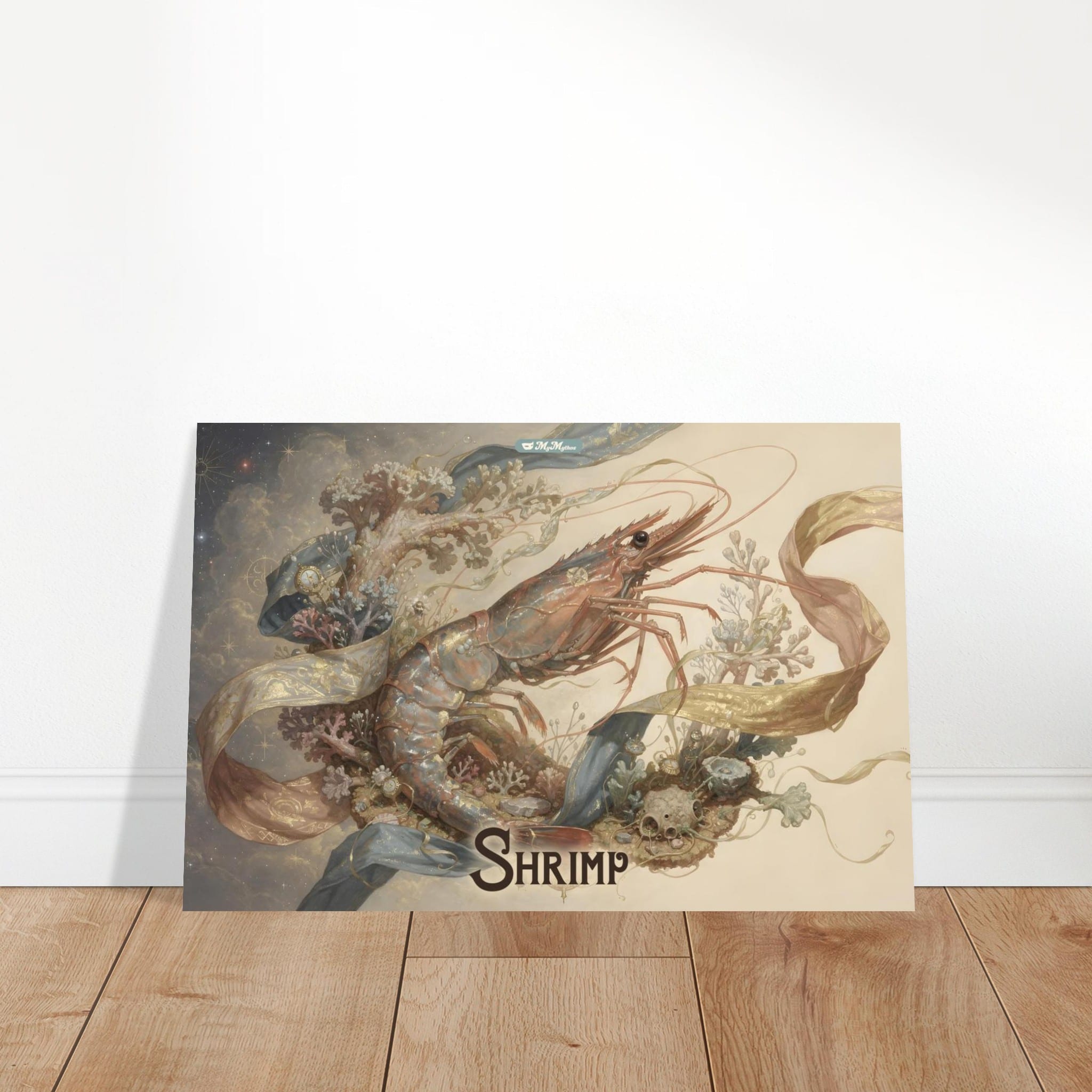
On your wall
Material
Sale! Was $19.00, now $14.25
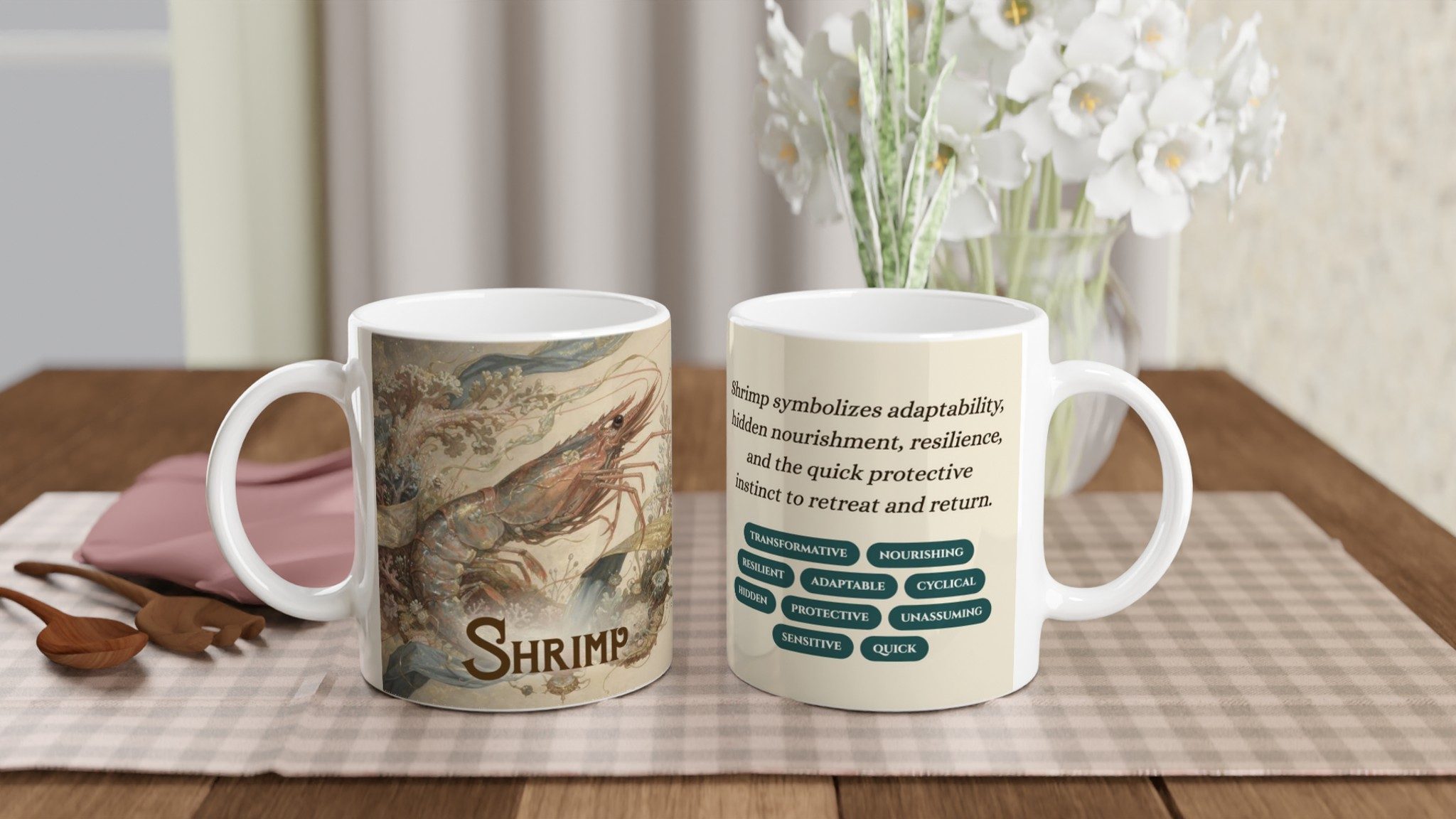
In your hands
Size
Color: White
Sale! Was $18.00, now $13.50
From elsewhere
Paid links: if you buy through these, MyMythos earns a small commission at no cost to you.