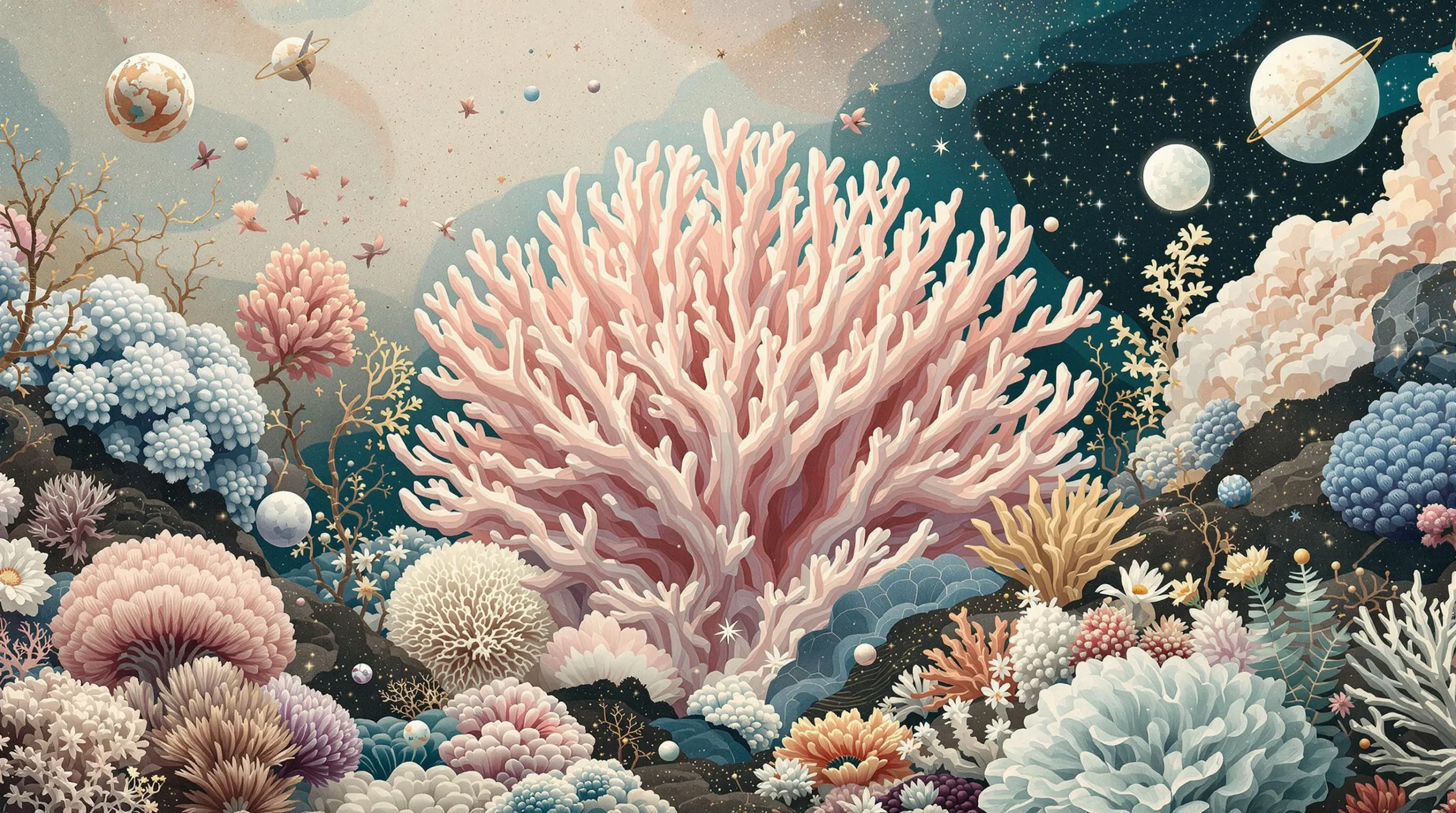


Coral

Archetype Meaning & Symbolism

Foundational, collaborative, patient, delicate, rigid, sheltering, historical, symbiotic, communal, vulnerable

  • What is built together, from the very essence of ourselves, endures beyond the individual tide. We are the architecture of our own sea.

If Coral is part of your personal mythology, you may...

Believe

  • That the most enduringly beautiful things are built slowly, over generations, from the bones of what came before.

    That the notion of a truly individual self is a fiction; we are all interconnected, symbiotic parts of a larger, living system.

    That true strength is not found in personal power, but in creating a structure that shelters and sustains others.

Fear

  • Sudden, systemic environmental change that you cannot adapt to, which threatens to dissolve the very foundations of your world.

    Profound isolation: being a single, disconnected fragment with no reef to belong to, no symbiotic partner to give life meaning.

    The loss of your inner 'color' and vitality; a spiritual or emotional bleaching that leaves you a mere ghost, a functional but lifeless skeleton.

Strength

  • An almost geological patience and a long-term perspective, allowing you to undertake and complete projects of lasting value.

    A profound and innate capacity for creating community and fostering symbiotic, mutually nourishing relationships.

    An inner resilience born of a strong, well-defined internal structure of core values and beliefs.

Weakness

  • A deep-seated rigidity or resistance to change, even when adaptation is necessary for survival, causing you to cling to outdated structures.

    An over-reliance on specific external conditions, leading to extreme vulnerability when your social or emotional environment turns toxic.

    A tendency to become insular, creating a fortress of community that inadvertently shuts out necessary new life, ideas, and perspectives.

The Symbolism & Meaning of Coral

The Coral archetype embodies the profound paradox of being both a living community and a geological feature, a creature that builds its own tomb and turns it into a city for others. Its symbolism is rooted in this duality: it represents legacy, the way the present is quite literally constructed upon the calcified remains of the past. For a personal mythos, this suggests a life built upon the foundations of ancestors, past selves, and cumulative experience. One does not discard history; one incorporates it, allowing it to become the very structure of the self. Coral speaks to deep time, to the patient, accretive nature of creating something that endures.

This archetype is also a supreme symbol of interdependence. A reef is not a monolith; it is a sprawling metropolis of individual polyps functioning in such exquisite concert that they become a single, superorganism. In personal mythology, this points toward an identity that is inherently relational. The self is not an isolated island but a node in a vast network, defined and sustained by its connections. Strength, in this view, is not a product of individual will alone, but of the health and integrity of the entire web. The story of 'me' is inseparable from the story of 'us.'

Finally, Coral holds the tension between vibrant beauty and stark fragility. It is the sea's memento mori, a living skeleton whose brilliant colors signal health and whose bleaching signals trauma and death. This may manifest in a personal mythos as a life lived with great aesthetic sensitivity, an appreciation for the complex beauty that can arise from structure. It also suggests a keen awareness of mortality and the delicate, precarious balance required to maintain one's own emotional and spiritual 'color' against the pressures of a changing world.


Coral Relationships With Other Archetypes

The Ocean

The Ocean is the great, undifferentiated source: the cosmic soup, the collective unconscious, the mother of all life and all chaos. Coral exists entirely within it, dependent on its currents for sustenance yet creating pockets of intricate order from its elemental nature. Their relationship is one of filiation and profound tension. The Ocean provides the calcium to build, but its shifting temperatures and chemistry can dissolve the very structures it helped create. For an individual, this may mirror the relationship between the conscious, structured ego (Coral) and the vast, unpredictable depths of the psyche (The Ocean), a constant negotiation between building form and surrendering to formlessness.

The Gardener

The Gardener is an archetype of conscious cultivation, of imposing external will to shape and nurture growth. Coral, however, is its own garden, its own architecture. It does not plan a reef; it organically becomes the reef. Its relationship with The Gardener archetype may be one of contrast and mutual misunderstanding. The Gardener prunes and weeds from the outside, while Coral's growth is an expression of an innate, collective blueprint. A person with a Coral mythos might, therefore, resist being 'managed' or overly directed, preferring to let their life and projects emerge organically, trusting the slow wisdom of the internal, communal process.

The Volcano

The Volcano represents sudden, violent, fiery creation: new land born from subterranean chaos. Coral, by contrast, embodies slow, cool, aqueous creation. They are antithetical methods of world-building, yet they are part of a cycle. A volcanic island, once cooled and settled in the sea, can provide the perfect subterranean foundation for a coral reef to begin its patient work. This suggests a mythic pattern in one's life: there may be volcanic eruptions of passion, trauma, or radical change that tear down the old world. But on the cooled lava of that past, the slow, quiet, community-building work of the Coral can begin, creating a complex and beautiful new reality.

Using Coral in Every Day Life

Creative Collaboration

When a project requires not a singular vision but a collective breath, the Coral archetype offers a model. It is the wisdom of the polyp: understanding that each minute, individual contribution accretes into a structure of breathtaking complexity. This mindset allows for the surrender of ego not as a loss, but as a necessary component of creating something vast and alive, a testament to the power of the communal hand.

Building a Family Legacy

The creation of a family history or a community's soul may follow the Coral's blueprint. It is the slow, patient accumulation of stories, rituals, and shared memories that forms a protective reef for the generations that follow. This perspective sees lineage not as a simple line, but as a living, expanding architecture, a place of shelter built from the very substance of its members' lives.

Navigating Personal Hardship

In times of emotional abrasion, when the world feels acidic and hostile, the Coral archetype suggests a strategy of internal fortification. It is the process of identifying and hardening one's core values, creating a personal 'skeleton' of belief that provides structure and integrity. This inner framework becomes a refuge, a solid place to exist even when the currents of life are turbulent and corrosive.

Coral is Known For

Reef Building

The collective biological process of creating vast, intricate limestone structures that evolve into entire ecosystems, providing shelter and sustenance for a biodiverse community of marine life.

Symbiosis

A profound, life-sustaining partnership with microscopic algae (zooxanthellae) that live within its tissues, exchanging the coral's structural shelter for the algae's photosynthetic energy.

Vulnerability

A stark sensitivity to environmental changes, particularly ocean temperature and acidity, which can cause 'bleaching'—the expulsion of its symbiotic algae, leaving a ghostly white skeleton and signaling severe systemic stress.

How Coral Might Affect Your Personal Mythology

How Coral Might Affect Your Mythos

A personal mythos informed by Coral may become a story of accretion rather than a linear quest. Life is perceived not as a journey with a destination, but as the slow, cellular construction of a complex inner world. Past identities, relationships, and experiences are not stages to be surpassed and forgotten; they are the calcified layers that provide the foundation for the present self. The narrative arc could feel cyclical and geological, valuing the patient process of building over dramatic, heroic climaxes. The central heroic act, in this mythos, is the creation of a 'place' within the self: a sanctuary of meaning, a legacy of structure, a beautiful and habitable architecture of the soul.

This life story may also be defined by a profound sense of the collective. The protagonist is never truly a solitary 'I' but is always part of a 'we.' The narrative of the self is inextricably woven with the narrative of one's community, family, and environment. Major plot points might revolve not around individual achievement, but around the health of the collective reef: the founding of new connections, the defense of the community against an external corrosive force, or the quiet, enduring act of providing shelter for others. The hero's journey is not outward, but inward and outward simultaneously, building the self by building the world around it.

How Coral Might Affect Your Sense of Self

One's conception of self may be shaped by a paradoxical sense of being both immensely strong and acutely fragile. The strength is structural, rooted in the internal skeleton of core beliefs, values, and memories that can withstand immense pressure. Yet, there is a constant, quiet awareness that this entire structure is contingent upon a healthy external environment: supportive relationships, stable circumstances, a nourishing culture. This can dissolve the fantasy of a singular, atomic 'I,' replacing it with a self-concept that is more of a nexus, a living component of a larger organism, whose well-being is inseparable from the whole.

Identity, then, could become deeply enmeshed with one's creations and contributions. The guiding principle might be 'I am what I build' or 'I am the sanctuary I provide.' Self-worth is not sought in the spotlight of individual glory but is cultivated in the health and beauty of the collective structures one helps to create and maintain. This may foster a deep well of patience with personal development, viewing growth not as a series of breakthroughs but as a slow, geological process of becoming, layer by patient layer.

How Coral Might Affect Your Beliefs About The World

The world, seen through the lens of the Coral archetype, may appear as a vast and intricate network of interconnected ecosystems. Problems are rarely isolated; they are systemic, like a change in current affecting an entire coastline. This fosters a holistic perspective, a deep-seated understanding that a single action can ripple through the entire web in unseen ways. It can lead to a potent ecological consciousness that extends beyond the natural world to social and psychological spheres: the health of the individual psyche and the health of the polis are understood to be two parts of the same living body.

This worldview often holds a profound reverence for history, legacy, and the unseen foundations of the present. The current world is literally built upon the skeletal remains of the past. Traditions, institutions, and cultural memory are not dusty relics but the living, calcified structures that give shape to reality. This can lead to a temperament that seeks to conserve what is valuable, but it can also foster a radical awareness of how past injustices become the bedrock of present crises, demanding solutions that go far deeper than the surface.

How Coral Might Affect Your Relationships

Relationships may be viewed not as discrete, isolated pairings but as contributions to a larger relational ecosystem. A friendship or a partnership is valued for how it strengthens the entire 'reef' of one's social world. There could be a marked preference for stable, long-term connections that are allowed to grow slowly and organically, developing history and shared structure over time. The ideal relationship is one of symbiosis: a mutual exchange of energy and support that makes both parties more vibrant and resilient, like the coral and its indwelling algae. Love is seen as a creative, world-building force.

This can also manifest as an impulse to create a protective barrier around one's chosen kin, forming a close-knit community that shelters its members from the indifference or hostility of the wider world. This instinct is profoundly nurturing, creating safe harbors for growth and expression. The inherent challenge is to ensure the reef's walls remain porous, allowing for new life and fresh currents of thought to enter, preventing the sanctuary from becoming a fortress. Boundaries are understood not as tools of separation, but as the essential, life-sustaining membranes of a healthy system.

How Coral Might Affect Your Role in Life

The role one feels called to inhabit may be that of the Founder or the Community Architect, but on a timescale that is more geological than human. It is not the flashy role of the revolutionary who smashes the old order, but the quiet, persistent role of the artisan who builds the new world piece by piece, often from the fragments of the old. This is a role defined by patience, endurance, and a focus on creating structures—be they families, artistic movements, ethical companies, or social justice frameworks—that are designed to outlast the individual ego.

Alternatively, the perceived role could be that of the Keystone: the being whose very presence allows a diverse community to flourish. Like the physical reef, one's existence creates the conditions and the habitat for others to find safety, purpose, and nourishment. This is a role of immense, often silent, responsibility. The power is not exercised through grand pronouncements or overt acts of leadership, but through the simple, unwavering act of being present, stable, and true to one's foundational nature, thereby allowing an entire ecosystem of relationships and endeavors to thrive in one's vicinity.

Dream Interpretation of Coral

To dream of a vibrant, thriving coral reef, teeming with color and life, could symbolize a period of profound psychological and social health. It may suggest that the dreamer's inner world is in a state of beautiful, complex harmony and that their life's work is successfully providing a sanctuary for both themselves and others. It is an image of creative flourishing, strong community, and symbiotic relationships working in perfect concert. The dream affirms that the dreamer's internal ecosystem is balanced and generative.

Conversely, dreaming of a bleached, broken, or dying coral reef is a potent and often distressing symbol. It could point directly to burnout, a toxic environment, or a deep sense of social and spiritual isolation. The image of the white, skeletal coral reflects a loss of vitality, a feeling that one's foundational relationships or beliefs are being eroded by external pressures. It may serve as an urgent warning from the unconscious that the 'water'—the dreamer's emotional, professional, or spiritual environment—has become unsustainable, placing the core structures of the self at risk of collapse.

How Coral Archetype Might Affect Your Needs

How Coral Might Affect Your Physiological Needs

The Coral archetype may forge a powerful link between one's physiological needs and the concept of a stable environment. Just as coral requires a narrow range of temperature, pH, and water clarity to survive, an individual with this mythos may be acutely sensitive to their physical surroundings. The need for clean air, predictable routines, and a calm, stable home is not a mere preference; it may feel like a non-negotiable requirement for basic health. Their body might be perceived as a delicate ecosystem, easily thrown out of homeostasis by external stressors or internal turmoil.

There could also be a heightened physiological awareness focused on the body's literal framework: the skeleton. Health and well-being might be conceptualized around bone density, posture, and the structural integrity that supports the entire self. Building a 'strong foundation' could translate directly into a focus on core exercises, calcium-rich foods, and practices that reinforce the body's architecture. Illness, in this context, might be felt not just as a sickness but as a crack in the foundation, a weakening of the core structure that threatens the whole.

How Coral Might Affect Your Ideas of Belonging

Belongingness is not about being popular; it is about being functionally integrated into a living whole. Love and connection are experienced through symbiosis, through a sense of being essential to the health and vitality of one's chosen community. The deep human need for belonging is met when one feels that their presence and contributions are a necessary part of the ecosystem, like the vital algae within the coral's tissue. The most profound sense of love may arise from collaborative acts, from building something beautiful and lasting together.

This archetype may also foster a deep, place-based identity. Belonging means being rooted, being part of a 'home reef.' To be uprooted or disconnected from this community or geographical location can trigger a crisis of identity and a profound sense of loneliness. Love becomes intertwined with loyalty—not just to people, but to the shared history, the place, and the culture that has been built together, a bond that calcifies over time into something powerful and hard to break.

How Coral Might Affect Your Feelings of Safety

Safety, from a Coral perspective, is conceived as structural integrity. It is found not in hiding, but in building a life with solid, dependable scaffolding: stable housing, reliable routines, and predictable resources. This archetype might inspire the creation of buffers and redundancies, preparing for lean times by establishing a strong foundation during times of abundance. Safety is less an emotional state and more of an architectural one, a well-designed and resilient fortress of habit and material security built to withstand the chaotic tides of fortune.

This search for structural safety may also manifest as a deep reliance on social contracts, rules, and traditions. The protective 'walls' of the reef are not just physical; they are the laws, customs, and unspoken agreements that provide a community with predictability and order. A threat to these established systems, a perceived descent into social chaos or normlessness, may feel like a direct and terrifying threat to personal survival. Safety is found in the strength and permanence of the surrounding social framework.

How Coral Might Affect Your Views of Esteem

Esteem is derived not from personal accolades but from the legacy one helps to build and the life one is able to shelter. Self-worth is measured by the strength, beauty, and vitality of one's 'reef'—whether that reef is a family, a body of creative work, an ethical business, or a thriving community. The respect of others is earned through reliability, endurance, and steadfast contribution to the collective good. Praise for one's individual brilliance may feel hollow compared to the quiet acknowledgment of one's foundational role.

There is often a deep, quiet pride in resilience, in the simple fact of having withstood pressure and the passage of time. Esteem is built slowly, layer by accreted layer, through consistent effort and unwavering integrity. It is the solid, unshakeable confidence of a structure that has provided a home for generations. The greatest achievement is not to be the most dazzling fish swimming past, but to be the reef itself, the very condition that makes the entire, beautiful ecosystem possible.

Shadow of Coral

The shadow of Coral emerges as a paralyzing rigidity, where the life-giving structure becomes a cage. The dedication to community calcifies into a suffocating demand for conformity, a beautiful prison of tradition and expectation where any deviation is perceived as a mortal threat to the whole. The individual may become brittle, unable to adapt or evolve, clinging to the skeletal remains of old beliefs long after their life-giving 'algae' have fled. This shadow turns the living reef into a beautiful fossil, a monument to what once was, incapable of generating new life.

Another dark aspect is a parasitic form of sheltering. The Coral mythos, when twisted, can lead one to cultivate dependencies not for mutual benefit, but for control and a sense of indispensability. They become the 'essential' structure that others cannot live without, but they subtly stunt the growth of those they protect, keeping them small and reliant to guarantee their own centrality. This is the reef that offers safety but simultaneously poisons the water, ensuring nothing can ever grow strong enough to swim away.

Pros & Cons of Coral in Your Mythology

Pros

  • You are a natural architect of lasting legacies, whether they manifest as strong families, supportive communities, or significant creative works.

    Your presence often creates a palpable sense of safety and stability, allowing others to feel secure enough to flourish.

    You possess a deep well of patience and a fundamental understanding of the quiet power of slow, consistent, cumulative effort.

Cons

  • You may be acutely vulnerable to shifts in your social or emotional climate, reacting to instability with a system-wide shutdown.

    Your inherent resistance to rapid change can make you appear stubborn or anachronistic, unable to pivot when new realities demand it.

    In your effort to maintain collective harmony, you might unintentionally stifle the individuality and autonomy of those within your care.