
Walrus
Symbolism, Meaning & Spirit Animal
The walrus is a large Arctic marine mammal with long ivory tusks, whiskers and thick blubber, found on ice floes and coasts around the North Pole. Walrus symbolizes patient strength, communal loyalty, deep feeling, and the courage to rest before the next hard crossing.
By Sidian M.S. Jones, personal mythologistHow these pages are made
The Symbolism & Meaning of Walrus
Walrus means strength that does not need to look streamlined. It carries an enormous body through cold water, feeds by touch in 
The walrus also gives patience a harder definition. It does not spend every hour hunting. It dives, searches the seafloor, consumes clams and other benthic animals, then hauls out to rest and regulate its life around ice, tides, and seasonal movement. Rest here is not escape from purpose. It is one of the conditions that make purpose possible. Walrus therefore speaks to endurance with intervals in it, to a life that knows the difference between idleness and recovery.
Its whiskers make the symbol stranger and more intimate. A walrus can locate prey by detecting disturbances in the sediment, using tactile information where sight may offer little. This is a form of intelligence that works close to the ground, through contact and minute changes. In a person, Walrus can describe a sensitivity to atmosphere, appetite, silence, and the small shifts that precede a larger event. The gift is not vague intuition. It is attention practiced in difficult conditions.
Dive deep, little clam; the pearls of wisdom wait in the cool, quiet depths.
The tusks add a public edge. They help a walrus haul onto ice, establish rank, defend against threats, and display age and sex. They are tools and announcements at once. A Walrus person may carry visible boundaries, an unmistakable presence, or a capacity to make a room understand that access is not automatic. The danger is turning every boundary into a challenge. The tusk that protects a 
Because walruses live in dense social groups and mothers nurse calves for years, the archetype also means loyalty expressed materially. It is not sentimental closeness alone. It is sharing a shore, guarding vulnerable bodies, tolerating noise, and staying near enough for a young animal to learn. The community may be crowded and inconvenient, but isolation is not automatically freedom.
Walrus symbolism holds opposites without smoothing them over. It is goofy and intimidating, tender and territorial, heavy on land and graceful below it. Its lesson is earned by the animal's actual life: meet the cold with insulation, meet darkness with touch, meet danger with tusks, and meet survival with company.
Walrus as a Spirit Animal, Totem & Power Animal
When Walrus is your spirit animal, totem, or power animal, it often arrives through a recognition of the body that has had to carry too much while still wanting pleasure, laughter, and company. You may be drawn to the animal's absurd face before you understand its severity. Then you notice the dives, the cold, the communal haul-out, the mother nursing a calf for years, and the image becomes less comic and more complete. Walrus does not ask you to choose between tenderness and force.
As a spirit animal, Walrus can accompany periods when you must work below the surface. Its whiskers find shellfish in dark sediment through touch, not spectacle. Your task may be similarly unglamorous: sorting facts, noticing the tremor in a conversation, finding nourishment in a place that looks barren, or listening long enough for a buried need to move. Walrus power is sensory and patient. It trusts repeated contact more than a dramatic flash of certainty.
As a totem, Walrus can describe a family or community identity organized around provision, endurance, and loud belonging. Arctic peoples have relied on walrus bodies for food, oil, hide, bone, and ivory, though traditions differ and cannot be reduced to one universal meaning. That history makes the symbol relational. Carrying Walrus means asking what your strength supplies, who is protected by your presence, and whether your community treats dependence as a normal part of life rather than a shameful exception.
As a power animal, Walrus becomes useful when a threat requires more than charm. The tusks are not decorative. They help the animal climb onto ice, establish space, spar, and defend itself. You may invoke this archetype when you need to make a boundary visible, refuse an unsafe demand, or stop apologizing for taking up room. Yet the tusks are attached to a social animal. Walrus power is not permission to dominate every shore. It is the strength to defend a place where life can continue.
Walrus asks you to respect cycles of effort and withdrawal. A walrus cannot live by diving forever, nor can it survive by remaining permanently hauled out. You may need a season of deep work, followed by an unapologetic return to rest, food, friendship, and sleep. The archetype arrives when your life has mistaken constant motion for courage. It leaves you with a more durable image: a large animal slipping into black water, searching carefully, then coming back to the crowded ice.
Which of these is also you?
Collect 8 to make a mythos.
These archetypes were chosen because you are reading about Walrus.
Walrus in Mythology & Folklore: Where the Symbolism Comes From
Walrus symbolism begins in the Arctic as lived knowledge rather than a neat emblem. Inuit and Yupik communities developed detailed relationships with the animal as a source of meat, oil, hide, bone, and ivory. In many communities, hunting a walrus demanded cooperation, technical skill, and respect for dangerous prey. The animal could feed a household or a 
In Inuit stories and oral traditions, animals often possess agency and obligations rather than functioning as fixed symbols. Walruses may appear as powerful beings associated with the sea, transformation, or the consequences of taking more than a community needs. The exact stories differ by people and region, and no single Inuit meaning can stand for every Arctic nation. What remains consistent is an attention to reciprocity: the hunter must act properly, the animal must be treated with care, and survival depends on a relationship rather than conquest.
In Norse literature and medieval European imagination, the walrus arrived as an exotic creature from the northern ocean. Old Norse sources describe walrus ivory and hides, and the animal's tusks helped produce the mistaken belief that some carved ivory came from elephants. In the medieval bestiary tradition, the walrus was sometimes folded into accounts of sea monsters or unfamiliar northern beasts. Adam of Bremen described strange creatures in the northern waters, and later European writers often made the walrus seem more monstrous than observable. Its whiskered bulk, tusks, and habit of hauling onto shore invited wonder and fear in equal measure.
The contrast matters. Arctic hunting traditions could read the walrus as a provider whose life entered a network of obligations, while distant European observers could read the same tusks as evidence of an uncanny monster. One tradition emphasized relationship and use; the other magnified strangeness. In Norse and later European trade, walrus ivory also carried prestige. It appeared in luxury objects such as the Lewis chessmen, probably carved in the twelfth century from walrus ivory, turning an Arctic animal into a material sign of wealth far from its habitat.
Modern Indigenous art and cultural practice continue to treat walrus ivory as a medium with local history, legal restrictions, and ethical weight, not as a generic magical token. When Walrus enters a personal mythology, its richest inheritance is therefore concrete: a creature that feeds many, gathers in vast noisy communities, survives cold water, and asks every human relationship with it to include restraint.




Walrus and Its Relationships With Other Archetypes

Seal
“Seal is my slimmer cousin; I am the one who grew tusks and a mustache to match.”
Walruses are pinnipeds like seals and sea lions, but they are the only living members of their own family, set apart by tusks and stiff, sensitive whiskers. Seal is the sleek, curious swimmer and Walrus is the heavy, social elder of the same line, and a person carrying both has play and gravity in one body.
Visit Seal
Clam
“I find clams in the dark seafloor mud with my whiskers and suck them clean from their shells.”
Walruses feed mainly on clams and other shellfish on the seafloor, locating them with hundreds of sensitive whiskers and pulling out the soft bodies by powerful suction. Clam is the closed, protected self and Walrus is the patient one that can open it gently, which makes the pair a picture of trust earned slowly.
Visit Clam
Alice (Alice in Wonderland)
“Tweedledee recited my poem to Alice: how I wept for the oysters and ate them all.”
In Lewis Carroll's Through the Looking-Glass, Tweedledee recites The Walrus and the Carpenter to Alice, in which a weeping walrus eats the oysters he claims to pity. Alice tries to decide which of the two was nicer and cannot, and the pairing asks a person to notice when tender feelings and hungry actions live in the same character.
Visit Alice (Alice in Wonderland)
Ice
“Ice is my resting place: I haul out on floating floes between long dives for food.”
Pacific walruses rest on sea ice between feeding trips, and as summer ice retreats they crowd onto beaches in huge numbers, where stampedes can be deadly. Ice and Walrus together describe a person who needs a safe place to rest before the next effort, and who suffers when that place disappears.
Visit Ice
Ivory
“My tusks were carved into chess pieces in Norway, then hidden in Scotland for six hundred years.”
The Lewis Chessmen, found on the Isle of Lewis in 1831, were carved mostly from walrus ivory in the twelfth or thirteenth century, probably in Norway. Ivory and Walrus together point to a person whose hardest, most defensive parts can also become something precious and finely made, given time and care.
Visit Ivory
Walrus also keeps company with the ocean: Albatross, Cuttlefish, Leviathan, Orca, Sea Lion and Starfish, among thirty-three others of the ocean.

Walrus in Dreams: Meaning & Interpretation
Dreaming of a walrus often brings the body back into the story. The dreamer may be carrying more than can be elegantly explained, needing sleep, food, touch, or a room where nobody demands a performance. The walrus's long dives and crowded haul-outs can give shape to a life divided between solitary effort and noisy belonging. Its whiskers detect movement in dark water, so the dream may also point toward a sensitivity that works below conscious language, sensing what is present before the mind can name it.
The dream is not necessarily asking for speed or conquest. It may be making a place for an awkward truth: endurance can look ungainly, pleasure can be loud, and rest can be part of survival rather than its reward. A walrus dream can let the dreamer approach grief, anger, or desire without polishing it. Its strange face often softens the encounter, giving permission to meet a serious need through humor, appetite, and the company of others.
A walrus resting peacefully among many others may reflect welcome belonging, especially when the dreamer feels accepted without having to become impressive. A walrus diving into clear water can mark a willing descent into feeling, memory, or private work, with the tusks and whiskers making the unknown navigable. A walrus pup pressed against its mother may bring tenderness toward dependence, care, or a young part of the dreamer's own life.
A walrus stranded far from water can warn of a body or relationship placed in conditions it cannot sustain. A tusked walrus charging from the surf may give anger a necessary shape, particularly when the dreamer has kept appeasing others. A herd blocking a narrow shore can suggest communal pressure, while a wounded walrus may ask the dreamer to notice what endurance has concealed before stoicism turns into isolation.
Walrus: Positive & Negative Meanings
Positive Meanings
- Patient under pressure
- Protective of vulnerable people
- Loyal through difficult seasons
- Comfortable with honest physical needs
- Tenacious in dark or uncertain conditions
- Able to make boundaries unmistakable
- Finds belonging without demanding perfection
Negative Meanings
- May carry burdens past the point of usefulness
- Can confuse loyalty with constant availability
- May become territorial when afraid
- Sometimes hides pain behind goofy humor
- Can mistake slowness for failure
- May use visible strength to avoid vulnerability
- Risks crowding others while seeking safety

The Shadow of Walrus
The shadow of Walrus begins when endurance becomes identity. A person may keep absorbing discomfort because being the one who can bear it has earned affection, authority, or simply the right to remain needed. The body becomes a storage place for unspoken fatigue. Rest arrives late, after collapse, and even then feels like a 
Walrus shadow can also make belonging possessive. The haul-out offers warmth and protection, but a crowded shore has pressure, noise, hierarchy, and territorial conflict. Someone carrying this shadow may confuse loyalty with constant availability, defend family members who are causing harm, or treat separation as betrayal. The same instinct that keeps a calf close can prevent an adult from changing waters.
The tusks add another danger: a boundary can become a weapon before anyone has crossed it. Suspicion may harden into preemptive hostility, particularly when vulnerability feels visible. The person may use humor, bulk, stubbornness, or a deliberately intimidating manner to make tenderness impossible to request.
The remedy is not to become sleek or solitary. It is to keep the useful weight while releasing the unnecessary burden. A walrus must dive, feed, surface, and haul out; it cannot prove strength by remaining underwater. The shadow loosens when endurance serves life instead of replacing it.
How Did You End Up at Walrus?
Who benefited when you learned to haul yourself onto the ice, making your heavy presence useful to everyone gathered there, even when nobody asked what it cost?
What was missing from your winter shore, that you learned to find beneath dark water with your whiskers, feeding yourself without waiting for someone to point out where nourishment lay?
Which verdict about your tusks, your weight, or your slowness did you accept once, then leave untested while you kept returning to the same crowded haul-out?
Whose noisy, patient way of surviving are you watching now, before you have to name what you are becoming?
Has Walrus turned up in your life, in a dream, a moment, a person? Put it on your page and join its kin, or tell the first story and take the Top Active seat.


 Written by Warren,
for you alone
A reading by Warren
What Walrus means for you
This page says what the Walrus means. Warren can tell you why it is showing up for you, now.
Walrus: Frequently Asked Questions
- What does Walrus symbolize?
- Walrus means strength that does not need to look streamlined. It carries an enormous body through cold water, feeds by touch in darkness, and returns to ice where hundreds or thousands may crowd together, bark, grunt, sleep, and make room by pressure rather than grace.
- What is the spiritual meaning of Walrus?
- When Walrus is your spirit animal, totem, or power animal, it often arrives through a recognition of the body that has had to carry too much while still wanting pleasure, laughter, and company. You may be drawn to the animal's absurd face before you understand its severity.
- What does Walrus represent?
- Walrus symbolism begins in the Arctic as lived knowledge rather than a neat emblem. Inuit and Yupik communities developed detailed relationships with the animal as a source of meat, oil, hide, bone, and ivory.
- What does it mean to dream about Walrus?
- Dreaming of a walrus often brings the body back into the story. The dreamer may be carrying more than can be elegantly explained, needing sleep, food, touch, or a room where nobody demands a performance.
- What is the shadow side of Walrus?
- The shadow of Walrus begins when endurance becomes identity. A person may keep absorbing discomfort because being the one who can bear it has earned affection, authority, or simply the right to remain needed.
- What are the positive and negative meanings of Walrus?
- Patient under pressure. May carry burdens past the point of usefulness.
- What does a Walrus tattoo mean?
- Often, a person wears a Walrus to mark endurance joined with belonging. Some choose it for an Arctic relationship, family memory, or respect for Indigenous material culture. Others like its permission to be humorous, physically grounded, and formidable without looking polished.
Characteristics of Walrus
- Color:
- brown
- Form:
- four-legged
- Size:
- giant
- Kind:
- mammal
- Diet:
- carnivore
- Active when:
- cathemeral
- Habitat:
- ocean, ice
- Element:
- water
A walrus is built for transitions between unlike environments: dense insulation and blood-flow control protect it in cold water, while broad flippers and specialized circulation support long periods hauled out on ice or shore. Its whiskers detect prey in dark sediment, and its tusks help it climb, spar, display, and defend space. Females nurse calves for roughly two years, an unusually long investment that keeps young dependent while they learn a demanding marine life.
Get the next one
Essays on personal mythology, archetypes, and the stories we tell ourselves.
Take Walrus home
Printed to order and shipped to you. Please allow a few extra days for production.
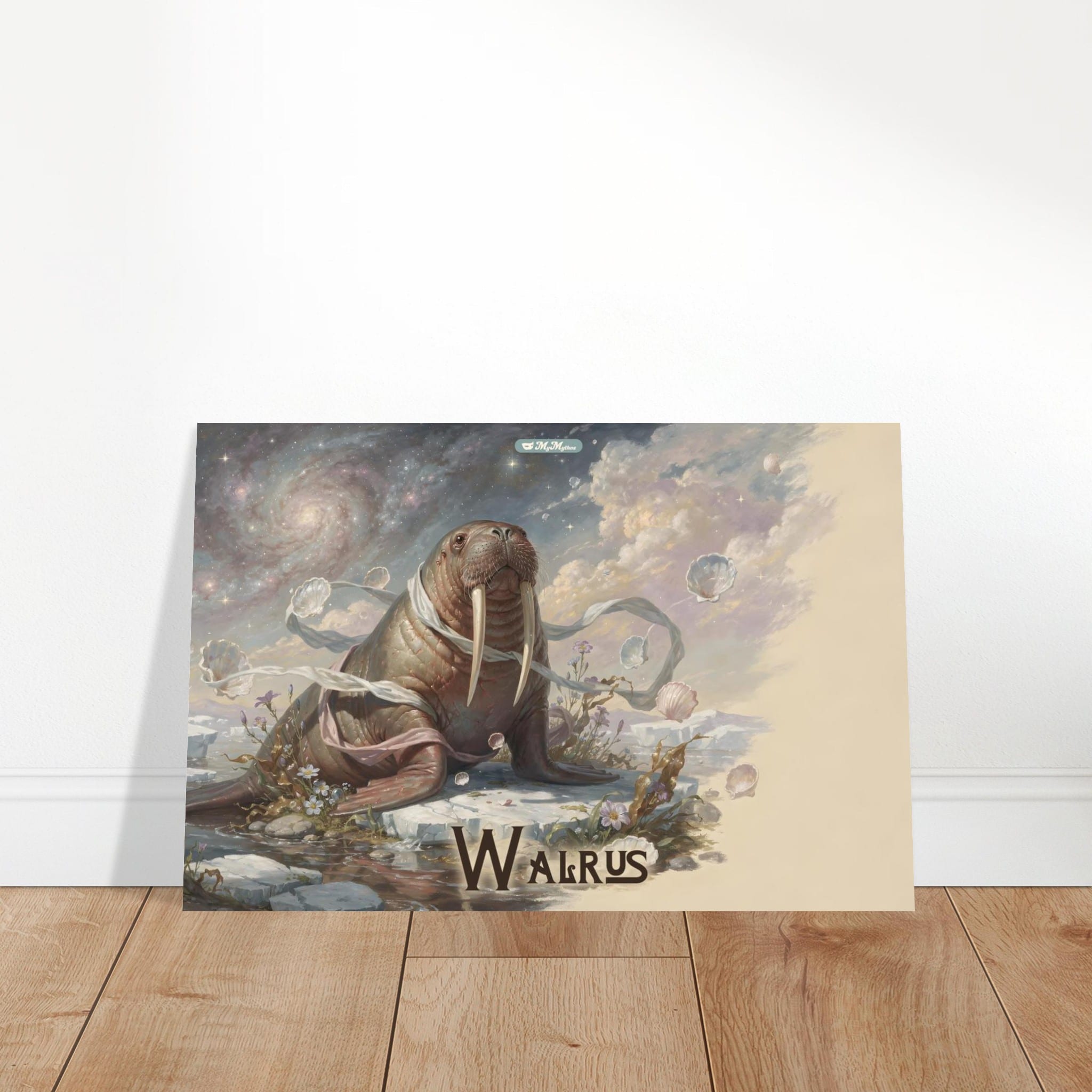
On your wall
Material
Sale! Was $19.00, now $14.25
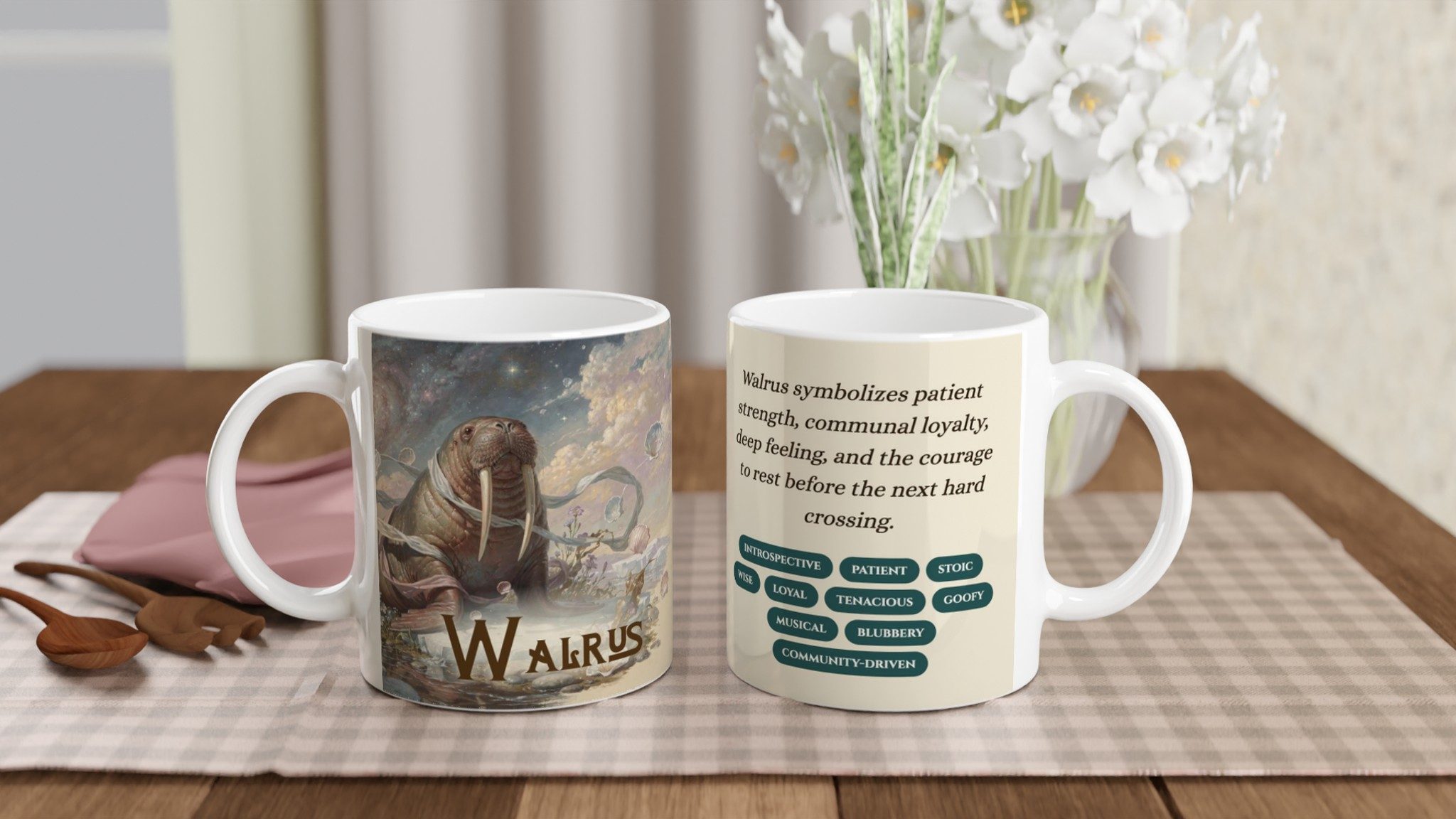
In your hands
Size
Color: White
Sale! Was $18.00, now $13.50
From elsewhere
Paid links: if you buy through these, MyMythos earns a small commission at no cost to you.