The Pier
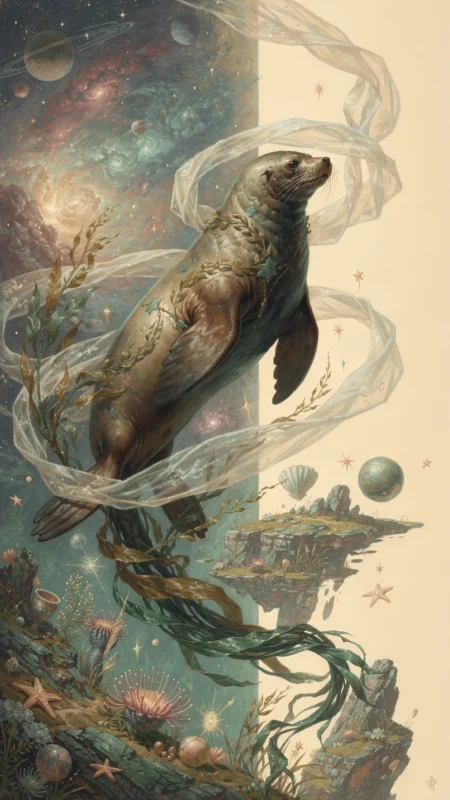
The relationship between the Sea Lion and the Pier may be one of the most fundamental a soul can have with its stage. The Pier is a necessary imposition, a hard line drawn between two worlds—the clumsy, gravitational certainty of the land and the fluid, weightless dream of the sea. For the Sea Lion, the Pier is not merely a place to rest; it is perhaps a threshold for transformation, a sun-bleached altar upon which its terrestrial awkwardness is offered up before it can be redeemed by the grace of the water. The rough, splintered wood could represent the very friction of society, the unyielding structures against which the Sea Lion’s boisterous, blubbery self must jostle and bark. It is here, in this public space of transit and observation, that the performance is born—a dialogue between the creature and the architecture that defines its limits, a comedy played out on the very edge of its own element.
The Jester
In the Jester, the Sea Lion perhaps recognizes a kindred spirit, another soul who has learned to wear foolishness as a kind of armor or, more profoundly, as a lens through which to view the world. Both archetypes seem to understand that a direct confrontation with solemnity is often a losing battle; better to flank it with a disarming guffaw or a playful antic. The Jester’s motley and bells could be the terrestrial equivalent of the Sea Lion’s sleek coat and echoing bark—a costume that invites underestimation while smuggling in a sharper intelligence. Their shared language may be one of distraction and redirection, using a performance of glee to mask a deeper sensitivity or to speak a truth that would be too abrasive if delivered without a smile. They are masters of the affectionate disruption, reminding the court, or the coastline, not to take itself so seriously, for they have seen the vast, indifferent ocean or the fickle whims of a king, and know the absurdity that underpins it all.
The Echo
The Sea Lion’s call is rarely a solitary event; it is a broadcast, sent out across the water in search of a reply, and in this, its truest partner could be the Echo. This is a relationship not with a being, but with a phenomenon—the physics of consequence, the world talking back to itself. When the Sea Lion barks, it may be testing the very shape of its environment, seeking the cliff face or fog bank that will confirm its own existence by returning a faint, ghostly chorus. The Echo is the validation of its voice, but it might also be a haunting reminder of its own solitude. It is a dialogue with absence, a conversation with the resonant hollowness of the world. This interaction perhaps speaks to the performer’s deep-seated need for an audience, even an invisible one, and the profound vulnerability of sending a part of oneself out into the void, hoping it does not simply vanish but comes back changed, softened, and affirmed by the journey.

 Believe
 Fear
Fear Strength
 Weakness