
Leviathan
Symbolism, Meaning & Spirit Animal
The Leviathan is a vast sea monster described in the Hebrew Bible, in the books of Job, Psalms and Isaiah, as a creature of the deep. Leviathan symbolizes primordial power, untamable depth, and the sovereignty to face what cannot be controlled.
By Sidian M.S. Jones, personal mythologistHow these pages are made
Encounters
Meet Leviathan inside a story
The Symbolism & Meaning of Leviathan
Leviathan means power at the edge of comprehension. It is not merely large, dangerous, or aquatic. It is the kind of presence that makes familiar measures fail. A hook cannot establish ownership over it. A weapon cannot settle the question of its body. A boat cannot turn the sea into solid ground. Leviathan gathers all the places where human confidence meets a world that does not consent to being reduced.
Its ancient force is not only destructive. The creature in Psalm 104 plays in the water, and that detail changes the symbol. The deep is not valuable because it can be conquered. It has its own motion, pleasures, and inhabitants. Leviathan therefore represents a life that does not ask permission from human usefulness. It can be frightening precisely because it is alive on terms that do not include the observer.
Do not seek to conquer the ocean: learn to breathe its water. The chaos you fear is merely the rhythm of a heart larger than your own.
This makes the archetype foundational rather than merely rebellious. Before a person can build an identity, there may be a submerged fact that refuses the building: grief that will not become a lesson, anger that will not become politeness, desire that will not fit a respectable plan. Leviathan gives that fact a body. It says that some inner realities are not problems to drain, classify, or overcome. They need a boundary, a season, and enough depth to remain intact.
The symbol also carries sovereignty. Leviathan does not rule by issuing commands from a throne. Its authority comes from scale, age, and indifference to capture. A person drawn to it may be learning that control is not the only form of strength. They may need to stop explaining every silence, defending every appetite, or making every loss useful. The archetype permits an older kind of dignity: remaining whole while the surface world mistakes stillness for defeat.
Yet the image does not excuse indiscriminate force. A sea monster can destroy a 
What It Means When You See Leviathan: Signs & Symbolism
When Leviathan keeps appearing in your attention, the question is not why the world has selected a sign for you. The sharper question is why this image, among all possible images, has become the one you cannot leave alone. You may be looking for a shape large enough to contain an experience that ordinary language makes too small. A difficult childhood, a loss without ceremony, or a desire that unsettles your public identity can feel less absurd when it rises as a creature from the oldest water.
If you meet Leviathan with unease, you may be avoiding the scale of something already moving beneath your routines. You might be calling a relationship complicated when it is consuming your judgment, or calling exhaustion discipline because admitting its depth would require change. The monster is not proof that catastrophe is coming. It may be the part of you that knows the boat has been taking on water.
If curiosity draws you in, the archetype may reveal a hunger for a life not organized around constant manageability. You may be tired of being legible, agreeable, and available at every surface. Leviathan gives you permission to respect what cannot be made neat. That can mean protecting solitude, choosing work with real depth, or allowing an interest to remain strange instead of turning it into a brand.
If grief is your first response, the creature may be carrying the size of what has been lost. A small symbol can fail a large sorrow. Leviathan does not make grief beautiful by reducing it. It gives grief a body that can move through dark water, disappear, return, and remain part of the world without being cured. You may be looking for companionship with an absence rather than an ending.
Meeting the archetype with fascination, fear, or mourning points to different needs, but all three readings ask for honesty about scale. What keeps returning may not be a command from outside you. It may be a neglected depth asking to be recognized before it decides how to rise.
Which of these is also you?
Collect 8 to make a mythos.
These archetypes were chosen because you are reading about Leviathan.
Leviathan in Mythology & Legend: Where the Symbolism Comes From
Leviathan enters Western imagination through Hebrew scripture, where it is less a single zoological creature than a name for the sea's most ungovernable life. In Psalm 74, God breaks the heads of Leviathan and gives it as food to the wilderness creatures. The image makes the monster an emblem of chaos subdued at 
Job 41 gives the fullest portrait. Leviathan cannot be caught with a hook, bought, bridled, or made into a household servant. Its armor resists human weapons, its snorting throws light, and its movement churns the waters. The chapter's argument is not that Leviathan is evil. Rather, it asks how a human being could claim mastery over the world when even this creature belongs beyond human reach. Its terror becomes evidence of a larger order.
The Hebrew Bible may preserve older West Semitic material. At Ugarit, on the Syrian coast, the storm god 
In Babylonian mythology, the sea is figured through Tiamat, the saltwater mother who confronts the younger gods before 
Later Jewish interpretation gives Leviathan several futures. Rabbinic texts describe male and female Leviathans, with the female killed so their multiplication will not destroy the world. Other traditions place a final battle between Leviathan and Behemoth at the end of time, followed by a feast for the righteous. Medieval Jewish commentators also treated the creature symbolically, as a figure for hostile kingdoms, arrogant power, or the wicked who seem impossible to restrain.
Christian writers inherited these readings and often made Leviathan a sign of Satan, hell, or spiritual pride. The shift narrows the older creature's range. In scripture, Leviathan can oppose God and still be God's made thing; in later moral allegory, it more often becomes an enemy to defeat. Its folklore keeps both meanings alive: the abyss that threatens order, and the ancient life that flourishes beyond the reach of command.




Leviathan and Its Relationships With Other Archetypes

Whale
“In Hebrew today my name means Whale, and once it meant something far older.”
Leviathan in the Hebrew Bible is a great sea creature, and in modern Hebrew the same word, livyatan, simply means whale. Whale gives Leviathan a real body, and the pairing reminds a person that the monsters of old stories often began as animals too large to understand.
Visit Whale
Sovereign
“Hobbes named his great state after me: a giant crowned and made of people.”
Thomas Hobbes called his 1651 book on government Leviathan, and its famous frontispiece shows a crowned giant whose body is made of tiny citizens. The pairing describes power that exists because many people lend it their strength, and a person who carries both knows how heavy that loan is.
Visit Sovereign
Tiamat
“Tiamat was split by Marduk; my heads were crushed by another god, and the sea remembers both.”
Babylon told of Marduk splitting the sea monster Tiamat to make the world, and Psalm 74 praises God for crushing the heads of Leviathan. Scholars often read the two together as sea chaos defeated at creation, and the pairing says that order is always built on something wild held down.
Visit Tiamat
Abyss
“My home is Abyss, the deep water below where any line can reach.”
The Book of Job asks whether anyone can draw out Leviathan with a hook, and describes the deep shining behind it. Abyss and Leviathan together describe a depth in a person that cannot be fished out or controlled, only respected.
Visit Abyss
Chaos
“I am Chaos given a body, and a psalm says I was made to play in the sea.”
Many stories set Leviathan against the gods as chaos itself, yet Psalm 104 describes it simply playing in the sea where ships go. The pairing suggests that what looks like disorder from shore may be at home, and a person who carries both can be untamed without being evil.
Visit Chaos
Leviathan also keeps company with the sea: Archipelago, Coastline, Island, Njord, Ran and Siren, among fifty-one others of the sea.

Leviathan in Dreams: Meaning & Interpretation
Dreaming of Leviathan often brings the dreamer into contact with a force too large to manage by ordinary methods. It may appear when grief, anger, desire, or fear has grown immense beneath a composed surface. Because Leviathan belongs to deep water and ancient myth, the dream can point toward material that feels older than the current crisis: family dread, inherited silence, bodily memory, or a need that has been postponed until it became a tide.
The dream is not necessarily asking for victory. It may be enlarging the frame around a problem so the dreamer can stop mistaking control for safety. A Leviathan that remains at a distance can make room for awe and honest uncertainty. One that rises beneath a boat may reveal how fragile a chosen plan feels. One that allows itself to be seen without attacking may show that the dreamer's unconscious is ready to be witnessed rather than conquered.
Leviathan circling calmly beneath clear water can suggest a welcome meeting with a buried strength, especially when the dreamer feels wonder instead of panic. The creature's size may make a private concern seem less shameful: something vast has been carried, and it has not destroyed the swimmer.
Leviathan breaking a boat, swallowing a 
Leviathan: Positive & Negative Meanings
Positive Meanings
- It can hold experiences too large for ordinary explanations.
- It respects depth, privacy, and inner sovereignty.
- It remains steady when surface conditions become chaotic.
- It recognizes that not every force must be conquered.
- It gives grief a form that can move and endure.
- It protects a life from being reduced to usefulness.
Negative Meanings
- It can turn withdrawal into a performance of mystery.
- It may make ordinary needs seem embarrassingly small.
- It can confuse intensity with truth.
- It may resist help until a crisis becomes enormous.
- It can use silence to avoid accountability.
- It may frighten others without recognizing the effect.

The Shadow of Leviathan
The shadow of Leviathan begins when depth becomes an identity that cannot be questioned. A person may turn every ordinary conflict into evidence of hidden enormity, treating explanation as shallowness and accessibility as betrayal. The sea becomes a 
This archetype can also make withdrawal feel noble. Silence may protect a real interior life, but it can also punish people who are expected to navigate without a 
Its darkest form worships scale. Small pleasures seem insulting, practical limits seem cowardly, and repair feels less meaningful than destruction. The person waits for a crisis large enough to justify what they have felt all along. The corrective is not to drain the 
How Did You End Up at Leviathan?
Which other shore might you have reached instead, if the ancient current had not closed that passage and left you circling this abyss?
Who watched the waters rise around you and kept silent, or named the flood a harmless ripple when you needed the truth?
What was the first moment your immense, patient stillness carried you safely through danger, making that old posture worth keeping?
What threat are you still guarding your depths against now, and does that danger still move beneath the water, or only in memory?
Has Leviathan turned up in your life, in a dream, a moment, a person? Put it on your page and join its kin, or tell the first story and take the Top Active seat.


 Written by Warren,
for you alone
A reading by Warren
What Leviathan means for you
This page says what Leviathan means. Warren can tell you why it is showing up for you, now.
Leviathan: Frequently Asked Questions
- What does Leviathan symbolize?
- Leviathan means power at the edge of comprehension. It is not merely large, dangerous, or aquatic.
- What is the spiritual meaning of Leviathan?
- When Leviathan keeps appearing in your attention, the question is not why the world has selected a sign for you. The sharper question is why this image, among all possible images, has become the one you cannot leave alone.
- What does Leviathan represent?
- Leviathan enters Western imagination through Hebrew scripture, where it is less a single zoological creature than a name for the sea's most ungovernable life. In Psalm 74, God breaks the heads of Leviathan and gives it as food to the wilderness creatures.
- What does it mean to dream about Leviathan?
- Dreaming of Leviathan often brings the dreamer into contact with a force too large to manage by ordinary methods. It may appear when grief, anger, desire, or fear has grown immense beneath a composed surface.
- What is the shadow side of Leviathan?
- The shadow of Leviathan begins when depth becomes an identity that cannot be questioned. A person may turn every ordinary conflict into evidence of hidden enormity, treating explanation as shallowness and accessibility as betrayal.
- What are the positive and negative meanings of Leviathan?
- It can hold experiences too large for ordinary explanations. It can turn withdrawal into a performance of mystery.
- What does a Leviathan tattoo mean?
- Often, a Leviathan tattoo marks a private allegiance to endurance in overwhelming conditions. Some wear it to honor a survival story kept below ordinary language; others choose it to hold grief, defiance, or a fascination with forces no person can master.
Characteristics of Leviathan
- Covering:
- scaled
- Form:
- serpentine
- Size:
- giant
- Diet:
- carnivore
- Habitat:
- ocean
- Element:
- water
- Realm:
- the sea
- Tradition:
- Jewish, Canaanite, Christian
- Era:
- ancient
The creature's descriptions emphasize an unusual combination of armor and mobility: its body is imagined as difficult to pierce, yet powerful enough to make open water seem unstable. Its presence also crosses physical categories, combining serpent form, aquatic habitat, and features such as heat, smoke, or light in poetic rather than zoological detail. The result is a creature built to remain outside ordinary capture, with its anatomy serving the text's central question about human limits.
Get the next one
Essays on personal mythology, archetypes, and the stories we tell ourselves.
Take Leviathan home
Printed to order and shipped to you. Please allow a few extra days for production.
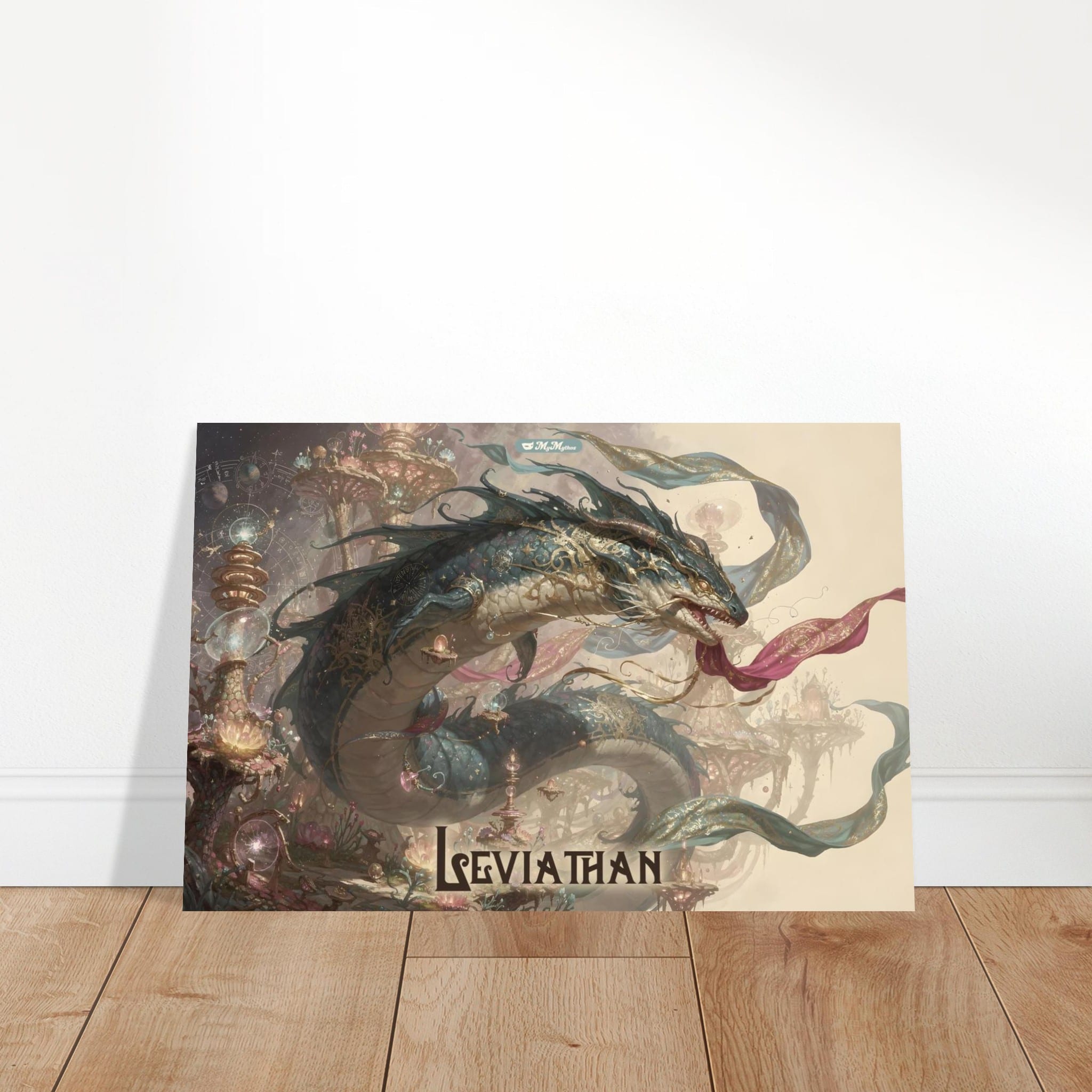
On your wall
Material
Sale! Was $19.00, now $14.25
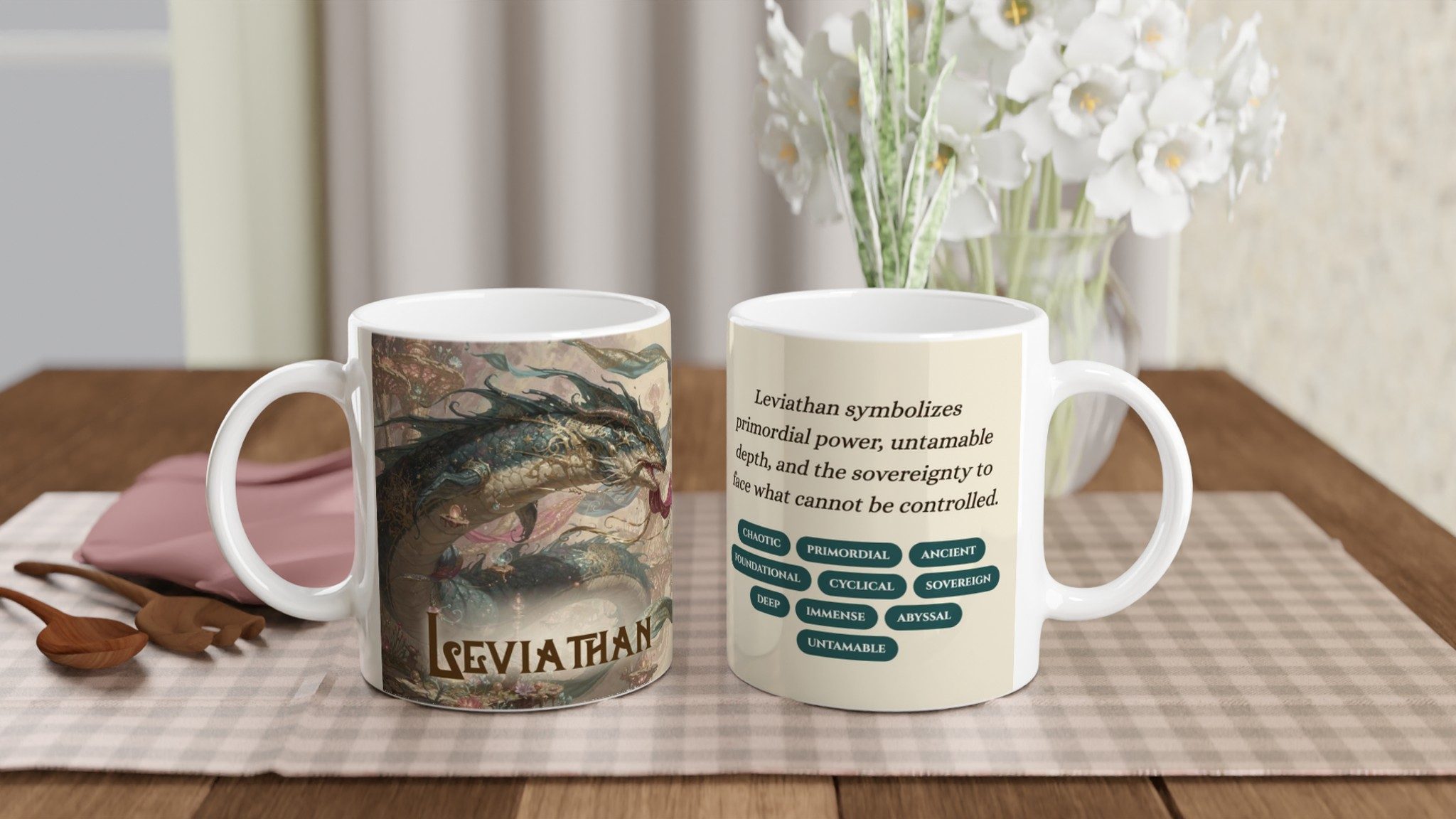
In your hands
Size
Color: White
Sale! Was $18.00, now $13.50
From elsewhere
Paid links: if you buy through these, MyMythos earns a small commission at no cost to you.