Believe
 Fear
Fear Strength
 Weakness
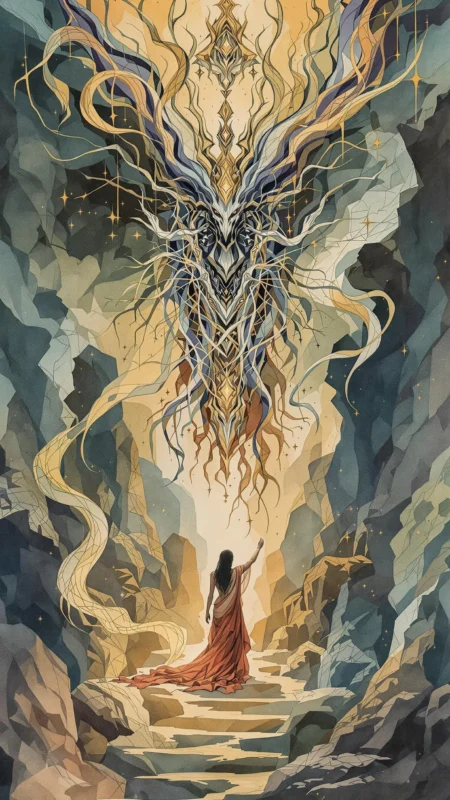
Tiamat is the unsung axiom of creation: that before any line can be drawn, there must be an infinite, unmarked page. In personal mythology, she is the raw, untamable force of potential that precedes identity. She is the chaos of the teenager's bedroom from which a personality emerges, the cacophony of a city that births new art, the turbulent emotions that fuel the most profound self-discovery. Her symbolism is not in the finished product, but in the churning, generative process. She is the part of the self that resists labels, that spills over the neat containers of personality tests and social roles. To find Tiamat in your mythos is to honor the part of you that is pure verb, not yet hardened into a noun.
Her story is a cautionary tale about what happens when this primordial energy is suppressed. Spurned by her children, the gods of order, her creative waters turn venomous. This suggests a deep psychological truth: the creative, chaotic feminine, when denied or demonized, becomes monstrous. The artist who cannot create may turn their energy to destruction. The spirit that cannot be free may become a source of turmoil for itself and others. Tiamat reminds us that the monster is often a mother whose children have forgotten her, a creative force that has been betrayed and now rises in a furious storm to reclaim its space.
Ultimately, Tiamat's meaning is found in her dismembered body. She is not merely defeated: she becomes the very firmament of existence. This is perhaps the most profound metaphor for the individual. Your greatest wounds, your most chaotic breakdowns, the parts of you that were torn asunder, may become the foundational structures of your world. The sky above you and the earth beneath your feet could be fashioned from what you thought was your end. She symbolizes a radical, alchemical transformation where even in defeat, in being named the monster and slain, one's essence becomes the very stuff of a new reality.