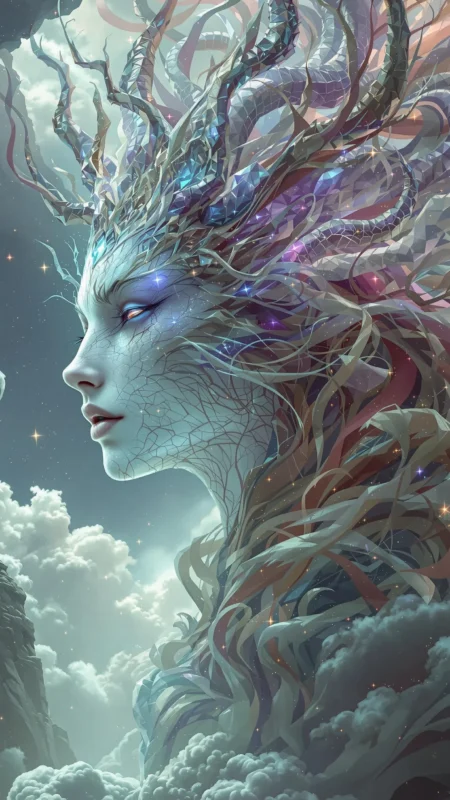


Ran

Archetype Meaning & Symbolism

Tempestuous, Insatiable, Inevitable, Sovereign, Abyssal, Unpredictable, Covetous, Ensnaring, Primal, Shadowed

  • All that the waves take, the depths keep. Come, rest in my halls. The sea owes you no explanation.

If Ran is part of your personal mythology, you may...

Believe

  • That the most profound truths are found in darkness, silence, and depth, not in the light.
  • That grief is not a problem to be solved, but a territory to be inhabited, with its own somber beauty and wisdom.
  • That chaos and unpredictability are fundamental forces of nature, and surrender is a more powerful strategy than control.

Fear

  • A deep-seated fear of emotional superficiality, of living a life that never breaks the surface.
  • An anxiety about being completely overwhelmed and consumed by your own emotions or the emotions of others, of being pulled under.
  • An irrational fear of entanglement, that relationships will become a net from which there is no escape, while simultaneously fearing absolute solitude.

Strength

  • An immense capacity for emotional depth and empathy, able to hold space for the most profound forms of human suffering and joy.
  • A profound resilience, like a vessel built for the storm, able to navigate crises that would shatter more rigid personalities.
  • A unique creativity that draws from the subconscious, producing art, ideas, or insights that are both haunting and beautiful.

Weakness

  • A tendency towards melancholy or depression, a risk of becoming lost in the depths of your own emotional world.
  • A potential for emotional possessiveness or a desire to 'collect' people, mirroring Rán's greed for the drowned.
  • An inclination to isolate, to retreat into your own deep waters and push away those who cannot or will not follow.

The Symbolism & Meaning of Ran

In the modern psyche, Rán surfaces as the great, untamable subconscious. She is the sovereign of all that has been submerged: the forgotten traumas, the drowned hopes, the silent griefs that lie on the seafloor of the soul. Her realm is not hell, not a punishment, but a truth. It is the acknowledgement that a vast portion of our being exists in darkness, and that this darkness is not empty but teeming with life, memory, and a strange, cold beauty. To have Rán in your personal mythology is to have a map to this inner ocean, to see her net not as a weapon but as an instrument of retrieval, capable of bringing long-lost parts of the self back to the surface, shimmering and dripping with the wisdom of the abyss.

Her legendary greed, her insatiable desire to pull sailors and their gold into her depths, may be reinterpreted. Perhaps it is not mere avarice, but a profound, gravitational pull towards substance, towards what has weight and history. She collects the drowned because they have stories, they have lived. She covets the gold not for its monetary value, but because, in its incorruptibility, it represents what endures even in the crushing dark. This archetype, then, could symbolize a deep hunger for authentic experience, a desire to bypass the superficial and hoard what is real, what is heavy with meaning, what will last when the surface storms have passed.

Ultimately, Rán symbolizes a necessary and powerful aspect of existence that civilized life often seeks to pave over: the beautiful, terrifying, amoral power of the ungovernable. She is the chaotic sea, yes, but she is also the womb of all life. She is the undertow of grief, but also the placid mirror of self-reflection. Her presence in one's mythos is a declaration that one will not live solely on the safe, sunlit shore. It is a commitment to honor the depths, to respect the storm, and to know that what is lost to the waves is never truly gone, but merely kept in the quiet, sovereign halls of the deep.


Ran Relationships With Other Archetypes

The Ghost

The relationship between The Ran and The Ghost is perhaps not one of simple pursuit, but of a kind of harrowing, inseparable dance. The Ghost is not always the trailing phantom in the rearview mirror; it may be the passenger, the silent co-pilot whose weight is felt in every sharp turn and sudden acceleration. It is the echo that gives the empty landscape its shape, the low hum of a past that has become the engine of the present. To run from The Ghost, then, could be a fool's errand, for its presence may be what lends the runner their velocity, their very definition. The Ran is, in a sense, a body in motion only because it is in a constant, gravitational fall toward a past it can never truly escape, a past that provides the dark matter of its own momentum.

The Horizon

The Horizon, for its part, might be seen as The Ran's most patient and cruelest lover. It is a perpetual promise, a shimmering destination that hangs just at the edge of exhaustion's reach. This is not a goal to be attained but a concept to be pursued; a canvas, perhaps, onto which The Ran projects the architecture of a future self, a life remade and unburdened. The relationship is a testament to a particular kind of faith—the belief that one more mile, one more sunrise, might finally close the distance. Yet, the Horizon's seduction could lie in its very unattainability, offering a purpose so infinite that it saves The Ran from the terrifying question of what they would do if they ever, finally, arrived.

The Shelter

With The Shelter, The Ran engages in a brief, transactional affair, steeped in both necessity and suspicion. A motel room, a bus station bench, an abandoned barn—these are not homes but parentheses in a life lived as a run-on sentence. Here, The Ran may momentarily unlace their boots, but they never truly unpack. The Shelter offers the dangerous gift of stillness, a quiet so profound it might allow the footfalls of The Ghost to finally be heard, clear and close. This temporary peace is a held breath, a fragile bubble of anonymity that could be popped by a knocking door or a knowing glance. The Ran may crave The Shelter's four walls, but they know it is a cage as much as a comfort, a place where the forward motion that defines them ceases, leaving them vulnerable to the one thing they fear more than the road: themselves.

Using Ran in Every Day Life

Navigating Overwhelming Grief

When loss feels like a drowning, a force pulling you under, invoking the mythos of Rán may offer a strange solace. Instead of fighting the current, you might choose to dive. Her archetype provides a framework for inhabiting grief as a realm, a dark, silent, deep place that has its own rules and its own treasures. It reconceptualizes the experience not as a failure to stay afloat, but as a necessary descent into the sacred abyss where what is lost is kept and honored.

Confronting the Unconscious

For one engaged in shadow work or deep psychotherapy, Rán could serve as the personification of the unconscious itself: vast, dark, and filled with both monsters and marvels. To “sail on Rán’s sea” may become a personal metaphor for exploring the psyche. Her net is not just a threat, but a tool that brings things up from the depths. It suggests that what ensnares you, what you feel trapped by, may in fact be the very thing you need to confront and understand to achieve wholeness.

Accepting a Lack of Control

The Rán archetype could be a powerful anchor in a world of chaos. She embodies the amoral, uncontrollable power of nature. When faced with circumstances utterly beyond your influence—a sudden illness, a market crash, a natural disaster—her mythos suggests a different kind of strength. Not the strength of resistance, but the strength of surrender. It is the wisdom of the sailor who, caught in the storm, does not curse the waves but instead works with them, respecting a power far greater than their own.

Ran is Known For

Her Net

A powerful symbol of fate, entanglement, and the inescapable pull of the depths. With this net, Rán catches not just fish, but the souls of drowned sailors, suggesting that some fates are beyond struggle, and one can be caught by forces both psychological and external.

Hall of the Drowned

Unlike the glorious warrior's afterlife of Valhalla, Rán's hall is a submarine resting place for those claimed by the sea. It represents an alternative destiny, one for those who met chaotic, unheroic ends. It is a quiet, perhaps melancholic, repository for the lost, suggesting that even in the abyss, there is a form of community and being.

The Nine Daughters

Personifications of the waves, her daughters represent the many moods and faces of the ocean, and by extension, the emotions. They are the playful ripples, the sorrowful tides, and the destructive tsunamis. They illustrate how a single force—the sea, the psyche—can manifest in countless, often contradictory, ways.

How Ran Might Affect Your Personal Mythology

How Ran Might Affect Your Mythos

When Rán becomes a central figure in your personal mythos, your life story ceases to be a straightforward, heroic ascent. It becomes, instead, a descent, a deep-sea exploration. Your narrative is not written in sunlight but in bioluminescence. The defining moments of your epic may not be victories on the battlefield, but moments of profound surrender in the storm. Your plot is not about conquering the dragon; it is about learning its deep, watery language and discovering the hoard of jewels it guards in its underwater cave. This is a life story that values depth over height, introspection over extroversion, and wisdom over acclaim.

Your mythos might be characterized by cycles of loss and retrieval. You may see your life as a series of voyages over a vast, mysterious sea, with periods of calm passage punctuated by sudden, transformative storms that pull you under. The wreckage of past relationships, careers, and selves are not seen as failures to be forgotten, but as sunken treasures that litter the seafloor of your memory, offering beauty and lessons to the one brave enough to dive for them. Your personal legend is one of resilience, of learning to breathe water, of finding a home in the very depths that others fear.

How Ran Might Affect Your Sense of Self

To hold Rán as part of your inner pantheon is to accept the oceanic nature of your own self. You may perceive your identity not as a solid, fixed landmass, but as a body of water with its own currents, tides, and unfathomable depths. This perspective fosters a radical self-acceptance of what society might deem 'too much': too emotional, too intense, too quiet, too deep. You may find a strange comfort in your own melancholy, seeing it not as a pathology but as a valid and informative emotional weather pattern.

This archetype may grant you a profound sense of inner sovereignty. Like Rán, who rules her realm without seeking the approval of the sky-gods, you might derive your self-worth from your own internal landscape. Your strength lies not in your surface presentation, but in the vast, unseen world you carry within. You may feel a kinship with the lost and the strange, for you understand that the most interesting things are rarely found in the brightly lit, crowded places. Your soul has its own gravity, its own ecosystems, its own silent, shimmering truths.

How Ran Might Affect Your Beliefs About The World

Through the lens of Rán's mythology, the world reveals itself not as a well-ordered garden or a predictable machine, but as a wild and chaotic ocean. You may come to see the structures of society—its laws, its ambitions, its certainties—as little more than fragile ships on a vast, indifferent sea. This is not necessarily a cynical view, but a realistic one. It fosters a respect for the awesome, amoral power of nature, fate, and the unconscious, forces that can and will shatter human plans without malice.

This worldview may prioritize adaptability and surrender over control and resistance. You might believe that true wisdom lies not in building higher walls against the tide, but in learning to build a better boat, or better yet, learning to swim. You may look for meaning not in grand, overarching narratives of progress, but in the specific, salvaged artifacts of experience, the glint of gold in the wreckage. The surface of things becomes less interesting; the real action, the real truth, is always in the depths.

How Ran Might Affect Your Relationships

In the realm of relationships, the Rán archetype could manifest as a craving for profound emotional depth. You may have little patience for superficial connections or small talk, feeling an almost gravitational pull toward souls who are willing to navigate the deep water with you. Friendships and romantic partnerships are not casual voyages; they are deep-sea expeditions to explore the sunken worlds of another. This can lead to bonds of extraordinary intimacy and loyalty, a connection between two people who have seen each other's inner wreckage and found it beautiful.

However, Rán's influence can also cast a shadow. Her insatiable, collecting nature might translate into a tendency towards emotional possessiveness, a desire to 'keep' a partner in your own emotional depths, ensnaring them in a net of intensity. There may be a fear of abandonment that mirrors the fear of the sea's emptiness, leading to clinging behaviors. Conversely, you might fear entanglement yourself, seeing the intimacy you crave as Rán's net, threatening your own sovereign solitude. Relationships, therefore, become a delicate navigation between drowning in another and being lost at sea alone.

How Ran Might Affect Your Role in Life

If Rán is your guide, your role in the world may not be that of the leader, the innovator, or the public figure. You may instead be the keeper of what is lost. You could be the artist who paints the abyss, the poet who gives voice to sorrow, the therapist who sits with a client in the wreckage of their past. Your function is to hold space for the overwhelming, to be the calm center in the emotional maelstrom for others. You are the one who is not afraid of the dark, the quiet, the grief that society pathologizes and rushes to fix.

Your purpose might be to act as a psychopomp for drowned dreams and forgotten selves, helping others to retrieve what they thought was lost forever beneath the waves of trauma or time. You might be drawn to professions that deal with the end of life, with history, with psychology, or with the literal ocean itself. Your role is not to provide easy answers or bright futures, but to offer a presence that validates the reality of the depths, reminding the world of the profound wisdom and beauty that can only be found when one has the courage to go under.

Dream Interpretation of Ran

In a positive context, to dream of Rán, her daughters, or her submarine hall may signal a profound moment of psychological integration. It could suggest that you are successfully navigating your own emotional depths, perhaps coming to terms with a significant loss or healing from an old wound. Being welcomed into her hall might not be a dream of death, but a symbol of finding peace with your own shadow self. Swimming freely in her waters or discovering treasure in the deep could represent the unearthing of a hidden talent, a deep insight, or a newfound sense of wholeness that comes from embracing all parts of your being.

In a negative context, a dream of Rán can be terrifying. To be caught in her net, dragged down by kelp, or to feel the crushing pressure of the abyss may reflect a waking state of being overwhelmed. This dream could be a potent warning that you are drowning in sorrow, anxiety, or a consuming relationship. It may point to a situation where you feel a complete loss of control, pulled under by forces you cannot fight. Such a dream is an urgent call from the psyche to find a lifeline, to seek help, and to acknowledge the dangerous power of the emotions or circumstances that threaten to consume you.

How Ran Archetype Might Affect Your Needs

How Ran Might Affect Your Physiological Needs

When Rán is part of the personal mythos, one's relationship with basic physiological needs can become deeply symbolic. The act of breathing may feel precarious, a constant negotiation against the possibility of being submerged by emotion. You might find that deep, conscious breaths are your primary tool for staying afloat in stressful situations. Water itself could be a necessity beyond mere hydration; you might need to be near the ocean, a lake, or even a bath to feel regulated and calm, as if your body's salinity needs to be balanced by an external, elemental presence.

Shelter, from this perspective, is less about a roof and more about a safe harbor. Your sense of physical well-being might be inextricably linked to having an emotional sanctuary, a place or person that provides refuge from the storms of life. Your sleep may not be just rest, but a nightly descent into the unconscious sea. Insomnia could be interpreted not just as a medical issue, but as a fear of letting go, a terror of what might surface when the conscious mind relinquishes control and drifts into the dark.

How Ran Might Affect Your Ideas of Belonging

For one with Rán in their mythos, belonging is not found in the bright, boisterous crowd. It is a quieter, deeper phenomenon. You may feel a profound sense of alienation in conventional social settings, which can feel shallow and performative. True belonging arises from finding your 'fellow divers,' those rare souls who are also unafraid of depth, silence, and emotional honesty. Your tribe is not a wide network, but a small, resilient crew, bound together by the shared experience of having navigated dark waters.

Love and intimacy are quests for the abyss. A romantic partner must be willing to be both a lighthouse and an anchor. The relationship is not about creating a perfect, storm-free life, but about the promise to hold onto each other when the waves crash over the deck. You might test the bonds of love and friendship to see if they can withstand the pressure. The deepest sense of connection comes not from shared joys, but from the shared willingness to sit together in the dark, holding vigil for what has been lost, and trusting that you will not be abandoned in the depths.

How Ran Might Affect Your Feelings of Safety

The archetype of Rán fundamentally challenges conventional notions of safety. If the world is an unpredictable ocean, then true safety is an illusion. This realization could manifest in two ways: either as a constant, low-grade anxiety and hyper-vigilance, or as a radical acceptance that security is not found in walls, but in adaptability. Your focus might shift from accumulating material safety nets (property, savings) to cultivating internal resources: resilience, intuition, and the courage to face the unknown.

Your sense of personal security may be tied to your ability to navigate chaos rather than avoid it. You might feel safer in a crisis than at a calm cocktail party, because the crisis is real, it has weight. Employment might be sought not for its stability, but for its depth of meaning. Health could be viewed not just as the absence of illness, but as a state of dynamic equilibrium between the light and dark parts of the self, a system that is strong enough to withstand the occasional storm and pressure change.

How Ran Might Affect Your Views of Esteem

Esteem, in the world of Rán, is not measured by public recognition or status. It is a quiet, internal gravity. Your self-worth may be derived from your personal history of survival, from the knowledge that you have descended into your own hell and returned, perhaps not unscathed, but wiser. You respect yourself for your resilience, for your refusal to live a superficial life, and for your courage to feel things deeply in a world that often encourages numbness.

Recognition from others is valued only if it comes from those who understand depth. You would rather have the quiet nod of a fellow traveler of the abyss than the applause of a stadium. Strength is not brute force, but the flexibility to bend without breaking. Freedom is not the absence of constraints, but the inner liberty to navigate any sea, no matter how stormy. Your esteem is the pearl that was formed around the grit of suffering, a thing of somber, secret beauty.

Shadow of Ran

The shadow of Rán emerges when the depths become the only reality. It is the maelstrom of unchecked depression, where grief is no longer a territory to visit but a permanent, suffocating home. Here, the archetype's possessiveness curdles into a vampiric neediness, pulling others down into a co-created misery, ensnaring them in a net of emotional blackmail and manufactured crises. The keeper of the deep becomes the hoarder of despair, refusing any lifeline, finding a grim satisfaction in the wreckage and actively working to sink any passing ship of hope. This shadow self doesn't just swim in the abyss; it becomes the abyss, cold, consuming, and hostile to all light.

Conversely, the starved shadow of Rán appears as a frantic avoidance of all emotional depth. It is a life lived entirely in the sunlit shallows, terrified of the slightest ripple of authentic feeling. This person may chase constant stimulation, deny loss, and enforce a relentless positivity that feels brittle and false. They reject their own depths, and so become profoundly superficial, unable to form genuine connections or weather any real life storm. They have abandoned their own ocean, and in doing so, have become a desert, vast and empty. Their fear of Rán's net makes them unable to catch anything of substance, and their fear of drowning leaves them perpetually thirsty.

Pros & Cons of Ran in Your Mythology

Pros

  • You possess a rare emotional courage, unafraid to confront the difficult, messy, and profound aspects of existence.
  • You are likely a source of incredible comfort and wisdom for those experiencing grief or crisis, acting as a calm anchor in their storm.
  • Your connection to the subconscious can be a wellspring of profound creativity, intuition, and self-knowledge.

Cons

  • You may be prone to bouts of intense melancholy or feel alienated from a world that often prizes superficiality and relentless optimism.
  • Your emotional intensity can be overwhelming for yourself and for others, making relationships complex and sometimes tumultuous.
  • There is a risk of romanticizing tragedy or becoming stuck in a narrative of loss, mistaking the depths for the entirety of the ocean.