
Turkey
Symbolism, Meaning & Spirit Animal
The turkey is a large ground-dwelling bird native to North America, domesticated for meat and a traditional centerpiece of American Thanksgiving meals. Turkey symbolizes abundance, communal courage, sacrifice, and the underestimated power of showing up fully.
By Sidian M.S. Jones, personal mythologistHow these pages are made
The Symbolism & Meaning of Turkey
Turkey means abundance that has to be gathered, carried, and shared. It does not symbolize plenty as an abstract overflowing bowl. It scratches through leaves for acorns, seeds, insects, berries, and small animals, then moves through a flock whose survival depends on many bodies noticing the same landscape. Its 
The 

Turkey's social intelligence gives the symbol a second backbone. Hens lead their young across open ground, call them toward food, and react quickly when danger appears. Poults follow close, learning the terrain through the mother's movement. A flock can scatter into brush, run hard, or rise into trees when threatened. This is not passive togetherness. It is coordinated attention, with each bird remaining a body that can move, feed, and sound an alarm.
Shake your tail feathers: the world is a stage, even if it sometimes feels like a chopping block. Find your flock, but don’t be afraid to gobble your own tune.
The bird's reputation for foolishness is therefore an incomplete reading. It can be vain, loud, and awkward, but it is also wary, fast, and difficult to catch when it has room to escape. The symbol holds both sides. You may be underestimated because your power arrives with a ridiculous flourish. You may also underestimate the cost of being the one who keeps the group supplied, entertained, or emotionally fed.
Turkey finally carries sacrifice because its place at the feast is inseparable from death. That meaning should not be romanticized into endless self-erasure. A body can nourish a community and still have been a body with a life before the table. Turkey asks where generosity becomes disappearance, and whether the communal story remembers what it consumed to create its sense of plenty.
To carry Turkey is to make room for the whole contradiction: pride with a ridiculous edge, beauty that is loud rather than delicate, usefulness that must not become exploitation, and belonging that includes an individual voice. The symbol does not ask you to become impressive. It asks whether you can remain fully present when the room has decided that your kind of presence is foolish.
Turkey as a Spirit Animal, Totem & Power Animal
When Turkey arrives as a spirit animal, it often appears through the pull toward gathering. You may find yourself feeding people, arranging a room so everyone has a place, or noticing who has been left outside the 

As a totem, Turkey belongs to people whose strength is entangled with community. In traditions that hold Turkey as a clan animal, the relationship is inherited and collective, not a private badge selected from a list. A respectful personal practice does not borrow a people's clan identity. It can still ask what flock, family, neighborhood, or mutual-aid network you are responsible to, and whether your giving creates resilience or teaches others to take you for granted.
As a power animal, Turkey lends a surprisingly physical kind of courage. It does not tell you to rise above embarrassment. It lets you strut through it. When challenged, a Turkey may spread, call, peck, run, or fly into a tree. Its defense changes with the threat. Carrying this archetype can mean meeting danger with a visible boundary instead of a carefully edited performance of calm. The display says, in effect, that the body in front of you is larger, louder, and less available for easy dismissal than you assumed.
Turkey also arrives when sacrifice has become a habit. You may be praised for being dependable, generous, funny, or endlessly available. Those qualities can harden into a role where everyone receives the 
Its flamboyance matters because Turkey's beauty is not separate from its awkwardness. The tail fan, the dangling head, the booming call, and the hurried run belong to the same animal. You do not have to edit the comical parts out before your pride becomes legitimate. In fact, the parts you fear will make you ridiculous may be the parts that let others recognize your courage.
Turkey's power is therefore communal but not anonymous. It gives you a place in the clearing and a voice in the flock, while reminding you that belonging should not require becoming dinner. Let the archetype bring you toward generous tables, honest displays, and boundaries strong enough to protect the life that keeps giving.
Which of these is also you?
Collect 8 to make a mythos.
These archetypes were chosen because you are reading about Turkey.
Turkey in Mythology & Folklore: Where the Symbolism Comes From
Turkey's oldest human stories belong to the peoples of the Americas, where the bird was food, feather, clan relative, offering, and household animal long before Europeans named it turkey. In the eastern woodlands, wild turkeys fed communities through autumn and winter, while their feathers entered robes, fans, headdresses, and ceremonial objects. The bird's abundance made it a fitting presence in stories and practices concerned with 
Among the Lenape, or Delaware, Turkey is one of the three clan animals, beside Turtle and Wolf. Clan traditions vary by nation and family, but a clan animal is not simply an emblem chosen for decoration. It can organize kinship, identity, responsibilities, and inherited belonging. Clan lists differ from nation to nation; the seven Cherokee clans, for instance, do not include Turkey. In these settings, Turkey points toward a living social relationship rather than a private personality label.
In Mesoamerica, the domesticated turkey was known in Nahuatl as huexolotl or guajolote. The bird lived close to people in central Mexico and appeared in markets, feasts, tribute, and ritual life. Nahua descriptions record its distinctive call, fan-shaped tail, and fleshy head. Turkeys could be offered in ceremonies, and their feathers were valuable materials. Colonial accounts often filtered these practices through European categories, so modern summaries can make a complex animal relationship sound like a single symbol. For many communities, its meaning depended on who raised it, who received it, and which ceremony it entered.
The Thanksgiving story gives Turkey another, more recent layer of meaning, but the familiar picture is simplified. The 1621 harvest gathering at Plymouth likely included Wampanoag people and English colonists, yet the surviving English account mentions fowl rather than clearly identifying turkey as the centerpiece. Wampanoag diplomacy, land pressure, disease, and later violence do not fit neatly inside the cheerful national feast. Turkey became central to the holiday much later, as nineteenth-century writers and civic traditions built a shared American story around the bird.
Turkey has also carried competing political meanings. Benjamin Franklin did not formally propose Turkey as the national bird, but in a 1784 letter he criticized the bald eagle as a bird of dubious character and called Turkey a respectable native bird, brave and suitable for a country of many people. He also joked about its foolishness and vanity. The passage reveals the split that still follows Turkey: dignified and ridiculous, communal and showy, generous and doomed to the platter.
That contradiction matters. A Turkey clan tradition, a Mesoamerican household bird, an Indigenous harvest relationship, and a modern holiday table cannot be collapsed into one universal message. Some traditions emphasize belonging and provision; others reveal the violence that can hide beneath a national symbol. Turkey's mythology comes from the whole bird: the gathered flock, the extravagant display, the useful body, and the fact that abundance may feed a community while costing one life.




Turkey and Its Relationships With Other Archetypes

Eagle
“Benjamin Franklin called Eagle a bird of bad moral character and me a much more respectable one.”
In a 1784 letter to his daughter, Franklin grumbled about the bald eagle as a national emblem and praised the turkey as a true native of America, though he never formally proposed it as the national bird. The pairing is about the underestimated choice, the plain and present bird set beside the grand symbol.
Visit Eagle
Thanksgiving
“Every November a table waits for me, and a whole country gathers around what I give.”
Nobody can be sure turkey was served at the 1621 harvest feast in Plymouth, but by the nineteenth century it had become the centerpiece of the American Thanksgiving table. Turkey and Thanksgiving together carry the idea of sacrifice at the heart of abundance, the gift that makes a gathering possible.
Visit Thanksgiving
Corn
“Corn and I were tended in the same Mexican fields long before any ship crossed the ocean.”
Turkeys were domesticated in Mesoamerica more than two thousand years ago, alongside maize, and both reached Europe after 1492. The pairing honors what grows from steady care in one place, the plain staples that end up feeding the world.
Visit Corn
Vulture
“Vulture wears a bare red head like mine, and English speakers named one kind after me.”
The turkey vulture of the Americas was named for its resemblance to the turkey, since both have featherless red heads. The pairing honors creatures that are mocked for their looks and are quietly essential to the places they live.
Visit Vulture
Gratitude
“People bow their heads over me once a year and say what they are thankful for.”
Gratitude is the feeling Thanksgiving is meant to hold, and Turkey is the one who provides the meal it is said over. Carried together, they describe someone whose generosity is easy to take for granted and whose presence is what makes the thanks possible.
Visit Gratitude
Turkey also keeps company with the birds: Black Eagle, Crane, Hawk, Osprey, Red-Tailed Hawk and White Crow, among eighty other birds.

Turkey in Dreams: Meaning & Interpretation
Dreaming of Turkey often brings the dreamer into contact with visibility, appetite, and the strange embarrassment of having more presence than a room expects. The bird may appear when a person is being underestimated, performing confidence, or deciding whether belonging requires becoming less conspicuous. Its meaning shifts with the dream's emotional weather. A calm flock can suggest reliable company and shared provision. A strutting bird may expose vanity, comic self-consciousness, or a wish to be admired without having to ask.
The dream is usually doing more than delivering a symbol. It stages a social problem in feathers and motion. Turkey gathers, displays, flees, feeds, and sometimes becomes food, so the dream may be testing where the dreamer stands in a group: at its center, outside its fence, or on the table as someone else's resource. It can also make sacrifice visible. If the dreamer wakes ashamed of the bird, the 

A Turkey spreading its tail in sunlight may point to a welcome desire to be seen without shrinking. If the dreamer feels delight rather than ridicule, the display can mark a return of pride, pleasure, or creative nerve after a period of keeping quiet.
A Turkey running through a house, attacking, or appearing trapped may warn that social pressure has become physical. A flock scattering can describe a fear that communal support will vanish, while a dead or plucked Turkey may bring grief around usefulness, exploitation, or a 
Turkey: Positive & Negative Meanings
Positive Meanings
- Generous with time, food, attention, and practical care
- Brings people together around shared resources
- Proud enough to remain visible when mocked
- Tenacious under pressure and quick to adapt
- Finds value in overlooked places and people
- Protective of family and vulnerable members
- Turns awkwardness into memorable presence
Negative Meanings
- Can confuse usefulness with lovability
- May perform confidence instead of naming fear
- Can become loud, vain, or theatrically defensive
- Gives past the point of replenishment
- May depend too heavily on group approval
- Can mistake self-erasure for noble sacrifice
- Risks being underestimated after inviting ridicule

The Shadow of Turkey
Turkey's shadow begins where abundance becomes performance. A person carrying this archetype may keep the table full, the group laughing, and the crisis supplied, then feel secretly betrayed when nobody notices the labor. Generosity can become a way to secure love without risking a direct request. The feast looks open, but the giver may be keeping score beneath it.
The bird's display can also turn into vanity and noise. Strutting may replace substance, while comic self-presentation becomes armor against being taken seriously. A person may exaggerate confidence so thoroughly that fear has no honest route out. Being underestimated can feel familiar enough to become an identity, making every challenge an invitation to prove how little the challenger understands.
Turkey's communal instinct has another danger: confusing togetherness with safety. The flock can become an audience that confirms old roles, including the role of the useful one. A person may stay among people who consume their care because solitude feels like failure. They may call self-erasure sacrifice when it is really a refusal to discover what remains after nobody needs feeding.
The deepest shadow is a feast built on an absent self. Turkey's place in holiday ritual makes that image stark: the celebrated body is also the body nobody asks about. The archetype becomes healthier when giving has limits, pride can tolerate a quiet room, and belonging includes the right to leave the table before being carved.
How Did You End Up at Turkey?
What were you keeping yourself safe from when you learned to puff up, gather a flock, or turn every threat into a loud and awkward display, and is that predator still near?
What praise, payment, or affection did you receive for being abundant and useful to everyone, until feeding the whole table hardened into the character you wear now?
What did you give up to remain proud, tenacious, and gregarious in the clearing, and when did you first notice the missing piece beneath the feathers?
If you stopped strutting for the old flock and chose a quieter life today, who might you become instead, and what still keeps that other path closed?
Has Turkey turned up in your life, in a dream, a moment, a person? Put it on your page and join its kin, or tell the first story and take the Top Active seat.


 Written by Warren,
for you alone
A reading by Warren
What Turkey means for you
This page says what the Turkey means. Warren can tell you why it is showing up for you, now.
Turkey: Frequently Asked Questions
- What does Turkey symbolize?
- Turkey means abundance that has to be gathered, carried, and shared. It does not symbolize plenty as an abstract overflowing bowl.
- What is the spiritual meaning of Turkey?
- When Turkey arrives as a spirit animal, it often appears through the pull toward gathering. You may find yourself feeding people, arranging a room so everyone has a place, or noticing who has been left outside the circle.
- What does Turkey represent?
- Turkey's oldest human stories belong to the peoples of the Americas, where the bird was food, feather, clan relative, offering, and household animal long before Europeans named it turkey.
- What does it mean to dream about Turkey?
- Dreaming of Turkey often brings the dreamer into contact with visibility, appetite, and the strange embarrassment of having more presence than a room expects. The bird may appear when a person is being underestimated, performing confidence, or deciding whether belonging requires becoming less conspicuous.
- What is the shadow side of Turkey?
- Turkey's shadow begins where abundance becomes performance. A person carrying this archetype may keep the table full, the group laughing, and the crisis supplied, then feel secretly betrayed when nobody notices the labor.
- What are the positive and negative meanings of Turkey?
- Generous with time, food, attention, and practical care. Can confuse usefulness with lovability.
- What does a Turkey tattoo mean?
- Some people wear a Turkey to honor family, harvest, or an Indigenous connection that belongs to their own story. Others choose it for comic self-possession, communal abundance, or the courage to remain visibly unusual. Often, the tattoo marks survival through being underestimated.
Characteristics of Turkey
- Color:
- brown
- Covering:
- feathered
- Form:
- two-legged
- Size:
- large
- Kind:
- bird
- Diet:
- omnivore
- Active when:
- diurnal
- Habitat:
- forest, grassland
- Element:
- earth
Turkey is a ground-foraging bird with a flexible, opportunistic diet and unusually elaborate social signaling. Males make the conspicuous display, but both sexes communicate through calls, posture, and movement, while hens lead poults to food and danger. Wild Turkey can fly strongly for short distances despite spending much of its time walking, and its broad visual field helps it detect threats before they reach the flock.
Get the next one
Essays on personal mythology, archetypes, and the stories we tell ourselves.
Take Turkey home
Printed to order and shipped to you. Please allow a few extra days for production.
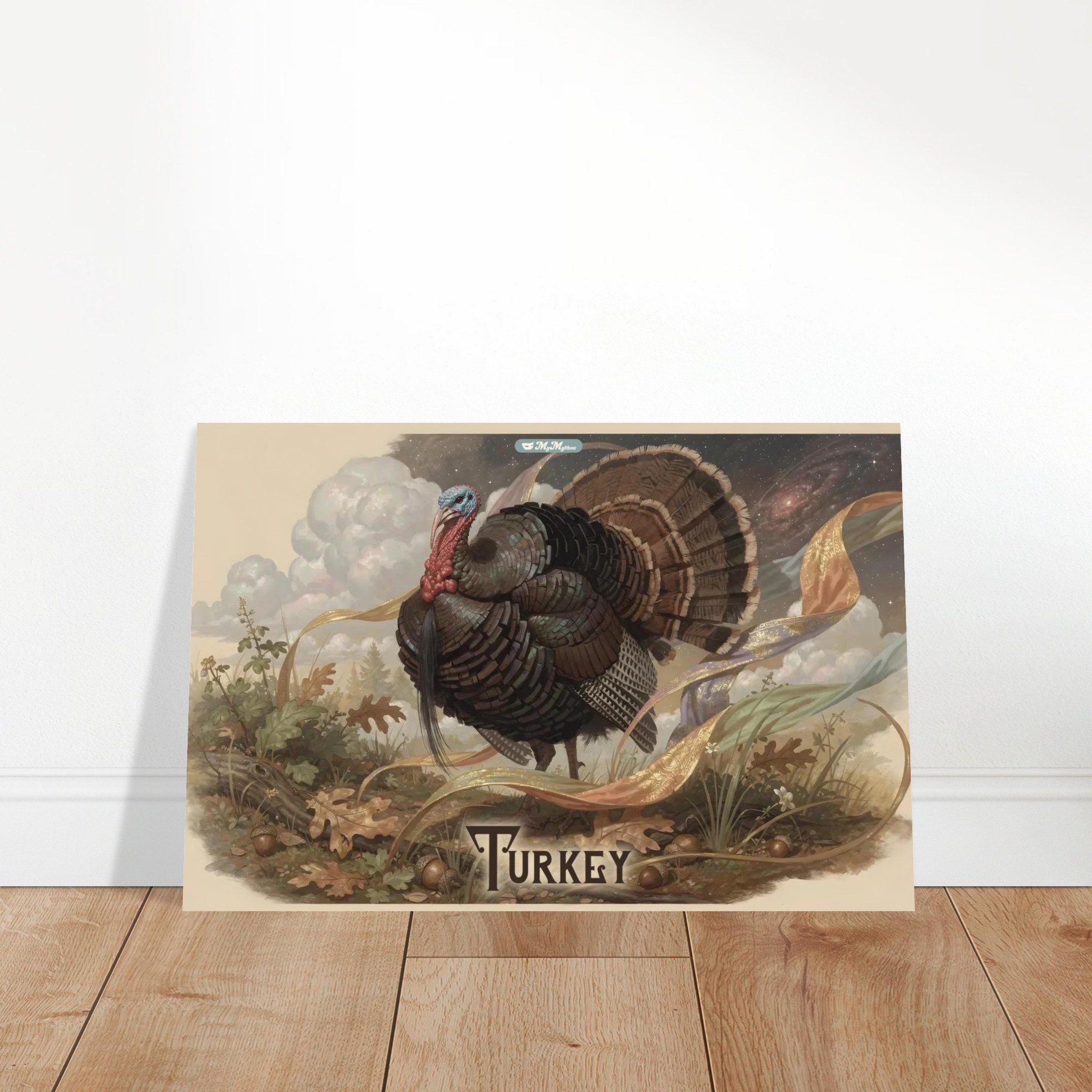
On your wall
Material
Sale! Was $19.00, now $14.25
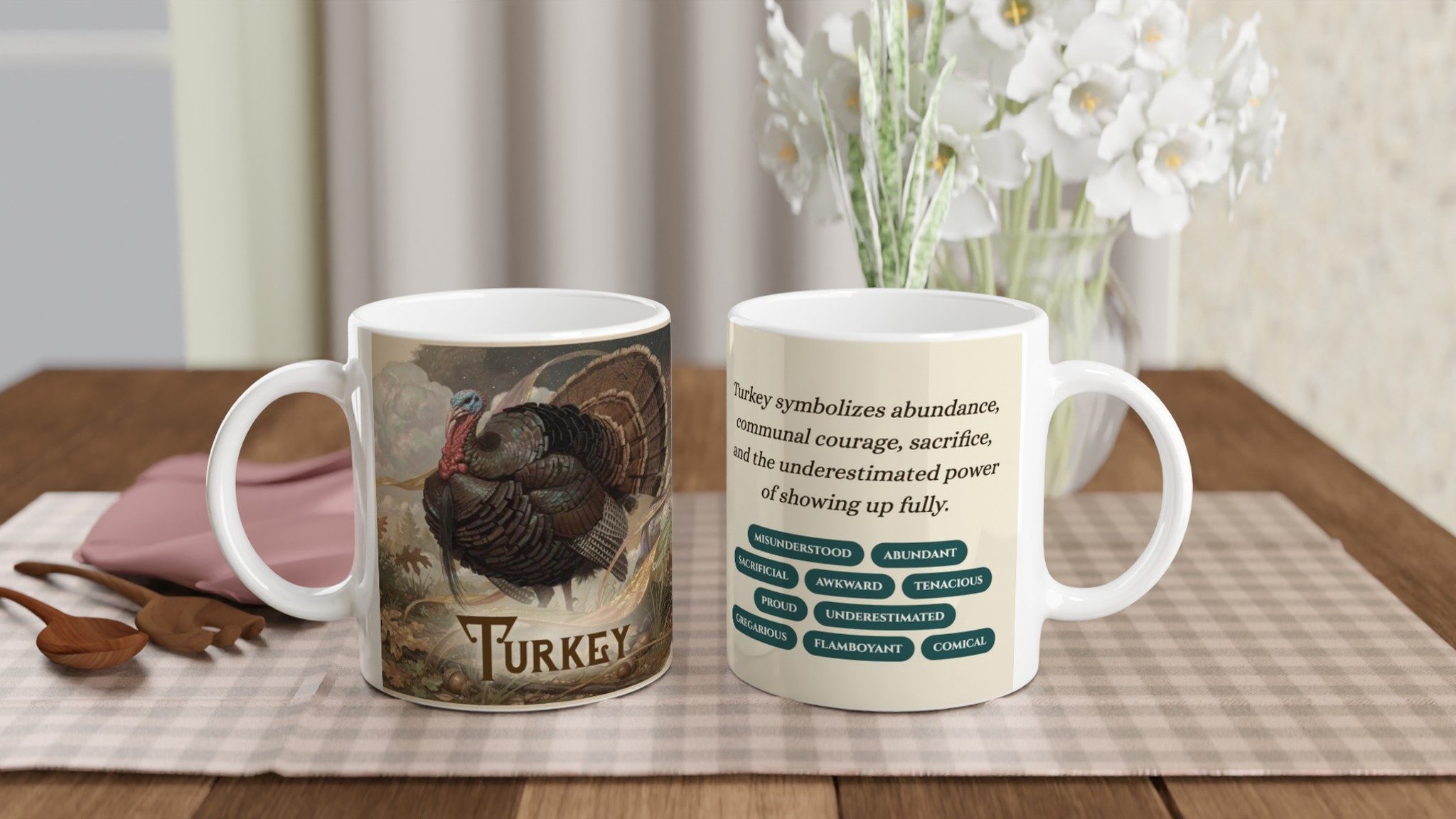
In your hands
Size
Color: White
Sale! Was $18.00, now $13.50
From elsewhere
Paid links: if you buy through these, MyMythos earns a small commission at no cost to you.