
A fawn is a young deer in its first year, usually born with a spotted coat that helps it hide in grass and leaves. Fawn symbolizes gentleness, alertness, vulnerability, and the quiet intelligence of moving carefully through danger.
By Sidian M.S. Jones, personal mythologistHow these pages are made
The Symbolism & Meaning of Fawn
The fawn's symbolism begins with a peculiar arrangement of facts. A newborn can walk within hours, yet its first defense is often to become nearly invisible. The doe leaves it tucked in grass or under brush, returning to nurse, while the fawn folds its legs beneath itself and waits. Its spotted coat scatters sunlight across its outline. What looks like passivity is a survival system: stillness saves energy, concealment keeps predators from finding the mother, and attention lets the young animal act when action has a chance of working.
That is why Fawn speaks of vulnerability without making vulnerability synonymous with weakness. The body is unprotected, but it is not unaware. Large ears turn toward a fox moving through leaves. The nose sorts familiar scent from threat. When danger comes close, a fawn may freeze; when it must flee, it can bound through cover with a speed that its delicate appearance hides. The symbol holds two gestures together: become small enough to survive the moment, then move when your legs and senses agree.
In the quiet of the forest, I found my voice. In the stillness of dawn, I found my strength.
Fawn also carries innocence, though not the blank innocence of someone who knows nothing. It is the 
In personal mythology, this archetype often names the part of you that approaches life with a keen, intuitive caution. You may notice beauty before you trust it. You may need a quiet perimeter around new love, creative work, recovery, or a changed identity. Fawn does not ask you to rush into the clearing to prove courage. It asks you to read the clearing accurately. The gentle answer may be a pause, a hidden hour, or a 
There is tenderness in that choice, but also discipline. A fawn cannot afford to spend every hour in flight. It alternates between stillness, feeding, play, and sudden movement. Its meaning therefore includes proportion: fear may sharpen attention, while too much fear turns shelter into a permanent enclosure. The archetype is at its best when softness remains mobile. It protects what is young without mistaking the young thing for the whole self.
Fawn as a Spirit Animal, Totem & Power Animal
When Fawn is your spirit animal, totem, or power animal, it tends to arrive through the image of a life that is both exposed and exquisitely alert. You may meet it in a recurring dream, a tattoo, an unexpected encounter on a trail, or an attraction to the small deer that appears before you can explain why. The meeting often comes during a threshold: beginning again, falling in love, entering unfamiliar work, or learning to live after fear. Fawn gives that threshold a body.
As a spirit animal, Fawn asks you to notice what your nervous system knows before your story catches up. A deer does not debate every snapped twig. It pauses, angles its ears, tests the 
As a totem, Fawn can describe a family or community pattern built around gentleness, watchfulness, and protection of the young. It may appear in a household where people read one another's moods before speaking, or where a small kindness matters more than a dramatic declaration. The gift is a finely tuned awareness of atmosphere. The risk is learning to disappear so completely that nobody can meet the person beneath the careful surface. A totem is inherited or shared language, not an excuse to stay hidden.
As a power animal, Fawn offers a particular kind of strength: the power to remain responsive without becoming hard. It helps when you need to enter a new place without pretending to know it, to protect a fragile project from premature judgment, or to leave an unsafe situation before you can defend your decision in words. Its power is not aggression. It is timing, concealment, quickness, and the refusal to confuse gentleness with surrender.
Fawn also asks something of you. Shelter the new thing, but do not keep it in the nursery forever. Let trustworthy people approach by degrees. Practice saying no before resentment has to say it for you. When the body says freeze, give it a moment of respect, then ask whether the danger is present now. The mature form of this archetype is not permanent youth. It is a person who can stay tender because tenderness has learned where the exits are.
Which of these is also you?
Collect 8 to make a mythos.
These archetypes were chosen because you are reading about Fawn.
Fawn in Mythology & Folklore: Where the Symbolism Comes From
Fawn inherits most of its traditional meaning from the deer, whose young appear in stories as creatures of the forest edge: visible, delicate, and not yet armored by antlers. In ancient Greece, deer belonged especially to 
At Brauron in Attica, girls served Artemis as arktoi, or little bears, in a rite associated with growing from childhood toward marriage. Deer were not the central costume there, but the wider Artemis tradition kept the young animal near questions of maidenhood, bodily change, and the boundary between a protected child and an adult who enters the woods at risk. A fawn in this setting can carry innocence, but not permanent innocence. It belongs to a threshold.
In Celtic and Welsh tradition, the white stag or hind often leads people away from ordinary roads and into the 

At Nara and Kasuga in Japan, deer are regarded as messengers of the kami associated with Kasuga Taisha. The animals have been protected around the shrine for centuries, and the city's deer have become living participants in its religious landscape. Their presence suggests gentleness and divine permission, but their boldness around visitors also shows that a protected creature is not the same as a tame one.
Buddhist Jataka stories use deer in a different moral register. In the Ruru Deer story, a golden deer risks himself to save a drowning man, who later betrays him for a reward. The king is moved by the animal's compassion and protects the deer. Here vulnerability does not prevent courage, while the human response exposes greed. Across these traditions, the fawn's smallness can invite care, but it can also conceal a wild intelligence that knows when to flee.




Fawn and Its Relationships With Other Archetypes

Deer
“Deer is who I will become; for now my spots are all I have for armor.”
Fawns lose their white spots within a few months as they grow into adult coats, so the spots mark a stage meant to be passed through. Deer is grace with experience behind it and Fawn is the same grace before experience, and a person carrying both remembers being new without needing to stay that way.
Visit Deer
Mother
“She leaves me hidden in the grass and comes back only to feed me, to keep danger away.”
For their first weeks, white-tailed deer fawns lie still and hidden while their mothers feed elsewhere, returning a few times a day so that a mother's scent does not lead predators to them. Mother and Fawn together show a kind of love that protects by keeping its distance, and a person with both may understand that being left alone was sometimes a form of care.
Visit Mother
Meadow
“I lie flat in tall grass and trust my stillness, even when the mower comes.”
Because fawns freeze instead of fleeing, many are killed by hay mowers each spring, and farmers in Germany and elsewhere now fly drones with heat cameras over meadows to find them first. Meadow and Fawn together suit a person whose first instinct is to keep still and unseen, and who may need to learn that the old strategy doesn't fit every danger.
Visit Meadow
Artemis
“Artemis guards the young of every wild thing, and deer are her sacred animal.”
In Greek religion Artemis protected young animals and young people, and deer were among her sacred animals; in some versions of Iphigenia's story she spares the girl at Aulis by leaving a deer on the altar in her place. Artemis and Fawn together describe a person who is both vulnerable and watched over, and who can grow into the guardian once they have been guarded.
Visit Artemis
Innocent
“I have not learned to be afraid of everything yet, and that is my gift and my risk.”
Innocent is the role of someone who meets the world without suspicion, and Fawn is its animal form, gentle, alert and new. Together they belong to a person who keeps a soft openness into adulthood and has to learn which situations deserve it.
Visit Innocent
Fawn also keeps company with the crepuscular hours: Bunny, Deer, Jackalope, Quail, Vole and White-Tailed Deer, among twenty-two others that are crepuscular.

Fawn in Dreams: Meaning & Interpretation
Dreaming of a fawn often brings attention to a tender part of life that has not yet grown a defense. It may be a new attachment, a young ambition, a recently recovered trust, or your own nervous body moving through unfamiliar ground. The detail that matters is not simply that the animal is gentle. A fawn survives by freezing, listening, hiding its scent, and following the doe when the danger has passed. The dream may therefore be showing you a form of intelligence that does not look forceful.
The fawn can act as a pause in the dreamer's usual strategy. It asks what your senses noticed before your plans began, where you have mistaken softness for helplessness, and whether you are safe enough to come out of hiding. If the dream feels luminous, it may be giving a new beginning room to breathe. If it feels hunted, injured, or separated, it may be staging the cost of leaving something vulnerable without protection. Its message is usually carried by distance, shelter, and the animal's response to your presence.
A fawn standing quietly at the forest edge can mark a new beginning that needs privacy rather than applause. If it lets you approach, the dream may be welcoming a gentler relationship with your own instincts. If it watches you and then returns to the trees, the welcome may be real but the boundary matters more.
A fawn running from dogs, trapped behind a fence, or lying alone in tall grass can warn of fear that has become organized around one vulnerable place. A wounded fawn may represent trust after an injury, while a hidden fawn can show a gift or desire kept concealed for safety. A doe appearing afterward changes the scene: the dream is not only about exposure, but about finding the protection that makes movement possible.
Fawn: Positive & Negative Meanings
Positive Meanings
- Gentle presence that lowers defensiveness
- Keen attention to subtle changes
- Adaptable movement through unfamiliar settings
- Protective care for beginnings and vulnerable people
- Grace under pressure without needless force
- Intuitive timing about when to approach or withdraw
Negative Meanings
- Timid avoidance of necessary confrontation
- Fragile self-image beneath a quiet exterior
- Appeasing others to preserve safety
- Mistaking fear for intuition
- Hiding so well that support cannot arrive
- Remaining youthful where adult agency is needed

The Shadow of Fawn
The shadow of Fawn appears when caution becomes identity. A fawn that freezes in grass is using a precise survival response; a person who freezes in every conversation may be protecting an old danger that is no longer there. The archetype can turn listening into surveillance, gentleness into appeasement, and innocence into a reason never to test the world directly.
Its vulnerability may also attract rescuers. Being visibly unsure can bring care, but performing helplessness can keep power in someone else's hands. Fawn's shadow does not always look delicate. It can become a quick, evasive life of disappearing before anyone can ask for an honest answer. The person may call this intuition when it is actually fear, or call every boundary a threat because the clearing has become too large.
The correction is not to grow antlers and become hard. It is to let stillness end. A fawn must eventually feed, follow, and cross open ground. Shadow work for this archetype means learning the difference between a body that detects danger and a body that remembers it, then allowing trusted companionship to make movement possible.
How Did You End Up at Fawn?
What might you have become if you had followed every bright movement into the clearing, and what in your life taught you to stay at the tree line instead?
Which moment made freezing, listening, and keeping your small body out of sight feel safer than running toward the noise?
What were you praised, paid, or loved for when your quiet face and careful steps made everyone else feel less afraid?
Whose way of lifting a head at the slightest sound are you noticing in yourself now, before you ever had a name for it?
Has Fawn turned up in your life, in a dream, a moment, a person? Put it on your page and join its kin, or tell the first story.


 Written by Warren,
for you alone
A reading by Warren
What Fawn means for you
This page says what the Fawn means. Warren can tell you why it is showing up for you, now.
Fawn: Frequently Asked Questions
- What does Fawn symbolize?
- The fawn's symbolism begins with a peculiar arrangement of facts. A newborn can walk within hours, yet its first defense is often to become nearly invisible.
- What is the spiritual meaning of Fawn?
- When Fawn is your spirit animal, totem, or power animal, it tends to arrive through the image of a life that is both exposed and exquisitely alert. You may meet it in a recurring dream, a tattoo, an unexpected encounter on a trail, or an attraction to the small deer that appears before you can explain why.
- What does Fawn represent?
- Fawn inherits most of its traditional meaning from the deer, whose young appear in stories as creatures of the forest edge: visible, delicate, and not yet armored by antlers. In ancient Greece, deer belonged especially to Artemis, goddess of wild places and the hunt.
- What does it mean to dream about Fawn?
- Dreaming of a fawn often brings attention to a tender part of life that has not yet grown a defense. It may be a new attachment, a young ambition, a recently recovered trust, or your own nervous body moving through unfamiliar ground.
- What is the shadow side of Fawn?
- The shadow of Fawn appears when caution becomes identity. A fawn that freezes in grass is using a precise survival response; a person who freezes in every conversation may be protecting an old danger that is no longer there.
- What are the positive and negative meanings of Fawn?
- Gentle presence that lowers defensiveness. Timid avoidance of necessary confrontation.
- What does a Fawn tattoo mean?
- Often, a person wears a fawn to keep a visible emblem of tenderness, new growth, or a life once protected. Some choose it after surviving fear without losing gentleness. Others may use the image to honor a place, memory, or bond with the wild.
Characteristics of Fawn
- Color:
- brown
- Marking:
- spotted
- Covering:
- furry
- Form:
- four-legged
- Size:
- small
- Kind:
- mammal
- Diet:
- herbivore
- Active when:
- crepuscular
- Habitat:
- forest, grassland
- Element:
- earth
A fawn's body is built for concealment and rapid change: its spotted coat breaks up the outline in dappled grass, while its legs lengthen quickly during the first weeks. Newborns spend much of the day motionless while the doe forages, relying on stillness rather than speed. Their early helplessness is temporary, and the transition from hiding infant to mobile juvenile happens with striking economy.
Get the next one
Essays on personal mythology, archetypes, and the stories we tell ourselves.
Take Fawn home
Printed to order and shipped to you. Please allow a few extra days for production.
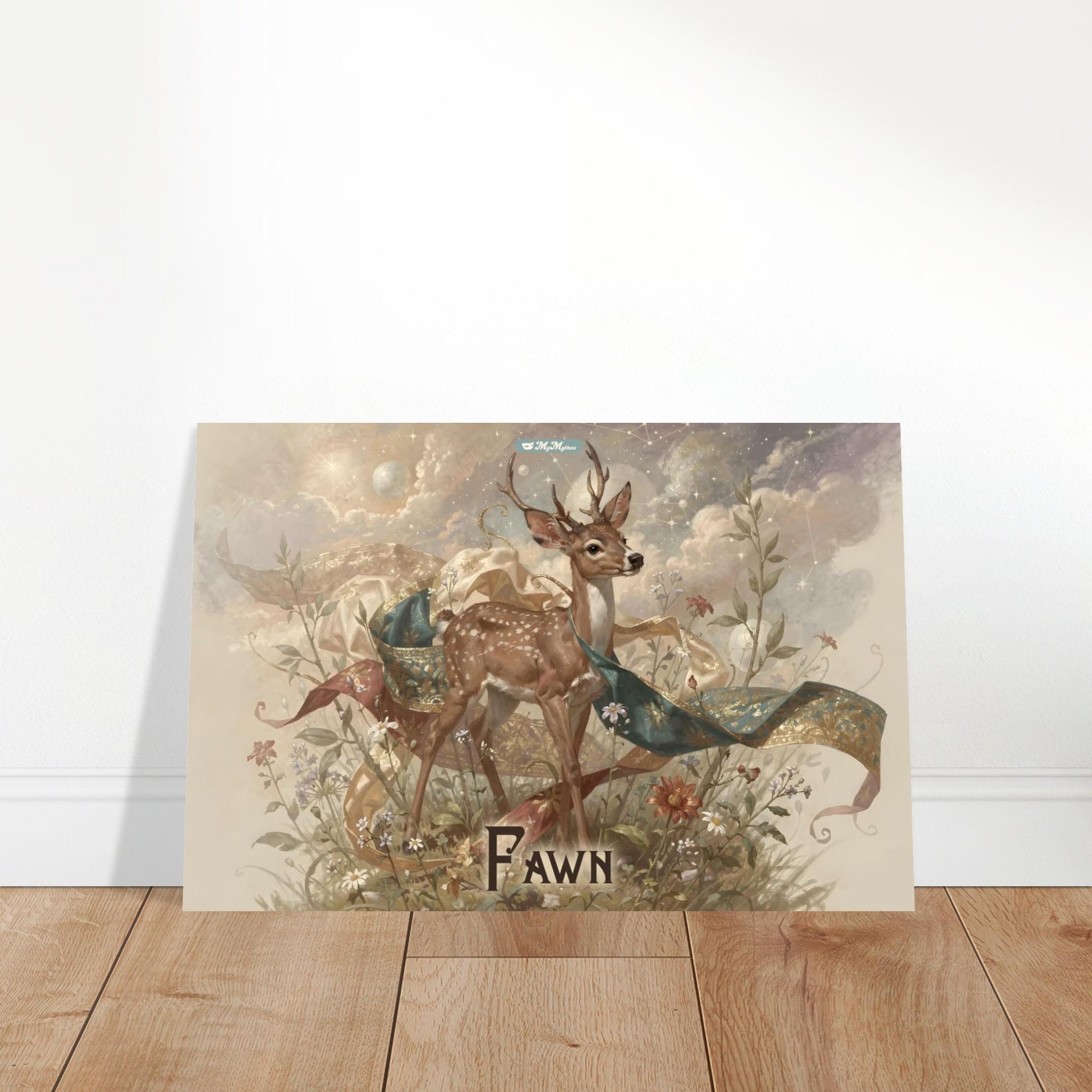
On your wall
Material
Sale! Was $19.00, now $14.25
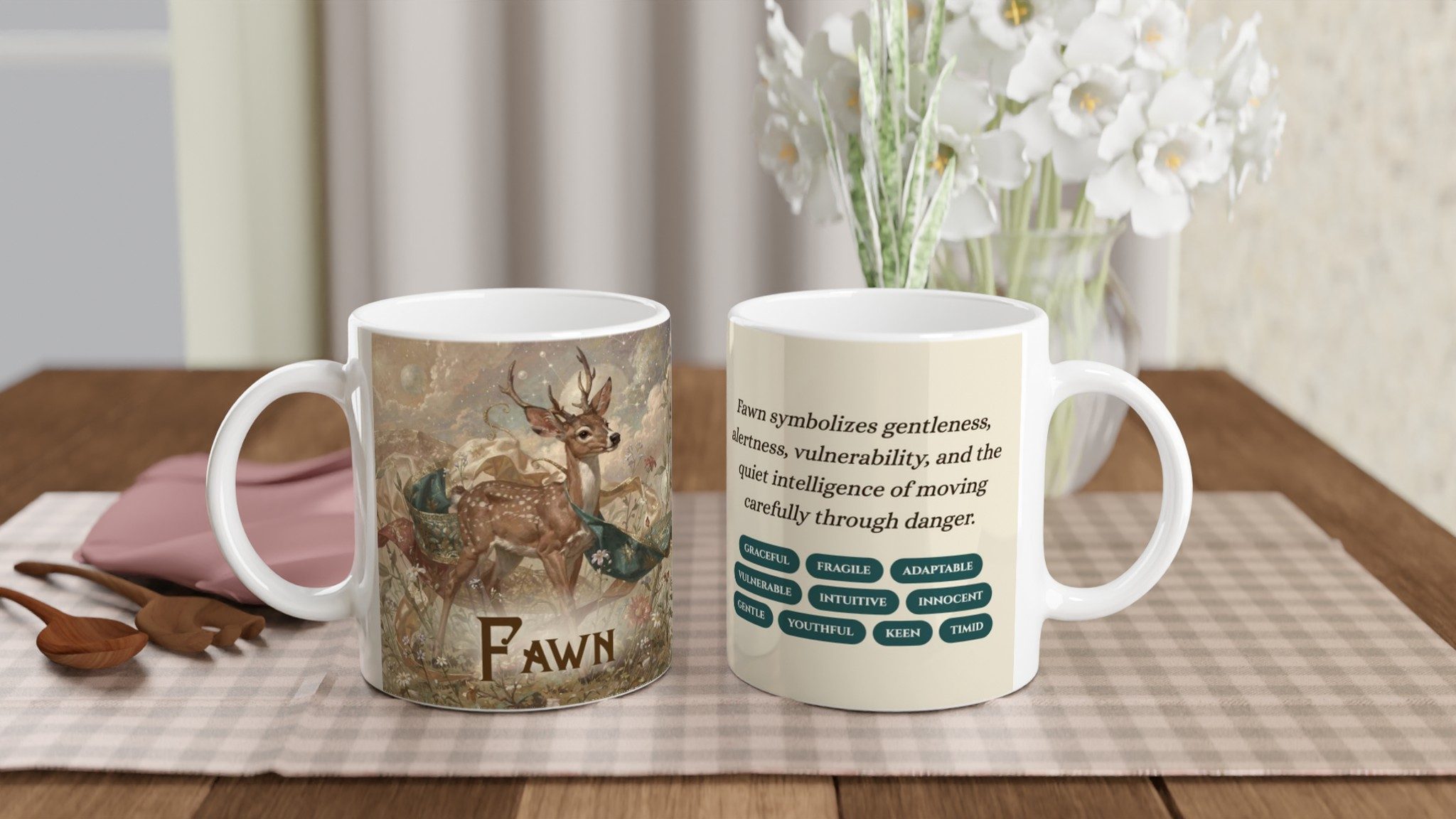
In your hands
Size
Color: White
Sale! Was $18.00, now $13.50
From elsewhere
Paid links: if you buy through these, MyMythos earns a small commission at no cost to you.