
A jackalope is a legendary North American creature, a jackrabbit with antlers, made famous by mounted taxidermy novelties sold in Wyoming. Jackalope symbolizes improbable resilience, watchful independence, clever escape, and the freedom to remain difficult to classify.
By Sidian M.S. Jones, personal mythologistHow these pages are made
Encounters
Meet Jackalope inside a story
The Symbolism & Meaning of Jackalope
The jackalope means that an unlikely self can still be a legitimate self. It joins the 
That contradiction is the heart of the symbol. The jackalope does not ask you to become ordinary before you can become strong. It suggests that the trait others misread as skittishness may be a sophisticated surveillance system, and that disappearing can sometimes preserve the life that a dramatic confrontation would spend. Its solitude is not necessarily loneliness. A jackalope lives in the margin between the known field and the story told about the field, where an observer must decide whether the shape ahead is a rabbit, a trick, a disease, a trophy, or something not yet named.
Believe in the antlers you haven't grown yet: they are already your shadow on the sunlit plains.
Because the creature comes from modern American tall tales, its power includes humor. The jackalope exposes the seriousness with which people defend their categories. A person may be too cautious for the bold, too strange for the conventional, too private for the intimate, and still possess a precise knowledge of when to move. The joke becomes a shelter. If others laugh at the impossible horns, they may fail to notice how quickly the animal has read the terrain.
The jackalope also carries the ethics of the improbable. It does not promise that every unusual story is true, or that suspicion is always wisdom. Real rabbits with horn-like growths show how easily observation can become legend, while taxidermy shows how readily people manufacture evidence for what they want to believe. The symbol therefore keeps one foot in skepticism. It asks for wonder with a checking instinct intact.
When this archetype belongs to your mythos, you may be learning to let contradiction remain visible. You can be tender and defended, elusive and deeply observant, funny about what hurts, quick to leave and slow to trust. The jackalope does not make strangeness decorative. It makes strangeness functional. Its improbable body says that survival may not resemble a heroic entrance. Sometimes it looks like a small animal crossing an empty road at dusk, carrying exactly the wrong shape for the world that thinks it has understood it.
What It Means When You See Jackalope: Signs & Symbolism
When the jackalope keeps appearing in drawings, decorations, dreams, or chance encounters, the important question is not whether the outside world has sent a coded instruction. It is why this particular impossible animal has become the shape your attention cannot leave alone. Of all the creatures around you, this one combines a vulnerable body with a visible warning. It is familiar enough to recognize and strange enough to prevent a final answer. You may be looking for permission to remain unusual without turning your life into a spectacle.
If you meet the jackalope with unease, it may reveal how carefully you have been managing exposure. You may fear that being seen will make you available to judgment, demand, or capture. The horns then represent a boundary that appeared after gentleness stopped feeling sufficient. The message is not that everyone is dangerous. It is that your nervous system has learned to scan before it settles, and it may need a form that respects this intelligence rather than mocking it.
Curiosity changes the reading. If the creature delights you, you may be searching for a way to make your oddness useful. The jackalope offers a life that can be playful without becoming shallow, skeptical without becoming sterile. It reminds you that a ridiculous story can carry serious knowledge about place, belonging, and who gets to define reality. You may be ready to experiment, rename yourself, or build a small refuge where your less explainable qualities are allowed to work.
Grief gives the encounter another depth. A jackalope glimpsed after a loss may stand for the self that vanished into usefulness, the younger person who learned to be quick rather than ask for comfort, or the relationship that was real even if outsiders never understood its shape. Its disappearance can feel cruel, but it can also preserve something from possession. What you are looking for may be proof that the strange and tender parts of life count, even when no official record can hold them.
Meeting this archetype repeatedly often means you are negotiating the distance between concealment and revelation. You do not need to show every horn to everyone. You do need to know whether hiding still protects a living possibility or merely preserves an old alarm. The jackalope catches your attention because it makes that question beautiful, funny, and impossible to answer with a borrowed rule.
Which of these is also you?
Collect 8 to make a mythos.
These archetypes were chosen because you are reading about Jackalope.
Jackalope in Mythology & Legend: Where the Symbolism Comes From
The jackalope is chiefly a creature of American folklore, especially the ranching and hunting culture of the American West. Its familiar body is a 
The word itself is a blend of jackrabbit and antelope, and the name helped the creature travel farther than any single campfire tale. Western stories claim that jackalopes are difficult to find because they are shy, fast, and watchful. Some say they can imitate human voices, especially the voices of cowboys, or sing beautifully when thunder rolls. Others give them a more practical danger: a startled animal can drive its horns into a rider or attacker. A common story says the best time to hunt one is during a thunderstorm, when males sing from the 
The horned rabbit also has a less playful real-world shadow. Rabbits can develop horn-like growths from infection with the Shope papilloma virus, the rabbit papillomavirus, first described in the 1930s. The growths are not antelope horns, but photographs of affected rabbits may have helped make the jackalope seem almost plausible. Here the same fact can be read in opposite ways. A storyteller sees proof that the impossible creature exists; a biologist sees a disease changing tissue into a misleading shape.
The jackalope is not an ancient pan-Indigenous figure, nor does it belong to one continuous European or Native American mythic tradition. It emerged as a modern American tall tale, though it borrows the older human habit of imagining hybrid animals and placing them at the edge of settled knowledge. Its closest cultural relatives include the fearsome critters invented by lumberjacks, miners, and woods workers, such as the hodag and the splintercat. Those creatures turned difficult landscapes, dangerous jobs, and outsider humor into animals that could be described with a straight face.
That mixture gives the jackalope its particular charge. It is a hoax that became folklore, a joke that acquired a home, a false animal supported by true rabbits, true horns, real disease, and the human appetite for one more creature just beyond the fence line. The symbolism comes from that unstable border between observation and invention: what is seen, what is believed, and what a community enjoys making possible for a while.




Jackalope and Its Relationships With Other Archetypes
Jackrabbit
“Half my name and most of my body come from Jackrabbit; the antlers are a separate story.”
Jackalope's name joins jackrabbit and antelope, and most mounted specimens are a real jackrabbit with deer antlers attached by a taxidermist. Jackrabbit is the fast, plain animal of the open West, and Jackalope is what that animal becomes once people start telling stories around it, which says a lot about how legends grow from the ordinary.
Visit Jackrabbit
Scientist
“A real virus can sprout hornlike growths on a rabbit's head, and someone had to explain it.”
In the 1930s the virologist Richard Shope identified the papillomavirus that causes horn-like growths on wild rabbits, and sightings of such rabbits may lie behind horned-hare legends. Scientist and Jackalope together suit a person who enjoys a tall tale but cannot resist asking where it came from, and who often finds the truth is stranger.
Visit Scientist
Trickster
“Ask about me in Wyoming and someone will sell you a hunting license, straight-faced.”
The modern jackalope is usually traced to Douglas Herrick of Douglas, Wyoming, who began selling mounted ones in the 1930s, and the town still hands out tongue-in-cheek jackalope hunting licenses. Trickster and Jackalope together describe a person who uses humor to test who is paying attention, and who keeps a straight face long enough to find out.
Visit Trickster
Postcard
“You will find me on more roadside postcards than you will ever find me in the wild.”
Jackalope postcards, often doctored photographs of giant horned rabbits, became a staple of American roadside tourism in the mid twentieth century. Postcard and Jackalope together point to a person who knows a good story travels farther than a dry fact, and who enjoys sending the story anyway.
Visit Postcard
Unicorn
“We are both horned animals that people half believe in, but nobody ever tried to tame me.”
Horned hares appear in European art and natural history as early as the late sixteenth century, including in the work of the Flemish painter Joris Hoefnagel. Unicorn is the solemn version of an impossible horned animal and Jackalope is the joking one, and a person carrying both keeps wonder alive without taking it too seriously.
Visit Unicorn
Jackalope also keeps company with the crepuscular hours: Bunny, Deer, Puma, Red Panda, Vole and White-Tailed Deer, among twenty-two others that are crepuscular.

Jackalope in Dreams: Meaning & Interpretation
Dreaming of a jackalope often points toward an identity that feels both recognizable and impossible to explain. The rabbit body suggests caution, speed, and vulnerability, while the horns interrupt that expectation with defiance, defense, and comic strangeness. The dream may arrive when you are tired of being read too quickly, or when a supposedly weak position has developed sharper edges than anyone noticed. It can also mark a private wish to remain unclaimed by the categories other people use.
The dream is doing more than delivering a symbol. It is making a contradiction visible so you can look at it without resolving it. A jackalope may let your mind rehearse an escape, test a disguise, or give form to the part of you that survives by appearing unbelievable. Its mood matters. A ridiculous creature in a bright field may loosen shame around eccentricity; one watching from a dark roadside may ask why vigilance has become a permanent home. The dream does not prove that danger is coming. It shows what kind of attention your inner life is currently practicing.
A jackalope sitting calmly beside a familiar path can suggest that an unusual part of the dreamer's life is ready to be acknowledged without performance. If it allows an approach, curiosity may be replacing the need to explain every difference. If it simply watches, the dream may be honoring privacy rather than demanding action.
A jackalope charging through a bedroom or breaking a fence can warn that guarded instincts have become difficult to contain. A wounded jackalope may carry grief for a self that learned to hide, while a jackalope with broken horns can reflect the fear of losing the strange defenses that made independence possible. A laughing or speaking jackalope may invite the dreamer to distrust a story that sounds absurd only because it is true in an inconvenient way.
Jackalope: Positive & Negative Meanings
Positive Meanings
- Resilience that grows under ridicule
- Quick perception of changing conditions
- Clever use of unlikely resources
- Independence without constant approval
- Humor that makes strangeness livable
- Swift movement when timing matters
- Privacy that protects creative life
Negative Meanings
- Suspicion that outlasts the original danger
- Flight mistaken for freedom
- Isolation disguised as discernment
- Jokes used to avoid honest need
- Defensiveness before a threat appears
- Difficulty accepting ordinary belonging
- A habit of making oneself impossible to reach

The Shadow of Jackalope
The shadow of the jackalope begins when watchfulness becomes identity instead of equipment. A person may become so practiced at reading exits that every room feels like a trap, so committed to being misunderstood that clear recognition feels suspicious, or so attached to improbability that ordinary care seems like surrender. The creature that once protected privacy can start manufacturing distance, leaving others to guess while quietly resenting their guesses.
Its humor can hide injury. The jackalope may turn every serious need into a joke before anyone can respond, or use strangeness as a shield against the risk of being plainly loved. Its cleverness can become evasion, its speed can become flight, and its solitude can become a court in which no one else is allowed to give evidence. A person carrying this shadow may mistake being difficult to capture for being impossible to know.
The horns have a darker use as well. They can turn defensiveness into preemptive attack, especially when an imagined threat feels more vivid than the person standing nearby. The correction is not to become harmless or transparent. It is to distinguish a real boundary from a dramatic disappearance, and a present danger from an old field remembered by the body. The jackalope's freedom survives when it can return from cover by choice, not only vanish by reflex.
How Did You End Up at Jackalope?
Who watched you keep still as a jackalope in the grass, saw the horns and the fear, and called your silence nothing worth naming?
Whose comfort depended on you staying a jackalope, improbable enough to dismiss and quick enough to vanish before anyone asked what you wanted?
What is happening now that makes the jackalope's hidden trail, raised guard, and sudden escape feel safer than standing plainly in the open?
Has Jackalope turned up in your life, in a dream, a moment, a person? Put it on your page and join its kin, or tell the first story.


 Written by Warren,
for you alone
A reading by Warren
What Jackalope means for you
This page says what Jackalope means. Warren can tell you why it is showing up for you, now.
Jackalope: Frequently Asked Questions
- What does Jackalope symbolize?
- The jackalope means that an unlikely self can still be a legitimate self. It joins the rabbit, an animal associated with alertness and exposed vulnerability, to horns, structures that announce defense, rank, and refusal.
- What is the spiritual meaning of Jackalope?
- When the jackalope keeps appearing in drawings, decorations, dreams, or chance encounters, the important question is not whether the outside world has sent a coded instruction. It is why this particular impossible animal has become the shape your attention cannot leave alone.
- What does Jackalope represent?
- The jackalope is chiefly a creature of American folklore, especially the ranching and hunting culture of the American West. Its familiar body is a jackrabbit or cottontail with antelope-like horns, though stories and mounted specimens have sometimes given it deer antlers instead.
- What does it mean to dream about Jackalope?
- Dreaming of a jackalope often points toward an identity that feels both recognizable and impossible to explain. The rabbit body suggests caution, speed, and vulnerability, while the horns interrupt that expectation with defiance, defense, and comic strangeness.
- What is the shadow side of Jackalope?
- The shadow of the jackalope begins when watchfulness becomes identity instead of equipment.
- What are the positive and negative meanings of Jackalope?
- Resilience that grows under ridicule. Suspicion that outlasts the original danger.
- What does a Jackalope tattoo mean?
- Often, a person wears a jackalope to claim an unusual identity with humor and edge. Some choose it for a connection to the American West or a private tall tale. Others use it to mark survival through being underestimated.
Characteristics of Jackalope
- Color:
- brown
- Covering:
- furry
- Form:
- four-legged
- Size:
- small
- Kind:
- mammal
- Diet:
- herbivore
- Active when:
- crepuscular
- Habitat:
- grassland, desert
- Element:
- earth
The jackalope is a fictional hybrid assembled from a rabbit and horned-animal parts, but its plausibility draws on real biology rather than pure fantasy. Rabbit papillomavirus can produce horn-like growths on rabbits, and mounted taxidermy displays can make an invented animal look briefly evidential. Its physical idea therefore depends on a sharp mismatch between a familiar prey animal and an unfamiliar defensive structure, a mismatch that the eye recognizes before the mind explains it.
Get the next one
Essays on personal mythology, archetypes, and the stories we tell ourselves.
Take Jackalope home
Printed to order and shipped to you. Please allow a few extra days for production.
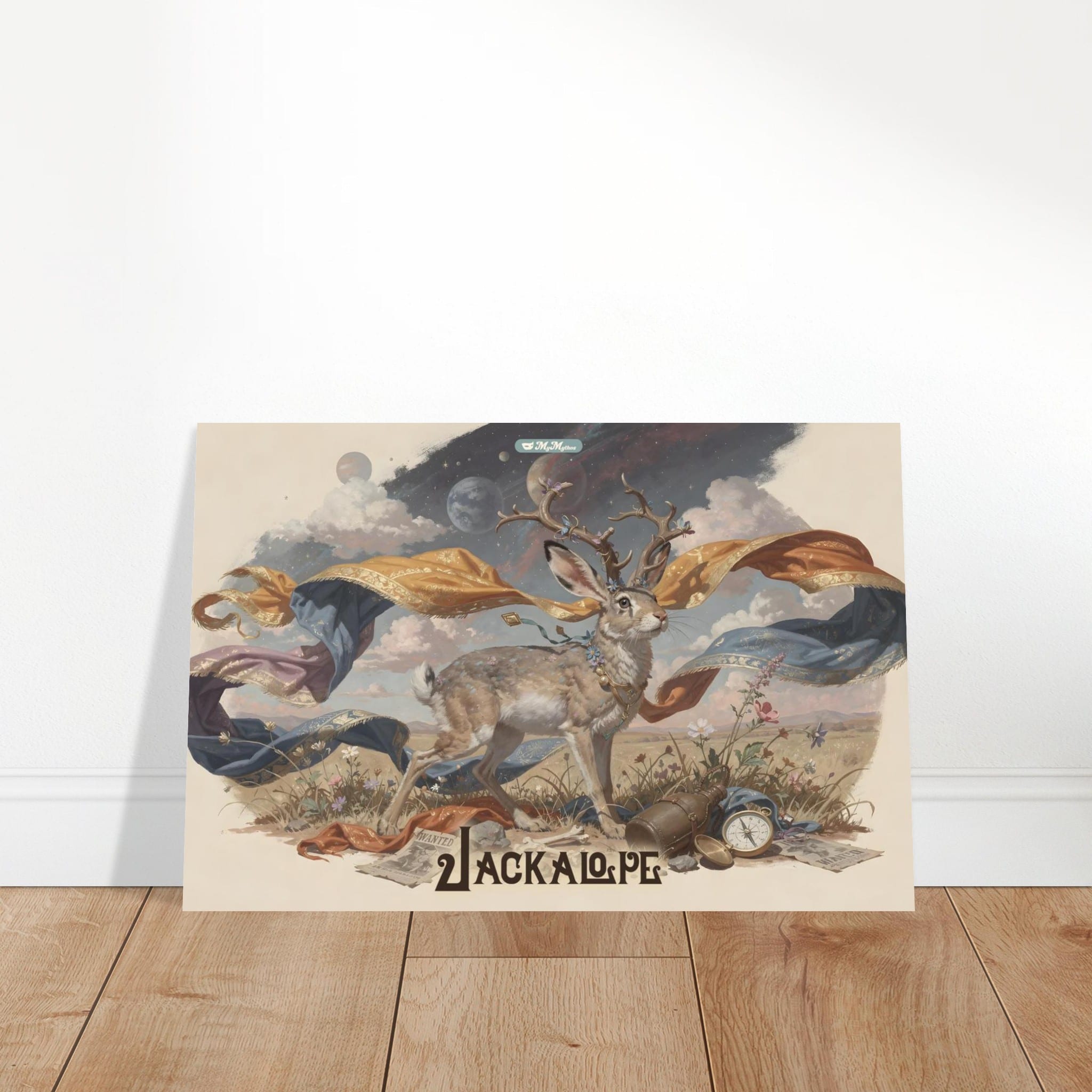
On your wall
Material
Sale! Was $19.00, now $14.25
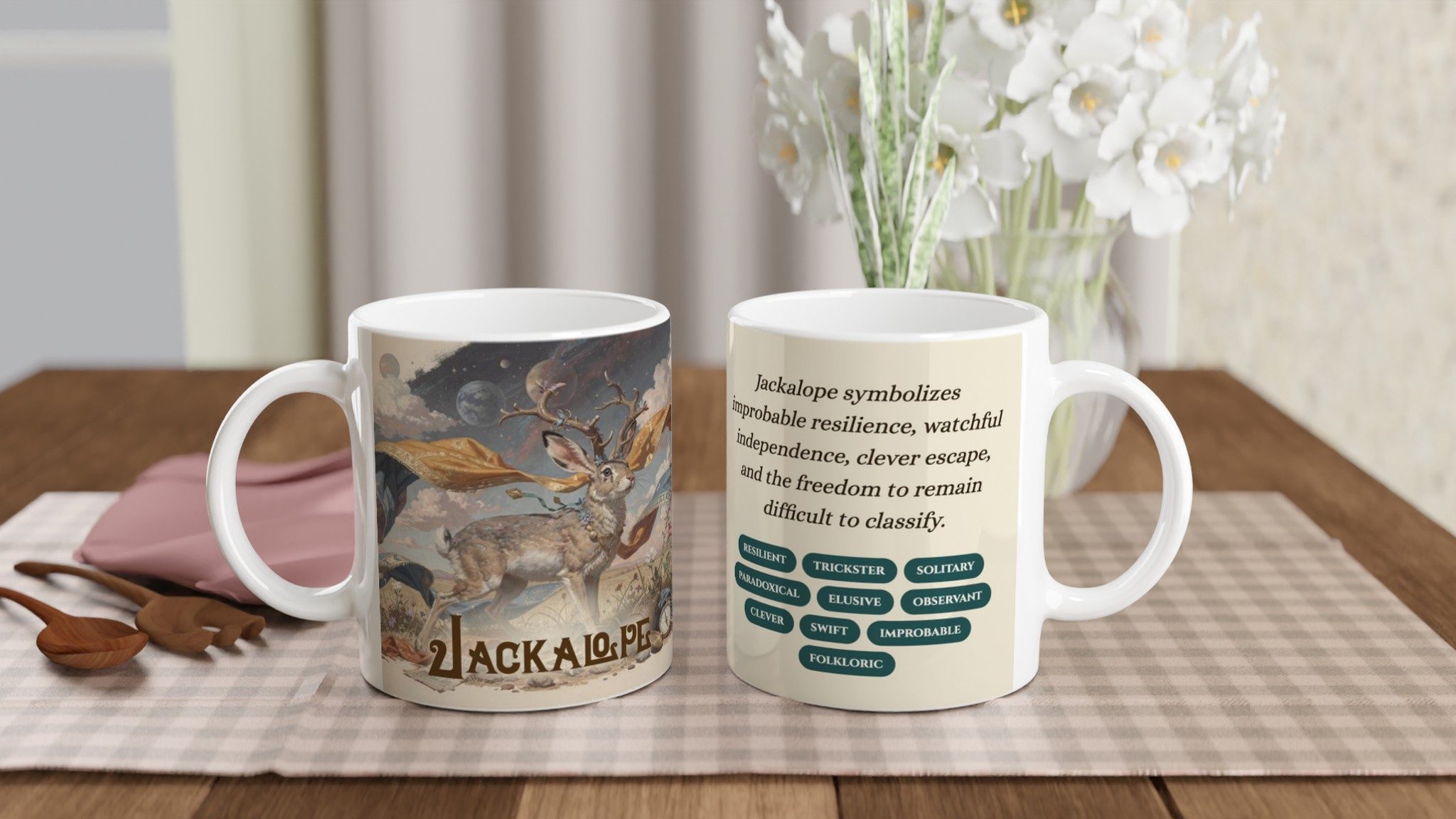
In your hands
Size
Color: White
Sale! Was $18.00, now $13.50
From elsewhere
Paid links: if you buy through these, MyMythos earns a small commission at no cost to you.