
A deer is a graceful hoofed mammal of the family Cervidae, found on most continents, whose males usually grow and shed antlers each year. Deer symbolizes grace, alertness, vulnerability, and the instinct to move gently through danger.
By Sidian M.S. Jones, personal mythologistHow these pages are made
The Symbolism & Meaning of Deer
Deer symbolism begins with a body that eats in the open and survives by noticing what arrives before it can be named. A deer lowers its head to browse leaves, shoots, grasses, berries, and sometimes bark, yet its ears keep turning and its nose keeps testing the 

The animal also makes vulnerability visible. A fawn may lie motionless in grass while its mother feeds elsewhere, relying on concealment rather than constant protection. A doe can raise young through a season of scarcity, nursing them, moving them between cover, and teaching them where food and danger gather. The hidden fawn is not helpless in the simple sense. Its stillness is an active strategy. Deer therefore speaks to a kind of quiet courage that does not announce itself as courage.
In the quiet of the forest, listen to the whispers of your heart: there lies your truest path.
Speed is part of the symbol, but not speed for its own sake. Deer can freeze, listen, and calculate, then clear a fence or cross a 
The stag adds another layer. Antlers grow from the skull, become weapons in contests, and fall away after the breeding season. They make strength temporary and visible. A stag can carry an image of dignity, sexual force, or authority, but the yearly shedding keeps those qualities from becoming permanent possessions. What looks like identity may be a season's equipment.
Across myth, the deer is pursued, protected, sacrificed, and followed into another world. Artemis's hind is forbidden prey; the white deer of Celtic stories leads hunters beyond ordinary roads; the deer of Kasuga carries a kami's message in Japanese tradition. The meanings do not agree, and that disagreement is useful. Deer is not simply peace. It is the charged border between a creature people want to approach and a creature that must remain free. Its grace comes with distance, its beauty with appetite, and its tenderness with the knowledge that a clearing is never entirely empty.
Deer as a Spirit Animal, Totem & Power Animal
If Deer is your spirit animal, totem, or power animal, you may recognize the world through small changes: a pause in conversation, a branch moving against the wind, a mood that enters a room before its cause appears. Your strength does not begin with domination. It begins with reception. You notice, and that notice gives you choices that a louder person may miss.
Carrying Deer can mean learning the difference between openness and exposure. Deer does not spend every hour hiding. It grazes, mates, travels, and raises young in places where other creatures can see it. Yet it keeps cover nearby and responds quickly when the pattern changes. Your version of this archetype asks for a life with both tenderness and refuge. You can welcome affection without handing every stranger the keys to your interior world.
The animal may arrive during a transition when an old identity has become too heavy to carry. A stag sheds antlers after investing energy in their growth; the next set begins again beneath velvet. Deer can enter through a recurring image, a meeting with the animal, a family story, or the feeling that your body has recognized a place before your mind has explained it. The 
As a power animal, Deer lends movement to fear. Fear can lock the legs, but it can also sharpen them. The archetype asks you to practice leaving cleanly rather than waiting until resentment, exhaustion, or danger makes the decision for you. It asks you to use your senses as information, not as a permanent sentence. A racing heart is a signal; it is not always a 
In a totemic or ancestral context, the word requires care. Deer traditions belong to particular peoples, landscapes, and relationships, and no single modern formula can stand in for them. If your connection comes through a family or cultural tradition, let its actual stories and obligations lead. If it is a personal archetype, honor the living animal by learning its habits and refusing to reduce it to decorative innocence.
Deer can make a person compassionate without making them available to every demand. It can sharpen artistic attention, deepen love of quiet places, and restore trust in a body that responds before language. Its power is not the absence of threat. It is the ability to remain responsive in a world where threat and beauty often share the same clearing.
Which of these is also you?
Collect 8 to make a mythos.
27 readers on MyMythos have picked Deer as one of their archetypes.
These archetypes were chosen because you are reading about Deer.
Deer in Mythology & Folklore: Where the Symbolism Comes From
In Greek myth, the deer belongs especially to 
Celtic traditions also give the deer a passage between human and otherworldly landscapes. In Irish and Scottish tales, a white hind or white stag may lead a hunter away from ordinary roads and toward an encounter with the sídhe, the fairy people, or with a woman who can change shape. In the medieval Welsh story of Pwyll, the prince finds the otherworldly ruler Arawn hunting a stag, and the hounds and quarry announce that the 
In Japanese Shinto practice, deer at Kasuga Taisha in Nara are regarded as messengers of the kami Takemikazuchi. According to shrine tradition, the deity arrived riding a white deer, and the animals that live around the 
Among the Sámi, reindeer have been central to livelihood, clothing, transport, and seasonal movement, so deer lore cannot be separated from practical knowledge of snow, pasture, migration, and herd care. In North American Indigenous cultures, meanings differ by nation and should not be collapsed into one pan-Indigenous symbol. Some traditions treat deer as a respected hunted being whose gifts require reciprocity; others place deer in stories of love, fertility, healing, or transformation. The animal can therefore mark both nourishment and restraint.
That tension appears in European folklore too. A white deer may signal an otherworldly summons or a royal hunt, while the hunted stag can stand for virility, status, and the right to rule. The same creature is protected guest, desired prize, guide, and meal. Deer symbolism comes from living at that edge: it feeds quietly, raises young under concealment, freezes when danger arrives, and then crosses a clearing in seconds.




Deer and Its Relationships With Other Archetypes

Artemis
“Actaeon saw Artemis bathing, and she made him one of us, torn down by his own hounds.”
In the myth Ovid tells, the hunter Actaeon stumbles on Artemis, whom Ovid calls Diana, as she bathes, and she turns him into a stag that his own dogs pull down. The pairing makes Deer the vulnerable side of a person who was once the hunter, and a warning about seeing what was not offered.
Visit Artemis
Deer Antler
“Each spring my bucks grow their antlers again from nothing, faster than any other bone grows.”
Antlers are true bone, shed every winter and regrown each year, and in large deer such as elk they can lengthen by more than two centimeters a day. Deer Antler beside Deer is loss treated as routine, a person who can drop what they built and grow it back larger.
Visit Deer Antler
Highway
“In your headlights I freeze, because stillness saved my kind long before cars came.”
Deer evolved to freeze when startled, which hides them from predators that track movement, and their eyes, built for dim light, are briefly blinded by headlights. Highway and Deer together describe an old instinct meeting a new danger, the moment when what once kept a person safe is the thing that puts them at risk.
Visit Highway
Crucifix
“A hunter chased me through the forest until he saw a crucifix shining between my antlers.”
Legends of Saint Eustace and Saint Hubert tell of a hunter converted when a stag turned to face him with a cross between its antlers, an image still printed on the Jägermeister label. Crucifix with Deer turns the hunted animal into the messenger, gentleness that stops a violent life in its tracks.
Visit Crucifix
Longing
“The psalm says a soul longs for God the way I pant for running water.”
Psalm 42 opens by comparing a thirsty deer at the water brooks to a soul thirsting for God, one of the Bible's best-known images of spiritual hunger. Longing beside Deer gives a gentle, wary creature a fierce want, and suggests that grace is often thirst moving carefully.
Visit Longing
Deer also keeps company with the Celtic tradition: Apple, Dagda, Halloween, Manannan mac Lir, Salmon and Tuatha Dé Danann, among fifty-three others of the Celtic tradition.

Deer in Dreams: Meaning & Interpretation
Dreaming of Deer often brings attention to a part of life that is sensitive without being weak. The animal may appear when you are reading a room before anyone speaks, protecting a private tenderness, or deciding whether to remain still or run. Because a deer survives by combining vigilance with grazing, concealment with sudden speed, the dream can hold two needs at once: nourishment and escape, belonging and distance, trust and a clear route out.
The dream is doing more than offering a pretty emblem. It may be placing your body back into the scene, asking what your senses already know before your explanations catch up. A deer that watches you can make your own watchfulness visible. A deer that bolts may give shape to an impulse you have delayed. A calm animal may let you approach vulnerability without forcing it to perform courage. The meaning changes with the animal's condition, the landscape, and your feeling on waking.
A deer standing at the edge of a forest may show a choice that is close enough to see but not yet safe to enter, especially if the animal watches without fleeing. If it lets you approach, the dream can welcome a careful reunion with tenderness, instinct, or a neglected part of yourself.
A deer running from you may warn that pressure is driving trust out of reach, while an injured deer can point toward a hurt kept quiet because exposing it feels dangerous. Dreaming of a stag with large antlers may bring questions of authority and display, but a deer trapped behind a fence makes the warning more concrete: a 
Deer: Positive & Negative Meanings
Positive Meanings
- Grace under pressure
- Strong sensory awareness
- Gentle approach to conflict
- Fast response when needed
- Protective care for the vulnerable
- Adaptability in changing conditions
- Respect for freedom and boundaries
Negative Meanings
- Overreaction to ambiguous danger
- Conflict avoidance
- Difficulty trusting safety
- Vanishing instead of communicating
- Exhaustion from constant vigilance
- Mistaking softness for helplessness
- Running before understanding the threat

The Shadow of Deer
The shadow of Deer appears when sensitivity becomes surveillance. A person carrying this pattern may read every silence as danger, every delayed reply as an approaching predator, every change of tone as proof that escape is necessary. The alert body keeps listening after the forest has gone quiet. What once protected life begins to consume it.
Deer shadow can also turn gentleness into disappearance. Avoiding conflict may preserve peace for an hour while leaving another person to make every decision. Shyness can become an excuse never to be known; innocence can become refusal to learn how power works. A person may call themselves adaptable while changing shape for whoever seems strongest in the room.
The image of flight has its own trap. Leaving can be wise, but fleeing every discomfort prevents trust from acquiring roots. Some threats are real, some are old memories wearing new faces, and some are simply the friction of honest intimacy. The shadow asks whether the route out is protecting a living boundary or protecting a fear from being tested.
The stag's shadow is different but related. Antlers can become display, status, and competition, especially when temporary strength is mistaken for permanent worth. The answer is not to reject force. It is to remember that even the impressive rack is shed. Deer becomes whole when alertness serves life rather than ruling it, when gentleness includes a voice, and when retreat is a choice instead of a reflex.
How Did You End Up at Deer?
What did you give up to keep your body quiet in the brush, and when did you first notice that staying graceful meant leaving some hunger, anger, or desire unfed?
Where are you still standing at the tree line now, ears turned toward every sound, even though the danger has passed and you could step into the open?
Has Deer turned up in your life, in a dream, a moment, a person? Put it on your page and join its kin, or tell the first story.


 Written by Warren,
for you alone
A reading by Warren
What Deer means for you
This page says what the Deer means. Warren can tell you why it is showing up for you, now.
Deer: Frequently Asked Questions
- What does Deer symbolize?
- Deer symbolism begins with a body that eats in the open and survives by noticing what arrives before it can be named. A deer lowers its head to browse leaves, shoots, grasses, berries, and sometimes bark, yet its ears keep turning and its nose keeps testing the air.
- What is the spiritual meaning of Deer?
- If Deer is your spirit animal, totem, or power animal, you may recognize the world through small changes: a pause in conversation, a branch moving against the wind, a mood that enters a room before its cause appears. Your strength does not begin with domination.
- What does Deer represent?
- In Greek myth, the deer belongs especially to Artemis, goddess of the hunt and wild places. Her sacred hind had golden antlers and bronze feet, and the hero Heracles had to capture it without killing it as one of his labors.
- What does it mean to dream about Deer?
- Dreaming of Deer often brings attention to a part of life that is sensitive without being weak. The animal may appear when you are reading a room before anyone speaks, protecting a private tenderness, or deciding whether to remain still or run.
- What is the shadow side of Deer?
- The shadow of Deer appears when sensitivity becomes surveillance. A person carrying this pattern may read every silence as danger, every delayed reply as an approaching predator, every change of tone as proof that escape is necessary.
- What are the positive and negative meanings of Deer?
- Grace under pressure. Overreaction to ambiguous danger.
- What does a Deer tattoo mean?
- Often, a person wears a Deer to keep a private connection with gentleness, wilderness, or a turning point in survival. Some choose it for a family, place, or spiritual tradition. Others want a visible reminder that vulnerability and alertness can share one body.
Characteristics of Deer
- Color:
- brown
- Covering:
- furry
- Form:
- four-legged
- Size:
- large
- Kind:
- mammal
- Diet:
- herbivore
- Active when:
- crepuscular
- Habitat:
- forest, grassland
- Element:
- earth
- Tradition:
- Celtic, Japanese, Greek
Deer are built for a life of exposed feeding and sudden escape, with sensory systems that detect movement and scent before a threat reaches them. Their survival depends less on fighting than on choosing cover, timing, and direction, while does hide newborn fawns and return to nurse them. Antlers make the male body seasonal: they grow, harden, are used in contests, and are shed, allowing the same animal to change visibly with the year.
Get the next one
Essays on personal mythology, archetypes, and the stories we tell ourselves.
Take Deer home
Printed to order and shipped to you. Please allow a few extra days for production.
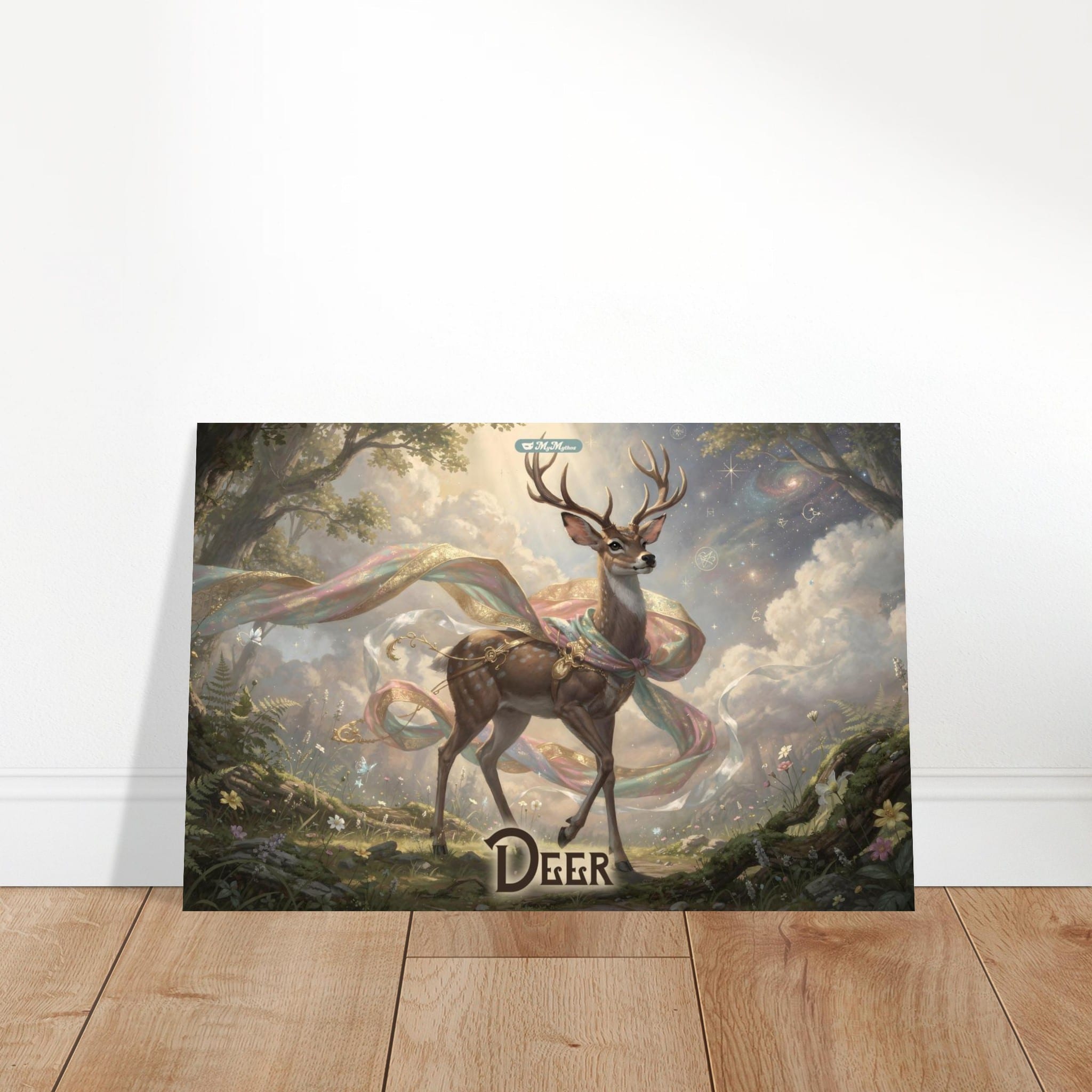
On your wall
Material
Sale! Was $19.00, now $14.25
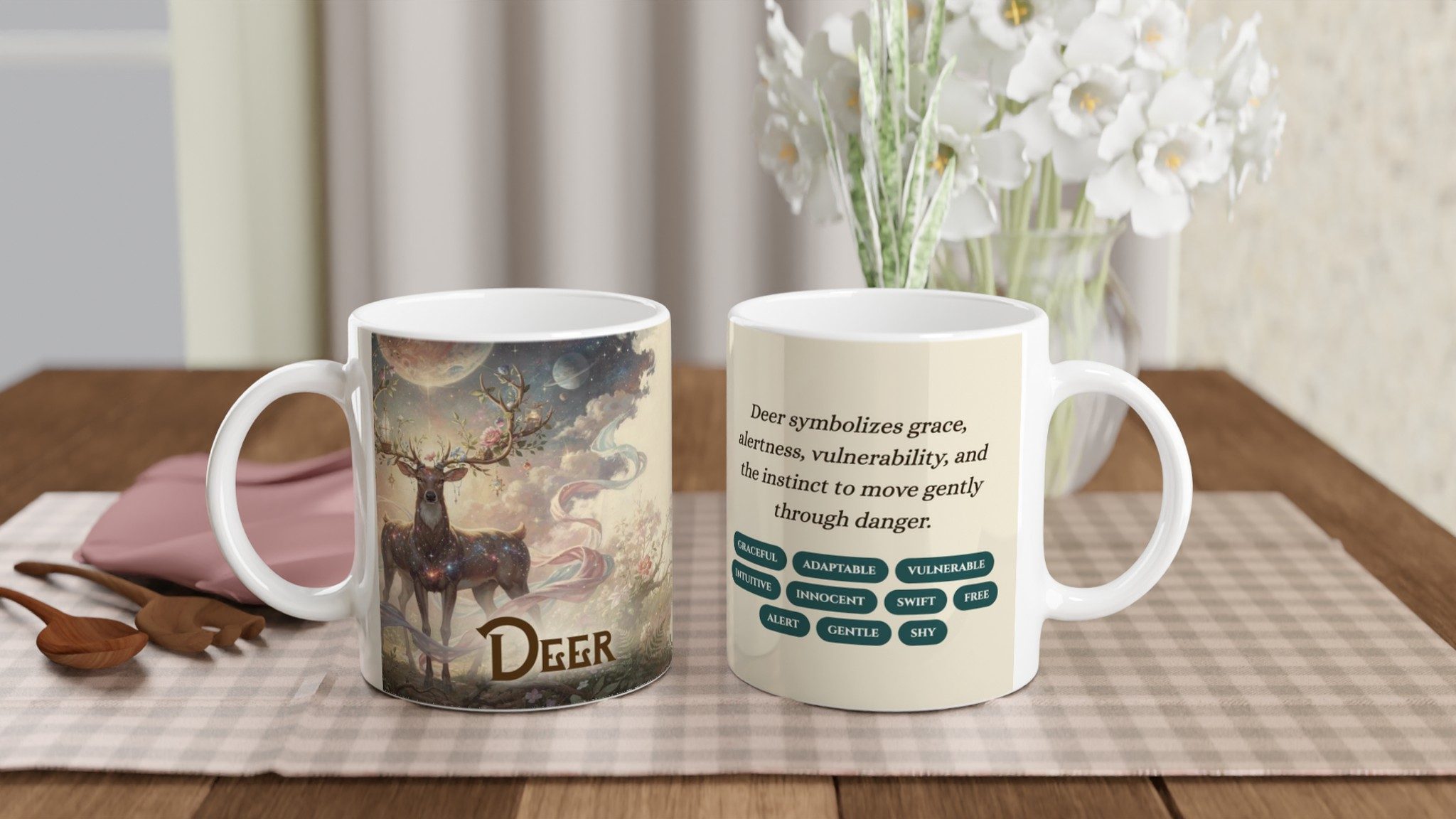
In your hands
Size
Color: White
Sale! Was $18.00, now $13.50
From elsewhere
Paid links: if you buy through these, MyMythos earns a small commission at no cost to you.