
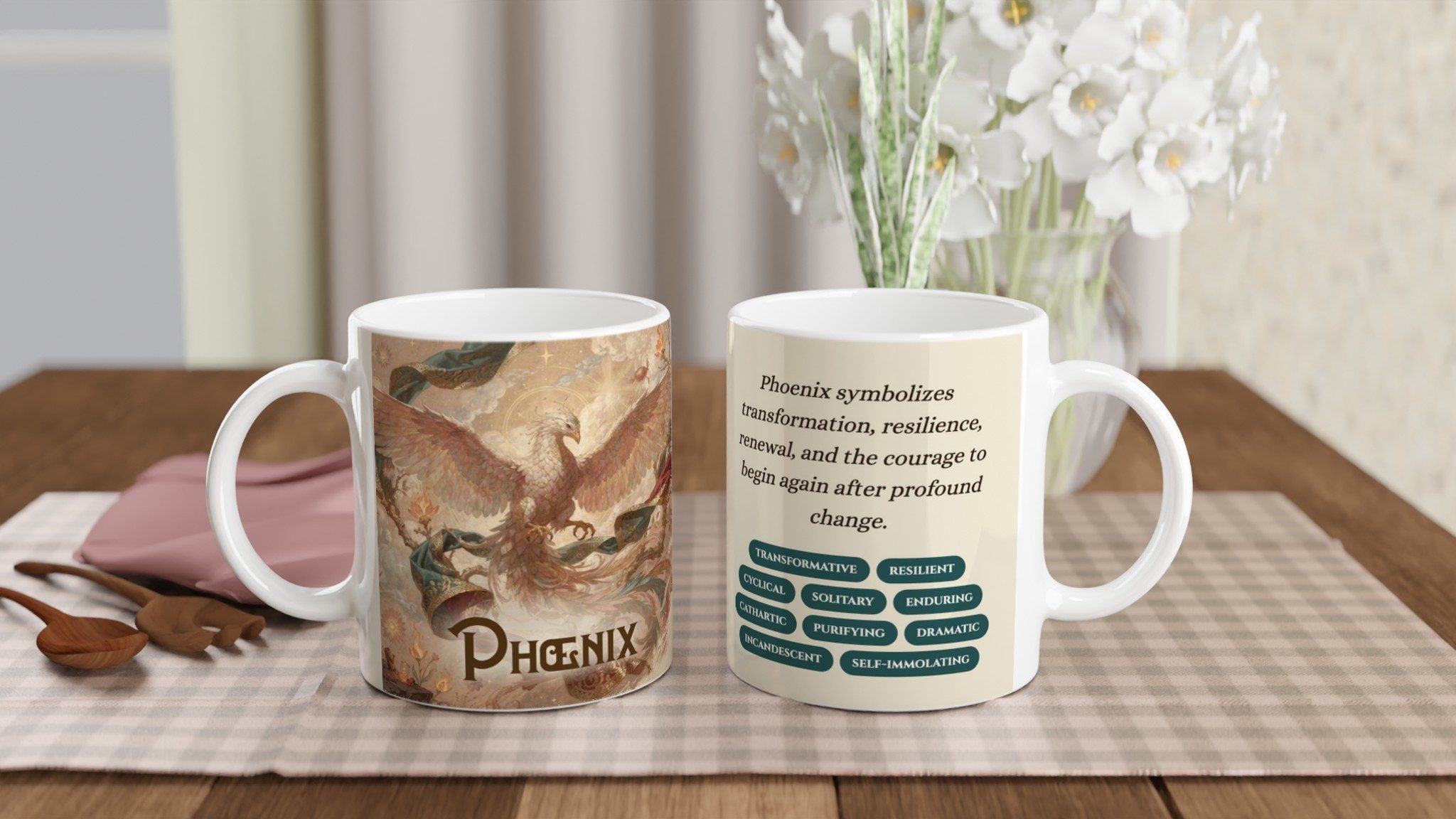
The phoenix is a mythical bird of ancient Greek legend that burns at the end of its life and rises again from its own ashes. Phoenix symbolizes transformation, resilience, renewal, and the courage to begin again after profound change.
The Symbolism & Meaning of Phoenix
Phoenix means renewal that does not pretend the past never happened. Its power comes from a particular sequence: the old form burns, the ashes remain, and something living rises from what cannot be restored. That sequence makes the Phoenix different from a simple symbol of victory. It does not promise that the same life will return intact. It suggests that survival may produce a stranger, brighter, less easily explained self.
The fire carries several meanings at once. It can be the heat of grief, the pressure of a necessary ending, the force of desire, or the cleansing that follows a life built around fear. The Phoenix is not merely destroyed by fire. In many versions, it enters the fire deliberately, making the image about consent to change as much as endurance. That choice can feel liberating when a person has outgrown a role, and frightening when the familiar still offers shelter.
Do not mourn the ashes. They are not an ending, but the purest starting material, the quiet testament to a fire that burned brightly enough to begin again.
Its cycle also gives renewal a rhythm. The Phoenix does not remain permanently reborn, triumphant, and untouched. It belongs to recurrence: a life reaches its limit, collapses into concentrated remains, and begins again. This makes the archetype useful for understanding repeated reinvention, especially when someone has had to become several versions of themselves to keep living. The risk is mistaking constant crisis for authenticity. Not every tired structure needs to burn. Sometimes the most Phoenix-like act is protecting the small ember until it can warm a different room.
The bird's solitude matters too. Classical accounts often place it far from ordinary human life, returning alone to the sun's city or to the nest it prepares for its own ending. That distance gives the Phoenix its grandeur, but it can also make renewal feel like a private obligation. Its meaning is strongest when transformation is honest rather than theatrical: when the ashes name something real, and the new life has enough ordinary substance to remain after the glow fades.
For someone drawn to Phoenix, the symbol may therefore mean permission to become unrecognizable without becoming false. It honors the part of a person that can turn loss into material, but it also asks whether the fire is freeing them or simply proving how much pain they can survive. The bird rises not because destruction is beautiful, but because life has found a form that 
What It Means When You See Phoenix: Signs & Symbolism
When Phoenix keeps appearing, the important question is not whether the world is sending a coded instruction. It is why this image has become more compelling than all the others around it. A person may be looking for a shape large enough to hold a recent ending: a 

Meeting Phoenix with unease often reveals fear of the necessary fire. Someone may know that a habit, loyalty, or public identity is finished, yet keep tending it because the ashes would make the truth undeniable. In that reading, the 
Meeting it with curiosity suggests a different hunger. The person may be searching for permission to change without presenting a tidy explanation. Phoenix becomes a companion for the awkward interval when a former self no longer fits and the replacement feels experimental. The attraction may say, "I want a life that can survive my honesty," rather than, "I want to return to who I was."
Meeting Phoenix through grief can be especially intimate. The image may hold someone who died, a home that vanished, a body that changed, or a future that will never arrive. Here, rising does not cancel mourning. It offers a way to imagine that love and loss can remain part of the material from which a new life is made. The reader may be avoiding the demand to be inspirational too soon, and the Phoenix can reveal that renewal does not have to look cheerful.
The archetype also sharpens a question about repetition. If every transformation requires a spectacular collapse, then the person may be unconsciously arranging for another fire. Phoenix is useful when it names genuine renewal, but misleading when it turns suffering into proof of depth. Its appearance may show a longing to be remade, and an equal longing to stop having to earn change through ruin. The most revealing sign is what the reader wants the bird to do next: burn, wait, rise, or simply remain nearby while the ashes cool.
Which of these is also you?
Collect 8 to make a mythos.
0 of 8
These archetypes were chosen because you are reading about Phoenix.
Phoenix in Mythology & Legend: Where the Symbolism Comes From
The Phoenix most familiar to modern readers comes from the classical Mediterranean. Greek writers described a rare bird from Arabia or Ethiopia that lived for centuries before returning to its birthplace to die and rise again. Herodotus reported a golden and crimson bird that appeared at Heliopolis, carrying its dead parent in an 


Egyptian tradition supplied an older image through the bennu, a sacred heron associated with Heliopolis, the creator Atum, the sun, and the first mound rising from primordial waters. The bennu was not simply a bird that burned and resurrected. It represented generative arrival, the return of light, and the beginning of time. Greek authors likely blended this Egyptian figure with stories of an eastern fire bird, which is why later Phoenix lore carries both solar birth and spectacular death.
Jewish and Christian writers adopted the Phoenix for different purposes. In some rabbinic stories, the bird remained alive because it alone refused to eat from the forbidden fruit in Eden. Its long life became a reward for restraint. Early Christian authors, including Clement of Rome and Lactantius, used the bird's death and renewal as evidence that resurrection could be imagined through the natural world. The same fire that signaled punishment in other biblical readings became, for them, a doorway to restored life.
China's fenghuang is often translated as Phoenix, though it belongs to a different tradition and does not usually burn and return from ashes. It is a composite bird with features associated with several creatures, and it appears in Chinese art as a sign of harmony, virtuous rule, and the balance of yin and yang. It may accompany the dragon as a complementary counterpart, especially in imperial symbolism. Japanese hō-ō developed from this Chinese tradition and likewise carries associations with peace and a just reign.
Persian lore preserves another related but distinct fire bird, the simurgh, a vast wise creature associated with healing, protection, and the renewal of kingship. It is not a resurrection bird, but its burning, luminous imagery helped later readers place many eastern birds in the Phoenix family. These traditions do not agree on what renewal requires. For the classical Mediterranean bird, destruction is the threshold. For the bennu, emergence precedes the emphasis on death. For the fenghuang, no burning is necessary at all: harmony itself is the sign of a world restored.




Phoenix and Its Relationships With Other Archetypes

Heron
“Before the Greeks named me, Egyptians saw me as the Bennu, a heron at Heliopolis.”
Many scholars trace the Greek phoenix to the Egyptian Bennu bird, usually shown as a heron and linked to the sun and creation. Heron and Phoenix together say that a myth of rebirth can begin with an ordinary bird standing in the shallows.
Visit Heron
Egg
“I carry my father to the temple sealed inside an Egg of myrrh.”
Herodotus wrote that the phoenix shaped an egg from myrrh, placed its dead parent inside, and flew it to the temple of the sun in Egypt. The pairing is about honoring what came before you as you start again.
Visit Egg
Sun
“Every five hundred years I fly to Heliopolis, the city that belongs to Sun.”
Ancient writers placed the phoenix at Heliopolis, the Greek name for the Egyptian city of the sun god. Sun and Phoenix together describe a cycle of setting and rising that a person can learn to trust.
Visit Sun
Cinnamon
“I build my last nest from Cinnamon, myrrh and cassia, and it smells of everything precious.”
Ovid and Pliny describe the phoenix building its final nest of rare spices before it dies. The pairing suggests that an ending can be prepared with care and even sweetness, not just endured.
Visit Cinnamon
Flame
“In the later stories I burn in my own Flame and rise out of it.”
The earliest Greek accounts of the phoenix say nothing about fire; burning and rising from the ashes became the familiar version later. Flame and Phoenix together describe a person who has turned their worst loss into the start of a new life.
Visit Flame
Phoenix also keeps company with the birds: Black Owl, Duck, Heron, Owl, Seagull and White Eagle, among eighty other birds.

Phoenix in Dreams: Meaning & Interpretation
Dreaming of a Phoenix often appears when an old identity is loosening but the next one has not yet taken recognizable form. The dream may gather grief, ambition, exhaustion, and hope into one image because ordinary language cannot hold all four at once. Fire can point to anger or purification; ashes can suggest what has already ended; the rising bird can mark a future that feels possible before it feels practical.
The dream is doing more than predicting a comeback. It gives the dreamer a controlled scene in which loss becomes visible and renewal becomes imaginable. A Phoenix may let someone rehearse a difficult departure, forgive a former self, or recognize that survival has changed them. Its message depends on the emotional temperature. Relief suggests release, awe suggests readiness, and terror may show that the dreamer is romanticizing collapse while still needing rest, support, or a gentler transition.
A Phoenix rising calmly from warm ashes often welcomes a new beginning that has been earned through mourning rather than forced through excitement. The dreamer may be ready to reclaim a voice, vocation, or relationship after a long season of silence.
A Phoenix trapped in a burning cage begins with the dream itself, and warns that reinvention has become performance. A bird that cannot rise may reflect repeated attempts to start over without changing the conditions that caused the collapse. A Phoenix circling a ruined home can hold both readings: grief for what cannot return, and curiosity about what kind of life could be built from the ground left behind.
Phoenix: Positive & Negative Meanings
Positive Meanings
- It gives endings a shape that can be survived.
- It turns grief into material for renewal.
- It supports bold reinvention after deep change.
- It can make resilience feel creative rather than merely defensive.
- It honors the dignity of becoming unfamiliar.
- It helps a person release identities that have expired.
Negative Meanings
- It can romanticize collapse and suffering.
- It may mistake constant crisis for transformation.
- It can encourage isolation during rebuilding.
- It may turn recovery into a performance.
- It can make stability feel dull or undeserved.
- It risks burning what could have been repaired.
- It may treat exhaustion as evidence of purpose.

The Shadow of Phoenix
The shadow of Phoenix begins when renewal becomes an identity that must be performed. A person carrying this archetype may grow attached to the dramatic ending, the public comeback, the story in which pain proves exceptional strength. Quiet maintenance can then feel like failure. They may abandon a workable life because it does not offer enough heat, or provoke rupture so the familiar cycle can begin again.
Another danger is self-immolation disguised as courage. Phoenix can make sacrifice look clean and voluntary even when exhaustion, coercion, or despair is doing the choosing. The person may burn relationships, work, health, or money and call the damage purification. Because the archetype promises a rise, it can postpone grief for what the fire actually destroyed.
Its solitude can harden into refusal. Someone may insist on rebuilding alone, reject help as evidence that the transformation is incomplete, or believe that nobody who did not see the flames can understand the new self. That leaves the reborn life without shelter. The antidote is not to deny the fire, but to stop worshiping it. Renewal needs water, witnesses, sleep, and ordinary tasks. A life that rises only for an audience has not yet escaped the blaze.
How Did You End Up at Phoenix?
Where are you still feeding a fire that once kept you alive, though its ashes now cover a room you no longer need to inhabit?
Who did you watch rise from ruin before you had a name for the bird, and what part of their burning did you copy?
What was the first time beginning again lifted you above the ashes, and how is that old victory shaping what you do now?
The Phoenix Hearth
Find Your Phoenix People
If Phoenix has ever turned up in your life, in a dream, a moment, a person, you are not the only one. Its people are gathering, and the first stories haven’t been told yet.
Joining is free: put Phoenix on your page, then press Join.

Talk to Warren about Phoenix
Phoenix means something different in every life it walks through. Tell me about yours, and we will see what it has been saying.

 Written by Warren,
for you alone
A reading by Warren
What Phoenix means for you
This page says what Phoenix means. Warren can tell you why it is showing up for you, now.
Phoenix: Frequently Asked Questions
- What does Phoenix symbolize?
- Phoenix means renewal that does not pretend the past never happened. Its power comes from a particular sequence: the old form burns, the ashes remain, and something living rises from what cannot be restored.
- What is the spiritual meaning of Phoenix?
- When Phoenix keeps appearing, the important question is not whether the world is sending a coded instruction. It is why this image has become more compelling than all the others around it.
- What does Phoenix represent?
- The Phoenix most familiar to modern readers comes from the classical Mediterranean. Greek writers described a rare bird from Arabia or Ethiopia that lived for centuries before returning to its birthplace to die and rise again.
- What does it mean to dream about Phoenix?
- Dreaming of a Phoenix often appears when an old identity is loosening but the next one has not yet taken recognizable form. The dream may gather grief, ambition, exhaustion, and hope into one image because ordinary language cannot hold all four at once.
- What is the shadow side of Phoenix?
- The shadow of Phoenix begins when renewal becomes an identity that must be performed. A person carrying this archetype may grow attached to the dramatic ending, the public comeback, the story in which pain proves exceptional strength.
- What are the positive and negative meanings of Phoenix?
- It gives endings a shape that can be survived. It can romanticize collapse and suffering.
- What does a Phoenix tattoo mean?
- Often, a person wears a Phoenix to mark survival after a private ending. Some choose it to honor a changed identity, while others use the bird as a promise that their next chapter can outlive the last one.
Characteristics of Phoenix
- Color:
- red, gold
- Covering:
- feathered
- Form:
- winged
- Size:
- large
- Kind:
- bird
- Habitat:
- sky
- Element:
- fire
- Realm:
- heavens
- Tradition:
- Greek
- Era:
- ancient
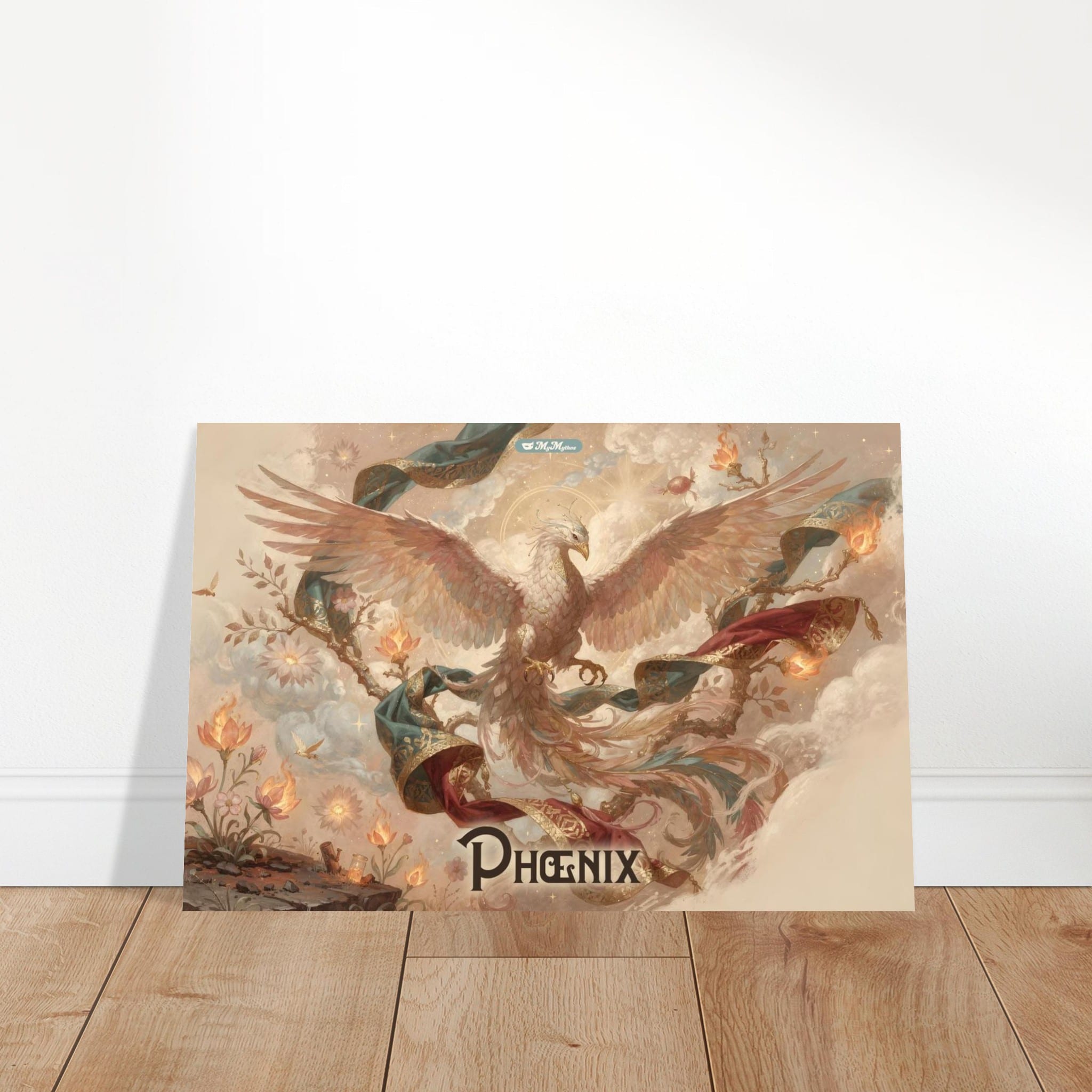
The Phoenix is built from a striking combination of recognizable bird anatomy and impossible life history, which makes it memorable even in traditions that describe it differently. Its image repeatedly gathers sun-colored plumage, aromatic nesting material, and a long interval of rarity around one dramatic event. The surprising feature is not flight or fire alone, but the way a single bird becomes a calendar, with its body carrying an entire cycle of death, waiting, and return.
Get the next one
Essays on personal mythology, archetypes, and the stories we tell ourselves.
Take Phoenix home
Printed to order and shipped to you. Please allow a few extra days for production.
On your wall
Material
$19.00
In your hands
Size
Color: White
$18.00
From elsewhere
Paid links: if you buy through these, MyMythos earns a small commission at no cost to you.