
Duck
Symbolism, Meaning & Spirit Animal
A duck is a web-footed waterbird with a flat bill, found on lakes, rivers and coasts around the world, and many kinds have been domesticated for meat and eggs. Duck symbolizes communal calm, adaptable care, emotional intelligence, and hidden depths.
By Sidian M.S. Jones, personal mythologistHow these pages are made
The Symbolism & Meaning of Duck
Duck symbolism begins with a body that refuses to belong to one surface. A duck walks, swims, dives, and flies, changing its method without changing its 
The duck's calm has physical evidence behind it. Waterproof feathers keep the body afloat. Webbed feet work powerfully below the surface while the bird appears almost still above it. A person carrying Duck may understand this kind of composure: not the absence of effort, but effort kept out of sight. The quiet surface does not prove that nothing is happening. It may mean the work is happening underwater.
Ducks are social animals. They feed in groups, rest together, and use calls to maintain contact. A flock offers warning, company, and shared vigilance. Duck therefore favors belonging that is practical rather than ornamental. It asks who notices when someone has disappeared, who makes room at the edge, and who stays close when conditions turn dangerous. Its communal instinct does not require constant intimacy. It requires reliable proximity.
Beneath the surface of stillness, there is constant motion: embrace both, and you will find your flow.
Nesting gives the symbol another layer. A mother duck conceals her nest among vegetation, leaves her eggs while feeding, and later leads newly hatched ducklings toward water. The young are vulnerable, but they are not kept still. They follow, paddle, dive, and learn in motion. Duck represents nurturing that prepares life for the real world instead of preserving it from every risk. Protection becomes guidance, vigilance, and a timely release.
Migration adds direction without demanding permanent attachment to one place. Many ducks travel with seasonal changes, using wetlands as stations along a route. They return to familiar regions, but they do not confuse familiarity with immobility. This gives Duck a meaning suited to people whose lives require departure, return, and adjustment.
The archetype also holds hidden depths. A duck can vanish beneath opaque water, search for food, and surface somewhere else. Its attraction often belongs to people whose visible manner seems simple while their emotional life remains active and layered. Duck does not make privacy cold. It makes privacy functional. Feelings may need time below the surface before they can be named.
At its best, Duck combines buoyancy with care. It keeps contact with the group, changes course when the water changes, and protects what is small without pretending danger does not exist. Its serenity is not escape. It is a practiced way of remaining present.
Duck as a Spirit Animal, Totem & Power Animal
When Duck arrives as a spirit animal, totem, or power animal, it often appears during a change in emotional weather. You may be moving between homes, roles, relationships, or communities. You may feel both visible and unreadable, surrounded by people while carrying private material no one has noticed. Duck comes through ponds, rivers, dreams, repeated sightings, family stories, and the sudden recognition that an ordinary bird has become personally charged.
Having Duck as yours does not mean being endlessly peaceful. It means knowing how to keep functioning while feeling deeply. You can feed yourself in shallow water, dive when necessary, and return for 
Duck power is strongest in shared life. It supports the person who coordinates meals, checks on a vulnerable relative, remembers the route, or notices who has fallen behind. Its care is concrete. It does not need a speech when food, shelter, timing, and attention will do more. If Duck is yours, your presence may make a household or team more workable. You know that safety is built from repeated acts, not one impressive rescue.
The animal also brings movement. Ducks migrate because conditions change, and their routes join memory with necessity. A Duck person may return to old places without remaining trapped there. You can carry a sense of home across distance, then recognize when a familiar place no longer provides enough water, food, or cover. The power lies in leaving without treating departure as betrayal.
Duck asks you to protect the small and unfinished. A nest hidden in reeds does not look dramatic, yet it holds a future. You may be called to defend a new project, a 
Its 
Carry Duck when you need steady care without spectacle. Let its buoyancy remind you that hidden effort still counts. Let its diving show that returning to the surface is part of the work. Your life need not look dramatic to be alive, connected, and in motion.
Which of these is also you?
Collect 8 to make a mythos.
These archetypes were chosen because you are reading about Duck.
Duck in Mythology & Folklore: Where the Symbolism Comes From
In ancient Egypt, ducks appeared in tomb paintings, offering scenes, and household decoration. Egyptians hunted wild ducks in the marshes and prepared them as food, while artists showed them among reeds, lotus flowers, and papyrus. The bird belonged to ordinary wetland life, yet its presence in funerary scenes connected abundance, hunting, and the marsh landscape with the afterlife. Duck images were also used in hieroglyphic writing, where different water birds could carry sound values or help identify words. Egyptian symbolism did not reduce the duck to one fixed moral quality. It remained a useful, recognizable creature of the Nile wetlands.
In the Kalevala, the Finnish national epic, a water bird helps bring the world into being. A duck, often translated as a 


Chinese tradition gives a different emphasis to the mandarin duck. Pairs of these ducks became associated with devoted spouses because they were commonly observed together and appeared in decorative art as matched birds. Mandarin duck motifs entered wedding textiles, ceramics, paintings, and household furnishings. The image can mean marital affection, harmony, and lasting partnership. This is not a universal reading of every duck. It belongs especially to the cultural life of the mandarin duck in China and later East Asian art.
In several Indigenous North American and northern Eurasian creation traditions, a water bird serves as an earth diver. The bird descends beneath the primeval water and brings up mud or a small piece of earth, sometimes after larger animals fail. Versions differ among peoples, and the bird may be duck, loon, grebe, or another diver. Where the duck appears, its ability to float, dive, and work at the water's edge makes it a fitting participant in creation. Some traditions therefore place the duck close to beginnings and practical persistence, while other stories treat waterfowl as food animals, hunting prizes, or ordinary neighbors.
These traditions pull in more than one direction. The duck can belong to cosmic beginnings, married companionship, household nourishment, or the marshes outside a city. Its symbolism grows from what people actually watched: a bird that feeds in shallow water, disappears below the surface, returns with young, and stays alert among others.




Duck and Its Relationships With Other Archetypes

Egg
“In a Finnish creation song, a waterbird's eggs broke into earth, sky, sun and moon.”
The Kalevala opens with a waterbird, often translated as a duck, nesting on the knee of the sea spirit Ilmatar until her eggs fall and become the world. Egg gives Duck an unexpected greatness, the calm bird on the water as the mother of everything.
Visit Egg
Marriage
“A pair of mandarin ducks is still a wedding gift, a picture of two who stay together.”
In Chinese tradition mandarin ducks stand for a faithful married couple, though real mandarins usually find new mates each season. Marriage shows the care Duck represents, and the gap between the ideal people hang on a bird and the bird itself.
Visit Marriage
Feather
“Eider mothers pluck down from their own breasts to line the nest, and people still gather it.”
Eider ducks line their nests with soft down from their own bodies, and in Iceland it is collected by hand after the ducklings leave. Feather shows Duck's hidden warmth, a comfort given away from the body itself.
Visit Feather
Rainstorm
“I preen oil through every feather, and the whole downpour rolls off my back.”
Ducks spread oil from a gland near the tail and keep their feathers tightly zipped, so water beads and runs off. Rainstorm and Duck give a person a picture of emotional calm that is maintained, not innate, the daily work behind staying dry.
Visit Rainstorm
Mother
“My ducklings follow the first moving thing they see, so I make sure it is me.”
Young ducks and geese imprint on the first moving figure they meet, as Konrad Lorenz showed when hatchlings followed him across fields. Mother names the communal care at Duck's center, a bond formed in the first hours that steers a whole life.
Visit Mother
Duck also keeps company with the birds: Barn Owl, Chickadee, Great Horned Owl, Mourning Dove, Raven and Turkey, among eighty other birds.

Duck in Dreams: Meaning & Interpretation
A duck in a dream often brings attention to the way you move through changing emotional conditions. It can point toward social belonging, domestic care, or a need to remain steady while circumstances shift. Because a duck feeds at the surface but dives for food, the dream may also hold two levels at once: what you show people and what you keep working through privately.
The dream is doing more than offering a pleasant animal image. It may be testing whether your calm is genuine, whether your group still supports you, or whether you have made yourself too available to everyone nearby. A duck can arrive when ordinary maintenance matters more than dramatic action. It asks you to notice who is fed, who is protected, and what feeling keeps surfacing after you thought it had gone under.
A duck gliding across clear water can mark a period of social ease, emotional steadiness, or a relationship that feels quietly mutual. If the duck leads ducklings, the dream may welcome a growing responsibility that needs patient attention rather than control.
A duck diving and failing to return can warn of an emotion, obligation, or memory that has gone too far below the surface. A flock scattering may begin with a small disturbance in waking life. A wounded duck can bring the neglected cost of keeping everyone else calm into view. A duck trapped indoors may show that a natural need for movement and water has been confined by routine.
Duck: Positive & Negative Meanings
Positive Meanings
- Communal loyalty and reliable companionship
- Calm responses during emotional disruption
- Adaptability across changing conditions
- Nurturing care for the vulnerable
- Protective attention to small details
- Emotional intelligence in groups
- Buoyancy after difficult experiences
Negative Meanings
- Hiding distress behind a calm surface
- Staying loyal to unsuitable groups
- Overprotecting what needs freedom
- Avoiding direct emotional speech
- Waiting too long for safety
- Absorbing other people's needs
- Confusing privacy with secrecy

The Shadow of Duck
The shadow of Duck appears when calm becomes concealment. A person may keep the flock comfortable by hiding fear, anger, grief, or exhaustion. Others see a reliable surface and assume no help is needed. The same emotional intelligence that reads a room can become constant self-erasure, especially when the person treats every disturbance as something to smooth over.
Duck's communal instinct can also keep someone in the wrong water. They may remain with a family, workplace, or relationship because leaving would scatter everyone else. Familiar calls begin to matter more than nourishment. Migration then becomes difficult, not because movement is impossible, but because loyalty has been confused with staying available.
Protection can harden into control. A person may monitor every risk around a child, project, or partner, then call the confinement care. Duck's natural pattern offers a better boundary: the mother hides the nest, but she eventually leads the young into water. Shadow Duck keeps circling the nest and mistakes dependence for safety.
There is another danger in the hidden depths. Privacy can become secrecy, and reflection can become avoidance. The person dives beneath an emotional problem, finds useful material there, and never brings it back to speech. Silence feels serene until it prevents repair. The shadow asks whether the quiet is restorative or merely keeping everyone from knowing what is true.
At its most difficult, Duck waits for conditions to become perfectly safe. They rarely do. The flock may need a call, the young may need direction, and the old water may be drying. Duck's shadow is not tenderness. It is tenderness without movement, belonging without choice, and calm that costs too much.
How Did You End Up at Duck?
Who benefited when you stayed in the flock, kept feeding others, and let your own hunger wait?
Whose eyes watched you paddle calmly past trouble, and what did their silence or wrong reading leave you believing?
What did you decide about yourself after one failed landing, and where have you refused to test that judgment again?
What are you keeping safe by staying near familiar water, and is that danger still moving beneath you now?
Has Duck turned up in your life, in a dream, a moment, a person? Put it on your page and join its kin, or tell the first story and take the Top Active seat.


 Written by Warren,
for you alone
A reading by Warren
What Duck means for you
This page says what the Duck means. Warren can tell you why it is showing up for you, now.
Duck: Frequently Asked Questions
- What does Duck symbolize?
- Duck symbolism begins with a body that refuses to belong to one surface. A duck walks, swims, dives, and flies, changing its method without changing its nature.
- What is the spiritual meaning of Duck?
- When Duck arrives as a spirit animal, totem, or power animal, it often appears during a change in emotional weather. You may be moving between homes, roles, relationships, or communities.
- What does Duck represent?
- In ancient Egypt, ducks appeared in tomb paintings, offering scenes, and household decoration. Egyptians hunted wild ducks in the marshes and prepared them as food, while artists showed them among reeds, lotus flowers, and papyrus.
- What does it mean to dream about Duck?
- A duck in a dream often brings attention to the way you move through changing emotional conditions. It can point toward social belonging, domestic care, or a need to remain steady while circumstances shift.
- What is the shadow side of Duck?
- The shadow of Duck appears when calm becomes concealment. A person may keep the flock comfortable by hiding fear, anger, grief, or exhaustion.
- What are the positive and negative meanings of Duck?
- Communal loyalty and reliable companionship. Hiding distress behind a calm surface.
- What does a Duck tattoo mean?
- Often, a Duck tattoo marks a bond with family, home, or a place near water. Some wear one after surviving an emotionally difficult period while appearing calm. Others choose it for marriage, parenthood, migration, or a private connection to a specific bird.
Characteristics of Duck
- Color:
- brown
- Covering:
- feathered
- Form:
- two-legged
- Size:
- small
- Kind:
- bird
- Diet:
- omnivore
- Active when:
- diurnal
- Habitat:
- wetland, river
- Element:
- water, air
Ducks are built for a divided life. Their webbed feet drive them through water but make walking on land less efficient, while oil spread through their feathers helps them remain buoyant and insulated. Many species can sleep with one brain hemisphere more alert than the other, allowing partial vigilance in a flock. Females often hide nests near water, then lead highly mobile young soon after hatching.
Get the next one
Essays on personal mythology, archetypes, and the stories we tell ourselves.
Take Duck home
Printed to order and shipped to you. Please allow a few extra days for production.
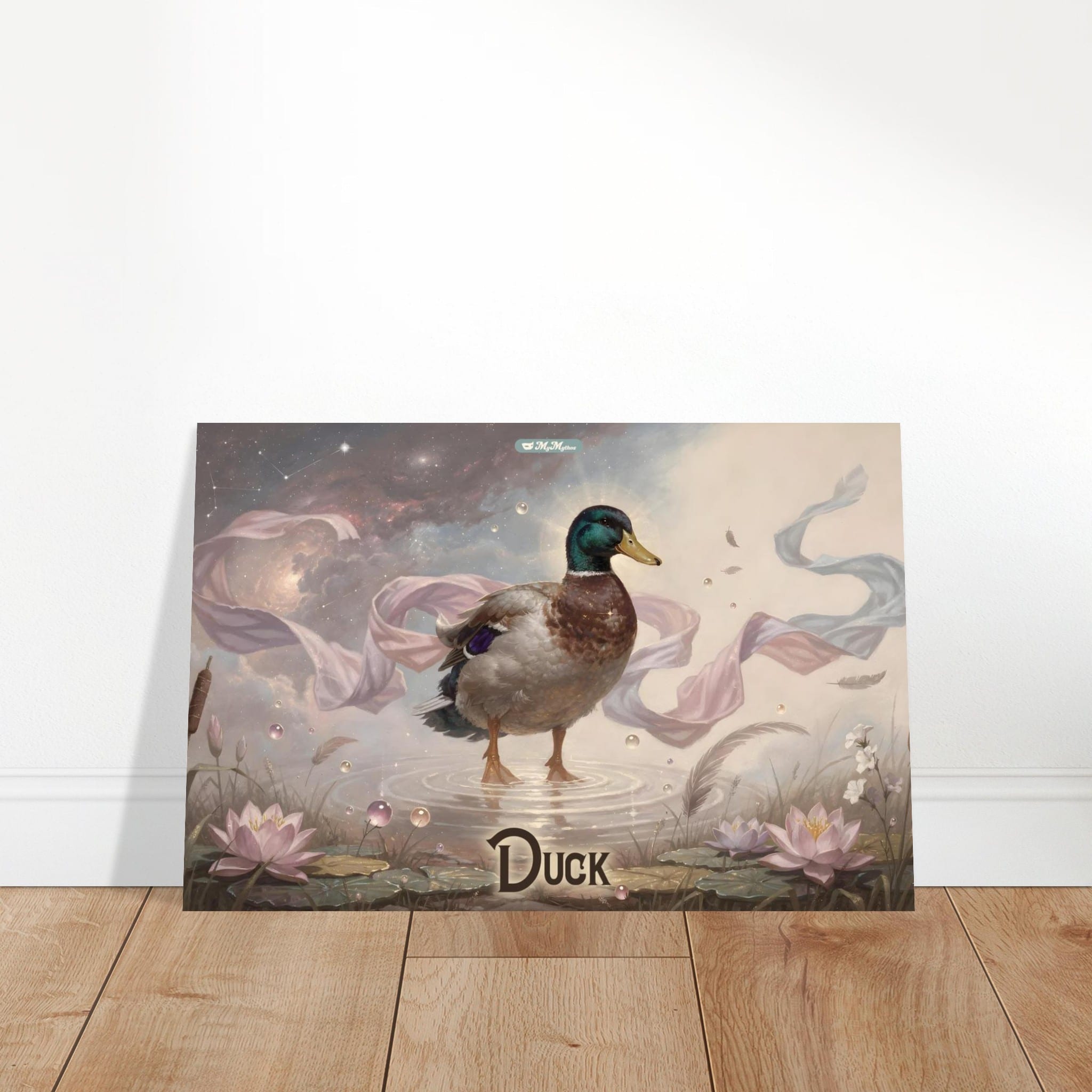
On your wall
Material
Sale! Was $19.00, now $14.25
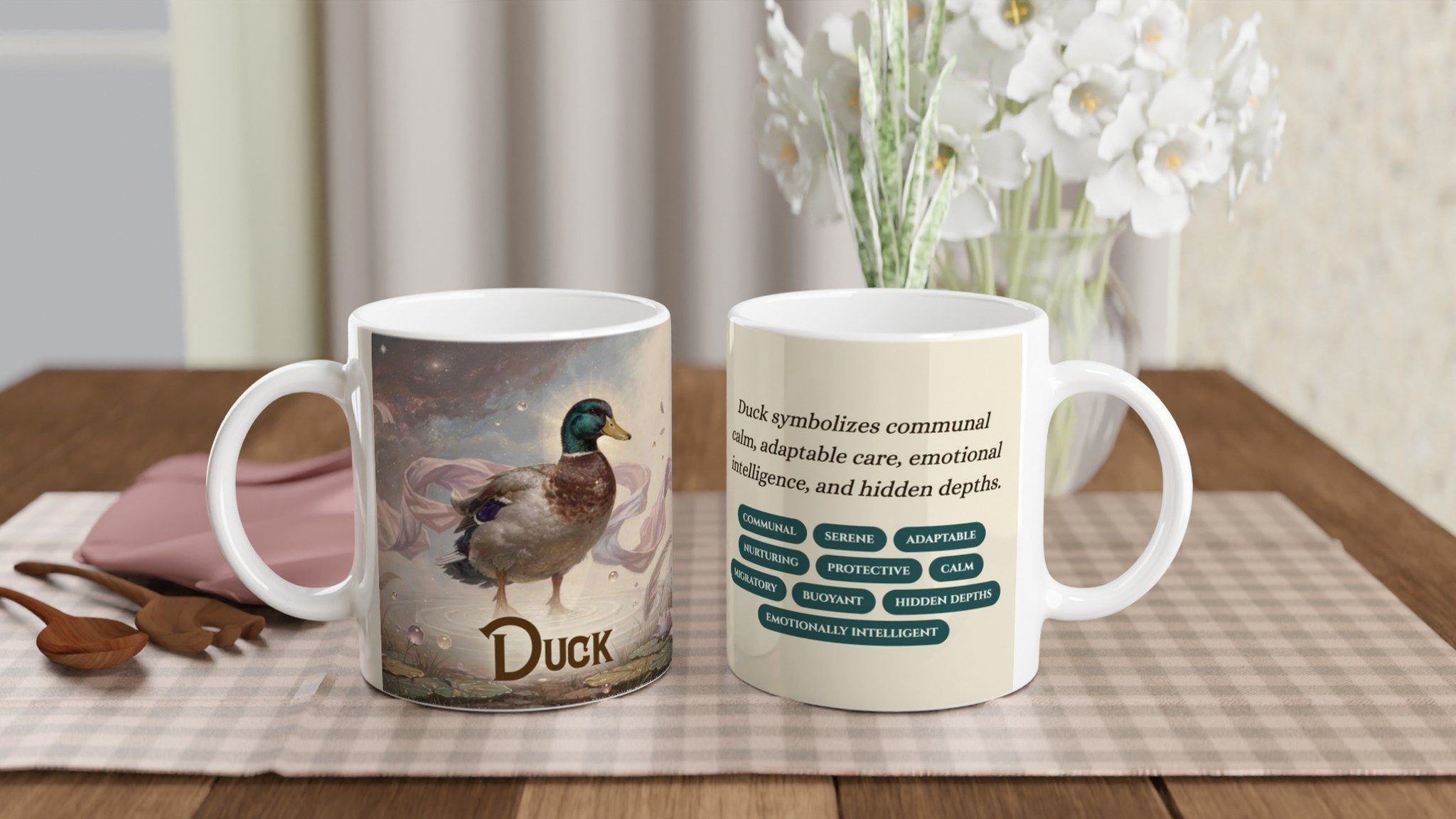
In your hands
Size
Color: White
Sale! Was $18.00, now $13.50
From elsewhere
Paid links: if you buy through these, MyMythos earns a small commission at no cost to you.