

An owl is a nocturnal bird of prey with forward-facing eyes, a flat face and silent flight, found on every continent except Antarctica. Owl symbolizes watchfulness, hidden knowledge, patient timing, and the courage to see clearly in the dark.
The Symbolism & Meaning of Owl
Owl's meaning begins with a practical advantage that looks almost supernatural from a human bedroom. Its feather edges reduce the sound of flight. Its facial disk gathers sound, and offset ear openings help locate a 
That makes Owl a symbol of observation, but not passive observation. The bird waits because waiting improves the hunt. It does not spend the night admiring ambiguity. It listens, measures, and commits. Its patience has teeth. When Owl is part of your mythos, the symbol can point toward a life in which you notice the overlooked detail, keep your distance long enough to understand a pattern, and refuse the pressure to perform certainty before you have earned it.
Owl also carries the meaning of solitude. Most owls hunt alone, and many defend a territory rather than moving through a permanent social group. Their independence is not a rejection staged for an audience. It is an arrangement that suits the work. This gives the archetype a particular kind of privacy. You may need rooms where nobody asks you to translate every thought in real time. You may be drawn to the edge of gatherings, where faces, pauses, and changes in tone remain easier to read.
The whispers of the night hold truths the sun forgets.
The bird's nocturnal life adds mystery, but mystery here is not mere decoration. An owl operates when human attention is reduced, when roads empty and familiar places acquire unfamiliar sounds. It becomes a figure for the information available in the hours others avoid: grief, dreams, secrecy, instinct, and the knowledge that arrives after the official story has gone to bed. Owl does not make darkness good or bad. It makes darkness legible.
In myth, that double meaning remains intact. Athena's owl made clear sight a civic virtue, while Roman and European traditions could treat the same cry as a death omen. The Hindu association with 
Its wisdom is therefore cool rather than warm. Owl may understand a situation without rushing to comfort everyone inside it. That detachment can preserve judgment when panic wants a witness and a crowd wants agreement. It can also make a person seem remote, especially when they keep observing after others have decided. The strongest Owl meaning is not cleverness. It is the disciplined union of silence, sensory attention, timing, and a willingness to act once the dark has finally supplied enough evidence.
Owl as a Spirit Animal, Totem & Power Animal
When Owl arrives as a spirit animal, totem, or power animal, it often appears during a passage when ordinary explanations have stopped holding. You may notice owls in books, dreams, calls outside the house, or images that keep returning without your having searched for them. The encounter does not need to be a supernatural appointment to matter. Attention has selected a shape, and that shape has begun to organize what you are living through. Owl comes when the unseen part of a situation needs a witness.
To carry Owl is to have a particular relationship with information. You may catch the pause before a person answers, hear strain beneath a casual sentence, or notice the one fact a group has agreed to ignore. This sensitivity can be useful in research, counseling, investigation, art, caregiving, and any work that depends on signals too quiet for a hurried mind. Owl power is not omniscience. The bird still misses prey, and you can still mistake anxiety for intuition. Its strength lies in making room between noticing and concluding.
Owl asks you to become comfortable with an unusual schedule of understanding. Some truths arrive late. A conversation may make sense three days afterward. A loss may reveal its shape only when the house is quiet. A decision may need a night in which you do nothing except listen. Carrying this archetype means allowing delayed clarity without turning delay into avoidance. The owl waits for the mouse to move; it does not wait forever.
As a totem, Owl can describe a family or community identity built around watchfulness. Someone may be the person who checks the locks, remembers the old story, spots the change in weather, or knows which visitor has entered by the sound of a 
As a power animal, Owl is especially useful when secrecy, transition, or conflicting accounts make direct action foolish. It lends the courage to enter an unfamiliar interior landscape without demanding immediate brightness. You can ask what is hidden, who benefits from the confusion, and what evidence would change your mind. The archetype does not ask you to become suspicious of everyone. It asks you to distinguish a quiet signal from a loud performance.
Its 
Which of these is also you?
Collect 8 to make a mythos.
0 of 8
These archetypes were chosen because you are reading about Owl.
Owl in Mythology & Folklore: Where the Symbolism Comes From
In ancient Greece, the little owl was linked to 

Roman writers inherited that association and gave the owl a less comfortable place in public life. An owl calling near a house or temple could signal death or disaster. Ovid describes owls as ill omens, and Roman authorities sometimes performed purification rites after one entered a sacred building. The same night vision that made the owl a 
In parts of South Asia, owl traditions also split sharply. Lakshmi, the Hindu goddess of wealth and prosperity, is often shown with an owl named Uluka as her vehicle. The 
In Japanese folklore, the owl is called fukurō, a name that can be heard as a phrase for protection from hardship or as luck that does not come. This wordplay has made owl images popular as charms and decorations. The association rests less on a single myth than on language, sound, and the bird's reputation for watchfulness. In Ainu tradition, the Blakiston's fish owl, kotan-kor-kamuy, was regarded as a spirit connected with the 
Across parts of Africa, owls have often been approached with caution. In some communities they are associated with witches, death, or messages from the unseen world. Those meanings do not arise from a single African belief, and they vary by people and region, but they share a recognizable fact: the owl arrives silently, sees at night, and hunts creatures that humans barely notice. In Britain and Ireland, older rural beliefs likewise treated an owl's cry near a sickroom as a death omen, while other traditions valued the bird for controlling vermin. Owl lore keeps returning to the same contradiction. It is useful because it sees and hunts in darkness, and frightening for exactly the same reason.




Owl and Its Relationships With Other Archetypes
Athena
“Athena kept me close, and Athens stamped my face on its silver coins.”
The little owl was the bird of Athena, goddess of wisdom, and it appeared on the silver tetradrachms of Athens for centuries, so often that people called the coins owls. The pair makes Owl the emblem of a mind that watches before it speaks, and a person who carries both is trusted for judgment more than cleverness.
Visit Athena
Dusk
“A philosopher wrote that wisdom, like me, only takes flight once the day is done.”
Hegel wrote that the owl of Minerva spreads its wings only as dusk falls, meaning that understanding comes after events, not during them. Dusk names Owl's timing, the patience of someone who waits until the noise is over before deciding what it meant.
Visit Dusk
An Owl Calling at Night
“Shakespeare had me hooting in the Roman marketplace at noon, one of the signs before Caesar fell.”
Romans treated an owl's call as an omen of death, and in Julius Caesar Shakespeare lists the bird of night sitting in the marketplace at noon among the portents before the murder. An Owl Calling at Night shows the fear Owl carries in folklore, which is often just the fear of hearing something true in the dark.
Visit An Owl Calling at NightMouse
“I swallow Mouse whole and later cough up a neat pellet of its fur and bones.”
Owls often swallow small prey whole and bring up the indigestible fur and bones as pellets, which scientists collect to learn what lives in an area. Mouse is the small life Owl's silent flight and keen hearing were made for, and the pair is a frank reminder that seeing clearly in the dark is also a way of hunting.
Visit Mouse
Lilith
“Where Isaiah's Hebrew names Lilith among the ruins, King James's translators wrote my name instead.”
Isaiah 34 names lilith among the creatures haunting ruined Edom, and the King James Bible rendered the word as screech owl, while later translations say night hag or keep the name Lilith. Lilith gives Owl its oldest dark reputation, a night presence in abandoned places that people feared because it would not be tamed.
Visit Lilith
Owl also keeps company with the Roman tradition: Bay Laurel, Golden Eagle, Laurel, Pomona, Scales of Justice and Volcano, among forty-six others of the Roman tradition.

Owl in Dreams: Meaning & Interpretation
Dreaming of an owl often brings attention to something you can sense but have not yet named. The bird does not need to explain the dark; it works inside it, turning its head, listening for movement, and waiting until a small sound reveals a position. Your dream may be giving shape to quiet perception, especially when waking life has become crowded with confident opinions. It can also mark a need for distance. An owl does not join the flock because the flock is nervous.
The dream is doing more than handing you a symbol. It is changing the pace of attention. Instead of demanding an immediate answer, it asks what becomes visible when you stop defending your first impression. The emotional tone matters. A calm owl may make room for private knowledge, while a threatening one may show that something hidden has begun to feel predatory. The dream does not promise that every intuition is correct. It invites you to test what you notice before you act.
An owl perched quietly beside a window suggests that a private truth is near the edge of awareness, visible but not yet entered. If its eyes feel calm, the dream may welcome solitude and careful observation rather than social performance.
An owl swooping toward you can warn that something ignored has acquired teeth. An owl calling from a dark house may bring grief, suspicion, or a message your waking mind has postponed, while an owl flying freely over open land can show perception becoming less frightened of what it sees.
Owl: Positive & Negative Meanings
Positive Meanings
- Notices what others overlook
- Waits for reliable evidence
- Keeps a steady head in uncertainty
- Protects privacy and independent thought
- Reads subtle changes in people and places
- Acts with precise timing
- Can remain calm in darkness
Negative Meanings
- May become suspicious without evidence
- Can seem cold or unreachable
- Risks mistaking isolation for wisdom
- Overanalyzes after the useful moment passes
- May use insight to expose or wound
- Finds it difficult to trust the group
- Can confuse fear with intuition

The Shadow of Owl
The Shadow of Owl begins when watchfulness stops serving perception and starts feeding fear. A person carrying this pattern may read every pause as evidence, every closed door as a plot, every private conversation as a threat. The owl's genuine ability to detect small movements becomes a nervous system that cannot stop hunting. Silence no longer restores attention. It becomes a room where suspicion echoes.
Detachment can sour in the same way. Owl knows how to remain outside the crowd long enough to see its shape, but the shadow may decide that belonging is proof of stupidity. The person keeps their feelings behind glass, then calls the glass wisdom. They may offer accurate observations without offering warmth, or use a reputation for insight to avoid being questioned themselves. Seeing others clearly is not the same as allowing oneself to be seen.
Another shadow is nocturnal rumination. The mind becomes most active when the house is dark, returning to old conversations and inventing improved versions of every response. Since Owl is associated with hidden knowledge, the person may believe that one more night of analysis will produce certainty. Instead, the hunt circles its own tracks. Patience has become postponement, and intuition has become an excuse not to choose.
The predatory side also deserves honesty. Owl does not merely observe prey; it kills to live. In human behavior, that can appear as a cool instinct for finding weakness, exposing hypocrisy, or timing a remark where it will do the most damage. The remedy is not to become bluntly open or endlessly social. It is to ask whether the information is being used to protect life, clarify a decision, or win power. A clear eye without a responsible hand is only a sharper weapon.
How Did You End Up at Owl?
Who did you watch sit awake while everyone else slept, noticing the smallest movement before you had a name for your own watchfulness?
Where are you still scanning the dark from a high, quiet place, even though the danger has moved on and no one needs guarding now?
Which night, silence, or sudden revelation taught you that seeing everything first was safer than being seen at all?
Who benefits now from your patient, owl-like distance, receiving your warnings and clear sight while you remain outside the circle?
The Owl Hearth
Find Your Owl People
If Owl has ever turned up in your life, in a dream, a moment, a person, you are not the only one. Its people are gathering, and the first stories haven’t been told yet.
Joining is free: put Owl on your page, then press Join.

Talk to Warren about Owl
I have known a good many people who were followed by Owl. Tell me how it came into your life, and I will ask the question that takes you one step further back.

 Written by Warren,
for you alone
A reading by Warren
What Owl means for you
This page says what Owl means. Warren can tell you why it is showing up for you, now.
Owl: Frequently Asked Questions
- What does Owl symbolize?
- Owl's meaning begins with a practical advantage that looks almost supernatural from a human bedroom. Its feather edges reduce the sound of flight.
- What is the spiritual meaning of Owl?
- When Owl arrives as a spirit animal, totem, or power animal, it often appears during a passage when ordinary explanations have stopped holding. You may notice owls in books, dreams, calls outside the house, or images that keep returning without your having searched for them.
- What does Owl represent?
- In ancient Greece, the little owl was linked to Athena, goddess of wisdom, strategy, and crafts. The owl appeared on Athenian coins and became a sign of the city itself.
- What does it mean to dream about Owl?
- Dreaming of an owl often brings attention to something you can sense but have not yet named. The bird does not need to explain the dark; it works inside it, turning its head, listening for movement, and waiting until a small sound reveals a position.
- What is the shadow side of Owl?
- The Shadow of Owl begins when watchfulness stops serving perception and starts feeding fear. A person carrying this pattern may read every pause as evidence, every closed door as a plot, every private conversation as a threat.
- What are the positive and negative meanings of Owl?
- Notices what others overlook. May become suspicious without evidence.
- What does an Owl tattoo mean?
- Often, an Owl tattoo marks a bond with solitude, night, or hard-won clarity. Some wear it to honor a watchful ancestor or a season of seeing through confusion. Others choose the bird because its stillness feels more honest than loud declarations.
Characteristics of Owl
- Color:
- brown, gray
- Marking:
- mottled
- Covering:
- feathered
- Form:
- winged
- Size:
- small
- Kind:
- bird
- Diet:
- carnivore
- Active when:
- nocturnal
- Habitat:
- forest, city
- Element:
- air
- Tradition:
- Greek, Roman
An owl's body is built around locating prey without giving away its own position. Specialized flight feathers break up the sound of air, asymmetrical ears help triangulate movement, and the facial disk directs faint sounds inward. Many species can rotate the head far to either side because the eyes remain fixed in their sockets. The result is a predator that turns stillness into a sensory instrument, then crosses the last distance with startlingly little warning.
Get the next one
Essays on personal mythology, archetypes, and the stories we tell ourselves.
Take Owl home
Printed to order and shipped to you. Please allow a few extra days for production.
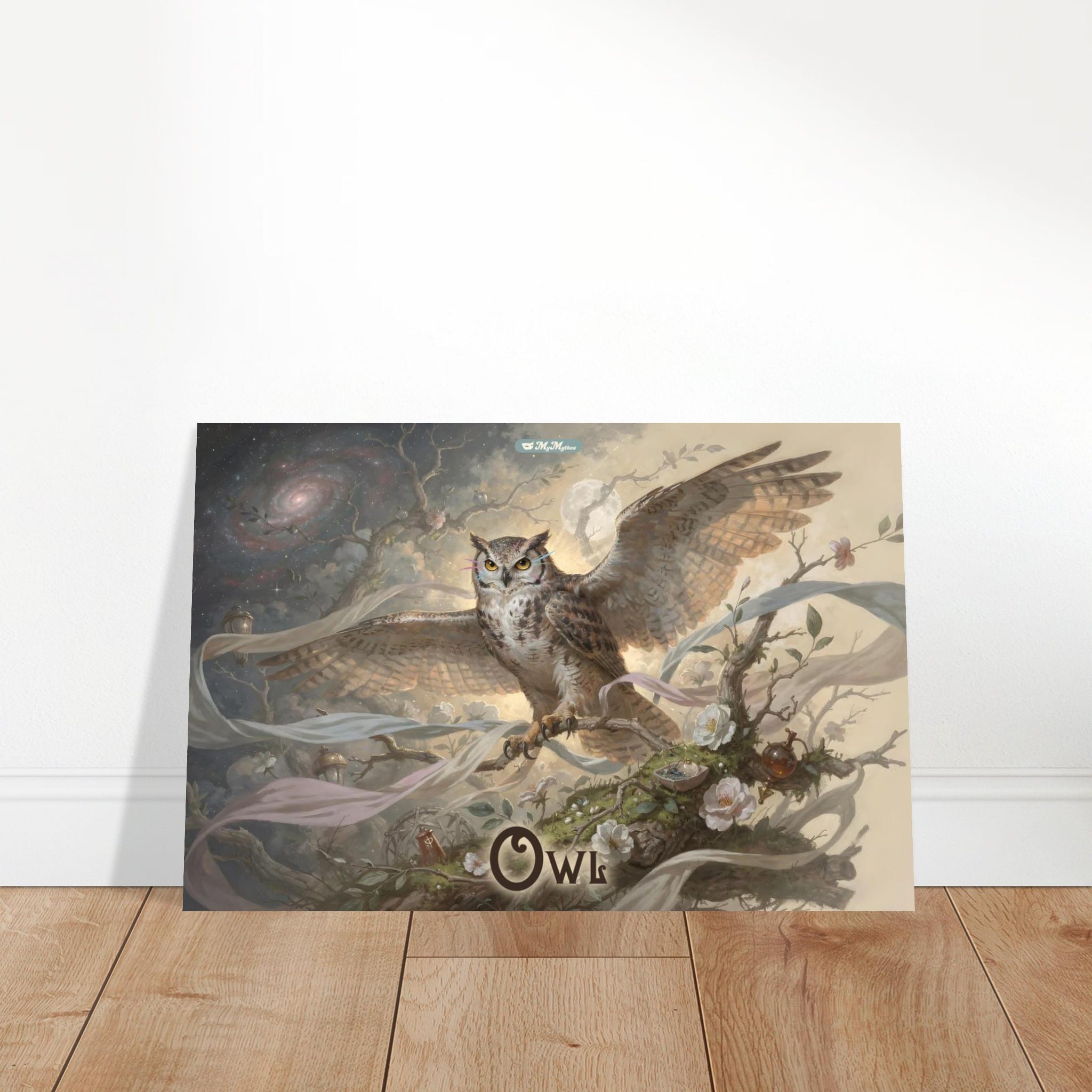
On your wall
Material
$19.00
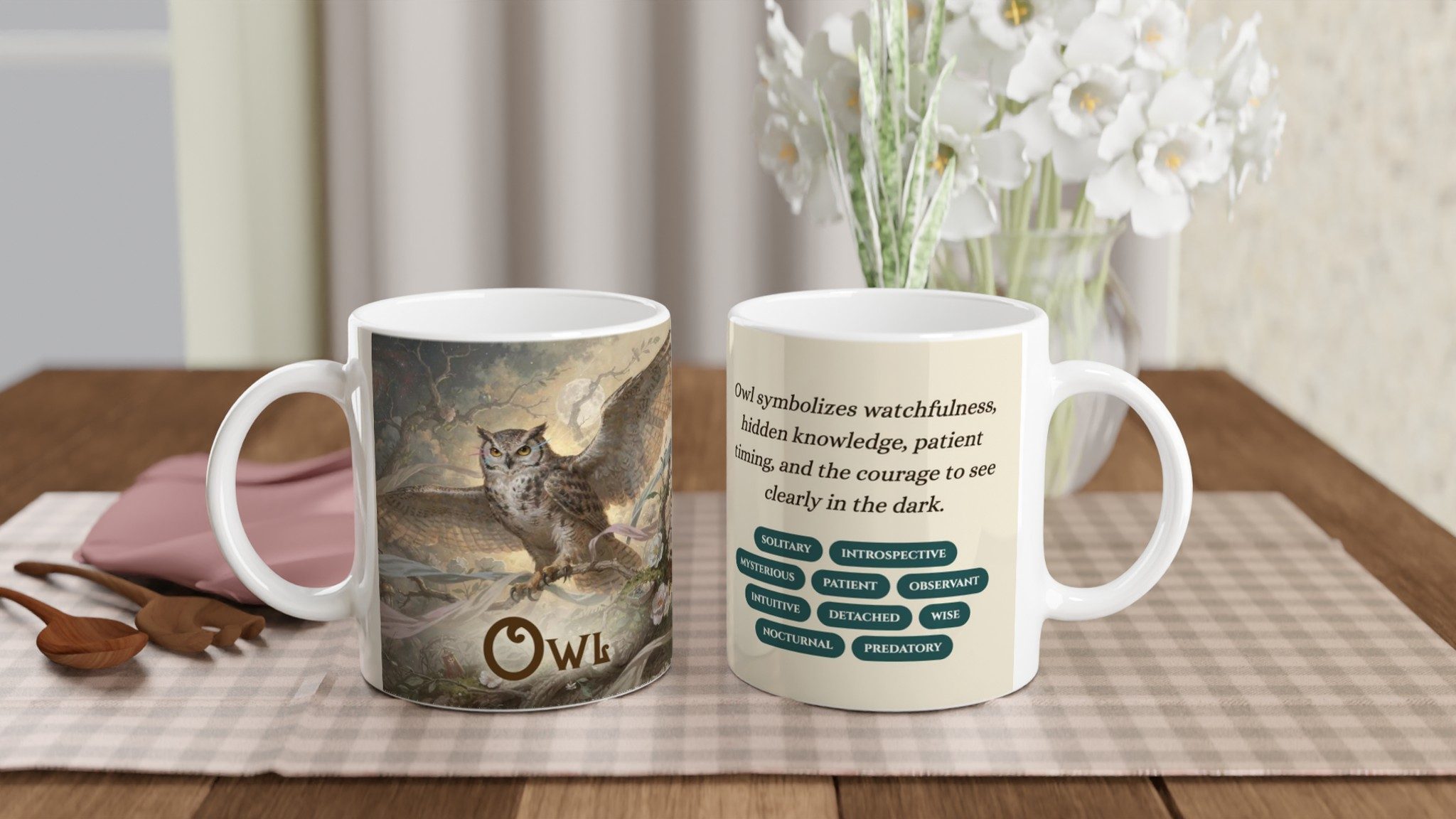
In your hands
Size
Color: White
$18.00
From elsewhere
Paid links: if you buy through these, MyMythos earns a small commission at no cost to you.