
Wolverine
Symbolism, Meaning & Spirit Animal
The wolverine is a stocky, powerful member of the weasel family that lives in cold northern forests and tundra and is known for scavenging and a fierce temperament. Wolverine symbolizes resilient self-protection, fierce independence, and the instinct to survive what others underestimate.
Encounters
Meet Wolverine inside a story
The Symbolism & Meaning of Wolverine
The wolverine means survival without polish. It does not win by looking imposing. A stocky animal roughly the size of a small dog can confront wolves at a carcass, drive other animals from food, and carry meat away for later. Its strength is not theatrical. It is the strength of a body arranged for leverage, persistence, and bad conditions.
That makes resilience the first current running through the archetype. The wolverine lives in cold forests and high country, travels across wide territories, and does not depend on one kind of meal. It hunts rodents and young animals, scavenges carrion, eats eggs and berries, and takes advantage of whatever winter has left exposed. Its adaptability is not a personality flourish. It is the practical intelligence of a creature that cannot afford a narrow menu.
The archetype also carries a hard-edged form of self-protection. Wolverines defend food with an aggression that seems disproportionate until the setting comes into view. A cached carcass may be the difference between making it through a lean stretch and not making it. The animal's threat display, powerful bite, and willingness to challenge larger competitors turn vulnerability into a difficult proposition. Wolverine symbolism therefore suits the person who has learned that access must be controlled, not merely requested.
I may heal fast, but the scars tell the real story. Live deep, fight hard, and don't be afraid to be alone with the truth.
Solitude belongs here, but not as a 
The old glutton stories add a warning. Appetite can become a reputation, and resourcefulness can look like greed to someone watching from the other side of the cache. Wolverine asks what you are storing, what you are guarding, and whether your defenses still match the danger. It does not demand softness, but it does distinguish protection from reflexive hostility.
As a personal myth, 
Wolverine as a Spirit Animal, Totem & Power Animal
When Wolverine arrives as your spirit animal, totem, or power animal, it tends to arrive through a situation that has made politeness inadequate. You may be asked to defend time, territory, family, work, or the last usable portion of your strength. The wolverine does not advise a grand entrance. It puts its paws on the ground and decides what must not be taken.
Having Wolverine as yours means carrying a form of power that is often misread. You may be smaller than the force opposing you, less decorated, less supported, or less willing to perform confidence for an audience. Still, you know how to make yourself costly to push aside. Your power comes from leverage, stamina, timing, and an accurate sense of what matters. A wolverine does not fight over every twig. It fights over food, young, and ground it has claimed.
This archetype asks you to become resourceful before you become impressive. Use the available meal. Repair the shelter. Learn the route through difficult country. Keep a reserve where careless hands cannot reach it. The wolverine's caches are part of its medicine, if that is the language your tradition uses: preparation made physical, hope stored under snow. A person carrying this archetype may keep skills, money, plans, or emotional energy in reserve until the season changes.
It also asks for a more honest relationship with solitude. You may need distance to hear your own instincts, and a crowd may not improve a decision simply because it is a crowd. Yet Wolverine is not an excuse to abandon every bond. Females raise kits through a long period of dependence, and the animal's solitary adult life does not erase its fierce investment in offspring. The archetype supports selective attachment, not permanent exile.
As a power animal, Wolverine can strengthen recovery after humiliation, exhaustion, betrayal, or displacement. It lends gruffness when explanation would only invite negotiation. It helps you meet an underestimated position without apologizing for the shape of your defense. It can also expose where survival habits have outlived the winter that formed them.
The mature expression is not constant combat. It is knowing when to leave, when to hide the remainder, when to share, and when to turn toward the larger animal that has mistaken your silence for surrender. Wolverine makes a person harder to consume. It should not make that person impossible to love.
Which of these is also you?
Collect 8 to make a mythos.
0 of 8
These archetypes were chosen because you are reading about Wolverine.
Wolverine in Mythology & Folklore: Where the Symbolism Comes From
The wolverine's folklore begins with its names. In Scandinavia, the animal is the glutton, järv in Swedish and ahma in Finnish, a name tied to an old reputation for eating beyond reason. Stories say it gorges on a kill, then squeezes between two trees to empty its stomach and return for more. The tale is biologically wrong, but its mistake is revealing: an animal that can drive larger predators from food became, in imagination, appetite with legs. In some northern European accounts, the wolverine's greed made it a nuisance, a creature whose cleverness served only itself.
That reading is not the only one. Among several Indigenous peoples of the North American subarctic, wolverine appears in local story traditions as a 
In other northern traditions, that same behavior can read less as wickedness than as competence. A small animal living among wolves, bears, and deep winter must find food where it can and defend it with unusual nerve. A 
European natural history helped fix the creature's reputation as a glutton, while North American observers often emphasized its strength, persistence, and ability to travel across harsh terrain. The scientific name Gulo gulo preserves the old appetite story. Yet the wolverine is not simply a hungry beast. It eats small mammals, birds, eggs, carrion, and whatever larger prey it can exploit; in lean country, flexibility is not indulgence but method.
Modern folklore has added the wolverine as a symbol of remote wilderness and stubborn resistance, especially in northern communities where its tracks mark enormous territories and its presence remains difficult to see. The tradition keeps circling the same evidence. The wolverine takes what it can, hides what it cannot finish, travels alone, and refuses to surrender a meal easily. Whether a culture calls that greed, trickery, or tenacity depends on where the listener stands when the animal arrives.




Wolverine and Its Relationships With Other Archetypes

Badger
“Badger is my weasel cousin; I am the largest of our family that lives on land.”
Wolverines and badgers both belong to the weasel family, and the wolverine is its largest land-dwelling member, with a reputation for ferocity far beyond its size. The pair shows the stubborn courage of small fighters, and a person carrying both does not back away from something larger.
Visit Badger
Caribou
“In deep snow I can bring down a caribou many times my weight.”
Wolverines mostly scavenge, but in deep snow their wide paws let them run where caribou flounder, and they occasionally kill animals far larger than themselves. Caribou beside Wolverine is a lesson in conditions, showing how the right ground can turn the smaller one into the stronger.
Visit Caribou
Glacier
“One of us climbed a mountain in Glacier National Park, nearly a mile up in ninety minutes.”
Biologists tracking a male wolverine in Montana's Glacier National Park recorded him climbing almost 5,000 feet up Mount Cleveland in about an hour and a half, through snow and over rock. Glacier is the high, cold country wolverines depend on, and the pair speaks to a person built for terrain that turns others back.
Visit Glacier
Cold
“Frost does not stick to my fur, so northern people trimmed their hoods with it.”
Wolverine fur sheds frost and breath-ice more readily than most furs, which is why it has long been prized for parka hoods in the Arctic. Cold beside Wolverine is hardship met with the right equipment, a person who has made themselves at home where comfort is scarce.
Visit Cold
Hero
“A comic book borrowed my name for a short, scarred hero who heals and keeps fighting.”
Marvel's Wolverine first appeared in 1974 and became one of its best-known heroes, a fierce loner with a healing power and a hard temper. Hero beside Wolverine is toughness turned toward protecting others, and the pair warns that endurance can harden into never letting anyone help.
Visit Hero
Wolverine also keeps company with the mountain: Beast, Chimera, Golden Eagle, Mule, Rosemary and White Eagle, among seventy-nine others of the mountain.

Wolverine in Dreams: Meaning & Interpretation
Dreaming of a wolverine often brings the question of what you are defending before it brings a clear answer. The animal may appear when your boundaries have become porous, when someone treats your reserves as public property, or when you have mistaken solitude for failure. Because wolverines range widely and use many kinds of food, the dream can also point to a life assembled from scraps, improvisations, and resources other people overlooked.
The dream is doing more than displaying aggression. It is testing whether you can recognize a real threat without turning every inconvenience into one. A wolverine at a carcass may ask who has earned access to your energy. One crossing snow alone may show that distance can be a form of orientation, not exile. The animal's appearance can restore a rough, practical intelligence: eat, hide what remains, keep moving, and let your actions make the explanation.
A wolverine guarding a buried cache suggests a reserve of time, money, affection, or skill that you have protected well. If it lets you approach, the dream may welcome careful trust; if it charges, someone may be reaching past a boundary you have never stated aloud.
A wolverine crossing a frozen valley warns of endurance without applause. A wolverine feeding peacefully can mark permission to use what is available instead of waiting for ideal conditions. A wounded wolverine that keeps walking may reflect recovery already underway, while a wolverine trapped in a cage points to fierce instincts confined by someone else's definition of acceptable behavior.
Wolverine: Positive & Negative Meanings
Positive Meanings
- Resilient under pressure and prolonged hardship
- Protective of people, resources, and hard-won boundaries
- Resourceful when ordinary options disappear
- Fierce enough to challenge larger forces
- Adaptable across changing conditions
- Comfortable working without applause
Negative Meanings
- Can mistake closeness for danger
- May hoard resources long after scarcity ends
- Often appears gruff, hostile, or inaccessible
- Can turn self-protection into isolation
- May fight simply because retreat feels humiliating
- Risks becoming proud of being misunderstood

The Shadow of Wolverine
The shadow of Wolverine begins where protection stops listening. A person carrying it may treat every request as an attempt to take, every question as a trap, and every relationship as a contest over access. The food cache becomes a locked room. Solitude, once useful, hardens into contempt for anyone who cannot survive without help.
The animal's reputation for gluttony gives this shadow a particular appetite. It can hoard time, attention, money, knowledge, or resentment, then call the collection preparedness. It may keep returning to an old injury because the wound still supplies a reason to bare its teeth. A person can become proud of being misunderstood and start correcting anyone who understands them.
Wolverine shadow energy also confuses fierceness with volume. It picks fights with larger forces not because the ground truly matters, but because retreat feels like the old humiliation. Its gruffness becomes cruelty. Its independence makes dependents feel punished for needing care. Its sharp instincts find danger everywhere, and its adaptability turns into shapelessness, changing loyalties whenever pressure rises.
The corrective is not domestication. It is discrimination. A cache needs protection, but food is meant to sustain life rather than prove ownership. A range needs boundaries, but no creature can occupy every horizon. The shadow loosens when the person can name the actual threat, share from genuine abundance, and discover that lowering the jaw is sometimes a more intelligent use of strength than closing it.
How Did You End Up at Wolverine?
What were you keeping safe from when you learned to circle the food cache alone, and is that threat still moving somewhere beyond the trees?
What verdict did you reach about yourself after one hard winter, and how long have you let that old hunger go untested?
Who watched you bare your teeth at the wrong danger, then called you difficult instead of asking what had cornered you?
Who benefits now from your wide solitary range, your gruff silence, and the fact that you still guard provisions no one else had to earn?
The Wolverine Hearth
Find Your Wolverine People
If Wolverine has ever turned up in your life, in a dream, a moment, a person, you are not the only one. Its people are gathering, and the first stories haven’t been told yet.
Joining is free: put Wolverine on your page, then press Join.

Talk to Warren about Wolverine
I have known a good many people who were followed by Wolverine. Tell me how it came into your life, and I will ask the question that takes you one step further back.
 Written by Warren,
for you alone
A reading by Warren
What Wolverine means for you
This page says what Wolverine means. Warren can tell you why it is showing up for you, now.
Wolverine: Frequently Asked Questions
- What does Wolverine symbolize?
- The wolverine means survival without polish. It does not win by looking imposing.
- What is the spiritual meaning of Wolverine?
- When Wolverine arrives as your spirit animal, totem, or power animal, it tends to arrive through a situation that has made politeness inadequate. You may be asked to defend time, territory, family, work, or the last usable portion of your strength.
- What does Wolverine represent?
- The wolverine's folklore begins with its names. In Scandinavia, the animal is the glutton, järv in Swedish and ahma in Finnish, a name tied to an old reputation for eating beyond reason.
- What does it mean to dream about Wolverine?
- Dreaming of a wolverine often brings the question of what you are defending before it brings a clear answer. The animal may appear when your boundaries have become porous, when someone treats your reserves as public property, or when you have mistaken solitude for failure.
- What is the shadow side of Wolverine?
- The shadow of Wolverine begins where protection stops listening. A person carrying it may treat every request as an attempt to take, every question as a trap, and every relationship as a contest over access.
- What are the positive and negative meanings of Wolverine?
- Resilient under pressure and prolonged hardship. Can mistake closeness for danger.
- What does a Wolverine tattoo mean?
- Often, a person wears a wolverine to mark survival through an ugly season. Some choose it for fierce privacy or a refusal to be underestimated. Others use the animal to honor a northern place, a family story, or the satisfaction of keeping their own counsel.
Characteristics of Wolverine
- Color:
- brown, black
- Marking:
- patched
- Covering:
- furry
- Form:
- four-legged
- Size:
- small
- Kind:
- mammal
- Diet:
- omnivore
- Active when:
- cathemeral
- Habitat:
- forest, mountain
- Element:
- earth
The wolverine's body is built for leverage rather than elegance. Broad paws spread over snow, powerful jaws open frozen food, and loose skin makes it difficult for a predator to hold the animal by the neck. Its movement covers surprising distances, and its scent-marked range can be enormous. Most surprising is the combination of opportunism and memory: it hunts, scavenges, and stores food, then returns to hidden provisions when winter makes every meal uncertain.
Get the next one
Essays on personal mythology, archetypes, and the stories we tell ourselves.
Take Wolverine home
Printed to order and shipped to you. Please allow a few extra days for production.
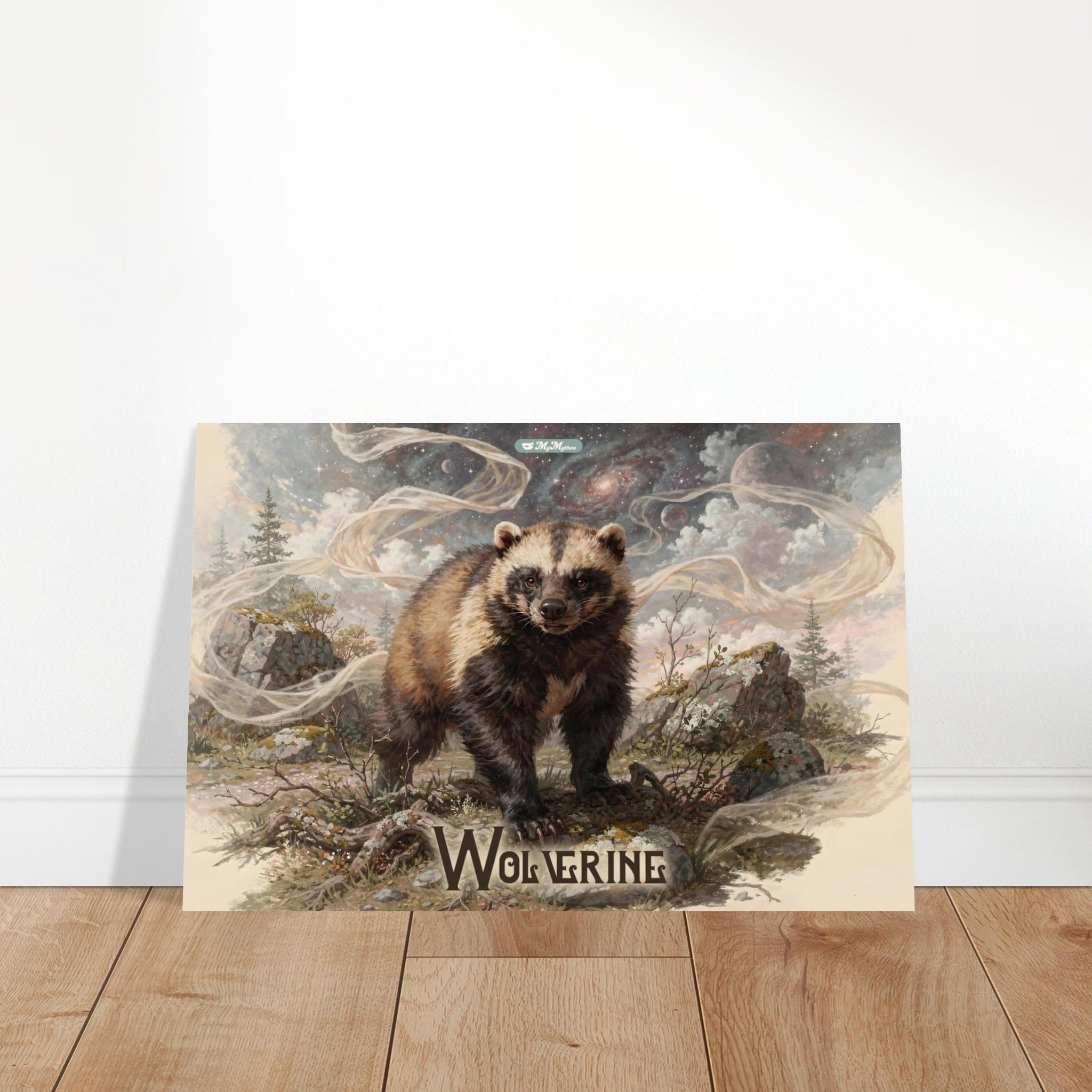
On your wall
Material
$19.00
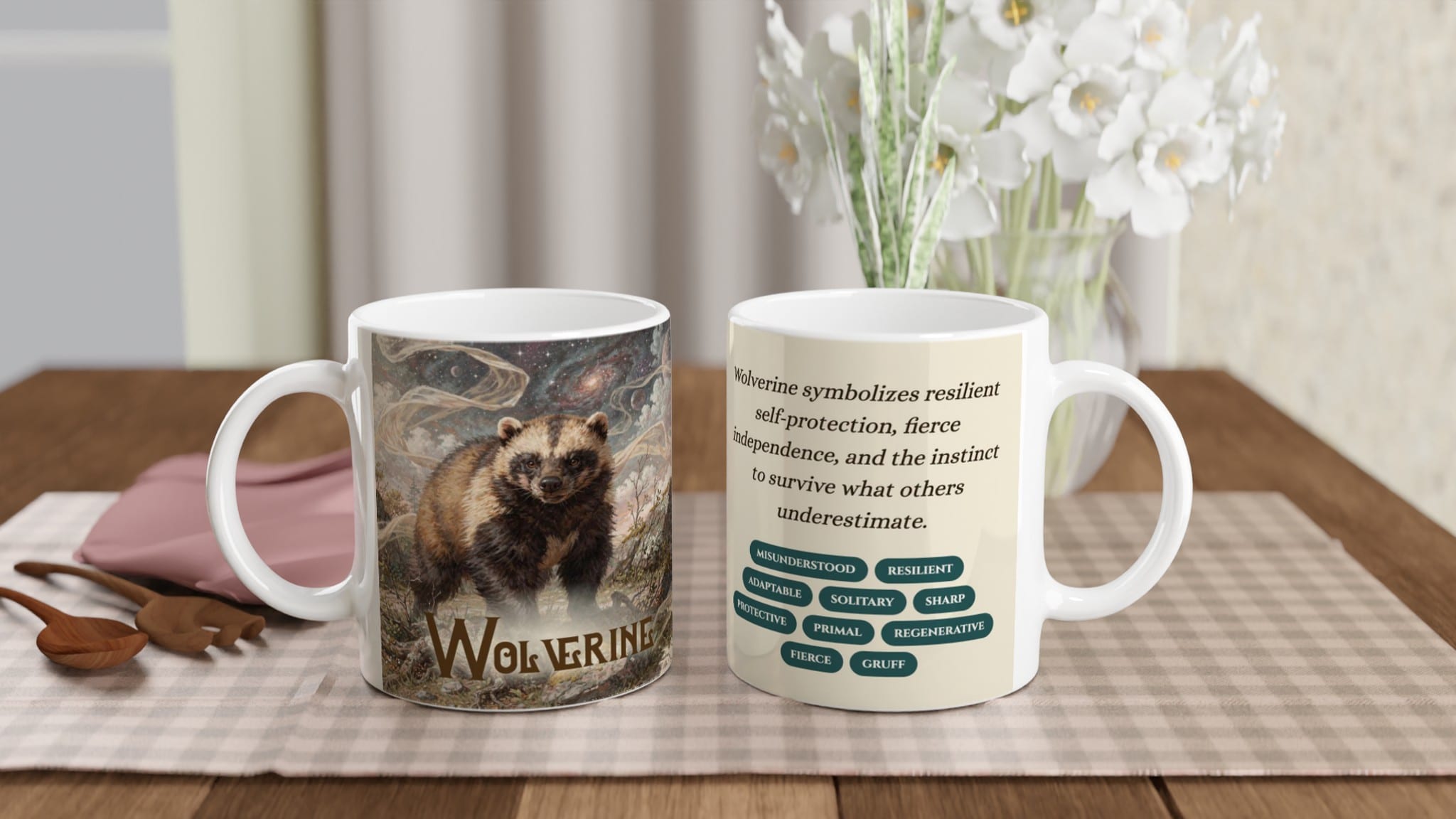
In your hands
Size
Color: White
$18.00
From elsewhere
Paid links: if you buy through these, MyMythos earns a small commission at no cost to you.