
Tomcat
Symbolism, Meaning & Spirit Animal
A tomcat is an adult male domestic cat, especially one that has not been neutered and roams widely. Tomcat symbolizes independence, guarded desire, territorial courage, and the freedom to move by instinct.
The Symbolism & Meaning of Tomcat
A tomcat does not ask permission to possess a life. He enters a yard, reads the smells on the fence, and decides whether the place is worth another visit. He may live beside people for years while keeping a private route through alleys, gardens, roofs, and moonlit gaps. That behavior gives the archetype its first meaning: independence that is not a performance. It is the ability to remain connected without handing over the keys.
His territory is written in scent, scratches, posture, and repeated patrol. The mark is not a speech about ownership. It is information left where another animal can read it. The person carrying Tomcat may therefore treat boundaries as practical things rather than emotional declarations. A room, a schedule, a friendship, or a body can have an edge. The edge need not be defended loudly to be real.
The tomcat's hunting gives the symbol a different texture from simple confidence. He does not chase every movement. He crouches, waits, adjusts his angle, and spends energy only when the distance is right. His curiosity is physical and investigative. A new smell can lead him under a shed; a flicker behind grass can hold his whole attention. This makes Tomcat a symbol of selective action, the kind that looks lazy to people who mistake motion for purpose.
Walk your own path. Curiosity is your compass. The night is your kingdom.
He is also sensual in a 
The archetype carries aloofness because the tomcat can leave. That departure is not always cruel, and it is not always wise. It means that attachment must survive the fact of another creature's freedom. His charm comes from this refusal to overexplain himself. He is interesting because he has an interior life no one can fully inspect.
Tomcat symbolism is therefore less about domination than self-possession. It honors the person who can be warm without becoming available to everyone, watchful without becoming frozen, and stealthy without confusing secrecy with truth. The dark street, the marked fence, and the quiet return all belong to one image: a life that keeps its own address.
Tomcat as a Spirit Animal, Totem & Power Animal
When Tomcat is your spirit animal, totem, or power animal, independence becomes a living practice rather than a slogan. You notice the door, the exit, the smell of a room, and the person who has begun treating your welcome as permanent access. You are not required to make yourself mysterious, but you may find that your strength grows when you stop narrating every movement. The tomcat leaves some roads unreported because a private life needs unreported roads.
As a totem, Tomcat often arrives around questions of territory and belonging. You may be learning to make a home that does not depend on approval, or to leave a place whose safety has become a form of confinement. The animal's own behavior gives the instruction its shape. He patrols, marks, rests, hunts, and returns. He does not spend the whole night defending the fence. He knows that vigilance without sleep makes a poor guardian.
As a power animal, Tomcat is especially useful when you must move through a social world without becoming absorbed by it. His stealth is not invisibility. It is controlled attention. He hears a small change, watches from cover, and acts before the room understands what shifted. This can help you in negotiations, creative work, recovery, and any situation where premature disclosure would scatter your strength. It also asks you to distinguish instinct from suspicion. A cat can detect a threat, but a frightened cat can treat every unfamiliar hand as one.
The archetype may come through a real male cat, a recurring dream, a black shape crossing a familiar street, or a period when solitude suddenly feels nourishing instead of punitive. It may appear after a move, a 

Carrying Tomcat means honoring desire without making every desire a command. It means keeping a sensual relationship with the world: good food, warm fabric, clean air through an open window, the pleasure of a body that is not being hurried. It also means accepting that freedom can look impolite. Some people will call a boundary aloofness because they were enjoying the absence of one.
Tomcat asks for courage of a particular kind. Not the courage to stand in the center and win the room, but the courage to leave the room, take the long route home, and trust your senses enough to choose where you will return. The power lies in being difficult to capture without becoming impossible to love.
Which of these is also you?
Collect 8 to make a mythos.
0 of 8
These archetypes were chosen because you are reading about Tomcat.
Tomcat in Mythology & Folklore: Where the Symbolism Comes From
The tomcat is not one single creature in folklore so much as a male cat carrying the meanings assigned to cats, with his roaming, mating, fighting, and night work adding a sharper edge. In ancient Egypt, cats were associated with 
In medieval and early modern Europe, the same animal acquired darker company. Christian writers and later witch-hunting traditions often linked black cats with witches, night spirits, and bad luck. A stray male cat slipping along a roof could look like a familiar, a creature carrying messages between the domestic room and the dangerous dark outside it. In Scotland, the Cat Sìth was described as a large black cat with a white mark on its chest, sometimes treated as a fairy creature and sometimes as a witch in animal form. The Cat Sìth is not specifically an ordinary tomcat, but the image shows how a male or oversized cat could become a border creature, neither tame nor wholly wild.
In Japan, the bakeneko and nekomata traditions give cats supernatural force after long lives. A cat might grow a divided tail, walk upright, speak, dance, or manipulate the household dead. The nekomata was especially associated with an older cat whose tail split, and some stories made it dangerous to its owners. A tomcat's roaming independence fits this suspicion: the animal leaves at night, returns without an account of its travels, and seems perfectly content to keep certain matters private.
In parts of European folk belief, a cat crossing a path could bring either luck or trouble, depending on place and circumstance. Sailors sometimes valued ship's cats for controlling rats, while other traditions treated an unfamiliar cat as an omen. The contrast is useful. The cat protects food stores by hunting mice, yet its nocturnal movements and unreadable attention invite unease. The same stealth that makes it a good household guardian can make it look like a spy.
Folklore also preserves the tomcat's sexual reputation. In English and European speech, a tomcat can mean a sexually active or roaming man, an association drawn from the male cat's wandering, scent marking, and competition with other males. That reading is less flattering than Bastet's protection, but it comes from observable behavior. A free-ranging male may patrol a broad area, fight rivals, and seek several mates, while offering little domestic explanation for himself. Across these traditions, the tomcat stands at the threshold of the house: useful but not obedient, familiar but not fully possessed, affectionate when it chooses, and most legible after dark.




Tomcat and Its Relationships With Other Archetypes

Alley
“Alley is my patrol, and I walk it every night as if I own the deeds.”
Unneutered male cats often hold and patrol a territory much larger than a female's, marking it with scent. Alley and Tomcat together describe a person who moves by instinct and keeps a sharp sense of where their ground begins and ends.
Visit Alley
Rooftop
“From Rooftop I sing to the whole street, and the whole street complains.”
Tomcats are famous for loud nighttime yowling, much of it about rivals and mates. Rooftop and Tomcat together suit a person who is not shy about wanting things, and who has accepted that not everyone will enjoy hearing about it.
Visit Rooftop
Lion
“Lion and I both guard our ground and carry the scars of every rival.”
Male lions and tomcats both defend territory against other males, and both often wear torn ears and old scars from it. Lion and Tomcat together describe a person whose courage is tested in repeated small fights, not one grand battle.
Visit Lion
Desire
“Desire walks me out the door at dusk, and I come back at dawn.”
A tomcat's roaming is driven by the search for mates, which is why tomcats wander so far from home. Desire and Tomcat together suit a person who knows their wants plainly, and who guards them with the same independence they guard their freedom.
Visit Desire
Witch
“Witch and I were feared together, and in some places punished together.”
European folklore linked cats with witches as familiars, and black cats in particular were treated with suspicion during the witch trials. Witch and Tomcat together describe a person whose independence has been read as danger, and who keeps going their own way anyway.
Visit Witch
Tomcat also keeps company with the night: Barn Owl, Cockroach, Jackal, Mink, Porcupine and Toad, among eighty-two others that wake after dark.

Tomcat in Dreams: Meaning & Interpretation
Dreaming of a tomcat often brings private territory into view. The dream may be sorting out where you feel at home, who has entered without permission, or which desire you keep allowing to prowl around the edges of your waking life. A tomcat does not usually arrive as a symbol of group approval. He comes through the 
The dream may be doing practical emotional work. It can let you rehearse independence without making a public declaration, or give shape to suspicion that has not yet become an accusation. A relaxed tomcat may accompany a need for sensual pleasure, solitude, or a return to instinct. An injured, trapped, or hissing one can stage the strain of defending yourself too often. Details matter: a familiar cat asks about trust and belonging, while a stranger at the door asks what you are willing to let close.
A tomcat curled at your feet may welcome a period in which comfort does not require conversation, and the dream may be giving you permission to enjoy your own company without calling it loneliness.
A tomcat marking your room may warn that a boundary has become a battleground, while a tomcat trapped behind glass can point to a life that looks safe from outside but leaves instinct with nowhere to go.
A tomcat hunting successfully through a dark house may show private competence returning after a period of hesitation. A tomcat that vanishes when you reach for him may reflect desire kept alive by distance, or the fear that closeness will turn freedom into obligation.
Tomcat: Positive & Negative Meanings
Positive Meanings
- Independent without needing constant approval
- Observant, patient, and selective with energy
- Protective of home, body, and personal boundaries
- Adaptable in unfamiliar surroundings
- Sensual, curious, and alive to small pleasures
- Charming without forcing attention
- Stealthy in difficult social situations
Negative Meanings
- Can confuse privacy with emotional avoidance
- May treat closeness as a threat to freedom
- Territorial reactions can become possessive
- Roaming desire may disrupt stable commitments
- Aloofness can leave others guessing
- Curiosity can become suspicion or intrusion
- Independence may conceal an unmet need

The Shadow of Tomcat
The shadow of Tomcat begins where independence stops being chosen and starts being used as camouflage. A person may call every need a threat to freedom, then wonder why affection never survives the locked door. The tomcat's privacy can harden into secrecy, and his aloof charm can become a way to keep others guessing while he avoids being known.
Territorial instinct also has a darker household. A person carrying this shadow may treat ordinary disagreement as trespass, protect a schedule with more force than the situation deserves, or collect grievances like scent marks along a fence. He may return only when he wants warmth, food, admiration, or sex, leaving other people to interpret the silence. The roaming male cat is not a model of mutual responsibility simply because he is attractive at midnight.
The shadow can make danger seem more interesting than peace. A restless person may keep choosing unavailable lovers, unstable work, or secret competitions because calm feels like capture. Curiosity then becomes intrusion, sensuality becomes appetite without care, and stealth becomes manipulation. The problem is not that the person has claws. It is that everyone nearby must guess when they will appear.
Tomcat's correction is not obedience or constant openness. It is accuracy. A boundary should describe a real limit, not punish someone for wanting closeness. Solitude should restore the body, not provide a permanent alibi. When the person can say what he wants before disappearing, the archetype's freedom becomes clean again. The cat may still leave through the window, but the room no longer has to pretend it was never inhabited.
How Did You End Up at Tomcat?
What verdict did you reach about being a tomcat at the edge of the room, and when did you last test whether anyone truly meant to make you leave?
What threat were you guarding your territory from when you learned to slip out after dark, and is that danger still prowling around you now?
The Tomcat Hearth
Find Your Tomcat People
If Tomcat has ever turned up in your life, in a dream, a moment, a person, you are not the only one. Its people are gathering, and the first stories haven’t been told yet.
Joining is free: put Tomcat on your page, then press Join.

Talk to Warren about Tomcat
I have known a good many people who were followed by Tomcat. Tell me how it came into your life, and I will ask the question that takes you one step further back.

 Written by Warren,
for you alone
A reading by Warren
What Tomcat means for you
This page says what Tomcat means. Warren can tell you why it is showing up for you, now.
Tomcat: Frequently Asked Questions
- What does Tomcat symbolize?
- A tomcat does not ask permission to possess a life. He enters a yard, reads the smells on the fence, and decides whether the place is worth another visit.
- What is the spiritual meaning of Tomcat?
- When Tomcat is your spirit animal, totem, or power animal, independence becomes a living practice rather than a slogan. You notice the door, the exit, the smell of a room, and the person who has begun treating your welcome as permanent access.
- What does Tomcat represent?
- The tomcat is not one single creature in folklore so much as a male cat carrying the meanings assigned to cats, with his roaming, mating, fighting, and night work adding a sharper edge. In ancient Egypt, cats were associated with Bastet, a goddess of protection, fertility, music, and household life.
- What does it mean to dream about Tomcat?
- Dreaming of a tomcat often brings private territory into view. The dream may be sorting out where you feel at home, who has entered without permission, or which desire you keep allowing to prowl around the edges of your waking life.
- What is the shadow side of Tomcat?
- The shadow of Tomcat begins where independence stops being chosen and starts being used as camouflage. A person may call every need a threat to freedom, then wonder why affection never survives the locked door.
- What are the positive and negative meanings of Tomcat?
- Independent without needing constant approval. Can confuse privacy with emotional avoidance.
- What does a Tomcat tattoo mean?
- Often, a person wears a Tomcat to mark independence or a life lived outside ordinary expectations. Some choose it for sensuality, night work, or a fiercely defended home. Others may be honoring a beloved male cat whose character became part of the wearer’s own.
Characteristics of Tomcat
- Color:
- black, white
- Form:
- four-legged
- Size:
- small
- Kind:
- mammal
- Diet:
- carnivore
- Active when:
- nocturnal
- Habitat:
- forest, city
- Element:
- earth
A tomcat is an adult male domestic cat, and his physical life is shaped less by fixed body design than by access to territory, food, shelter, and females. Free-ranging males may travel widely, scent-mark, fight, and alter their routes as rivals appear. His hunting remains finely economical, with stalking, stillness, and a rapid pounce packed into a small predator. Neutering can substantially change roaming and fighting behavior, showing how strongly hormones organize the unaltered male’s daily range.
Get the next one
Essays on personal mythology, archetypes, and the stories we tell ourselves.
Take Tomcat home
Printed to order and shipped to you. Please allow a few extra days for production.
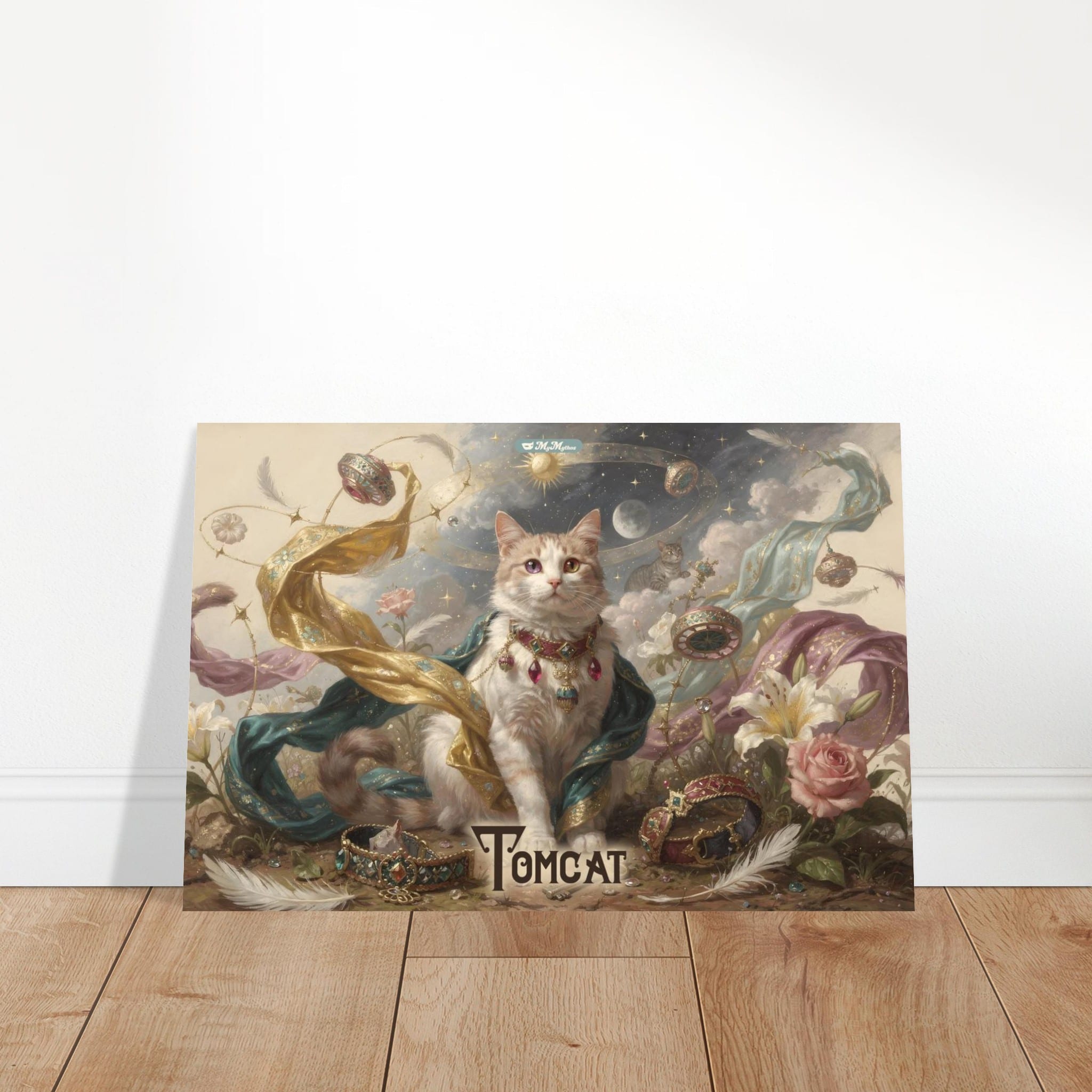
On your wall
Material
$19.00
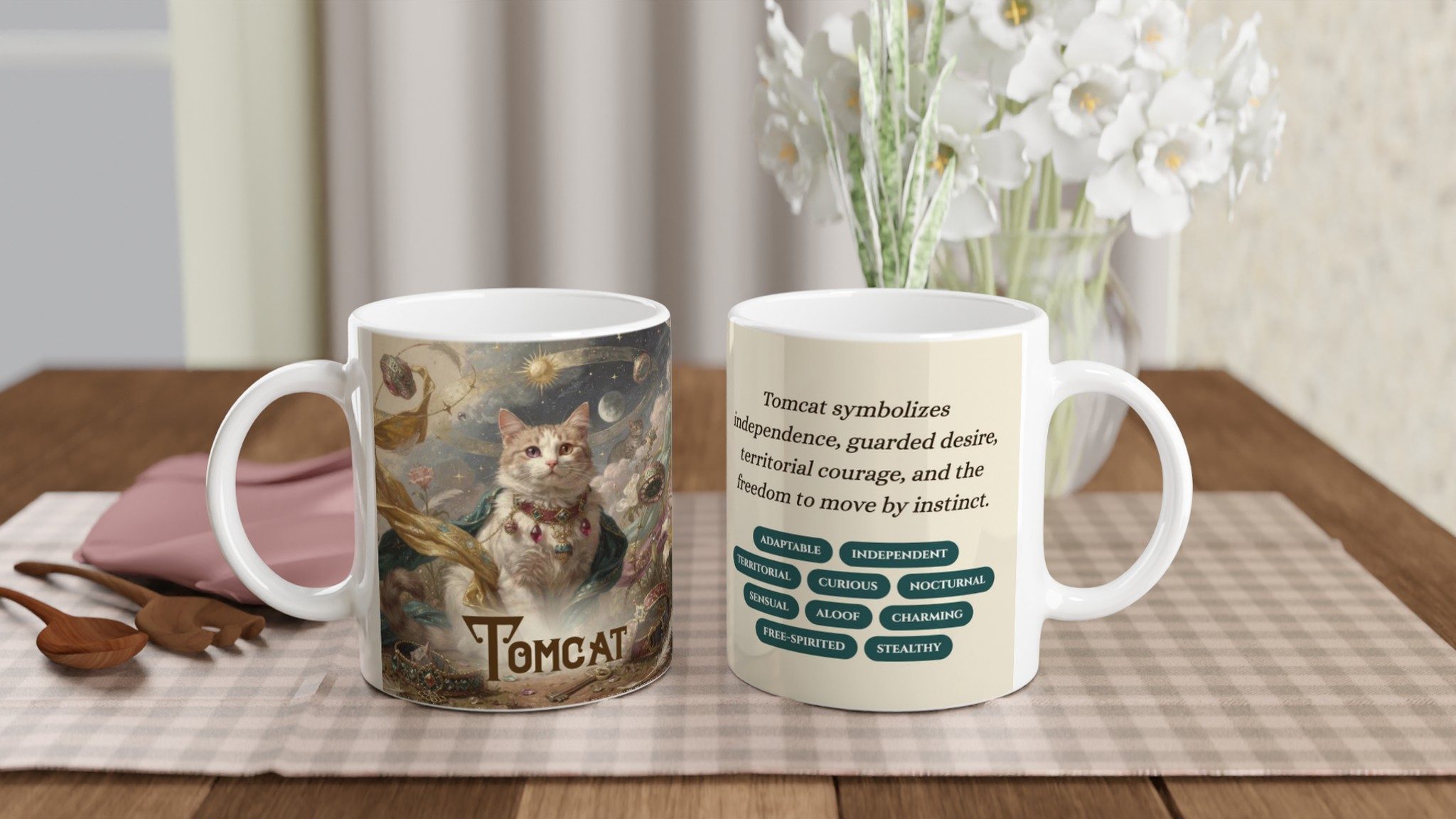
In your hands
Size
Color: White
$18.00
From elsewhere
Paid links: if you buy through these, MyMythos earns a small commission at no cost to you.