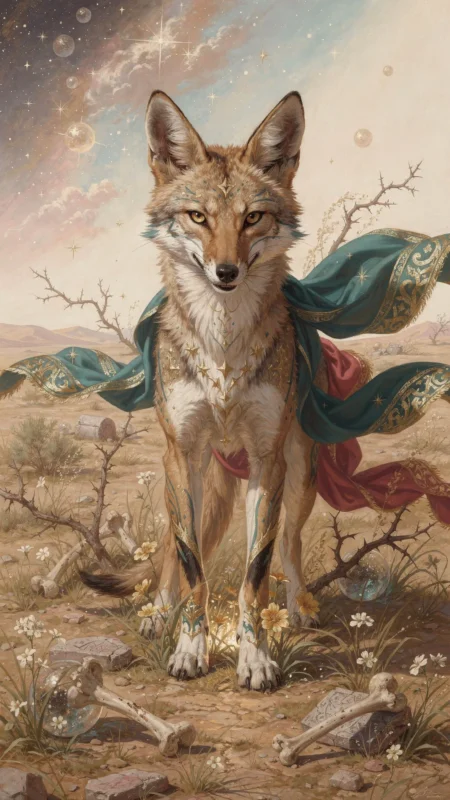
The Ruin
The Jackal may find its truest reflection not in a pool of water, but in the hollow eyes of a fallen colossus. The Ruin, be it a city bleached by the sun or an institution hollowed out by its own hypocrisy, is not merely the Jackal’s habitat; it is perhaps its collaborator, its silent partner in a dialogue about entropy. Where others see a tragic end, a failure of grand design, the Jackal could be said to read a different kind of scripture written in dust and fracture. It does not mourn the cathedral, for it was never a believer; instead, it finds a subtle beauty, a complex ecosystem of opportunity, in the moss that overtakes the altar. The relationship is less one of depredation and more one of quiet curation, with the Jackal acting as the unsentimental archivist of all that has been irrevocably broken, finding its nourishment in the footnotes of forgotten empires.
The Crossroads
One might imagine the Jackal not as a guide who leads you down a path, but as the spirit of the path itself—specifically, the one that is unpaved, unmarked, and ethically ambiguous. At the Crossroads, that nexus of fate and frantic decision, the Jackal could represent the tempting whisper of pure pragmatism. It is the patron of the third option, the one that lies between the righteous struggle and the noble sacrifice. This path does not promise glory, only survival; it is paved not with good intentions but with discarded principles. The Jackal, then, is the shadow cast by the signpost, an embodiment of the unsettling truth that when all maps are burned, the most vital direction is simply “away from the fire.” Its presence suggests that the most profound choices are often not between good and evil, but between a beautiful death and a complicated life.
The Jester
The Jester and the Jackal are, perhaps, two portraits of the outsider, sketched in different mediums. Both are connoisseurs of absurdity, but they operate in separate theaters of collapse. The Jester performs his truth within the castle walls, a licensed critic whose barbs are softened by the jingle of his own bells; his is the art of speaking truth to power in a way that allows power to laugh at itself, and thus, survive. The Jackal, however, offers no such performance. It waits beyond the walls, its silence a more profound critique than any joke. While the Jester holds up a mirror to the king’s vanity, the Jackal simply watches and waits for vanity to become carrion. It could be that the Jester is the system’s tolerated pressure valve, while the Jackal is the ecological consequence of the system’s eventual, inevitable explosion.

 Believe
 Fear
Fear Strength
 Weakness