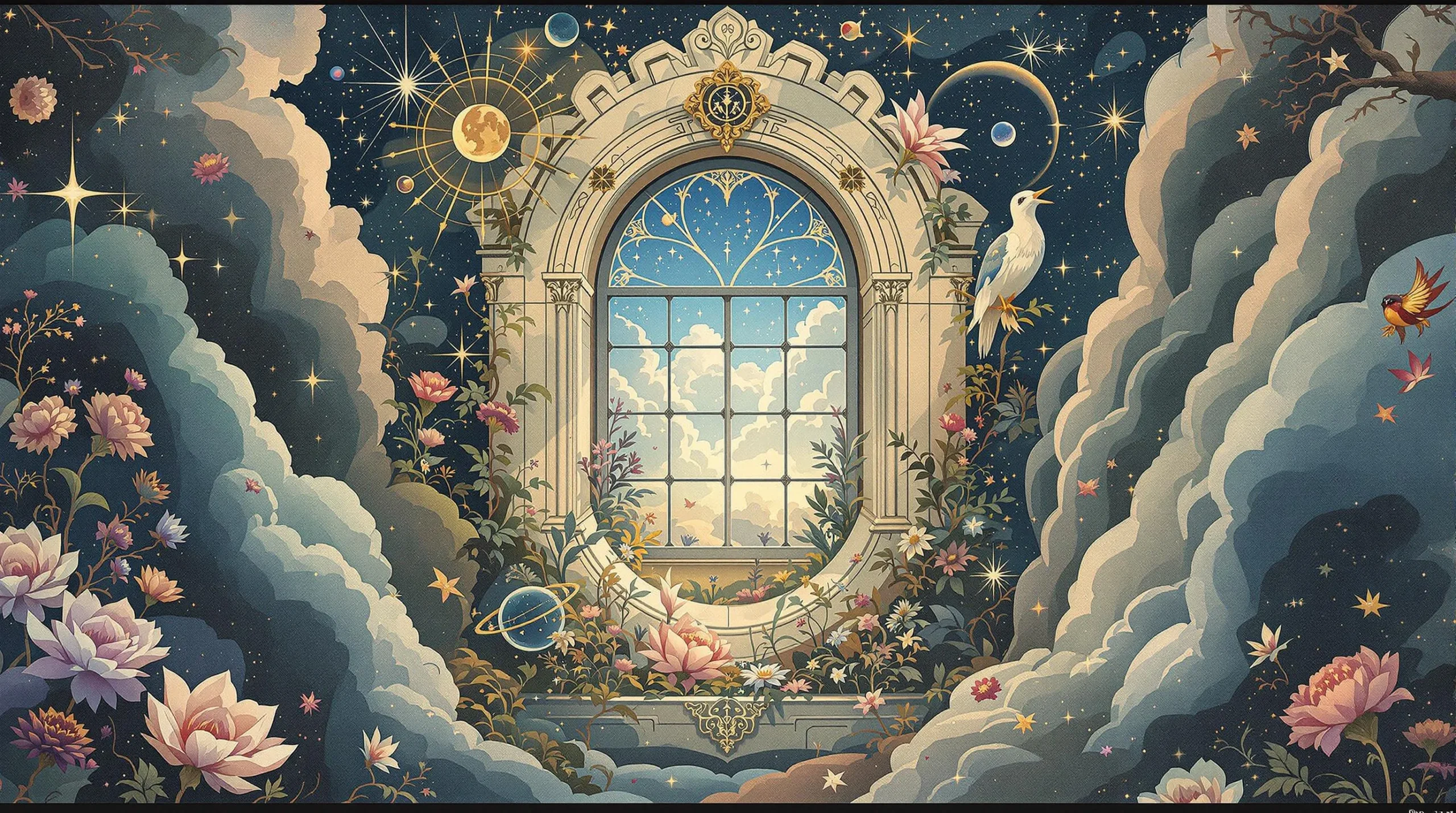


Window

Archetype Meaning & Symbolism

Observational, Liminal, Transparent, Reflective, Distant, Yearning, Framed, Protective, Vain, Curious

  • The world is not what it is, but what you see from where you stand. I only offer one view; your life is the house with many.

If Window is part of your personal mythology, you may...

Believe

  • You may believe that true understanding requires a degree of separation; you can only see the whole picture when you are not standing inside the frame.
  • You may believe that the way you frame a thing determines its reality, and that perspective is the most powerful tool a person can possess.
  • You may believe that what is longed for from a distance is often more beautiful and powerful than what is held in the hand.

Fear

  • You may fear being irrevocably trapped inside, watching life pass you by, unable to ever reach the world you observe so intently.
  • You may fear the glass shattering, that the chaos, violence, or overwhelming emotion of the world will suddenly rush in and destroy your inner sanctum.
  • You may fear discovering that the view you cherish is merely a projection or an illusion, and that there is nothing, or no one, truly out there.

Strength

  • You may possess an extraordinary ability to see situations with clarity and objectivity, detaching from emotion to find the core truth.
  • You may have a profound, almost poetic appreciation for beauty, moments, and the quiet, sacred act of observation.
  • You may exhibit great patience and a capacity for deep contemplation, allowing you to act with wisdom and foresight when you finally choose to.

Weakness

  • You may have a tendency toward inaction and passive observation, leading to analysis paralysis where you understand a problem perfectly but cannot bring yourself to act.
  • You may feel a persistent sense of detachment or alienation from your own experiences and relationships, as if you are watching a movie of your life.
  • You may be prone to idealizing the unknown or the unattainable, while inadvertently devaluing the reality of your present circumstances.

The Symbolism & Meaning of Window

To have the Window as part of your personal mythology is to live in a state of eloquent tension. You are a creature of the threshold, forever mediating between the interior world of the self and the exterior world of others. The Window is the symbol of perspective itself: a clear, defined, and sometimes limiting frame through which you perceive reality. Your truth may be a curated one, a beautiful and poignant composition you observe from a safe, and perhaps lonely, distance. This archetype suggests a life of observation, where meaning is found not in the visceral chaos of participation but in the quiet, profound act of watching it unfold. You may be the keeper of stories, the one who sees the patterns everyone else is too busy to notice, the chronicler of a world you feel intimately connected to but not entirely part of.

The Window is also a barrier, a transparent wall that defines the known from the unknown. For you, the glass may represent a psychological boundary: a necessary shield that protects your inner sanctum from the overwhelming weather of the outside world. Yet, this protection comes at a price. The barrier that keeps the storm out may also be the one that keeps the fresh air from circulating. It fosters a longing, a yearning for the life, the love, the experience that is tantalizingly visible but just out of reach. Your personal myth could be a narrative of this longing, a story about the constant negotiation between the safety of the inside and the vital, risky promise of the world beyond the pane.

Finally, the Window archetype is a mirror in the dark. When night falls on the world outside, the transparent pane becomes reflective, forcing you to gaze upon your own image superimposed over the darkness. It is a moment of reckoning. The observer must turn their gaze inward. This duality is central to your mythos: by day, you look out and seek to understand the world; by night, you look out and are forced to confront yourself. The Window teaches that all observation is, in part, a reflection of the observer. Your perception of the world is indelibly marked by the soul who is looking through.


Window Relationships With Other Archetypes

The Wall

The Window has a complex relationship with the Wall archetype. Where the Wall is a symbol of absolute separation, a definitive and opaque end to a space, the Window is the Wall's moment of weakness, its point of curiosity. It is a compromise. The Wall says, 'You shall not pass.' The Window whispers, 'You may look, but you cannot touch.' For a person whose mythos includes the Wall, the Window archetype may appear as a sudden, unsettling urge for connection, a crack in their defenses that lets in a sliver of light and the temptation of another world. It represents the flaw in perfect solitude, the place where the fortress of the self admits the existence of an outside.

The Mirror

The Window and the Mirror are opposing siblings, governing the direction of one's gaze. The Mirror is concerned with the interior, with identity, self-reflection, and truth as found within. The Window is concerned with the exterior, with the other, with perspective, and truth as observed in the world. A person strongly aligned with the Mirror archetype might find the Window a disorienting force, pulling their attention away from the essential work of self-discovery toward the distraction of the outside world. Yet, their tension is most potent at twilight, when the Window ceases to be a clear portal and becomes a darkened Mirror, reflecting a ghost of the self against the vast unknown. It forces the question: is the self you see inside an authentic being, or is it defined by what it sees outside?

The Traveler

For the Traveler, the Window is both a memory and a promise. It is the frame of the home they left behind, a rectangle of light signifying safety, family, and the past. Looking back, they see faces in the window. But it is also the portal through which they view the next horizon, be it from a train, a plane, or a seaside inn. Each window presents a new world, a new possibility, a new life to be sampled. The Window, for the Traveler, is not a permanent state but a transient frame for a series of temporary realities. It symbolizes the very act of passage: looking out at where you are going while simultaneously feeling the presence of what you have left behind.

Using Window in Every Day Life

Navigating a Difficult Decision

You might use the Window archetype to gain perspective. Instead of immediately diving into a conflict, you could mentally place the situation on the other side of the glass. You observe the dynamics, the moving parts, the emotional weather, all from a place of safety. You watch it unfold without being swept away. Only when you have seen the storm for what it is do you decide whether to open the latch and engage, armed with the clarity of distance.

Processing Intense Emotions

When overcome by a powerful feeling like grief or anger, the Window offers a tool for regulation. You might visualize yourself inside a quiet room, placing the overwhelming emotion outside the pane. It is not about denial; it is about demarcation. You can see the emotion, acknowledge its presence and its power, even tap on the glass to understand its texture, without allowing it to flood your interior space. It allows for a relationship with your feelings that is not one of total immersion.

Breaking a Creative Block

The Window can serve as a catalyst for new ideas. It is the act of looking at the familiar as if it were alien, of framing a mundane scene until it becomes profound. You could sit before an actual window and describe not what you see, but the story of what you see. The couple walking the dog becomes a myth of companionship. The falling leaf becomes an essay on surrender. The archetype encourages you to find the universe in a single, framed view, transforming the known world into a source of endless novelty.

Window is Known For

Framing Perspective

It is known for curating reality, for creating a composition out of the chaotic world. The Window dictates what is seen and, more importantly, what is left unseen, shaping our understanding by the very nature of its borders.

The Barrier of Observation

The archetype is defined by the transparent wall it erects between the self and the other, the inside and the outside. It facilitates a connection through sight but enforces a separation through substance, creating the fundamental tension of seeing but not touching.

Letting in Light

Beyond the view, the Window is a conduit for illumination. It is the aperture through which clarity, understanding, and hope can enter a darkened inner space. Its presence suggests the possibility of enlightenment and the vanquishing of shadows.

How Window Might Affect Your Personal Mythology

How Window Might Affect Your Mythos

When the Window informs your personal mythos, your life story may not be one of heroic deeds, but of profound perception. Your narrative is likely framed by moments of seeing: the instant you looked out and understood your family dynamic, the afternoon you watched a stranger and grasped a universal truth about sorrow, the dawn you saw from your office that clarified your path. Your myth is that of the Witness. You may be the character in the tower, the quiet observer in the corner cafe, the one who sees the beginning of the story and its end, but whose hands do not directly shape the plot. Your central conflict is not against a dragon or an enemy, but against the glass itself: will you remain a seer, or will you shatter the pane and step into the scene?

This archetype shapes your mythos around the theme of liminality. You are forever caught between states: inside and outside, safety and risk, knowing and experiencing. Your heroic journey might be an internal one, a quest to integrate these two worlds. Perhaps your story is about learning to open the window, to let the world in, and to step out. Or perhaps it is about learning to appreciate the sanctity of your interior space, to polish the glass so your view is clearer, and to accept your role as the one who understands rather than the one who does. Your personal legend is written in the space between you and the world, a testament to the power and the pain of seeing everything.

How Window Might Affect Your Sense of Self

Your sense of self may be intrinsically linked to your role as an observer. You might see yourself as perceptive, thoughtful, and discerning, someone who possesses a clarity that others, lost in the fray of life, lack. This can cultivate a strong, stable identity built on intellectual and emotional insight. You may feel that your core being is a protected, sacred space, a quiet room from which you can safely engage with the world. This feeling of a well-defined internal self, separate from the chaos outside, can be a source of immense stability and resilience.

However, this same mechanism can foster a self-concept colored by detachment and alienation. You may perceive yourself as fundamentally separate from others, a spectator to the game of life rather than a player. This can lead to a quiet melancholy, a feeling of being insubstantial, like a ghost looking in on the living. You might question your own reality and agency: are you truly living, or merely watching a film of a life? Your sense of self might feel fragile, defined not by your own actions but by what you are not, by the world you can see but cannot fully inhabit.

How Window Might Affect Your Beliefs About The World

Your worldview is likely one of framed composition. You may not see life as a messy, sprawling, chaotic whole, but as a series of distinct scenes, each with its own mood, characters, and meaning. This allows for a deep appreciation of moments, of the aesthetic quality of reality. You might believe that truth is not found in grand, sweeping ideologies but in small, carefully observed details. The world, for you, is a gallery of moments, and your wisdom comes from studying each picture intently. This can lead to a philosophical, almost artistic, approach to life.

This perspective may also engender a fundamental dualism in your worldview. There is 'in here,' the realm of safety, thought, and control, and there is 'out there,' the realm of chaos, action, and the unknown. You may view the external world with a mixture of fascination and apprehension. It is a spectacle to be consumed, but also a potential threat to the sanctity of your inner world. This can make you cautious, perhaps even cynical, about grand movements, passionate causes, or anything that threatens to break the glass and disrupt the careful order of your perceptions. The world is a thing to be understood from a distance, not necessarily trusted up close.

How Window Might Affect Your Relationships

In relationships, you may exhibit a tendency to observe your partner rather than merge with them. You might be an excellent listener, a perceptive and empathetic confidant, able to see your loved one's struggles with stunning clarity. You provide the calm, stable viewpoint they may lack. You are the safe harbor, the room with the steady view, where they can make sense of their own emotional storms. You offer the gift of perspective, a rare and valuable form of love.

Yet, this observational stance can create an invisible barrier. Your partner may feel that they are always being analyzed, always on display. They might long for you to step out from behind the glass, to enter into the messy, unpredictable dance of intimacy with them, rather than simply commenting on the choreography. There may be a fear of vulnerability on your part, a reluctance to 'open the window' and let another person fully into your private world. This can create a poignant loneliness within your most intimate connections, a sense of being close but never truly together.

How Window Might Affect Your Role in Life

The Window archetype may cast you in the role of the Sage, the Analyst, or the Chronicler. Your purpose in your family, community, or workplace is to be the one who sees clearly. People may come to you for advice, not because you have the most direct experience, but because you have the best vantage point. You are the one who can detach from the emotion of a situation and see the underlying pattern, the hidden logic. Your role is to provide the map, even if you are not the one taking the journey. This is a position of quiet power, earning respect through wisdom rather than force.

This role, however, can feel profoundly passive. You may feel like a supporting character in other people's stories, or even in your own. While others are out in the world making their mark, you are documenting it. This can lead to a crisis of agency, a feeling that your life lacks impact. You might struggle with the sense that you are merely a conduit for understanding, rather than a catalyst for change. Your life's work may become a struggle to reconcile your role as observer with a deep-seated need to participate, to not just see the world but to actively shape it.

Dream Interpretation of Window

In a positive context, dreaming of a window often symbolizes clarity, new opportunities, and a healthy connection between your inner and outer worlds. A large, clean window with a beautiful view might suggest an expansion of consciousness, an optimistic outlook, and the arrival of fresh insight. To dream of opening a window and breathing in fresh air could signify a release from old patterns of thought, a readiness to engage with the world in a new way, or the resolution of a problem that has left you feeling stifled. It is the psyche's signal that your perspective is clear and you are ready for what is next.

In a negative context, a window in a dream can represent obstacles, distortion, and isolation. A dirty or grimy window may suggest that your perception of a situation is clouded by old beliefs or unresolved emotions. A barred, locked, or painted-shut window could symbolize a feeling of being trapped, hopeless, or cut off from opportunities and connection. Seeing a frightening or disturbing scene through the window might reflect your anxieties about the external world or a sense of impending doom. To dream of a window shattering could signify a sudden, violent intrusion into your psychic space or the breakdown of a necessary psychological boundary.

How Window Archetype Might Affect Your Needs

How Window Might Affect Your Physiological Needs

The Window archetype can translate physiological needs into psychic imperatives. The need for air becomes a need for new ideas and the freedom to think. A stuffy room is not just a physical discomfort; it is a psychic threat, representing stale thoughts and a lack of inspiration. You may find yourself physically drawn to open windows, balconies, and vistas, feeling a visceral relief when you can breathe freely and see a horizon. This isn't just about fresh air; it is about ensuring the flow between your inner and outer worlds remains unobstructed.

The need for light is equally potent. Sunlight streaming through a window could be experienced as a direct infusion of hope, clarity, and vitality. Periods of darkness or living in a space with little natural light might be profoundly depressing, felt as a kind of soul-level starvation. You may organize your life and living spaces to maximize light, understanding intuitively that illumination of your physical space is tied to the illumination of your mind. The physiological becomes a direct metaphor for the psychological: you need light to see, both literally and figuratively.

How Window Might Affect Your Ideas of Belonging

Your need for belonging is complicated by the Window. On one hand, you may feel a deep sense of belonging to your own inner world, your sanctuary. This is where you are most yourself, most secure. The feeling of being 'at home' is potent and deeply cherished. This self-contained belonging can be a source of great strength and independence. You may not need a crowd to feel that you have a place.

On the other hand, the Window can create a profound and painful sense of being an outsider. It fosters a dynamic of 'us' and 'them' where you are perpetually on the inside looking out. You may watch families, groups of friends, or romantic couples with a deep, analytical longing, understanding the mechanics of their connection but feeling unable to experience it yourself. This can lead to a feeling of being fundamentally separate from humanity, a lonely observer of a party to which you were not invited. Belonging becomes a beautiful landscape you can see, but a country you cannot enter.

How Window Might Affect Your Feelings of Safety

Safety, for you, might be defined by the integrity of the glass. The Window provides security by allowing you to see threats without being exposed to them. It is the comfort of watching the blizzard rage while you are warm inside, of seeing the world's chaos from a position of protected stillness. Your sense of safety may depend on maintaining this boundary. Control over who and what is allowed to cross that threshold—to open the window or come through the door—is paramount. Safety is a well-maintained frame and an unbroken pane.

Consequently, threats to your safety may be perceived as breaches of this barrier. A crack in the glass, a rattling frame, or an unlocked latch could create a disproportionate sense of anxiety. This isn't just a fear of a physical intrusion; it is a fear of psychological violation. The outside world, with its unpredictable energy and demands, threatens to rush in and overwhelm your carefully managed inner space. The ultimate terror may be the shattering of the glass, representing a total loss of control and the violent merging of the safe interior with the dangerous exterior.

How Window Might Affect Your Views of Esteem

Esteem may be built upon your unique perspective. You gain self-worth from being the person who 'gets it,' the one who sees the truth that others miss. Your ability to offer clear-eyed advice, to find the pattern in the chaos, and to articulate a nuanced point of view is a source of pride. This intellectual or emotional superiority, the esteem of the sage or the seer, can be very powerful. You are respected for your mind and your insight, for the wisdom that comes from your observational perch.

However, esteem can be eroded by a lack of agency. If self-worth is tied to action and accomplishment in the external world, the Window archetype can be a source of insecurity. You may compare your life of observation to the lives of action you see outside, and find your own lacking. The feeling of being a passive spectator rather than an active participant can lead to self-doubt and the nagging question, 'What have I actually done?' Esteem may then become a fragile thing, dependent on the validation of others who benefit from your wisdom, rather than an internal sense of your own power in the world.

Shadow of Window

The shadow of the Window archetype emerges when observation curdles into voyeurism. This is the state of watching without empathy, of consuming the lives of others as a spectacle for one's private amusement or analysis, devoid of genuine connection or compassion. The shadow self feels entitled to the view, believing its separation grants it a right to judge and scrutinize without the risk of being judged in return. It is the person who lives entirely through screens, who stalks social media profiles for hours, who gossips not for connection but for a feeling of superior knowledge. This shadow turns the protective pane of glass into a one-way mirror, where the humanity of the person on the other side is diminished.

Another facet of the shadow is the prison. The Window ceases to be a choice and becomes a necessity. This is the agoraphobic who cannot bear the thought of stepping outside, the hermit whose solitude becomes a fortress against a world perceived as entirely hostile. Here, the archetype's gift of perspective becomes a curse of distortion, where the glass no longer clarifies but warps everything into a menacing caricature. The world 'out there' is nothing but threat, and the 'in here' is no longer a sanctuary but a cell. The shadow Window does not let light in; it only shows you your own reflection trapped in the dark.

Pros & Cons of Window in Your Mythology

Pros

  • Having the Window in your mythology fosters a deep and abiding sense of perspective, allowing you to navigate life with unusual wisdom and foresight.
  • It provides a powerful psychic shield, creating a space for emotional safety that allows you to process the world without being overwhelmed by it.
  • It cultivates a rich inner life and a natural talent for creativity, as the act of observation is the foundation for art, writing, and insight.

Cons

  • This archetype can lead to a state of perpetual longing and dissatisfaction, where the grass is always greener on the other side of the glass.
  • It carries the inherent risk of creating emotional distance in your relationships, making true intimacy a challenge.
  • It can foster a deep-seated passivity, a reluctance to engage directly and messily with life's challenges, preferring to analyze them from afar.