
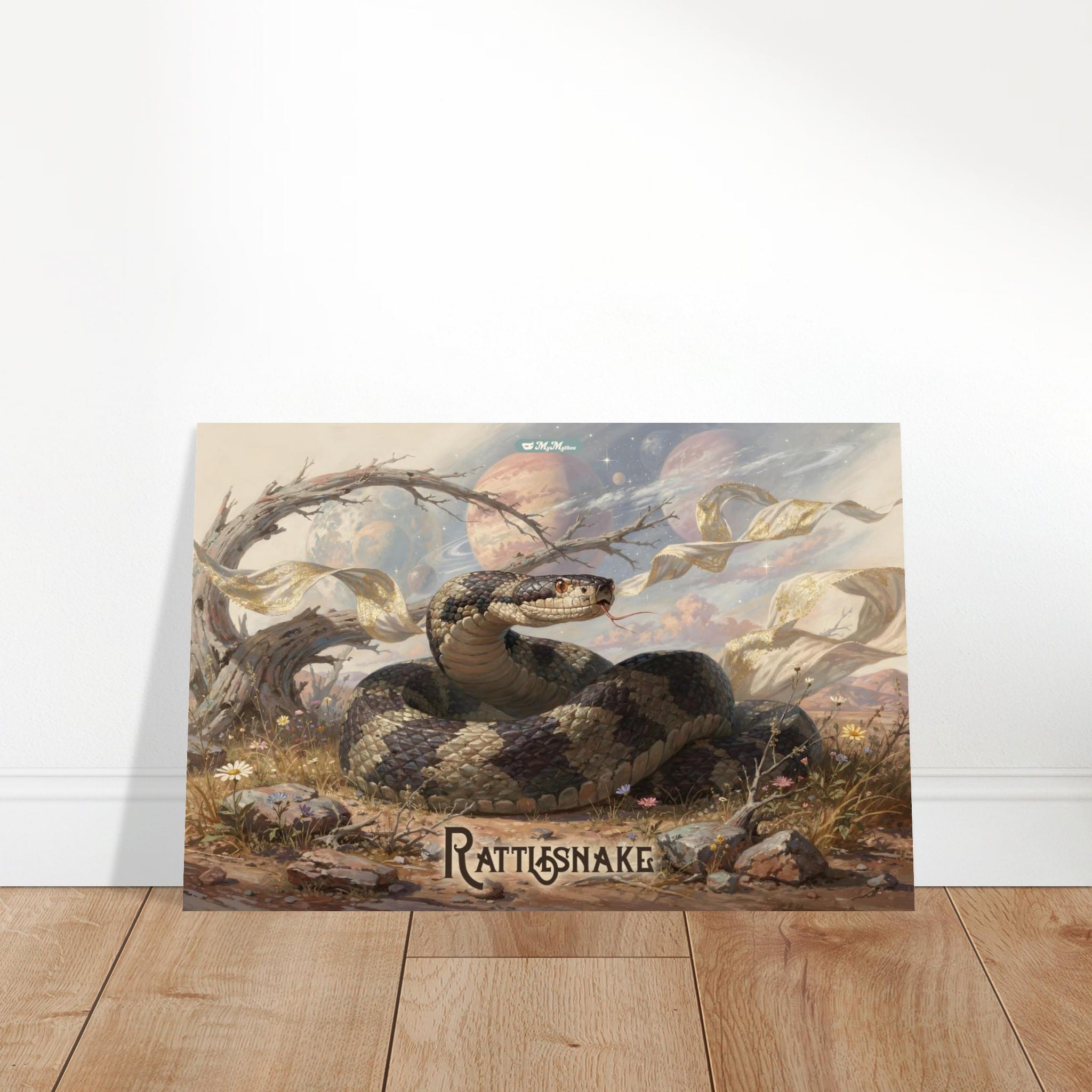
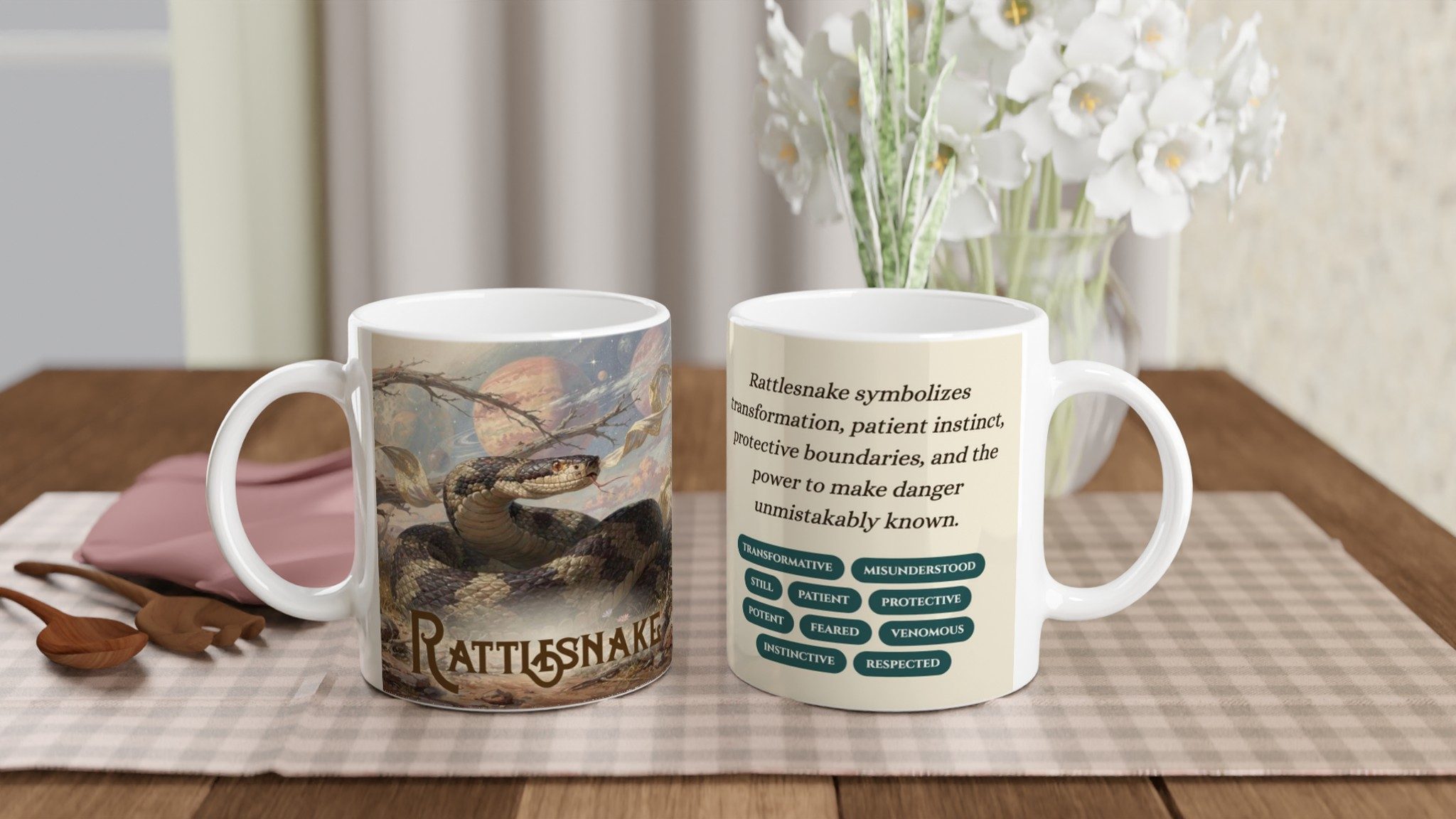
A rattlesnake is a venomous pit viper of the Americas whose tail ends in a rattle of loose segments that it shakes as a warning. Rattlesnake symbolizes transformation, patient instinct, protective boundaries, and the power to make danger unmistakably known.
By Sidian M.S. Jones, personal mythologistHow these pages are made
Encounters
Meet Rattlesnake inside a story
The Symbolism & Meaning of Rattlesnake
Rattlesnake begins with a rare courtesy among dangerous animals: it tells you that it is there. The warning does not make the snake harmless. It makes the boundary legible. Its rattle gives sound to a decision that many people postpone in ordinary life. You can move back. You can give the animal space. You can also ignore the signal and discover that patience has limits.
That pattern gives Rattlesnake its first meaning: protection through clear limits. It does not chase a person across the landscape looking for conflict. Most rattlesnakes prefer to conserve energy, avoid notice, and remain still until prey comes within range. When threatened, a 
Rattlesnake also carries the tension between being misunderstood and being dangerous. A harmless snake can be killed because it resembles one. A rattlesnake can be hated before it has moved. That makes the archetype useful for people whose restraint is overlooked until they finally speak. It also makes the symbol morally sharper than a simple image of toughness. A warning is protection when it prevents harm. It becomes intimidation when it is used to control every room.
The desert whispers secrets of patience: only strike when the moment is ripe, and your venom will be true.
The animal's hunting method adds another strand. Rattlesnakes do not need frantic pursuit. They use camouflage, stillness, chemical sensing, and heat-sensitive pits to locate warm prey. After striking, they may release the animal and follow its scent rather than hold on and risk injury. This is patience with a nervous system behind it, not passive waiting. Rattlesnake therefore speaks to timing, especially the discipline of refusing to spend energy before the moment is real.
Its venom makes transformation a bodily fact rather than a decorative promise. Venom begins digestion before the meal reaches the stomach, breaking down tissue and disabling prey. The same substance that kills small animals can become medicine when scientists isolate and understand its compounds. Rattlesnake symbolism can hold that contradiction: potency may injure, heal, or do nothing useful depending on dose, purpose, and control.
Then comes the shed skin. As the snake grows, the old covering loosens and comes away in one piece. The rattle grows too, adding a record of each new segment, though it does not reliably tell the snake's age. One part of the animal leaves the past behind; another carries change as sound. This is why Rattlesnake belongs to a personal mythology of boundaries and renewal. It asks for a warning before rupture, patience before action, and enough honesty to admit when the old skin has become too tight.
Rattlesnake as a Spirit Animal, Totem & Power Animal
When Rattlesnake is yours, change usually arrives through the body before it becomes an explanation. You notice the tightening first. A room feels unsafe. A promise sounds false. A role that once protected you begins to restrict your movement. The archetype does not ask you to invent danger everywhere. It asks you to listen when your senses register something your manners would rather ignore.
As a spirit animal, Rattlesnake brings the discipline of the warning. You do not need to bare your teeth at every inconvenience. The rattle is useful because it comes before the bite. In practical life, this can mean naming a limit while you still have the energy to enforce it. It can mean leaving a conversation before anger turns your words poisonous. It can mean refusing to explain your boundary until the other person has agreed that it exists.
As a totem, Rattlesnake can describe a family or community shaped by guardedness, survival, and a strong memory of trespass. Such a group may value self-reliance and read small signals quickly. Its protection can keep vulnerable people safe. Its shadow can teach children that closeness is always a trap. The inherited task is not to discard caution, but to separate accurate perception from fear that has outlived its original threat.
As a power animal, Rattlesnake arrives when force would waste more than it would solve. It supports stillness, timing, and a response proportionate to the intrusion. A person carrying it may become harder to manipulate because they no longer rush to prove that they are kind, available, or unafraid. They can wait. They can watch. They can let another person reveal whether a warning is needed.
The shed skin gives the archetype its regenerative edge. Rattlesnake does not renovate itself by adding another performance over the old one. It loosens the covering and leaves it behind. This can be uncomfortable in a life built around a familiar identity: the reliable one, the dangerous one, the silent one, the person who never needs help. A new self may feel exposed before it feels free.
The archetype arrives in dreams, repeated encounters, a tattoo, a sudden fascination, or a season when your old methods stop working. Its presence is not proof that every instinct is correct. Venom is potent because it is specific. Your work is to know what deserves a warning, what deserves distance, and what deserves no response at all. Rattlesnake gives you the nerve to be clear without making fear your only language.
Which of these is also you?
Collect 8 to make a mythos.
14 readers on MyMythos have picked Rattlesnake as one of their archetypes.
These archetypes were chosen because you are reading about Rattlesnake.
Rattlesnake in Mythology & Folklore: Where the Symbolism Comes From
Rattlesnakes appear in the stories and ceremonies of many Indigenous peoples of North America, but no single Indigenous meaning covers every nation. In parts of the American Southwest, Hopi Snake Dance traditions involve living snakes carried and released in prayers connected with rain, fertility, and the balance between people and the land. The snakes are not simply monsters. Their movement through dry country belongs to a relationship with weather, crops, and water. Other communities have treated snakes as powerful beings requiring careful distance, rather than as animals to be handled casually.
Among some Pueblo peoples, horned or rattling serpents appear in traditions involving rain and the 
The rattlesnake also entered the political folklore of the early United States. Benjamin Franklin's 1754 woodcut, published with the phrase "JOIN, or DIE," showed a snake cut into pieces, though it was not clearly a rattlesnake. Later American writers and revolutionaries increasingly used the rattlesnake as an emblem of the colonies. Franklin described it as cautious rather than aggressive, but certain to strike when stepped on. The image turned the animal's defensive behavior into a political warning: leave it alone and it will not pursue you; threaten it and the response will be swift.
That reading differs sharply from older European Christian symbolism, where the serpent often carried associations of temptation, deceit, and evil. The difference is not just a matter of good versus bad symbolism. A rattlesnake gives an audible warning before it bites, while a serpent in biblical interpretation often represents a danger that works through concealment and persuasion. The same body could therefore stand for honest warning in one tradition and corrupting deception in another.
Mexican and Mesoamerican traditions more often center feathered serpents such as 




Rattlesnake and Its Relationships With Other Archetypes

Snake
“Of all my kin, I am the one who shakes a warning before anything else happens.”
Snake carries the old weight of temptation, renewal and the hidden strike, while Rattlesnake adds an announcement to it. A person with both has learned that a boundary stated out loud usually prevents the bite it threatens.
Visit Snake
Rebel
“On the yellow flag I coiled beneath three words: Don't Tread on Me.”
An essay attributed to Benjamin Franklin praised rattlesnakes as an emblem of the American colonies because they never strike without warning, and Christopher Gadsden's 1775 flag put a coiled timber rattlesnake above the words Don't Tread on Me. Rebel and Rattlesnake together describe resistance that gives fair warning, the kind of defiance that would rather be left alone than start a fight.
Visit Rebel
Snake Skin
“Every time I shed, a new segment locks onto my tail, so my rattle is a record of outgrowing.”
A rattle is made of hollow keratin segments, and a new one is added with each shed, which can happen several times a year, so counting segments does not give a snake's age. Snake Skin is what Rattlesnake leaves behind and the rattle is what it keeps, a reminder that some of what we outgrow stays on as our voice.
Visit Snake Skin
Red-Tailed Hawk
“From the sky she comes for me, and my rattle means nothing to wings.”
Red-tailed hawks are among the predators that take rattlesnakes, striking from the air where a buzz and a coiled strike are little use. The pairing reminds a person whose defense is warning and threat that not every danger stops to listen, and that some situations ask for cover instead of noise.
Visit Red-Tailed Hawk
A Shiver Down the Spine
“My buzz goes straight past your thinking and runs cold along your back before you know why.”
The dry buzz of a rattle sets off a startle that arrives faster than conscious thought, which is exactly what the rattle evolved to do. A Shiver Down the Spine is the body's own warning system answering Rattlesnake's, and a person who carries both trusts that quick, wordless signal.
Visit A Shiver Down the Spine
Rattlesnake also keeps company with the crepuscular hours: Black Fox, Copperhead, Ferret, Jackrabbit, Rabbit and Snow Leopard, among twenty-two others that are crepuscular.

Rattlesnake in Dreams: Meaning & Interpretation
Dreaming of a rattlesnake often brings attention to a danger, boundary, or instinct that has been noticed but not yet answered. The dream may not predict an attack. It may be staging the moment before one, when the rattle gives you information and you must decide whether to step closer, move away, or remain still. Because rattlesnakes shed their skins, the image can also appear during a period when an old identity no longer fits.
The dream is doing more than frightening the dreamer. It is making a quiet signal audible. A person may have tolerated an intrusion, dismissed a bodily response, or mistaken patience for helplessness. The snake gives shape to the warning and tests the dreamer's distance from it. Its meaning changes with the dreamer's behavior: watching from safety suggests alertness, while handling it carelessly suggests denial of risk. A dead snake may show that a threat has ended, or that protective instinct has been suppressed.
A rattlesnake resting in warm sunlight can mark a welcome return to the body. The dreamer may be recovering energy, accepting a slower pace, or recognizing that stillness is active rather than empty. If the snake rattles without striking, the warning may be sufficient. Something requires attention, but not panic.
A rattlesnake inside the house often points to a boundary violation close to private life. A bite can represent the cost of ignoring a clear signal, though it may also show that anger or fear has finally broken through numbness. Chasing a rattlesnake suggests pursuing danger or forcing a confrontation. Finding a shed skin is gentler: the dreamer may be leaving behind a role that once protected them. Killing the snake can mean safety after a threat, but it can also reveal the loss of a useful instinct.
Rattlesnake: Positive & Negative Meanings
Positive Meanings
- Patient timing before decisive action
- Clear warnings before conflict
- Strong protection of vulnerable boundaries
- Instinctive reading of movement and danger
- Capacity to shed an outdated identity
- Power held in reserve
- Respect earned through consistency
Negative Meanings
- Suspicion that outlasts the original threat
- Warnings used to intimidate
- Retaliation mistaken for protection
- Emotional distance disguised as patience
- Fear of being misunderstood
- Silence that delays necessary action
- A tendency to make danger part of identity

The Shadow of Rattlesnake
The shadow of Rattlesnake begins when the warning becomes more important than the danger. A person may rattle before anyone has crossed a boundary, mistaking visibility for safety. Suspicion can become a habit that keeps intimacy outside the coil. Every question sounds like an intrusion. Every request feels like an attempt to take something.
This archetype can also make retaliation feel righteous. Because the animal truly can defend itself, the person may treat every sharp response as justified. Venom then becomes identity rather than last resort. A cutting remark proves strength for a moment, but it can poison relationships that offered no threat. The shadow is not simply anger. It is the belief that being feared is safer than being known.
Another danger is confusing stillness with avoidance. Rattlesnakes wait because waiting helps them hunt and conserve energy. A person may use that fact to excuse paralysis, withholding, or endless observation. They gather evidence but never choose a direction. The old skin remains because change has been postponed until it feels painless.
The shadow loosens when the warning becomes precise again. The person asks what happened, what is happening now, and what response will actually protect life. Not every disturbance deserves a 
How Did You End Up at Rattlesnake?
What might you have become if you had not learned to stay beneath the leaves, and what closed that open ground to you?
Which moment made giving a warning before you struck feel safer than trusting anyone to notice your fear?
What were you praised, paid, or loved for when your silence and sudden distance kept everyone from getting hurt?
Whose careful stillness, quick retreat, or unmistakable warning are you watching in yourself now, before you have a name for it?
Has Rattlesnake turned up in your life, in a dream, a moment, a person? Put it on your page and join its kin, or tell the first story.


 Written by Warren,
for you alone
A reading by Warren
What Rattlesnake means for you
This page says what the Rattlesnake means. Warren can tell you why it is showing up for you, now.
Rattlesnake: Frequently Asked Questions
- What does Rattlesnake symbolize?
- Rattlesnake begins with a rare courtesy among dangerous animals: it tells you that it is there. The warning does not make the snake harmless.
- What is the spiritual meaning of Rattlesnake?
- When Rattlesnake is yours, change usually arrives through the body before it becomes an explanation. You notice the tightening first.
- What does Rattlesnake represent?
- Rattlesnakes appear in the stories and ceremonies of many Indigenous peoples of North America, but no single Indigenous meaning covers every nation.
- What does it mean to dream about Rattlesnake?
- Dreaming of a rattlesnake often brings attention to a danger, boundary, or instinct that has been noticed but not yet answered. The dream may not predict an attack.
- What is the shadow side of Rattlesnake?
- The shadow of Rattlesnake begins when the warning becomes more important than the danger. A person may rattle before anyone has crossed a boundary, mistaking visibility for safety.
- What are the positive and negative meanings of Rattlesnake?
- Patient timing before decisive action. Suspicion that outlasts the original threat.
- What does a Rattlesnake tattoo mean?
- Often, a person wears a rattlesnake to mark survival, guarded independence, or a warning that should not be ignored. Some choose it after shedding an old identity. Others want their body to carry a visible boundary.
Characteristics of Rattlesnake
- Color:
- brown, gray
- Marking:
- banded
- Covering:
- scaled
- Form:
- serpentine
- Size:
- small
- Kind:
- reptile
- Diet:
- carnivore
- Active when:
- crepuscular
- Habitat:
- desert, grassland
- Element:
- earth, fire
Rattlesnakes combine ambush hunting with unusually precise warning behavior. They locate warm prey with heat-sensing pits, track vibration through the ground, and can wait motionless until a strike is worth the risk. Their young are born live rather than hatched from laid eggs, and mothers may remain near newborns for a short period. The rattle is built from hollow keratin segments that add new pieces as the snake grows, making sound from repeated physical change.
Get the next one
Essays on personal mythology, archetypes, and the stories we tell ourselves.
Take Rattlesnake home
Printed to order and shipped to you. Please allow a few extra days for production.
On your wall
Material
Sale! Was $19.00, now $14.25
In your hands
Size
Color: White
Sale! Was $18.00, now $13.50
From elsewhere
Paid links: if you buy through these, MyMythos earns a small commission at no cost to you.