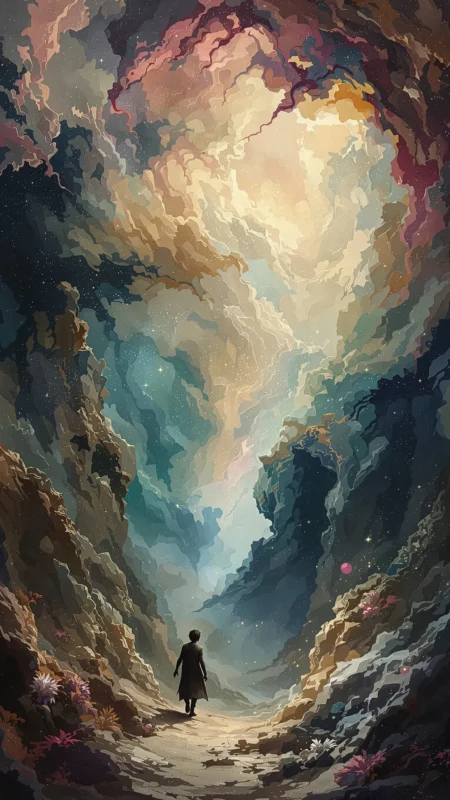


Underworld

Archetype Meaning & Symbolism

Subterranean, forgotten, liminal, fertile, unconscious, cathartic, resonant, dormant, ancestral, transformative

  • Do not fear my darkness. It is only the soil from which all new light grows.

If Underworld is part of your personal mythology, you may...

Believe

  • You may believe that what is hidden holds more power and truth than what is openly displayed.
  • You may believe that periods of darkness, confusion, and fallowness are not signs of failure but are necessary and fertile stages of growth.
  • You may believe that the greatest wisdom is found by confronting one's own shadow and deepest fears, not by avoiding them.

Fear

  • You may fear being permanently trapped in the underworld of your own psyche, lost in depression or introspection, and unable to return to the light and joy of the everyday world.
  • You may fear that what is buried within you is truly monstrous or shameful, and that excavating it will destroy you or alienate everyone you love.
  • You may fear a life of superficiality, terrified of living and dying without ever having engaged with the deeper questions and mysteries of your own soul.

Strength

  • You possess a profound capacity for introspection and self-awareness, allowing you to understand your own motivations and patterns with rare clarity.
  • You have a powerful resilience, forged by navigating difficult internal landscapes, that allows you to weather life's storms with uncommon grace and stability.
  • You have the ability to see the hidden potential and meaning in situations others might dismiss as endings or failures, making you a source of quiet hope and wisdom.

Weakness

  • You may have a tendency towards melancholy, withdrawal, or social isolation, finding the demands of the outer world draining and intrusive.
  • You may find it difficult to engage with the simple, mundane, or lighthearted aspects of life, as your focus is perpetually drawn toward what is deep and complex.
  • You risk becoming lost in the labyrinth of your own mind, leading to analysis paralysis, inaction, and a disconnect from the embodied, present moment.

The Symbolism & Meaning of Underworld

In the contemporary mythos, the Underworld has largely shed its cloak of fire and brimstone, revealing itself as a metaphor for the vast, fertile, and often intimidating landscape of the unconscious. It is the inner geography where we are all sole sovereigns: a realm of echoing caverns that hold our deepest fears, riverbeds carved by the flow of old griefs, and sleeping gardens where our greatest potentials lie dormant. To have the Underworld as a central feature of your personal landscape suggests a life oriented not toward the sunlit peaks of constant achievement, but toward the resonant depths of meaning. It is an acknowledgment that what is buried—the family secret, the abandoned dream, the disowned part of the self—still exerts a gravitational pull on the surface of everyday life.

The symbolism is not one of punishment, but of profound potential. It is the darkroom where the negatives of our experience are developed into meaningful images. The journey there is often involuntary, triggered by loss, failure, or a sudden crisis that cracks the surface of a well-managed life. Yet, for one whose mythos includes this realm, such descents are not aberrations. They are rites of passage. The treasures found in this place are not gold and jewels, but self-knowledge, compassion born of seeing one's own monstrosities, and a creativity that draws from the rich, composted soil of all that has been lived and forgotten.

Ultimately, the Underworld archetype signifies a relationship with mystery. It is the understanding that some questions do not have simple answers, that some wounds do not fully heal but become sources of wisdom, and that life's most potent magic happens in the dark. It is a commitment to wholeness over perfection, recognizing that the lotus flower of consciousness is nourished by the mud and muck of the unseen depths. It is less a place to be feared and more a territory to be respectfully navigated, a source of gravity and substance in a world that can often feel weightlessly superficial.


Underworld Relationships With Other Archetypes

The River

The River often acts as the boundary or conduit to the Underworld, a mythic echo of the Styx or Lethe. In a personal mythos, this relationship may symbolize the flow of consciousness or emotion that can, sometimes unexpectedly, carry one into deeper psychic territory. A sudden current of grief, a stream of creative inspiration, or the relentless flow of memory can act as the ferry. For the individual, this means that emotional states are not just moods; they are passages. Learning to navigate these currents, to know when to surrender to their pull and when to seek the shore, becomes a central life skill. The River doesn't judge; it simply flows, and its destination is always the great, dark sea of the unconscious.

The Seed

The Seed shares an intimate and necessary relationship with the Underworld. It holds immense potential, but can only realize it after a period of burial, dormancy, and unseen struggle within the earth. For a person whose mythos contains the Underworld, their own potential and creative projects may feel like these seeds. They may require a period of introversion and private gestation, hidden from the critical light of day, before they are ready to sprout. This archetype teaches patience and trust in unseen processes. It counters the cultural demand for immediate results, suggesting that the most vital growth happens slowly, in the dark, nourished by the rich soil of the inner world.

The Hero

The Hero's journey is incomplete without a descent, a nekyia or katabasis, into the Underworld. This is where the Hero must confront their deepest fear, their shadow, or the source of their community's malaise. In a personal mythology, the Underworld is the arena for the most difficult trials of the inner Hero. It is not a place of slaying literal dragons, but of facing personal demons: addiction, ancestral trauma, a core wound. The Underworld tempers the Hero's sunlit confidence with humility and wisdom, transforming them from a mere warrior into a true guide. The treasure the Hero brings back is not a golden fleece, but a more integrated, whole, and compassionate self.

Using Underworld in Every Day Life

Navigating Creative Blocks

When the well of inspiration runs dry, the Underworld archetype suggests the issue is not a lack of ideas, but a blockage to the source. The journey required is not one of frantic searching for something new, but a quiet descent into the personal depths where forgotten images, half-formed thoughts, and resonant emotions are stored. It may involve dream journaling, exploring family history, or simply allowing for a period of fallow quiet, trusting that the seeds of the next great idea are already there, germinating in the dark.

Processing Grief

The Underworld is the mythic landscape of loss. Engaging with this archetype provides a map for grief that honors its disorienting and subterranean nature. Instead of being told to “move on” or “stay in the light,” one’s personal mythos might frame this period as a necessary katabasis, a descent to honor what has passed. It allows one to sit with the ghosts of memory, to understand that grief is not an illness to be cured but a landscape to be traversed, one that ultimately reshapes the traveler who emerges from it.

Understanding Ancestral Patterns

To have the Underworld in your mythos is to feel the presence of the roots beneath the family tree. This archetype provides a framework for exploring inherited traumas and gifts. It is the work of the soul’s archaeologist: digging into the patterns of behavior, the unspoken rules, and the emotional legacies passed down through generations. This is not about blame, but about understanding: by visiting the underworld of one's lineage, one can choose which treasures to carry back to the surface and which ghosts to finally lay to rest.

Underworld is Known For

The Repository of the Forgotten

It is the vast, unseen archive of the psyche where everything deemed unacceptable, painful, or simply unimportant by the conscious mind is stored. It holds repressed memories, latent talents, and the shadow aspects of the self.

The Site of Transformation:

Like a seed in the soil, things must often go into the dark to undergo fundamental change. The Underworld is the alchemical chamber where old forms dissolve so that new, more integrated ones can emerge, a necessary stage for any profound growth.

The Realm of Ancestors and Roots:

This is the landscape that connects an individual to their lineage and to the collective unconscious. It is the source of deep, instinctual wisdom, the place where personal stories intersect with the great myths of all humanity.

How Underworld Might Affect Your Personal Mythology

How Underworld Might Affect Your Mythos

When the Underworld is a key setting in your personal mythos, your life story may cease to be a linear ascent towards success and instead become a cyclical saga of descent and rebirth. Periods of depression, creative fallowness, or social withdrawal are not scripted as chapters of failure but as necessary acts in a larger drama of soul-making. Your narrative is perhaps punctuated by these descents, where the protagonist disappears from the sunlit world only to return later, changed and bearing a rare wisdom. This mythos doesn't value the peak as much as it values the entire mountain, especially its deep, foundational roots.

The plot of your life may revolve around quests for lost things: a lost sense of self, a forgotten ancestral story, a buried talent. The antagonists in this story are often internal—the personal Cerberus guarding a painful memory, the siren call of addiction, the labyrinth of one's own denial. Victories are measured not in external accolades but in moments of profound integration, when a piece of the shadow is reclaimed and a new light, born of darkness, is brought back to the conscious world. Your story becomes a testament to the idea that one must go down to go up, and that wholeness is forged in the dark.

How Underworld Might Affect Your Sense of Self

Your sense of self may be unusually deep, complex, and layered. You might perceive yourself less as a fixed identity and more as a landscape, with sunlit meadows on the surface and vast, unexplored cave systems below. This could foster a quiet self-assurance that is not dependent on external validation, as your self-worth is rooted in the rich, dark soil of self-knowledge. You may be comfortable with solitude, viewing it not as loneliness but as a necessary opportunity to commune with the deeper, often wiser, parts of your own nature. There is an acceptance, perhaps even an appreciation, for your own shadow—the anger, the envy, the sorrow—seeing it not as a flaw to be eradicated but as a vital part of your wholeness.

This internal cartography, however, could also lead to a feeling of being fundamentally different or separate from others. You might struggle to share the full extent of your inner world, knowing that its language of symbol, dream, and paradox is not widely spoken. This can create a certain gravity or seriousness in your demeanor, as you are always implicitly aware of the depths that lie just beneath the surface of casual conversation. Your identity is not a business card; it is a sprawling, subterranean epic, and you are its sole, and often solitary, explorer.

How Underworld Might Affect Your Beliefs About The World

Your worldview could be one that honors the unseen. You may look at a thriving forest and think not of the canopy but of the intricate, communicating network of roots beneath. In culture and politics, you might focus less on the visible leaders and more on the underlying currents of collective belief and trauma that shape events. This is a perspective that inherently distrusts surfaces and seeks the hidden structures, the forgotten histories, and the unconscious motivations that truly govern the world. You might see life and death not as opposites, but as partners in a continuous cycle of transformation, where decay is a holy and necessary prerequisite for new life.

This lens may make you skeptical of simplistic solutions, black-and-white moralities, and narratives of perpetual progress. The world, in your eyes, is not a problem to be solved but a mystery to be inhabited. There is a deep appreciation for nuance, ambiguity, and the long, slow, often invisible processes of change. You may find more truth in art, poetry, and dreams than in statistics and headlines, believing that reality's most profound truths are spoken in the symbolic language of the soul's underworld.

How Underworld Might Affect Your Relationships

In relationships, you may be drawn to a depth of connection that transcends superficial pleasantries. You have little time for small talk, preferring conversations that excavate the soul. This makes you a rare and valuable friend: someone who is not afraid of another's darkness, who can sit with them in their grief or confusion without needing to fix it. You might intuitively understand the unspoken wounds and longings in others, creating bonds of profound intimacy and trust. You seek soul-mates, not just playmates, partners who are willing to undertake the journey of mutual discovery, exploring both the light and shadow aspects of the connection.

However, this same pull toward the depths can pose challenges. You may unconsciously attract people who are lost in their own underworld, casting yourself in the role of psychopomp or rescuer, a dynamic which can lead to exhaustion and codependency. There may also be a tendency to hold back, to keep the vastness of your inner world private, making it difficult for others to truly know you. The risk is an isolation born of depth, a fortress of intimacy so profound that few are granted entry, leaving you feeling like Persephone, queen of a rich and meaningful realm, but a solitary one nonetheless.

How Underworld Might Affect Your Role in Life

You may feel your role in the world is to be a guardian of what is deep, hidden, or forgotten. This might manifest as a career as a therapist, an archaeologist, a historian, a writer of dark fiction, or an artist whose work explores the complexities of the human psyche. Whatever the profession, the underlying function is that of a guide, a psychopomp, someone who can navigate the dark places and help others retrieve something of value. Your purpose is not to bring everyone into the light, but to make the darkness habitable, meaningful, and transformative.

You may also see your role as a depth-holder in any group or family system. You are the one who remembers the old stories, who senses the unspoken tensions, and who is unafraid to ask the difficult questions that everyone else avoids. This is a vital but often thankless role. It can be perceived as being negative or overly serious, but your mythos tells you that without someone to tend to the roots, the entire tree becomes sick. Your life's work, in essence, may be to ensure that the connection to the underworld—to the source of dreams, memory, and renewal—is not severed.

Dream Interpretation of Underworld

In a positive context, dreaming of the Underworld—caves, tunnels, deep water, or subterranean cities—may be a powerful invitation from your unconscious. It could signify a readiness to explore a deeper part of yourself. A dream of discovering a beautiful, crystal-lit cavern might represent the uncovering of a hidden talent or a source of inner wisdom. Meeting a wise figure in a tunnel could symbolize an encounter with a guide archetype in your psyche. These dreams are often numinous and memorable, feeling less like anxieties and more like initiations. They suggest that you are being called to a period of introspection and that your unconscious believes you are strong enough to make the journey and return with its treasures.

Conversely, a negative dream of the Underworld could manifest as a powerful anxiety. Being trapped in a collapsing cave, chased through endless dark tunnels, or drowning in murky water can reflect a waking state of feeling overwhelmed, depressed, or stuck. It might point to a repressed memory or trauma that is demanding attention but which you are terrified to face. These dreams often have a suffocating, oppressive quality, indicating that your relationship with your unconscious has become adversarial. It is not an invitation but a warning: the ignored depths are becoming volatile, and some form of conscious descent is necessary to relieve the pressure and restore psychic balance.

How Underworld Archetype Might Affect Your Needs

How Underworld Might Affect Your Physiological Needs

Your connection to the Underworld archetype may translate into a physiological need for periods of profound rest and sensory deprivation, akin to a metaphorical hibernation. You may find constant light, noise, and social stimulation to be physically draining, while solitude, silence, and even darkness can feel restorative, allowing your nervous system to recharge. Your body’s rhythms may feel more attuned to the seasons, with a natural inclination to turn inward and conserve energy during the 'winter' phases of your life or creative cycles. The need for sleep might be profound, as you recognize it not just as rest, but as your primary mode of travel to the inner world.

This orientation could also manifest as a certain disregard for the body in favor of the mind or spirit's journey. During periods of intense introspection or creative work, you might forget to eat, sleep, or engage in physical activity, treating the body as a mere vessel for the soul's exploration. The danger here is a disconnection from the grounding, sensory reality of physical existence. The challenge is to see the body not as a distraction from the Underworld journey, but as the sacred, earthy ground where that journey both begins and ends, the very soil that holds the roots of the psyche.

How Underworld Might Affect Your Ideas of Belonging

Your need for belonging is likely fulfilled not by large communities or social gatherings, but by a few connections of profound depth and authenticity. You find your tribe among fellow 'underworld travelers': artists, poets, therapists, and soulful individuals who speak the same language of shadow and light. Belonging, for you, is being able to share your inner world without fear of judgment, to have your complexities seen and accepted. It is the quiet understanding that passes between two people who have both known darkness and are not afraid to acknowledge it in each other.

This quest for deep connection can also lead to a persistent sense of alienation. In a world that often prizes superficiality and relentless positivity, you may feel like a foreigner speaking a forgotten language. Small talk can feel like a betrayal of the soul's true concerns. This can result in a self-imposed isolation, a retreat into the safety of your own rich inner world where you are never misunderstood. The core challenge becomes learning to build bridges from your underworld to the sunlit world of others, finding ways to share your depth without overwhelming, and accepting that most connections will exist in the twilight rather than the full dark.

How Underworld Might Affect Your Feelings of Safety

Your sense of safety may be rooted not in external security—a steady job, a locked door—but in a deep, internal resilience. True safety, in your mythos, is the knowledge that you have journeyed through your own darkness and survived. It is the confidence that you can handle chaos, uncertainty, and loss because you have navigated similar landscapes within yourself. This makes you less fearful of life's inevitable crises. While others seek safety in avoiding the dark, you find it by becoming intimately familiar with its terrain, knowing you have the skills to make it through.

This can, however, lead to a certain carelessness with conventional forms of safety. You might be drawn to psychological risks, emotionally intense situations, or lifestyles that lack traditional stability, trusting in your ability to handle the fallout. The fear is not of failure or collapse, but of a life unlived, a soul unexplored. Your quest for psychological security might eclipse the need for physical or financial security, operating on the belief that if the inner foundation is strong, the outer world can be rebuilt as needed. The challenge is balancing the courage to explore the depths with the practical wisdom needed to maintain a stable vessel for the journey.

How Underworld Might Affect Your Views of Esteem

Your self-esteem may be built upon a foundation of self-knowledge rather than external achievement. It comes from the courage to face your own shadow, to take responsibility for your hidden motivations, and to integrate the disowned parts of yourself. Each journey into the personal underworld, each painful truth acknowledged, adds another layer to this solid foundation. You may derive a quiet pride from your psychological resilience, your emotional depth, and your ability to find meaning in difficult experiences. Your worth is not measured by your successes, but by the wholeness you have cultivated through your inner work.

However, because this form of esteem is not based on visible metrics, it can be fragile in the face of a world that rewards surface appearances. You may struggle with 'imposter syndrome' in conventional settings, as your inner sense of competence feels invisible and irrelevant. There can also be a spiritual pride, a shadow form of esteem where you may subtly look down on those who seem to live more superficially. True, integrated esteem requires balancing the inner validation with a compassionate engagement with the outer world, recognizing the value in all modes of being, not just the deep and subterranean.

Shadow of Underworld

The shadow of the Underworld archetype manifests when the journey becomes the destination, when the explorer refuses to return to the surface. This is not profound introspection; it is a retreat from life, a morbid fascination with one's own wounds that becomes a form of psychic navel-gazing. The individual may cultivate their darkness as an identity, wielding their trauma like a shield or a weapon to keep others at a distance or to claim a kind of spiritual superiority. They may become emotionally vampiric, drawing others into their psychodramas, playing the perpetual role of the beautiful and damned soul who cannot be saved. Here, the fertile darkness sours into a stagnant swamp of self-pity and inaction, and the wisdom of the depths is traded for the gloomy comfort of the prison.

Conversely, a shadow aspect can emerge from a violent rejection of the Underworld. This individual fears their own depths and projects that fear onto the world, becoming judgmental of anyone who displays emotional complexity or vulnerability. They may pursue a life of relentless, hollow positivity, becoming a tyrant of light who shames and silences any expression of sorrow, doubt, or ambiguity. Their inner world, ignored and repressed, then seeps out in unconscious ways: passive-aggression, unexplained illnesses, or sudden, destructive outbursts. By refusing the call to descend, they ensure that the Underworld, instead of being a source of wisdom, becomes a source of poltergeists that haunt their sunlit life.

Pros & Cons of Underworld in Your Mythology

Pros

  • You develop a profound and resilient self-knowledge, leading to an integrated and authentic sense of self.
  • You gain access to a deep wellspring of creativity, symbolism, and intuition that is fed by the riches of the unconscious.
  • You cultivate a rare form of wisdom and compassion that can serve as a powerful source of comfort and guidance for others navigating their own dark times.

Cons

  • Your life path almost certainly includes periods of intense emotional difficulty, solitude, and psychological struggle.
  • You may be perceived by others as overly serious, intimidating, morose, or unapproachable, which can lead to social isolation.
  • The powerful lure of the inner world can make it a constant challenge to function effectively and remain present in the practical, everyday world.