
Meerkat
Symbolism, Meaning & Spirit Animal
A meerkat is a small mongoose of southern Africa's deserts that lives in burrowing groups, and members take turns standing upright as lookouts. Meerkat symbolizes alertness, communal care, nimble defense, and the courage to watch before acting.
By Sidian M.S. Jones, personal mythologistHow these pages are made
The Symbolism & Meaning of Meerkat
Meerkat means alertness with a social body behind it. It does not survive by being the strongest animal on the 
That makes Meerkat a symbol of active belonging. You are not asked to dissolve into a crowd. You are asked to remain distinct enough to notice what others miss, then connected enough to make the warning useful. A person carrying this archetype often reads rooms quickly, tracks changes in mood, and knows when a harmless task has acquired a dangerous edge. Their caution can look small from the outside. In practice, it may keep a family, team, or friendship from walking into trouble.
The world whispers secrets to those who stand tall and scan the horizon.
Meerkat also gives retreat a clean meaning. When threatened, it does not perform bravery for an audience. It runs underground. Burrows offer darkness, shelter, and routes back to daylight. The symbol therefore includes a refusal to remain exposed merely to prove courage. Leaving can preserve the body that will return later.
Yet the lookout cannot watch forever. A Meerkat that never feeds, rests, or joins the group has lost the rhythm that makes vigilance worthwhile. The archetype asks for alertness, not permanent alarm. It favors quick assessment, precise signals, and movement before danger becomes intimate. Its courage is practical. Its loyalty is visible in the way the animal risks exposure for others, then accepts protection when another adult takes the post.
The romantic pull is easy to understand. Meerkat turns an ordinary life into a pattern of small, consequential acts: glance up, listen closely, call out, move together, disappear when needed, return when safe. It offers no grand throne. It offers a place in the lookout line.
Meerkat as a Spirit Animal, Totem & Power Animal
As a spirit animal, totem, or power animal, Meerkat arrives when your attention has become one of your main ways of loving people. You notice who has gone quiet. You see the loose hinge, the altered plan, the person standing too close to danger. Your gift is not abstract intuition. It is the habit of looking up while everyone else is busy with the ground.
Having Meerkat as yours asks you to make that attention useful. A mob depends on a lookout who gives a clear alarm, not one who creates panic over every shadow. Your work is to separate movement from threat, discomfort from danger, and a real change from an old fear wearing a new face. Speak plainly. Give people enough information to act. Do not make them live inside your nervous system.
The archetype also asks you to accept community as a working arrangement, not a sentimental idea. Meerkat adults share pup care and take turns watching. They groom one another and defend the burrow. Carrying this animal may mean learning to ask for the watch to change. You can protect others without becoming the only person responsible for their safety. You can let someone else notice the horizon while you eat, sleep, or play.
As a totem, Meerkat can describe a family or group whose strength lies in mutual attention. Such a group may communicate through quick signals, practical help, and an instinct to gather when one member calls. The shadow appears when belonging becomes surveillance. A person may check everyone constantly, mistake privacy for danger, or punish a loved one for failing to report every movement.
As a power animal, Meerkat can be called upon before a difficult conversation, a public appearance, a risky decision, or a return to a place that once frightened you. Its power is nimble rather than forceful. It helps you scan the conditions, find the nearest exit, and choose the moment. It does not demand that you confront every threat. Sometimes its strongest instruction is to go below ground, wait for the alarm to pass, and come back with your body intact.
Meerkat comes to people who have survived by noticing. It stays when noticing becomes a disciplined form of care. The point is not to remain afraid. The point is to remain available to life after danger has moved on.
Which of these is also you?
Collect 8 to make a mythos.
These archetypes were chosen because you are reading about Meerkat.
Meerkat in Mythology & Folklore: Where the Symbolism Comes From
Meerkat has less old, formal mythology than lion, jackal, hare, or baboon. That absence matters. In southern Africa, where meerkats live, oral traditions vary among San, Tswana, Nama, and other peoples, and published collections do not establish one single meerkat myth shared across the region. Many stories that circulate online as ancient San tales are modern retellings with uncertain sources.
The animal does appear in southern African naming and observation. The English word comes through Afrikaans meerkat, meaning roughly lake cat, although the animal is neither a 
In contemporary South African storytelling, meerkats are often given the role their bodies make obvious. One stands upright while others forage, and a sharp alarm sends the group underground. Children's books, wildlife programs, tourism writing, and popular fables turn this behavior into vigilance, family loyalty, and comic nervousness. Those are modern symbolic readings, not a single documented tribal doctrine.
Where the same behavior receives different readings, the contrast is plain. A lookout on a mound can represent responsibility: one animal exposes itself so others can eat safely. The same lookout can represent suspicion or cowardice, because it spends much of its time scanning for danger and fleeing before a fight. Neither reading requires invented ritual. Both begin with the animal's actual life.
Meerkats live in cooperative groups called mobs. Adults share pups, babysit, groom, and help defend burrows. They eat insects, scorpions, lizards, small vertebrates, eggs, and some plant matter, and they can handle venomous prey with practiced speed. Their underground systems contain chambers and escape routes. Folklore and modern popular culture therefore find ready material in the species: communal child-rearing, watchfulness, sudden alarm, and the ability to vanish below ground.
The most honest tradition surrounding Meerkat is thus a living one. People watch the animal, name its habits, and build stories from them. Its symbolism comes less from an ancient pantheon than from repeated human attention to a small body that survives by staying connected, reading the open ground, and reacting together.




Meerkat and Its Relationships With Other Archetypes

Scorpion
“We eat Scorpion, and we teach our pups how by bringing them ones with the sting removed.”
A 2006 study in the Kalahari found adult meerkats give pups dead or disabled scorpions, adjusting as the young ones learn. Scorpion and Meerkat together show how to face danger: carefully, in stages, with help.
Visit Scorpion
Desert
“Desert is my home, the red sand of the Kalahari with its burrows and sun.”
Meerkats live in the arid south of Africa, in groups that share tunnels to escape heat and predators. The pairing describes resilience that comes from community in a hard place.
Visit Desert
Sun
“Every morning we stand up straight and turn our bellies toward Sun to warm them.”
Meerkats bask after cold desert nights, and the thin fur on their bellies lets heat through. Sun and Meerkat together describe a person who knows what restores them and makes time for it each day.
Visit Sun
Teacher
“I show the young ones the hard skills step by step, and I stay close.”
Meerkats are one of the few animals shown to teach in the strict sense, changing their behavior to help the young learn. Teacher and Meerkat together describe a person who knows when to step back and when to stand by.
Visit Teacher
Watcher
“One of us stands guard on a high spot so the others can eat.”
Meerkat sentinels call out alarms, and their calls differ for threats from the sky and from the ground. Watcher and Meerkat together describe vigilance as a gift to the group, not a burden carried alone.
Visit Watcher
Meerkat also keeps company with the desert: Bighorn Sheep, Chupacabra, Gazelle, Jackrabbit, Pomegranate Flower and Tortoise, among forty-four others of the desert.

Meerkat in Dreams: Meaning & Interpretation
Dreaming of Meerkat often brings attention to vigilance, group safety, and the moment before action. The dream may place you on open ground, looking for movement, listening for an alarm, or checking whether the people around you are still near. It can point toward a real situation where you are gathering information before speaking, deciding, or committing yourself.
The dream is doing more than telling you to be careful. It is showing how much work your attention performs. You may be the person who notices a change in tone, a weak point in a plan, or a threat others dismiss. A Meerkat dream can also expose the strain of remaining on watch too long. Look at the group in the dream. Are you protected by shared attention, or are you standing alone while everyone else feeds? The answer can distinguish useful caution from exhausting suspicion.
A Meerkat standing upright while others forage suggests a role that requires observation, timing, and responsibility. The dream may welcome your ability to notice trouble early, especially when the group trusts your judgment. If the animal calmly returns underground, it can show that withdrawal is currently sensible rather than fearful.
A Meerkat giving repeated alarms while the group ignores it warns of dismissed evidence or an overworked nervous system. A Meerkat disappearing into a burrow while you cannot follow can reflect exclusion, lost shelter, or fear that support is unavailable. A bite from a 
Meerkat: Positive & Negative Meanings
Positive Meanings
- He notices changes before others do.
- He protects the group with clear warnings.
- He adapts quickly when conditions shift.
- He values dependable community.
- He retreats before danger becomes damage.
- He combines caution with nimble action.
Negative Meanings
- He may mistake uncertainty for threat.
- He can monitor people too closely.
- He may struggle to rest without guilt.
- He sometimes alarms others without enough evidence.
- He may retreat before speaking honestly.
- He can confuse isolation with safety.

The Shadow of Meerkat
The shadow of Meerkat begins with a useful alarm and ends with a life organized around alarms. The person sees danger quickly, but speed can flatten distinctions. A late reply becomes rejection. A changed plan becomes betrayal. A stranger's expression becomes evidence. The body keeps standing guard after the original threat has gone.
This shadow can also hide inside helpfulness. The person monitors everyone, solves problems before being asked, and treats rest as negligence. They may call their control care because the group benefits from their attention. Yet the group can begin to feel watched rather than protected. Their warnings may become so frequent that nobody knows which ones matter.
Meerkat's retreat has a darker version too. Going underground can preserve safety, but it can also become disappearance. The person withdraws before anyone can question them, leaves conversations unfinished, or waits for perfect certainty that never arrives. They remain near the exit and call that freedom.
The cure is not blindness or reckless exposure. It is proportion. A useful lookout eats, rests, gives a specific warning, and hands over the post. The shadow loosens when the person can name what is happening now, rather than making every present moment answer for an older danger.
How Did You End Up at Meerkat?
Which life might you have entered instead of circling every danger, and what closed that open ground before you could cross it?
Who watched you scan the room, retreat underground, or stand alone on the mound, and who answered your alarm incorrectly or stayed silent?
What was the first time your quick warning, careful timing, or sudden retreat kept you safe, so you kept using it afterward?
What are you still guarding against now, and does that danger remain outside your burrow, or only in your watchful body?
Has Meerkat turned up in your life, in a dream, a moment, a person? Put it on your page and join its kin, or tell the first story and take the Top Active seat.


 Written by Warren,
for you alone
A reading by Warren
What Meerkat means for you
This page says what the Meerkat means. Warren can tell you why it is showing up for you, now.
Meerkat: Frequently Asked Questions
- What does Meerkat symbolize?
- Meerkat means alertness with a social body behind it. It does not survive by being the strongest animal on the plain.
- What is the spiritual meaning of Meerkat?
- As a spirit animal, totem, or power animal, Meerkat arrives when your attention has become one of your main ways of loving people. You notice who has gone quiet.
- What does Meerkat represent?
- Meerkat has less old, formal mythology than lion, jackal, hare, or baboon. That absence matters.
- What does it mean to dream about Meerkat?
- Dreaming of Meerkat often brings attention to vigilance, group safety, and the moment before action. The dream may place you on open ground, looking for movement, listening for an alarm, or checking whether the people around you are still near.
- What is the shadow side of Meerkat?
- The shadow of Meerkat begins with a useful alarm and ends with a life organized around alarms. The person sees danger quickly, but speed can flatten distinctions.
- What are the positive and negative meanings of Meerkat?
- He notices changes before others do. He may mistake uncertainty for threat.
- What does a Meerkat tattoo mean?
- Often, a Meerkat tattoo marks a person’s bond with close community and careful observation. Some wear one to honor a period of survival or alertness. Others choose it for humor, family loyalty, or the image of a small creature standing bravely in open ground.
Characteristics of Meerkat
- Color:
- brown
- Marking:
- banded
- Covering:
- furry
- Form:
- four-legged
- Size:
- small
- Kind:
- mammal
- Diet:
- omnivore
- Active when:
- diurnal
- Habitat:
- desert, grassland
- Element:
- earth
Meerkats are specialized for cooperative life in exposed, arid country. Their dark eye patches reduce glare, while flexible ears close during digging and their long claws loosen hard soil. They can eat scorpions and some snakes, and adults coordinate pup care, foraging, grooming, and alarm calls. The surprising feature is not simple sociability but division of labor: a mob behaves like a many-bodied detection system, with individuals repeatedly switching between feeding and watching.
Get the next one
Essays on personal mythology, archetypes, and the stories we tell ourselves.
Take Meerkat home
Printed to order and shipped to you. Please allow a few extra days for production.
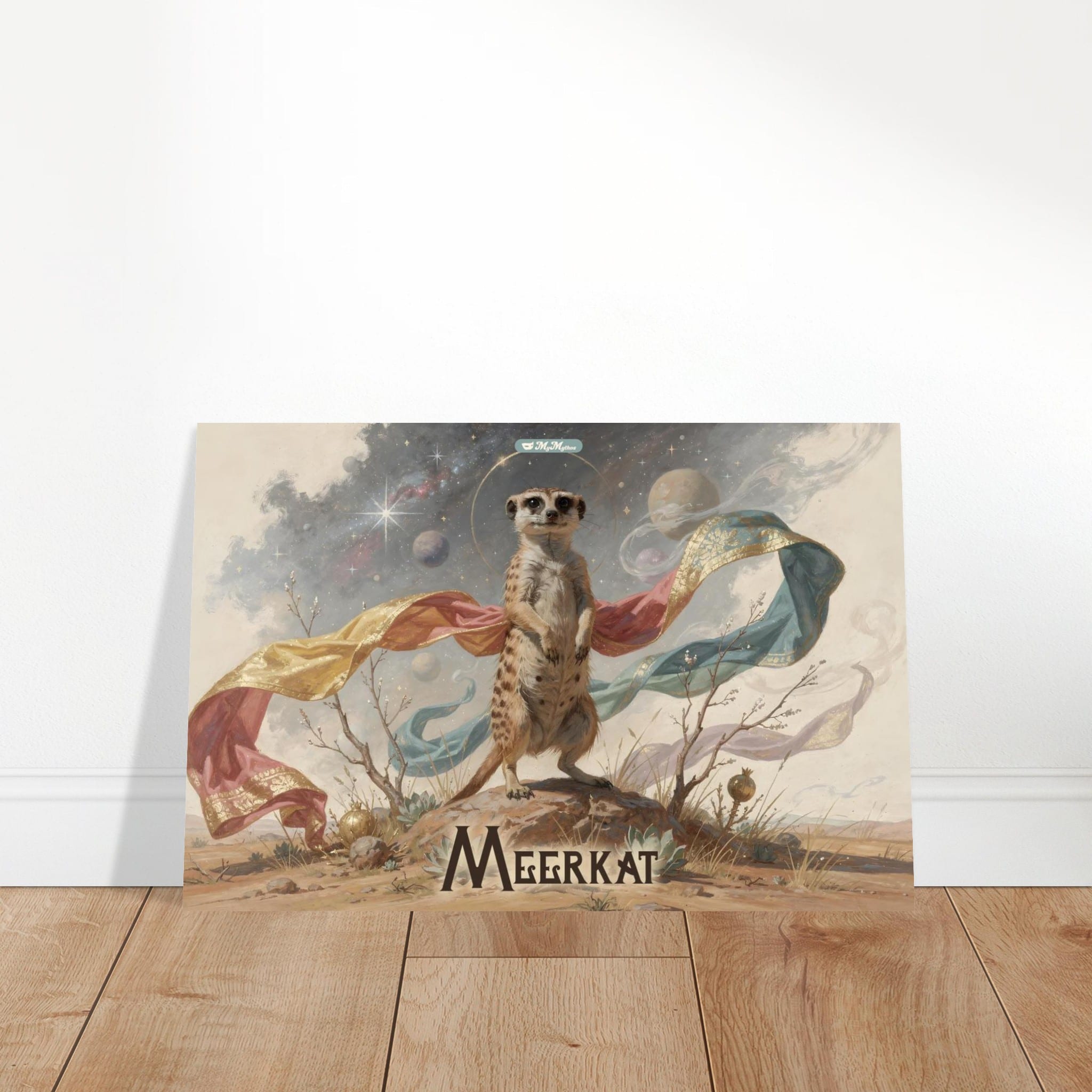
On your wall
Material
Sale! Was $19.00, now $14.25
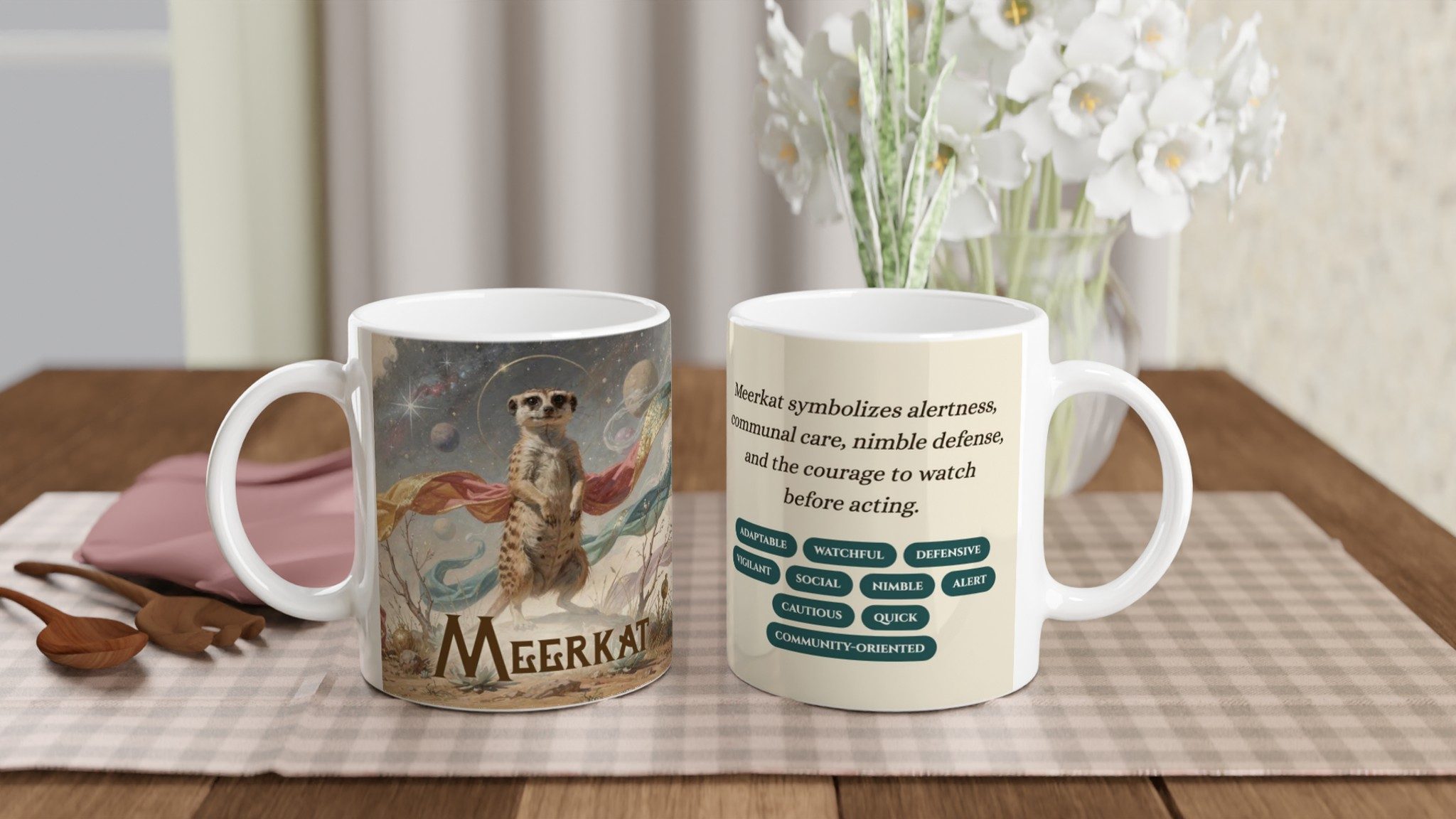
In your hands
Size
Color: White
Sale! Was $18.00, now $13.50
From elsewhere
Paid links: if you buy through these, MyMythos earns a small commission at no cost to you.