

Dream meaning
Dreaming of Being Lost
What it could mean, and what it might be pointing at
In short
Dreaming of being lost often points to uncertainty, divided direction, or a life whose landmarks no longer feel reliable. The place, your company, and the feeling on waking may change the reading most.
- A city: Possibly too many choices, demands, or unfamiliar social rules.
- A building: May point to a complicated inner or practical situation.
- Alone: Could reflect carrying uncertainty without enough support.
- No way home: May echo distance from comfort, belonging, or a settled decision.
By Sidian M.S. Jones, personal mythologist, read against the dream research in our sources. How these pages are made

While you slept
The reading
What Dreaming of Being Lost Could Mean
A dream about being lost often gathers around a simple human problem: you are moving, but the signs that once told you where you were no longer help. The dream could belong to a job that has changed shape, a relationship that has become difficult to read, a decision with no clean answer, or a version of yourself you have outgrown. Being lost in a dream does not necessarily suggest failure. It may show that an old map is being tested.
The setting gives the feeling somewhere to live. A 
Your emotion on waking matters more than any fixed symbol. Panic may point to pressure that has not found words. Frustration may fit a problem that keeps resisting your efforts. Relief, curiosity, or even pleasure could suggest that part of you wants freedom from a route chosen by other people. If you woke feeling calm, the dream may be giving you permission to pause rather than warning you to hurry. If you woke frightened, it may be worth asking what currently feels impossible to navigate.
The myth beneath it

I am
I cannot tell if I chose my life.

The world is
A group you join alone never fully feels like yours.
I am
I follow whoever sounds the most certain.

What is coming
I will end up wherever other people steer me.
I am
If I do not reach out first, nobody reaches out to me.
The world is
If you agree with everyone, nobody can tell what you want.
I am
I do not know what I want when nobody is asking.

Other people are
Most people are hiding how unsure they really are.
I am
I cannot tell how good I actually am.
The world is
If you never decide, the decision still gets made.
I am
I cannot tell if I chose well or just got lucky.
What is coming
I will never be more than competent.
I am
I am waiting for a sign before my life can begin.
I am
My best results were luck I could not repeat.

Where You Were
Lost in a City, Hotel, Mall, or Airport
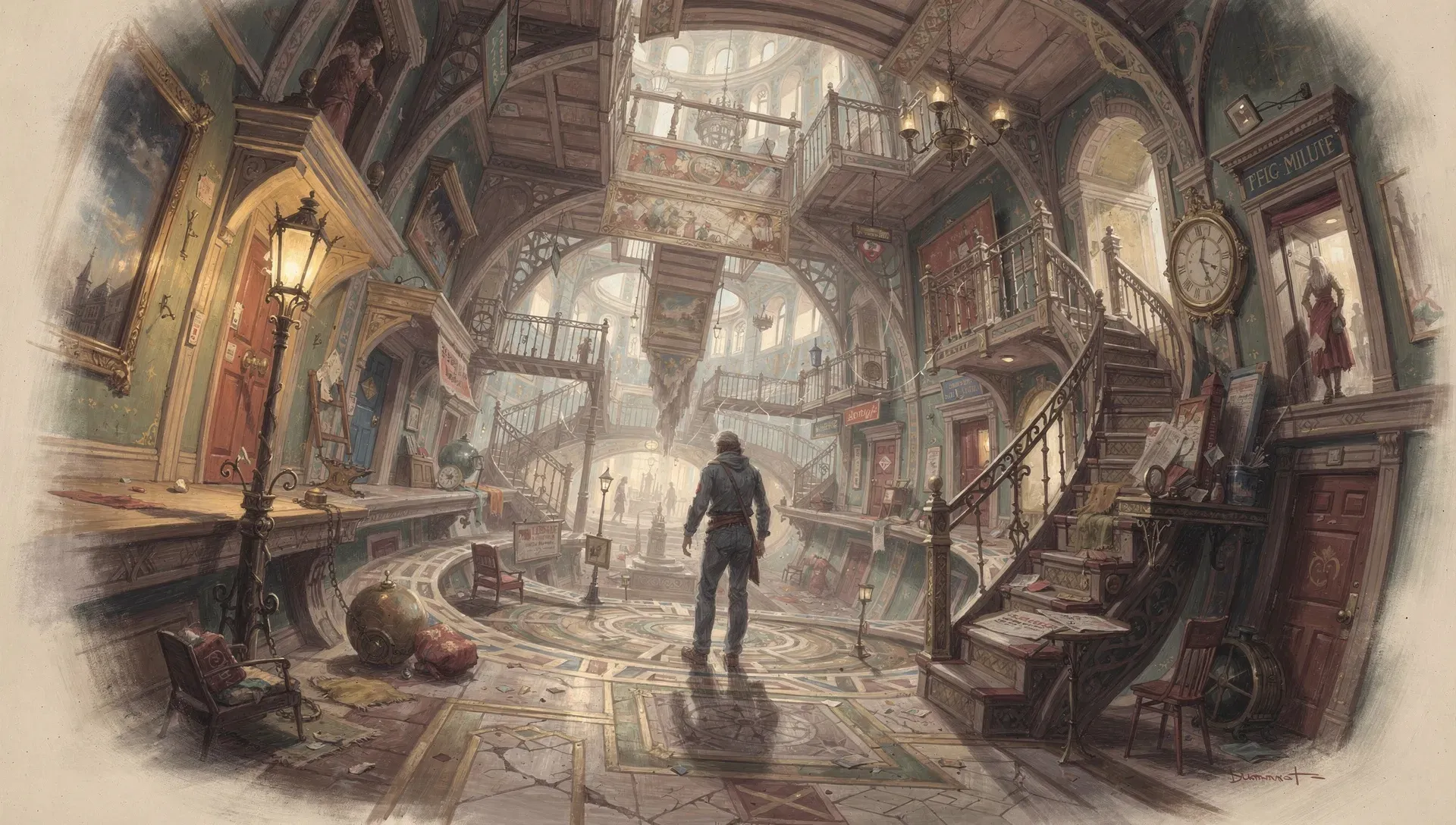
The place in a being lost dream can show what kind of uncertainty your mind is staging. A public place may make the problem feel exposed or crowded, while a private place can suggest confusion closer to home. These settings are possibilities, not verdicts. Notice what the place demanded from you and what you were trying to reach.
A city
Being lost in a city could reflect too many options, social demands, or unfamiliar rules. A strange city may stand for a new role or environment where everyone else seems to know how things work. A familiar city that has become unreadable may point to change in a life you once understood.
A building
Being lost in a building may turn uncertainty inward. An 

A hotel or mall
A hotel can suggest a temporary stage, somewhere you are staying without feeling settled. A mall may bring choice, comparison, and the pressure to select among attractive possibilities. In both settings, the dream could ask whether you are spending energy navigating other people's routes instead of choosing your own.
An unknown place
Being lost in an unknown place, a foreign country, or the woods may fit a transition where familiar skills no longer feel sufficient. The unknown does not automatically make the dream negative. Fear may show strain, while wonder or calm may suggest room to explore before committing.
Sea, station, or airport
Being lost at sea, on a cruise ship, in a train station, or at an 

Your own dream
Write Down Your Dream
Dreams fade by breakfast. Write yours on your page while it is still clear: what happened, where you were, how it felt. It is free, and it stays yours.
Morpheus, keeper of dreams, reads the dreams you have written down for members on a paid plan. Meet Morpheus
Why it keeps coming
Why You Keep Dreaming of Being Lost
The body can help build this dream. Poor sleep, fever, unfamiliar surroundings, alcohol, some medications, and waking repeatedly during the night can make dreams more vivid and easier to remember. Jaw tension, a full bladder, heat, or a cramped sleeping position may add alarm to the story without providing its whole explanation. Check the physical conditions before treating the dream as a message.
The mind often uses a recurring setting when a concern remains active. In a recurring dream of being lost, the repeated streets or rooms may be less important than the repeated feeling: helplessness, urgency, embarrassment, loneliness, or the stubborn hope of finding a way through. The same pattern can return when you keep postponing a decision or when a problem changes faster than your coping strategy.
Life supplies the material. Moving, starting work, ending a relationship, caring for someone, becoming responsible for money, or losing a familiar routine can all leave you without reliable landmarks. Ask what changed shortly before the dream began, and what you were trying to find. Why you dream about being lost may have a practical answer before it has a mystical one. "


When you wake
What to Do After Dreaming of Being Lost
- Write down the place, companions, emotion, and destination before the details fade.
- Check sleep quality, stress, medication, alcohol, illness, and physical discomfort.
- Name one waking decision that currently feels unclear, then choose its next small step.
- If the dream keeps frightening you, discuss recurring nightmares with a qualified clinician.

Spiritual meaning
The Spiritual Meaning of Being Lost Dreams, and How Faiths Read Them
In older dream traditions, being lost could be read as a condition of the soul or the conscience, but not as a fixed prediction. Artemidorus, writing in Oneirocritica, treated dream images through the dreamer's circumstances and associations rather than a universal dictionary.
A spiritual reading might therefore ask where your inner compass feels borrowed, neglected, or divided. The dream could become an invitation to examine a choice, return to a value, seek counsel, or accept a period of not knowing. Folk belief sometimes treats finding the way home as fortunate and wandering without end as troubling, but the emotional ending matters. A frightening dream may be a prompt for care, while a peaceful one may accompany necessary change.

Each faith's own reading, in its own terms and credited to its source. These are theirs, not ours. The book under each is a paid link: MyMythos earns a small commission if you buy through it.
In Christianity
Ecclesiastes 5:3 links dreams with the abundance of activity and cares, rather than giving every dream a supernatural message. Christian readers may also place feeling lost beside the Bible's lost sheep and lost coin in Luke 15, stories about absence and recovery, without treating your dream as a prediction.
Ecclesiastes 5:3; Luke 15:1-10
In Islam
Islam has no teaching on this dream by name, but Qur’an 93:7 places the image of being lost before guidance: “And He found you lost and guided [you].” The verse reminds the Prophet that God found him lost and guided him. Readers of the passage may notice its movement from being lost toward guidance.
Qur'an 93:7
In Hinduism
Hinduism has no teaching on this dream by name, but Chandogya Upanishad 6.14.1 describes a man led blindfolded from Gandhara and left in a desolate place, crying that he is lost. A guide points the way home. Readers have taken this image as the soul led astray, then finding its path through a teacher, not as a teaching about dreams.
Chandogya Upanishad 6.14.1
In Buddhism
Buddhism has no teaching on this dream by name, but its image of being lost can be read through a familiar Buddhist comparison. In the Digha Nikaya, King Ajatasattu praises the Buddha as one who helped him, like someone “to show the way to one who was lost.” The passage concerns the image, not dreams themselves.
Digha Nikaya 2 (Samannaphala Sutta)
What dream research says
What Dream Research Says About Being Lost Dreams
The continuity hypothesis, developed in dream research by G. William Domhoff, proposes that dreams commonly reflect waking concerns, relationships, and emotions. That does not prove a city dream has one translation. It supports starting with the uncertainty, pressure, or transition already present in your life.
Antti Revonsuo's threat simulation theory proposes that dreaming may rehearse threats and responses. A dream of being lost can fit that model when it includes urgency, danger, pursuit, or the need to find shelter, but the theory does not show that every lost dream is a warning. Some dreams may simply continue ordinary planning and emotion.
Nielsen and colleagues' 2003 study of 1,181 Canadian university students found that being chased was the most commonly reported dream theme, which shows how widely certain dream situations are shared. Shared themes do not come with a fixed codebook, so the personal meaning may lie in the feeling. What you feared, wanted, or could not reach may tell you more than the street name.
The book links are paid links: if you buy through them, MyMythos earns a small commission at no cost to you. Papers link to the paper itself.
- Krippner, Bogzaran and de Carvalho, Extraordinary Dreams and How to Work with Them, SUNY Press, 2002.
- G. William Domhoff, The Scientific Study of Dreams, 2003
- Calvin S. Hall and Robert Van de Castle, The Content Analysis of Dreams, 1966
- Antti Revonsuo, The Reinterpretation of Dreams: An Evolutionary Hypothesis of the Function of Dreaming, Behavioral and Brain Sciences, 2000
- Nielsen et al., The Typical Dreams of Canadian University Students, Dreaming, 2003
- Artemidorus, Oneirocritica, second or third century
- Ecclesiastes 5:3; Luke 15:1-10
- Krakow and colleagues, Imagery Rehearsal Therapy for Chronic Nightmares in Sexual Assault Survivors with PTSD, JAMA, 2001
- Morgenthaler et al., Position Paper for the Treatment of Nightmare Disorder in Adults, Journal of Clinical Sleep Medicine, 2018

The waking mind
Readers' dreams
Have You Had This Dream?
No one has shared a being lost dream here yet. Tell yours, in your own words, and it may help the next person who has one.
Share your dreamBeyond the dream
Archetypes Close to This Dream

Common Questions About Dreaming of Being Lost
- What does being lost in a dream mean?
- Dreaming of being lost often points to uncertainty, divided direction, or a life whose landmarks no longer feel reliable. The place, your company, and the feeling on waking may change the reading most.
- Why do I always dream about being lost?
- A recurring dream may return because the waking concern or emotional pattern remains active. Notice whether each dream repeats loneliness, urgency, embarrassment, or difficulty choosing, then look for a current situation that carries the same feeling.
- How do I stop dreaming about being lost?
- Check sleep quality, illness, medication, alcohol, stress, and physical discomfort first. Write a new ending in which you find help, a landmark, or a safe room, then rehearse it awake for several minutes. This is imagery rehearsal therapy, recommended for recurring nightmares by Krakow and colleagues in JAMA in 2001 and the American Academy of Sleep Medicine's 2018 position paper.
- Is dreaming of being lost a good or bad sign?
- It could feel troubling if the dream brings panic, isolation, or danger, and it may point to pressure that needs attention. It could also be useful or even positive if you felt curious, calm, or free from an old route. The ending and waking emotion matter.
- What does the Bible say about dreaming of being lost?
- The Bible does not give a single rule for this exact dream. Ecclesiastes 5:3 connects dreams with many cares and activity, while Luke 15 uses lost sheep and a lost coin in stories of absence and recovery. Those passages may offer reflection, not a guaranteed interpretation.
- What does being lost with someone in a dream suggest?
- The other person may represent your relationship with them, a shared problem, or a quality you associate with them. Feeling supported could point to companionship during uncertainty. Feeling abandoned or responsible for them may show where the relationship currently feels uneven.
- Can being lost in a dream be spiritual?
- Possibly. Folklore and older dream writing sometimes treat lost roads as images of uncertain direction or moral confusion. A spiritual reading may help you examine your values and choices, but the dream does not by itself prove a warning, prophecy, or message from God.