
Swordfish
Symbolism, Meaning & Spirit Animal
A swordfish is a large ocean fish with a long flat bill like a sword that it uses to slash at schools of smaller fish. Swordfish symbolizes relentless focus, strategic independence, and the courage to pierce cleanly through resistance.
By Sidian M.S. Jones, personal mythologistHow these pages are made
Encounters
Meet Swordfish inside a story
The Symbolism & Meaning of Swordfish
The swordfish carries its answer in the architecture of its body. Its bill is not ornamental. It helps the fish slash through schools of prey, while its speed lets it return for what the first pass has stunned. Symbolically, this makes Swordfish less about indiscriminate aggression than about a precise use of force. The point is not to hit everything. The point is to enter the right current, identify the opening, and spend power where it changes the water.
Its hunting life also gives the archetype a distinctive relationship with focus. Swordfish pursue squid and fish across open ocean, often moving through great depths and changing temperatures. Heat-producing tissue around the eyes and brain helps them see and coordinate in cold water. The image is striking because the creature does not wait for perfect conditions. It carries the means to remain alert when the environment would dull another hunter's senses. Swordfish therefore speaks to attention that survives uncertainty, distance, and pressure.
Find your magnetic north, and pursue it with the unwavering focus of my bill. The depths hold the truths you seek.
Migration adds another layer. Swordfish are not fixed to one familiar patch of sea. They travel between feeding and spawning grounds, following temperature, prey, and season. This is not restless wandering. It is movement with biological reasons, a life that recognizes when one water has stopped providing what is needed. The archetype can consequently belong to people who must leave a known place without treating departure as failure. Their direction may look severe from shore, but it follows a deeper reading of conditions.
The 
There is beauty in the danger, but the danger should remain visible. A sword is useful because it can injure. Focus can become fixation; independence can become exile; speed can become a way to avoid feeling the water around the body. The mature meaning of Swordfish is not constant attack. It is disciplined penetration: seeing what is actually before you, choosing the necessary force, and then knowing when the passage has been made. Its power is cleanest when it does not need to advertise itself.
Swordfish as a Spirit Animal, Totem & Power Animal
When Swordfish arrives as a spirit animal, totem, or power animal, it often arrives through attraction to the open route rather than the protected one. You may recognize yourself in a creature that hunts far from shore, crosses changing waters, and carries its weapon as part of its own anatomy. The connection is not a command to become hard. It is an invitation to notice what your attention does when conditions grow cold, crowded, or uncertain.
As a spirit animal, Swordfish can accompany a period when your life needs a decisive line. You may have spent too long answering every demand, explaining every instinct, or treating every obstacle as equally important. This animal narrows the field. It asks what you are actually pursuing, what evidence tells you the pursuit remains alive, and what distractions have mistaken themselves for duty. Its presence is swift, but not careless. The fish studies movement, tracks prey, and commits when the opening is real.
As a totem, Swordfish describes a recurring family or personal pattern of migration. People carrying this archetype may be drawn to travel, research, the sea, difficult projects, or work requiring sustained concentration. They often recognize a place or purpose by the quality of its current. A stagnant environment can feel physically wrong, while a demanding one may restore them if it offers direction. Their independence is strongest when it serves a living purpose rather than merely opposing other people.
As a power animal, Swordfish can be called upon when resistance has become diffuse. Its strength is not endless exertion. It is the ability to concentrate force in a narrow, useful stroke. Before acting, you might ask what the fish would detect: where the prey moves, where the water changes, where an apparently solid barrier has a seam. The answer may require patience. A predator that attacks at every flash would soon waste itself.
This archetype also asks for honest care of the instrument. Swordfish eyes and brains benefit from specialized warmth, allowing perception in deep, cold water. Your own capacity to see clearly may depend on rest, solitude, movement, or a change of environment. Protecting those conditions is not indulgence when your work depends on them. Nor is leaving a depleted place betrayal. Migration can be a form of intelligence.
The relationship becomes mature when the sword is no longer confused with identity. You can lower it. You can turn. You can travel without making every encounter a target. Swordfish gives you a way to move through resistance with elegance, provided you remember that the 
Which of these is also you?
Collect 8 to make a mythos.
These archetypes were chosen because you are reading about Swordfish.
Swordfish in Mythology & Folklore: Where the Symbolism Comes From
The oldest written symbolism attached specifically to swordfish is Mediterranean and practical before it is mystical. Aristotle, writing in fourth-century BCE Greece, described the xiphias, the fish named for its sword, in his accounts of sea life. Pliny the Elder later included the swordfish in Natural History, where its projecting snout appears as a weapon and a means of attack. These authors did not make it a god or a moral emblem. They recorded a creature whose body seemed to carry its purpose visibly: a fish armed at the front, built for pursuit.
That image entered the visual culture of the ancient Mediterranean. Fish appear in Greek and Roman mosaics, coins, vessels, and wall paintings, although species were often rendered schematically and modern identifications can be uncertain. A long-billed fish could be read as a swordfish, a billfish, or another large sea fish. The distinction matters. Later retellings sometimes give the swordfish a mythology that belongs more securely to the general ancient imagination of the sea than to a named swordfish tradition.
In the western Pacific and Indian Ocean, swordfish were known through fishing communities that understood their seasonal movements, dangerous strength, and value as food. In Hawaiʻi, the name aʻu refers to swordfish, while other billfish carry other names. Hawaiian fishing culture preserves extensive knowledge of ocean species, fishing grounds, winds, currents, and kapu, but swordfish should not casually be assigned the stories of Kūʻula-kai or the 
The same caution applies in Māori and wider Polynesian contexts, where long-billed billfish are frequently grouped in modern English under marlin or swordfish. A traditional account about a marlin, broadbill, or an ancestral sea creature cannot be transferred simply because the English names overlap. In Japan, the swordfish is known as mekajiki, and it belongs to established culinary and fishing knowledge, but it does not possess a single nationally shared symbolic role comparable to the 
What survives most clearly across these places is a visual reading rather than a codified myth. The fish's bill suggests a spear, blade, or lance. Its migrations connect distant waters, and its sudden attacks make it a creature of timing rather than brute persistence alone. Some modern spiritual writing therefore treats it as a power animal of penetration and direction. Older Mediterranean natural history, by contrast, presents the same feature without reverence: a weapon is simply an adaptation. That contrast is useful. One tradition romanticizes the blade; the other observes the hunter. Both begin with the same fact, that the swordfish enters the water already equipped to cut a path through it.




Swordfish and Its Relationships With Other Archetypes

Ace of Swords
“Ace of Swords is one clean blade of truth; my whole face points the same way.”
In tarot, Ace of Swords stands for a breakthrough of clarity, a single decisive cut through confusion. Ace of Swords and Swordfish together describe a mind that goes straight to the point and stays there, sometimes leaving bruises along the way.
Visit Ace of Swords
Ship
“Sailors have pulled my broken bill from the timbers of their wooden hulls.”
There are recorded cases of swordfish ramming wooden ships, and museums keep planks with a bill still lodged in them. Ship beside Swordfish is the cost of relentless focus, the force that sometimes charges the wrong target and leaves part of itself behind.
Visit Ship
Hunter
“I slash through a school of fish with my flat bill, then turn back for the stunned ones.”
Swordfish hunt by swiping their bill sideways through schools of prey rather than spearing them. Hunter and Swordfish together suit a person who is strategic about their strength, using it to make an opening and then moving in calmly.
Visit Hunter
Midnight
“By day I hunt in the cold deep; at midnight I rise toward the surface.”
Swordfish dive hundreds of meters during the day and come up into shallower water at night, following their prey. Midnight beside Swordfish is the independent rhythm of a person who keeps their own hours and does their best work while others sleep.
Visit Midnight
Ocean
“A special organ warms my eyes and brain, so I see sharply in Ocean's cold dark.”
Swordfish have a heater organ that keeps their eyes and brain warmer than the surrounding water, helping them spot fast prey in the deep. Ocean and Swordfish together describe focus as something you protect on purpose, kept warm against everything around it.
Visit Ocean
Swordfish also keeps company with the fishs: Blobfish, Eel, Koi Fish, Minnow, Seahorse and Trout, among nine other fishs.

Swordfish in Dreams: Meaning & Interpretation
Dreaming of a swordfish often gathers around a single penetrating aim. The dream may come when scattered concerns have begun to feel like open water and some part of you wants one clean direction. Because the fish hunts by speed, sight, and timing, it can represent a decision that requires more than force. You may be looking for the exact point where effort will matter, rather than spending yourself against every obstacle.
The dream is doing more than announcing determination. It may be sorting signal from movement, showing you what deserves pursuit and what only flashes past. A calm swordfish can lend the dream a sense of disciplined independence, especially when you have been crowded by other people's urgency. A threatening one may expose the cost of living with the point always forward. Its presence asks whether your focus is opening a route or narrowing your life until nothing else can enter.
A swordfish moving through clear water may mark a welcome period of direction, when a long-delayed choice is becoming legible and your energy can travel without needless resistance. A swordfish cutting through dark water can point to insight working before certainty arrives, with the dream asking you to trust careful observation rather than panic. A swordfish swimming beside you may suggest that independence need not mean isolation.
A swordfish charging you may begin with a warning about your own momentum, particularly if the dream leaves you cornered or unable to turn. A broken bill can reflect frustrated agency, a plan whose chosen instrument no longer works, or a refusal to change tactics. A swordfish tangled in a net may show focus captured by obligation. If you kill one, the dream may be staging victory over resistance, but it may also ask what valuable force has been spent simply to prove that you could win.
Swordfish: Positive & Negative Meanings
Positive Meanings
- Relentless pursuit of meaningful goals
- Strategic use of energy and timing
- Independent judgment under pressure
- Swift response when an opening appears
- Focused attention in difficult conditions
- Resolute movement through resistance
- Insightful reading of changing circumstances
Negative Meanings
- Fixation disguised as purpose
- Impatience with slower companions
- Isolation mistaken for strength
- Sharpness that injures useful bonds
- Migration used to avoid commitment
- Relentless effort after the goal has changed
- A narrow view of what deserves pursuit

The Shadow of Swordfish
The shadow of Swordfish appears when precision becomes compulsion. A person carrying this archetype may begin to treat every disagreement as something to pierce, every delay as an insult, and every relationship as a current that either advances the mission or obstructs it. The bill that once made clear action possible becomes a permanent posture. Nothing can approach without being measured for resistance.
Its independence can also grow possessive. Swordfish hunts alone, and the image may tempt someone to believe that needing help proves weakness. They may migrate from one project, place, or intimacy to another before anyone can ask them to remain present. Movement protects them from entanglement, but it can also prevent the slow work by which trust becomes more than admiration for competence.
The shadow is especially sharp around focus. Narrow attention can produce brilliant results, yet it can hide hunger, grief, fatigue, and collateral damage. A person may win the argument, secure the position, or break through the obstacle while losing the reason the effort mattered. The remedy is not to blunt the sword or abandon ambition. It is to widen perception before striking, to notice the surrounding water, and to accept that turning is sometimes a more intelligent act than impact.
How Did You End Up at Swordfish?
What were you keeping safe from when you first learned to keep your bill pointed forward, and is that threat still moving beneath your waters?
Which praise, payment, or affection made you prized for striking cleanly at the right target, until the hunting posture hardened into your character?
What currents, companions, or softer appetites did you give up to remain swift and focused, and when did you first feel their absence?
If you could turn from the long migration and choose another shape now, what might you become, and which current closed that route?
Has Swordfish turned up in your life, in a dream, a moment, a person? Put it on your page and join its kin, or tell the first story and take the Top Active seat.


 Written by Warren,
for you alone
A reading by Warren
What Swordfish means for you
This page says what the Swordfish means. Warren can tell you why it is showing up for you, now.
Swordfish: Frequently Asked Questions
- What does Swordfish symbolize?
- The swordfish carries its answer in the architecture of its body. Its bill is not ornamental.
- What is the spiritual meaning of Swordfish?
- When Swordfish arrives as a spirit animal, totem, or power animal, it often arrives through attraction to the open route rather than the protected one. You may recognize yourself in a creature that hunts far from shore, crosses changing waters, and carries its weapon as part of its own anatomy.
- What does Swordfish represent?
- The oldest written symbolism attached specifically to swordfish is Mediterranean and practical before it is mystical. Aristotle, writing in fourth-century BCE Greece, described the xiphias, the fish named for its sword, in his accounts of sea life.
- What does it mean to dream about Swordfish?
- Dreaming of a swordfish often gathers around a single penetrating aim. The dream may come when scattered concerns have begun to feel like open water and some part of you wants one clean direction.
- What is the shadow side of Swordfish?
- The shadow of Swordfish appears when precision becomes compulsion. A person carrying this archetype may begin to treat every disagreement as something to pierce, every delay as an insult, and every relationship as a current that either advances the mission or obstructs it.
- What are the positive and negative meanings of Swordfish?
- Relentless pursuit of meaningful goals. Fixation disguised as purpose.
- What does a Swordfish tattoo mean?
- Often, a person wears a Swordfish to keep a chosen direction visible on the body. Some choose it for independence, endurance, or a remembered sea. Others may be claiming a sharp passage through grief, change, or resistance.
Characteristics of Swordfish
- Color:
- blue, white
- Covering:
- bare-skinned
- Form:
- finned
- Size:
- large
- Kind:
- fish
- Diet:
- piscivore
- Active when:
- cathemeral
- Habitat:
- ocean
- Element:
- water
Swordfish are built around pursuit in open water, with a rigid upper jaw, a streamlined body, large eyes, and heat-exchange organs that keep the eyes and brain warmer than the surrounding sea. That thermal advantage supports rapid visual hunting in cold, deep water. Adults usually shed the scales and teeth of their youth, and their bill is used to slash or stun prey rather than to skewer it cleanly. The result is a predator whose unusual anatomy concentrates speed, vision, and controlled impact.
Get the next one
Essays on personal mythology, archetypes, and the stories we tell ourselves.
Take Swordfish home
Printed to order and shipped to you. Please allow a few extra days for production.
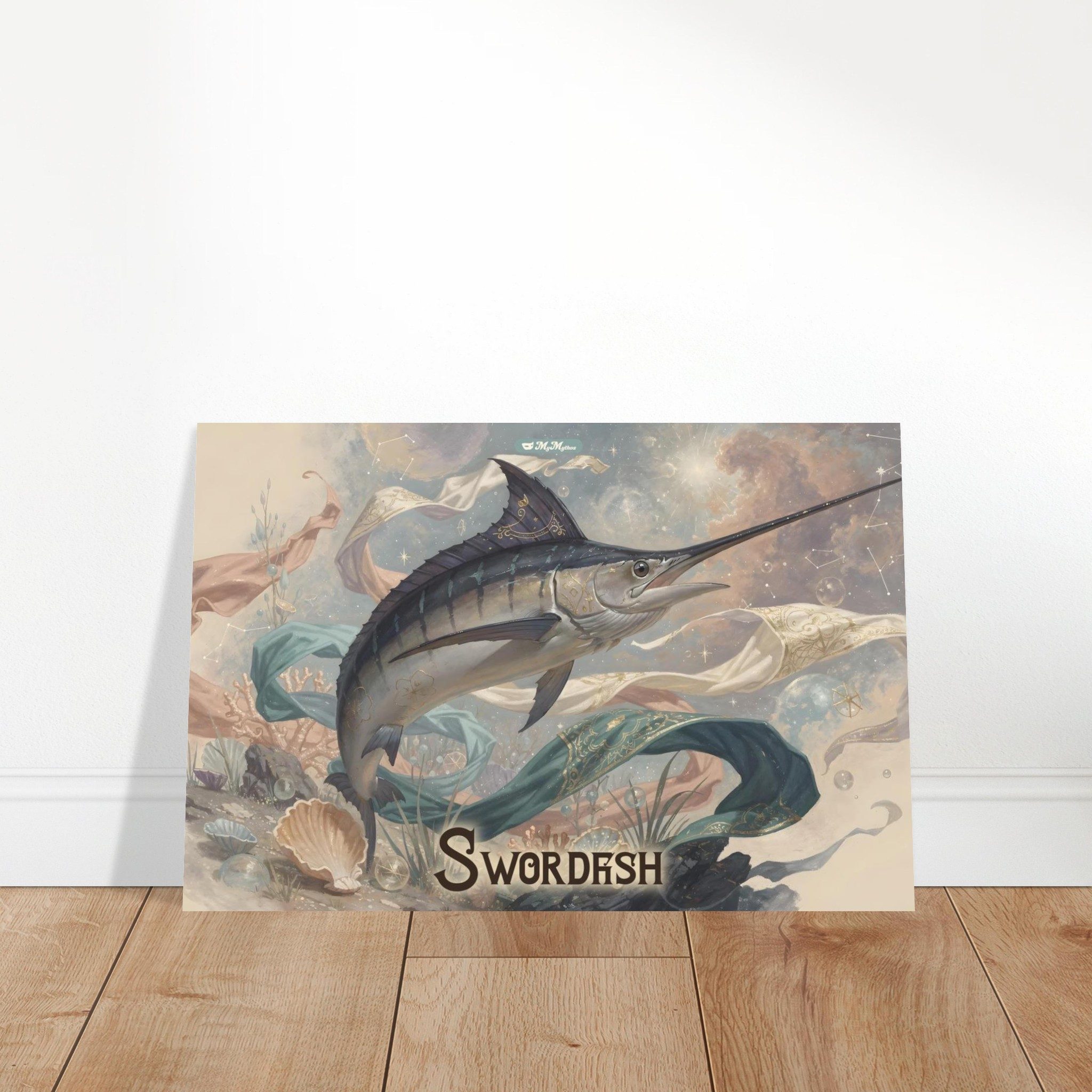
On your wall
Material
Sale! Was $19.00, now $14.25

In your hands
Size
Color: White
Sale! Was $18.00, now $13.50
From elsewhere
Paid links: if you buy through these, MyMythos earns a small commission at no cost to you.