
Pony
Symbolism, Meaning & Spirit Animal
A pony is a small breed of horse, usually standing under about 14.2 hands, or 58 inches, at the shoulder. Pony symbolizes gentleness, independence, resilience, and the freedom to move through life at your own pace.
By Sidian M.S. Jones, personal mythologistHow these pages are made
The Symbolism & Meaning of Pony
Pony means a form of strength that does not need to look imposing. It comes from the animal's actual arrangement of qualities: a compact body, a steady appetite, a thick coat, quick feet, and a long partnership with human beings. The pony survives on marginal ground, reads the mood of a herd, and carries loads far beyond what its appearance suggests. Its power is not the blast of a predator. It is the power to keep going, to remain useful, and to make difficult terrain negotiable.
That is why Pony often belongs to people who are underestimated. The archetype does not ask you to become louder, larger, or more intimidating. It gives dignity to the person who has learned to work with limited space, limited resources, or a body and temperament that do not match someone else's ideal. A pony does not waste energy pretending to be a racehorse. It finds footing, lowers its head, and gets across.
Pony also symbolizes affectionate independence. Domestication has not erased the animal's need for social order or open movement. A pony may bond closely with a person, yet it still has a mind of its own. It can refuse a fence, stop at a puddle, flatten its ears, or choose the pace of the 
Let your heart guide your hooves, and you will find your way home.
The image carries innocence, but not naivety. A pony's softness invites approach, and its association with children, stories, and fairy landscapes can make it seem harmless. Yet ponies can bite, kick, bolt, and defend food or territory. Their caution has a physical basis. They know that a small body can be injured, so they inspect, resist, and conserve themselves before committing. In personal mythology, this makes Pony a symbol of gentleness with boundaries rather than gentleness as surrender.
The archetype is especially vivid around speed. A pony may spend hours grazing, standing, or moving with deliberate economy, then cross a field in a sudden burst. The contrast matters. Freedom is not always a dramatic escape; sometimes it is the knowledge that the 
At its best, Pony means a life made trustworthy through repeated contact with reality. It favors the person who notices the quality of the ground, the strength of the fence, the hunger in the herd, and the difference between a hand that guides and a hand that takes. Its magic is not an escape from the ordinary. It is the 
Pony as a Spirit Animal, Totem & Power Animal
As a spirit animal, Pony arrives through the contrast between tenderness and force. You may be drawn to it after loving a particular pony, returning to an image from childhood, or recognizing your own life in an animal that seems approachable until it plants all four feet and refuses. The connection does not depend on pretending the pony is human. It begins with attention to the actual creature: its grazing, herd awareness, sudden speed, thick winter coat, and ability to live on rough country.
To have Pony as yours is to carry a small-looking strength. You may move through rooms where people have already decided what you can handle, then quietly handle more than their estimate allowed. Pony does not urge you toward domination. It asks you to develop reliable footing, to know what you eat and what drains you, to stay near people who understand your signals, and to leave situations in which every request arrives as a bridle.
The archetype also gives permission to be visibly affectionate without becoming available to everyone. Ponies form social bonds and communicate through touch, posture, calls, and proximity, but they do not offer the same trust to every hand. Your warmth can remain selective. You can nuzzle a friend, stand shoulder to shoulder with your herd, and still pin your ears at a demand that crosses the line.
Pony's power is often needed when life has become too grand in its demands. A crisis may ask for a heroic identity, a perfect transformation, or a dramatic severing from the past. Pony brings the question back to the next patch of ground. Can you eat, rest, repair the fence, choose a safer route, and move one body-length at a time? These acts may look modest, but they restore the conditions in which speed and courage become available.
As a totem, Pony can link a person to family history, rural work, childhood memory, or a place where animals were partners rather than decorations. In some families, the symbol follows a real animal whose patience carried a 

As a power animal, Pony is useful when you need resilient gentleness. Call on the image before entering a negotiation, beginning a long recovery, or making a change that must preserve your bonds. Picture the animal testing the ground, reading the gate, and choosing its own stride. Let the power be concrete: conserve energy, stay close to trustworthy company, refuse the unsafe crossing, and run when the opening is genuine. Pony does not ask you to become invulnerable. It asks you to remain mobile, loving, and difficult to force.
Which of these is also you?
Collect 8 to make a mythos.
These archetypes were chosen because you are reading about Pony.
Pony in Mythology & Folklore: Where the Symbolism Comes From
Pony folklore gathers around the places where domestic life touches the 
Cornish tradition gives the boundary sharper teeth. The pisky, or pixie, was sometimes said to ride or use ponies, and tales from Cornwall describe fairy beings misleading travelers, borrowing animals, or leaving a horse exhausted after a night of unseen riding. The pony's patience and strength made it a credible servant of the invisible world. Its domestic familiarity was precisely what made the image work: a person could recognize the hoofprints without knowing who had made them.
On the Shetland Islands, the native Shetland pony lived beside stories of trows, beings associated with hills, mounds, and nighttime music. The trows were not always tiny, harmless sprites. They could steal food, disturb sleep, and borrow animals, while their hidden celebrations echoed human ones. A pony moving in the dark therefore carried two possible readings. It was a tough island animal conserving warmth and energy, or it had been taken into the hills by a people who did not welcome witnesses.
The water-horse traditions of Britain and Ireland add an important contrast. The Scottish each-uisge and the Irish each-uisce were horse-shaped beings that lured riders onto their backs, then carried them into deep water. These stories usually concern a 
In Icelandic folklore, the huldufólk, or hidden people, inhabit a neighboring unseen landscape, while horses remain central to travel, work, and story. Icelandic horse lore is more strongly attached to the horse than to the word pony, yet the small, sure-footed animal fits the same northern imagination: a creature able to cross difficult land and carry a person where roads disappear. In Celtic and northern traditions alike, the pony stands close to the threshold because it is both useful and untamed, kept by people but still capable of vanishing over a ridge.
That double role shapes the symbolism. In one story, a pony carries the child safely home; in another, a mysterious rider takes it into the night. The same sturdy body can mean companionship or enchantment, protection or seduction. Pony folklore does not offer innocence without risk. It offers a living creature whose trust must be met with care, whose strength is easy to underestimate, and whose path may lead farther from the ordinary world than its familiar face suggests.




Pony and Its Relationships With Other Archetypes

Horse
“Horse is my taller kin; I am what's left when the same spirit is built close to the ground.”
A pony is not a young horse but a small breed, usually under about fourteen and a half hands and often hardier for its size. Together they describe a person who keeps a horse's strength and will without needing to be the biggest one in the field.
Visit Horse
Carousel
“Carousel copies my shape in painted wood, and every child rides it in circles dreaming of me.”
The carousel grew out of a jousting game for mounted riders and became a fairground ring of carved, painted horses and ponies. The pairing holds a first taste of freedom, offered safely, and asks when a person is ready to step off the platform onto a real back.
Visit Carousel
Mine
“Mine is where my kind once worked in the dark, hauling coal on short, steady legs.”
Pit ponies hauled coal in British mines from the eighteenth century, and the last of them retired in 1999. The pairing remembers that gentleness and endurance often live together, in a person who does hard, unseen work and still comes up to the field.
Visit Mine
Child
“Child is usually my first rider, small hands in my mane and a grown-up walking alongside.”
Ponies are often the animal through which a child first learns to care for something larger than a pet. Together they speak of trust built at a child's own pace, and of a person who still remembers what it felt like to be trusted with a living creature.
Visit Child
Independence
“Independence is my temper: I'm sweet until you push, and then I plant my hooves.”
Horse people know ponies for stubborn, clever streaks that bigger horses rarely show. The pairing describes a person who is easy company yet cannot be hurried, and who decides for themselves when to move.
Visit Independence
Pony also keeps company with the mountain: Birch, Cougar, Griffin, Panther, Sequoia and Yak, among seventy-nine others of the mountain.

Pony in Dreams: Meaning & Interpretation
Dreaming of a pony often brings the manageable form of a larger instinct. A horse can fill the dream with speed, danger, sex, war, or overwhelming freedom; a pony brings those forces nearer to the body and household. You may be meeting a desire that wants room without wanting spectacle, a stubborn feeling that has survived because it learned to conserve itself, or a part of you that still knows pleasure through touch, weather, movement, and companionship. The pony's condition matters. A healthy animal suggests available energy and a relationship with freedom that can remain affectionate. A frightened, neglected, or trapped pony may show where gentleness has been mistaken for consent.
The dream may be doing practical emotional work. It can reduce a huge question to the size of a creature you can approach, groom, feed, lead, or release. Notice who holds the reins, whether the pony chooses to follow, and what happens when the gate opens. A pony that refuses a jump may be protecting itself from a bad demand, not failing. One that runs may be carrying your wish to leave before explanation becomes another enclosure. The dream asks you to watch behavior rather than accept the role assigned to you.
A pony running through an open field often carries a welcome image of recovered appetite, movement, and freedom that does not require leaving tenderness behind. If you run beside it rather than chase it, the dream may be showing a pace at which your body and desire can cooperate.
A pony locked in a small stall, limping, or standing saddled beneath a stranger's weight is a warning about usable strength being spent for someone else's direction. A pony that bites, kicks, or refuses the bridle may mark a boundary that has become urgent, while a white pony appearing from fog can bring wonder, but it may also ask whether you are giving a beautiful story more authority than the animal's actual behavior.
Pony: Positive & Negative Meanings
Positive Meanings
- Quietly resilient in difficult conditions
- Warm, loyal, and socially attentive
- Independent without abandoning companionship
- Swift when a genuine opening appears
- Grounded in practical reality
- Protective of vulnerable people and animals
- Able to make modest resources last
Negative Meanings
- Can become stubborn under pressure
- May mistake caution for permanent safety
- Can hide refusal behind sweetness
- May stay too long out of loyalty
- Can romanticize hardship and self-denial
- May resist useful guidance as control
- Can spend too much energy proving independence

The Shadow of Pony
The shadow of Pony appears when caution becomes a permanent enclosure. A person carrying this form may call every difficult request a bridle, every unfamiliar road a dangerous mountain, and every invitation to grow an attempt to make the body perform for someone else. The original intelligence is real, but it can harden into refusal. A pony that has learned to plant its feet may eventually stop distinguishing between a harmful demand and a necessary crossing.
Another shadow is hidden stubbornness. Because Pony is associated with sweetness, a person may expect others to excuse obstruction as innocence. They may withhold a clear no, resist indirectly, then resent people for failing to understand the signals. The animal's flattened ears are honest; the human version can become passive defiance, delayed answers, or a refusal to name hunger until it turns into a kick.
Pony can also confuse loyalty with remaining in the same pasture. Herd attachment matters to the animal, but a familiar group can still be unsafe, overcrowded, or badly managed. The archetype's fear of abandonment may keep a person beside people who consume their patience while offering little care in return. Being needed can feel like belonging, especially when usefulness has been the safest route to affection.
The most dangerous distortion is romanticizing deprivation. Ponies can survive sparse forage, cold, and rough terrain, but survival is not proof that neglect is good for them. A person may take pride in needing little, refuse support, or treat exhaustion as evidence of character. The shadow loosens when resilience includes nourishment, veterinary care, rest, and enough room to move. Pony's gentleness remains strong only when it is not being starved.
How Did You End Up at Pony?
What did you stop yourself from becoming when you chose the narrow trail, the sturdy little body, and the sure footing over the wide field and the dangerous leap?
Who watched you keep your ears turned toward the gate, saw the warning in your tightened jaw, and answered with silence or the wrong command?
Where did you first discover that a quiet nicker, a steady back, or one quick run could change what happened, and what made you keep that method?
What are you still circling behind the fence to stay safe from, and is that threat beside you now, or only the old sound of a latch lifting?
Has Pony turned up in your life, in a dream, a moment, a person? Put it on your page and join its kin, or tell the first story and take the Top Active seat.


 Written by Warren,
for you alone
A reading by Warren
What Pony means for you
This page says what the Pony means. Warren can tell you why it is showing up for you, now.
Pony: Frequently Asked Questions
- What does Pony symbolize?
- Pony means a form of strength that does not need to look imposing. It comes from the animal's actual arrangement of qualities: a compact body, a steady appetite, a thick coat, quick feet, and a long partnership with human beings.
- What is the spiritual meaning of Pony?
- As a spirit animal, Pony arrives through the contrast between tenderness and force. You may be drawn to it after loving a particular pony, returning to an image from childhood, or recognizing your own life in an animal that seems approachable until it plants all four feet and refuses.
- What does Pony represent?
- Pony folklore gathers around the places where domestic life touches the otherworld. In Wales, the mountain pony belongs to the same landscape that holds stories of the Tylwyth Teg, the fair folk, and Welsh tradition preserves the coblynau and other subterranean beings who live beneath hills and mines.
- What does it mean to dream about Pony?
- Dreaming of a pony often brings the manageable form of a larger instinct. A horse can fill the dream with speed, danger, sex, war, or overwhelming freedom; a pony brings those forces nearer to the body and household.
- What is the shadow side of Pony?
- The shadow of Pony appears when caution becomes a permanent enclosure. A person carrying this form may call every difficult request a bridle, every unfamiliar road a dangerous mountain, and every invitation to grow an attempt to make the body perform for someone else.
- What are the positive and negative meanings of Pony?
- Quietly resilient in difficult conditions. Can become stubborn under pressure.
- What does a Pony tattoo mean?
- Often, a person wears a Pony to keep a bond with childhood, freedom, or a beloved animal close to the skin. Some choose it for stubborn survival in a gentle form. Others may be marking a private connection to fairy lore, open land, or a life that refuses to be hurried.
Characteristics of Pony
- Color:
- brown
- Form:
- four-legged
- Size:
- large
- Kind:
- mammal
- Diet:
- herbivore
- Active when:
- diurnal
- Habitat:
- grassland, mountain
- Element:
- earth
The pony's body is built for economical strength rather than show: a deep trunk, dense bone, and efficient movement let it carry weight across cold, uneven ground while consuming relatively little. Many breeds grow thick winter coats and change their metabolism seasonally, which helps them survive poor forage but also makes them prone to obesity and laminitis when kept on rich pasture. Their social intelligence is practical and immediate, expressed through vocal calls, grooming, spacing, and careful attention to handlers.
Get the next one
Essays on personal mythology, archetypes, and the stories we tell ourselves.
Take Pony home
Printed to order and shipped to you. Please allow a few extra days for production.
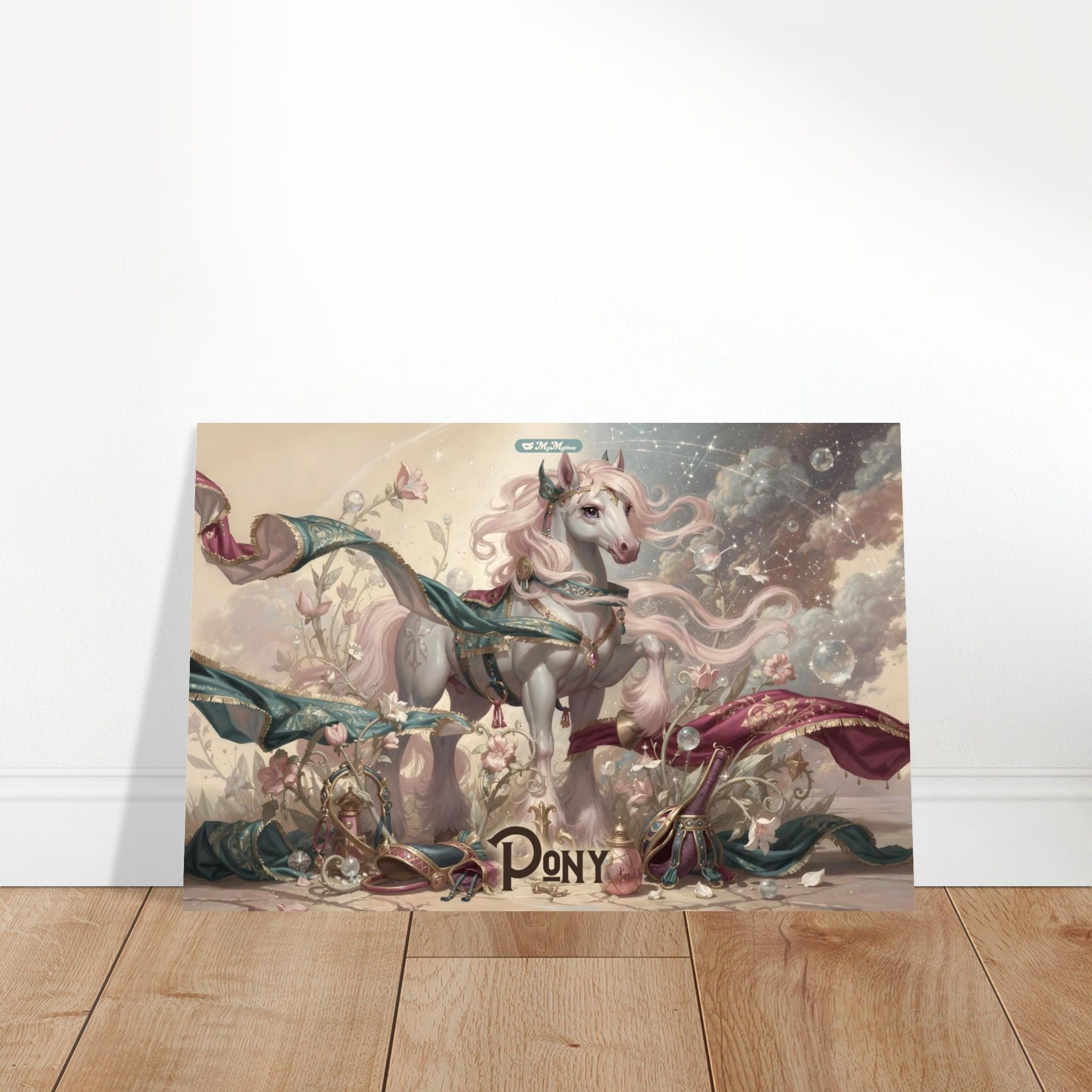
On your wall
Material
Sale! Was $19.00, now $14.25
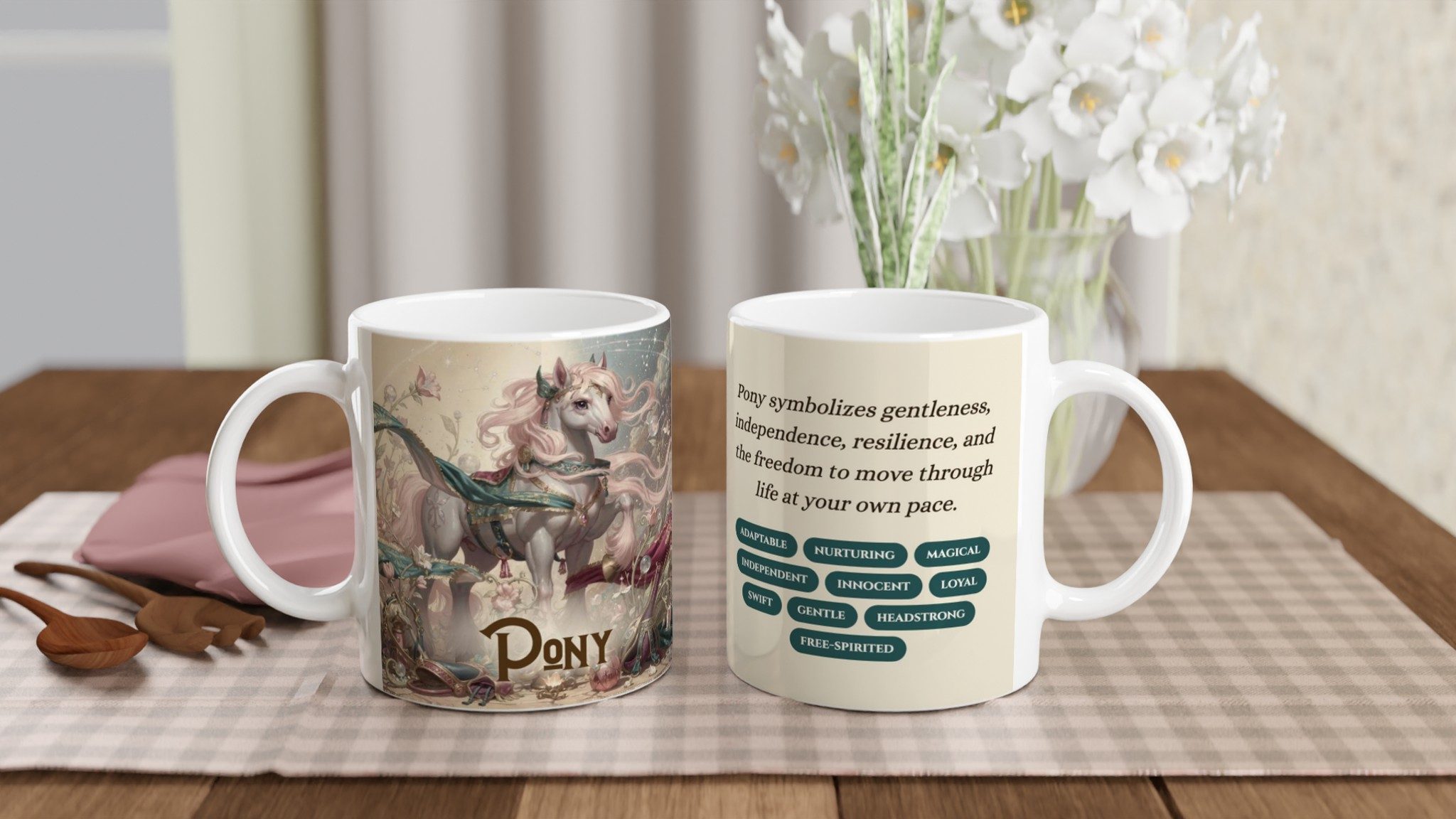
In your hands
Size
Color: White
Sale! Was $18.00, now $13.50
From elsewhere
Paid links: if you buy through these, MyMythos earns a small commission at no cost to you.