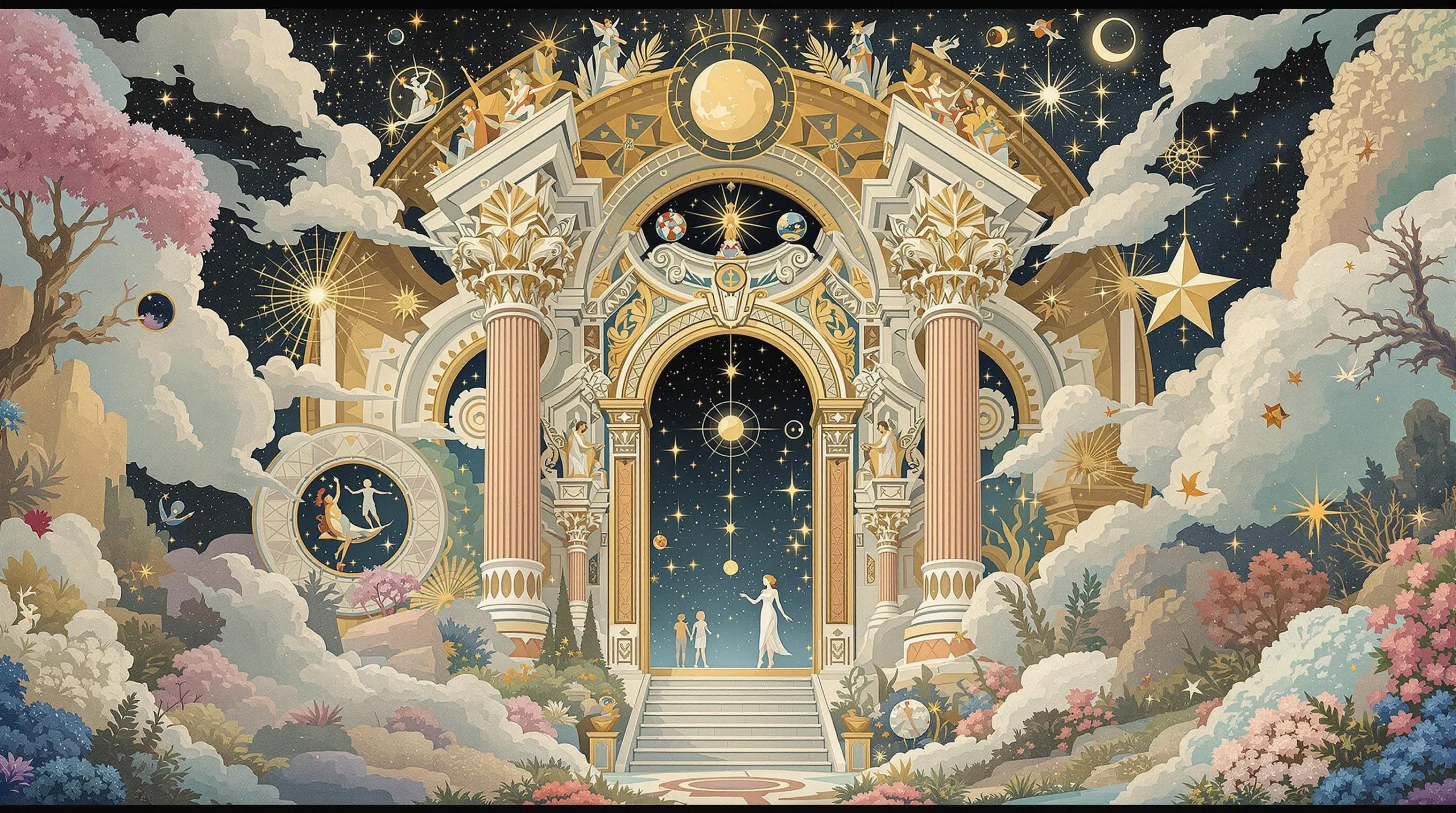


Gate

Archetype Meaning & Symbolism

Liminal, Decisive, Permissive, Restrictive, Transitional, Ominous, Inviting, Secretive, Symbolic, Defining

  • I do not create the path, I merely frame the choice. What lies beyond is a reflection of the courage you bring to my threshold.

If Gate is part of your personal mythology, you may...

Believe

  • You may believe that every significant choice you make creates a new reality, and the old one becomes inaccessible.
  • You may believe that some knowledge and some places are not for everyone, and that boundaries are a sacred and necessary part of life.
  • You may believe that the most important journeys are not across continents, but from one state of being to another.

Fear

  • You may fear making the wrong choice and finding yourself trapped on the other side of a gate with no way back.
  • You may fear that the gates to your greatest desires will remain forever locked to you.
  • You may fear that all gates are ultimately illusions, and that no real transformation is ever possible.

Strength

  • You may possess an uncanny clarity and decisiveness during major life transitions that overwhelm others.
  • You may have a profound gift for creating and respecting boundaries, which makes others feel safe and seen in your presence.
  • You may be exceptionally skilled at letting go of the past, understanding that closing one door is necessary to open another.

Weakness

  • You may be paralyzed by indecision when facing a choice, over-analyzing the infinite possibilities behind every door.
  • You may have a tendency to compartmentalize your life too rigidly, preventing a holistic sense of self from forming.
  • You may struggle with nuance and ambiguity, seeing people and situations in binary terms: in or out, with me or against me.

The Symbolism & Meaning of Gate

In a personal mythology, the Gate is rarely just a physical object. It is a potent symbol for life’s profound junctures, those moments that cleave time into a distinct 'before' and 'after.' It represents the precipice of a major decision, the charged space where potential energy is about to become kinetic. To have the Gate as a central feature of your mythos suggests a life narrative not of linear progression, but of discrete episodes, of moving from one chamber of experience to another. Each chamber has its own light, its own rules, its own texture. The passage from one to the next is never trivial; it is a momentous act that redefines the self and the world. You might see your education, your relationships, your career moves not as additions to a single life, but as passages through a series of gates into entirely new realities.

The Gate also speaks to the nature of opportunity and consequence. An open gate is an invitation, a possibility, a risk. A closed gate is a barrier, a protection, a missed chance. Your mythos may be colored by the gates you have passed through, the ones you found locked, and the ones you chose to leave unopened. This archetype forces an awareness of choice as the fundamental mechanism of fate. It is not a river carrying you along; it is a landscape of doors. The courage to turn the handle, the wisdom to know which doors to approach, and the grace to accept the ones that remain shut become the central virtues of your story.

Furthermore, the Gate can symbolize the threshold between the known and the unknown, the conscious and the subconscious, the mundane and the sacred. It is the portal in the fairy tale, the wardrobe into Narnia, the looking-glass Alice steps through. In your life, this may manifest as a fascination with transformative experiences: travel to a foreign land, the exploration of a new philosophy, or the deep dive into your own psyche through creative work or introspection. The Gate suggests a belief that other worlds, other ways of being, are always accessible. They are not in some distant heaven, but right here, just on the other side of a door, waiting for the turn of a key.


Gate Relationships With Other Archetypes

The Key

The relationship between the Gate and the Key is one of potential and actualization. The Gate, in its locked state, is pure potential, a promise and a barrier. The Key is the specific piece of knowledge, the insight, the rite of passage, or the person required to unlock that potential. One without the other is incomplete. If the Gate is a central part of your mythos, you may find yourself perpetually searching for 'keys' to unlock the next stage of your life. This could be a literal search for information or a more metaphorical quest for the right psychological tool to overcome a personal obstacle. Their relationship suggests that passage is not granted by force, but by finding the correct, often elegant, solution.

The Guardian

Where the Gate is an impersonal barrier, the Guardian is the living, conscious entity that tests those who seek entry. The Guardian and the Gate often work in concert. The Sphinx guards the gates of Thebes; Cerberus guards the gates of the Underworld. In a personal mythos, the Guardian may represent the internal or external challenges that must be overcome before a transition is possible. It could be the skeptical inner critic that must be silenced, the difficult boss who must be won over for a promotion, or the societal expectations that must be defied. The Gate is the change itself; the Guardian is the trial that proves you are ready for it.

The Path

The Path is what leads to and from the Gate. A Gate without a Path is an architectural folly in the middle of nowhere, a door with no wall. The Path gives the Gate context and purpose. In your personal narrative, the Path represents the journey, the work, the preparation. The Gate is the climax of that journey. You may believe that the nature of the path you walk determines which gates become available to you. A path of scholarship leads to the gates of a university; a path of devotion leads to the gates of a monastery. The relationship highlights that transformative moments do not happen in a vacuum; they are the culmination of the road traveled.

Using Gate in Every Day Life

Navigating Career Changes

When you stand between a familiar but stifling job and an unknown but promising venture, you are standing at a Gate. To embody this archetype is not simply to weigh pros and cons, but to recognize the moment as a sacred transition. You might perform a small ritual: writing down what you are leaving behind and burning it, then writing what you hope to find and placing it in a pocket as you step through the metaphorical 'door' of accepting the new role. It transforms a practical decision into a mythological passage, marking a clear 'before' and 'after' in your professional narrative.

Healing from Past Trauma

Recovery can be seen as approaching a heavy, long-shut Gate. On one side lies the landscape of your life as defined by the traumatic event; on the other, a future where it is an integrated part of your history, not the totality of your present. Working with the Gate archetype might involve visualizing this barrier, studying its locks and hinges. Therapy, new habits, or forgiveness may be the keys. The act of healing becomes the conscious, deliberate act of opening that gate and stepping through, choosing not to forget the old room but to no longer live inside it.

Embracing a New Identity

Major life shifts like parenthood, marriage, or a profound change in faith are passages through a Gate. The person you were before is not the person you will be after. Using the Gate archetype allows you to honor this transition. You might mark the occasion not just with a public ceremony but with a private acknowledgment of the threshold you are crossing. It helps articulate the feeling of being in-between, the liminal state where the old self is dissolving and the new one has not yet fully formed. It gives a name to the strange, sacred space of becoming.

Gate is Known For

Transition

A Gate is known foremost as a marker of passage. It does not exist for its own sake but to delineate the boundary between two states, be they physical locations, stages of life, or levels of consciousness. It is the architectural punctuation at the end of one chapter and the beginning of another.

Decision

A Gate inherently forces a choice. To approach it is to be confronted with the question of passage

to cross or not to cross, to open or to leave closed, to enter or to turn back. The Gate is the physical embodiment of a pivotal moment, demanding action or inaction.

Boundary

It functions as a separator, defining what is 'inside' from what is 'outside'. This can be a form of protection, creating a sanctuary, or a form of exclusion, barring entry. The Gate controls access, and therefore, holds power over who or what can belong to a particular space.

How Gate Might Affect Your Personal Mythology

How Gate Might Affect Your Mythos

When the Gate is a prominent feature of your personal mythos, your life story may not be a linear epic but rather an anthology of self-contained novellas. Each major life phase: childhood, first love, a specific career, a period of grief: is its own 'room,' with its own distinct atmosphere and rules. The transitions between these rooms are the most significant parts of your narrative. You may remember the 'day I left home' or the 'moment I decided to quit' with more vividness than the years that followed. Your autobiography would be structured around these pivotal crossings, seeing them as the points where the plot truly turns and you become a new character.

This framework also imbues your mythos with a profound sense of agency and consequence. The story hinges on your decisions at these thresholds. The narrative is not something that happens to you, but something you actively co-author by choosing which gates to open and which to pass by. This can create a powerful story of self-determination, but also one haunted by the ghosts of 'what if.' The paths not taken are not just forgotten trails; they are entire worlds you chose not to enter, rooms whose contents will forever remain a mystery. Your mythos becomes a meditation on the power and terror of choice.

How Gate Might Affect Your Sense of Self

Your sense of self might be fluid, defined less by a stable core of identity and more by your capacity for transformation. You are the traveler, the one who passes through. This can foster incredible adaptability and resilience. You may not fear change because, in your mythos, change is the primary mechanism of growth. The self is not a statue to be polished but a series of costumes to be worn, each appropriate for the specific room you currently inhabit. This can lead to a rich, varied life and a deep understanding of different perspectives.

Conversely, this can sometimes lead to a fragmented sense of self. If you are always on the verge of becoming someone new, who are you right now? There may be a persistent feeling of being 'in-between,' of standing in a drafty hallway between two doors. This can manifest as a reluctance to fully commit, a fear that settling down in one room means missing out on all the others. The self is then perceived not as a presence, but as a perpetual passage, which can feel both liberating and deeply ungrounded.

How Gate Might Affect Your Beliefs About The World

Your worldview is likely partitioned. You may see society not as a single, homogenous entity, but as a collection of separate, walled gardens: different cultures, professions, belief systems, and social classes, each with its own gate and gatekeepers. Gaining access is a matter of learning the codes and passing the tests. This can make you a savvy navigator of social structures, acutely aware of the invisible barriers and portals that govern people's lives. You understand that the world looks very different depending on which side of the gate you are on.

This perspective can also foster a certain fatalism or rigidity. You may believe that true communication between different 'rooms' is impossible. People are defined by the gates they have passed through, and there is no common language to bridge the gap. This could lead to a view of the world as fundamentally divided, a place of insiders and outsiders. Change is possible, but it is revolutionary rather than evolutionary: it requires a dramatic, difficult passage, not a gradual blending. You might see social progress not as a gentle slope, but as a series of locked doors that must be broken down.

How Gate Might Affect Your Relationships

In relationships, you may view the process of getting to know someone as passing through a series of gates. The first date is an outer gate, moving in together a more significant one, marriage a nearly sacred threshold. You might be very conscious of these transitions, perhaps even marking them with private rituals. This can bring a sense of intention and solemnity to your connections. You understand that intimacy is a journey into another person’s inner world, and you respect the boundaries and doors they have in place.

However, this can also create an all-or-nothing approach to connection. A person is either inside your gate or outside. You might struggle with ambiguity, with relationships that don't fit into neat categories. A breakup might feel like a slamming, locking door, a permanent exile. You may have difficulty remaining friends with an ex, as in your worldview, they belong in a room you have already left. The nuance of maintaining connections across different life chapters could be a challenge.

How Gate Might Affect Your Role in Life

You may perceive your role in life as that of a Gatekeeper. You are the one who creates and maintains boundaries, who assesses who is ready to enter a new state. This could be a literal role, like a teacher, a manager, or a therapist who guides others through transitions. You find meaning in holding the space for transformation, in testing and preparing others for what lies ahead. You are the guardian of a certain standard, the protector of a community or an idea.

Alternatively, you might see your role as the Opener of Gates. You are the innovator, the trailblazer, the one who forges new paths and creates new possibilities for others. You are not content with the existing doors; you seek to build new ones. Your purpose is to challenge the status quo, to connect previously separate worlds, and to show others that the walls they perceive are not as solid as they seem. Your role is to increase access, to create passages where none existed before.

Dream Interpretation of Gate

In a dream, an open and inviting Gate, perhaps made of light or surrounded by a beautiful landscape, may symbolize a profound opportunity on your horizon. It suggests you are psychologically prepared for a major life change and that the universe is conspiring in your favor. Stepping through it willingly signifies a readiness to embrace a new chapter, a new self, or a new understanding. The dream validates a choice you are contemplating and suggests that the path forward is clear and blessed. It is an archetype of permission and potential, a sign that you have the 'key' to your own next step.

Conversely, dreaming of a Gate that is locked, rusted shut, barred, or blocked by a fearsome entity could point to a feeling of being trapped or thwarted in your waking life. It may reflect a deep-seated fear of the unknown that is preventing you from making a necessary change. You may feel you lack the 'key,' whether that is the skill, the courage, or the permission to move forward. The dream might also be a warning, suggesting that the path you are considering is not right for you at this time. It is a symbol of frustration, of being stuck in a liminal state without resolution.

How Gate Archetype Might Affect Your Needs

How Gate Might Affect Your Physiological Needs

From a mythological perspective, your relationship with your physiological needs may be filtered through the lens of thresholds. The act of eating is a conscious passage of the outer world into the inner sanctum of the body. You might be highly attuned to the quality of what you allow to cross this gate. Breath itself could be seen as a constant, rhythmic opening and closing of a gate between life and the void, each inhale a choice for existence, each exhale a letting go. Your body is a temple with many gates, and you are its primary keeper.

This can lead to a heightened awareness of bodily boundaries. You may have a strong sense of personal space, feeling a palpable shift when someone enters your intimate sphere. Sickness might be perceived as a breach, a failure of the body's gates to keep out invaders. This perspective could foster meticulous self-care routines, seeing them not as chores but as sacred acts of maintaining the integrity of your physical vessel. It is a way of honoring the body as the first and most fundamental space you inhabit.

How Gate Might Affect Your Ideas of Belonging

The need for belonging is experienced as a profound desire to be on the 'right' side of the gate. Love and friendship are about being granted access to another's inner world and granting them access to yours. You may see the formation of a group, a family, or a community as the collective building of a shared, protected space. To belong is to be given the key, to be counted as an 'insider.' The rituals of inclusion, from a secret handshake to a shared holiday tradition, are deeply meaningful to you.

This can make the pain of exclusion or rejection particularly acute. To be left outside the gate is not just a social slight; it is a fundamental statement about your worthiness. You might fear being blackballed, ostracized, or 'unfriended' more than others, as it resonates with a core mythological theme of exile. This can sometimes lead to a desperate effort to conform to group norms to ensure your place inside, or a cynical rejection of all groups to pre-emptively avoid the pain of being cast out.

How Gate Might Affect Your Feelings of Safety

Your need for safety is inextricably linked to the strength and integrity of your gates. A sense of security comes from knowing your boundaries are respected and your 'inner world' is protected. This may manifest as a need for a very secure home: strong locks, a fenced yard, a clear demarcation between private and public space. This is not just physical; it extends to your digital life with secure passwords and your emotional life with well-defined boundaries. Safety is the ability to control who and what you let in.

This can, however, create a persistent anxiety about being breached. You may be hyper-vigilant about potential threats, seeing danger not just in overt aggression but in any unwelcome intrusion. A ringing phone from an unknown number, an uninvited guest, or an invasive question could feel like a violation of your primary sense of safety. The world outside your gates may seem inherently chaotic and threatening, leading to a tendency to retreat and isolate oneself in the name of security. True safety, then, is a constant act of monitoring and reinforcing the perimeter.

How Gate Might Affect Your Views of Esteem

Your self-esteem may be built upon the foundation of the gates you have successfully navigated. Your 'trophy room' is not filled with material objects, but with memories of the thresholds you have crossed: the diploma (gate to a profession), the wedding ring (gate to a partnership), the key to your first apartment (gate to independence). Your esteem is a measure of your courage and competence in the face of life's pivotal transitions. You feel good about yourself when you have successfully leveled up, entering a new 'room' of existence.

Consequently, your self-esteem might suffer greatly when you feel stuck or unable to pass through a gate you believe you should. Being passed over for a promotion, facing writer's block on a creative project, or feeling trapped in an unhappy situation can feel like a fundamental failure of self. You might judge yourself harshly for your indecision or your inability to find the 'key.' Esteem is not a constant state but something that must be re-earned at every new threshold, which can be both a powerful motivator and a source of relentless pressure.

Shadow of Gate

When the Gate archetype falls into shadow, it becomes a prison door or a border wall. In its excessive form, it manifests as rigid, merciless gatekeeping. This is the bigot who denies entry based on prejudice, the bureaucrat who wields rules to crush hope, the elitist who creates impossibly high standards to maintain their own exclusivity. The shadow Gatekeeper is obsessed with purity and control, defining themselves not by what they are, but by what they shut out. Their world becomes a fortress, small and sterile, devoid of the new life that comes from unexpected arrivals. It is a fear-based existence, terrified that any breach of the walls will lead to annihilation.

In its deficient form, the shadow Gate is a broken turnstile, swinging meaninglessly in the wind. Transitions lose their sacredness and become superficial. This can manifest as a life of constant, frantic change with no integration or depth: a series of jobs, relationships, and identities picked up and discarded without a second thought. There is no 'before' or 'after' because every moment is a shallow 'now.' There is no transformation, only motion. The person becomes a tourist in their own life, passing through countless portals but never truly arriving anywhere. The Gate, which should frame life's most meaningful moments, becomes a symbol of their ultimate meaninglessness.

Pros & Cons of Gate in Your Mythology

Pros

  • You have a gift for navigating life’s great changes, understanding instinctively when a chapter needs to end and a new one must begin.
  • You bring a sense of sacredness and intention to transitions, helping yourself and others mark these passages in a meaningful way.
  • You possess a rare clarity about what you are leaving behind and what you are moving toward, which minimizes regret.

Cons

  • You might struggle with the 'in-between' states of life, the long periods of quiet work that happen between the dramatic exits and entrances.
  • You may be prone to burning bridges, seeing the closing of a gate as an absolute and irreversible act, cutting off valuable past connections.
  • You can be paralyzed by the fear of commitment, viewing every settled state as a trap rather than a home.