
A hen is an adult female chicken, kept on farms for eggs and meat and known for sitting on her eggs to hatch them. Hen symbolizes nurturing, fertile attention, protective warmth, and the courage to make a life from ordinary routines.
By Sidian M.S. Jones, personal mythologistHow these pages are made
The Symbolism & Meaning of Hen
Hen means care made physical. She does not symbolize nurture because someone decided that a 
A hen's fertility is practical. Eggs arrive as food, as potential life, and as a reason to keep the nesting place secure. When she goes broody, she changes her whole posture. She stays where she is, lowers her body, gathers the eggs beneath her, and tolerates long stretches without the ordinary search for food. That concentration gives the archetype its sense of incubation. Something important may need warmth and privacy before it can be shown. The work is not dramatic, but it is consuming.
Worry less about the fox and more about the seeds you sow; a full coop attracts less predators.
Her protection has teeth. A hen spreads her 

The domestic quality matters as much as the maternal one. Hen is not the symbol of leaving everything behind. She belongs to the yard, the coop, the kitchen, the morning, and the familiar path between shelter and food. She makes routine feel alive. She knows the ground by pecking it, not by surveying it from a height. Her wisdom is granular: this seed, that insect, this noise, that chick. A person carrying Hen may find dignity in maintenance, in preparing the meal, checking the latch, answering the message, and making a place hospitable.
Yet the flock is not a perfect refuge. Pecking orders can be harsh, and a crowded enclosure can turn closeness into competition. Hen's symbolism includes scattered attention, social worry, and the urge to gather everyone under one wing. Her gift is the ability to make life livable through warmth and repetition. Her question is whether the shelter still has a door.
Hen as a Spirit Animal, Totem & Power Animal
When Hen arrives as a spirit animal, totem, or power animal, she rarely arrives with thunder. She appears in the ordinary evidence of your life: the meal you remember to pack, the friend whose silence you notice, the list of small repairs that keeps a household from fraying. You may feel drawn to her because you understand that survival is often assembled from modest acts repeated until they become a home.
To have Hen as yours is to carry a strong instinct for tending. You see who has not eaten, who is standing at the edge of the group, which task will become a crisis if nobody touches it today. You may create welcome without calling it a gift. A clean bed, a stocked cupboard, a warm message, and a familiar schedule can be your way of saying that someone belongs. This is not lesser magic. A hen turns scraps, soil, and time into nourishment, and your power may work the same way.
Hen also asks for a relationship with fertility that is broader than childbirth. You may be raising a 

Her warning comes from the same wing that shelters. You may scan faces for distress, hear danger in a neutral tone, or answer every cluck as if it were your name. Hen can make you dependable, but she can also make you scattered. The flock's needs can fill the whole yard until you cannot remember which direction you wanted to walk. A power animal is not a permission slip to repeat a reflex forever. Hen asks you to distinguish a real predator from a passing shadow and a 
In ritual or reflection, her presence may be felt through eggs, dawn, warm food, feathers, or the sound of a household waking. Her message is not to retreat from ambition. It is to notice what ambition is meant to feed. She brings you back to the living center: the body, the table, the nest, the work that allows something fragile to become capable. When Hen is yours, care becomes a form of power, provided it remains chosen and leaves room for the gate to open.
Which of these is also you?
Collect 8 to make a mythos.
These archetypes were chosen because you are reading about Hen.
Hen in Mythology & Folklore: Where the Symbolism Comes From
In ancient Egypt, the hen belonged to the working world of food, fertility, and household continuity. Egyptian images and surviving references often treat domestic fowl as useful creatures rather than remote sacred beasts, yet the hen's eggs and steady production made her naturally available to fertility symbolism. The Roman world made the chicken more ominous. Roman augurs watched sacred chickens before military decisions, noting whether they ate, refused food, or let morsels fall from their beaks. A hen eating eagerly could promise favor; a refusal could halt an expedition. The ordinary peck became a public reading of divine will.
Greek tradition connects the domestic fowl with 

In Chinese tradition, the rooster occupies the zodiac, but the hen appears in household belief and wedding custom as a fertile, productive animal. A hen and rooster given to a bride and groom could point toward a thriving household, while eggs and poultry carried practical wishes for 
Among Slavic peoples, a hen could guard the boundary between household order and night danger. Folkloric tales give hens and cocks roles in announcing witches, spirits, or the approach of dawn. In Russian and Ukrainian traditions, the chicken may appear in divination, especially around marriage and household prospects. Elsewhere in Europe, a black hen became a figure in treasure lore and occult legend, sometimes as a supernatural guide to hidden wealth. The same bird could therefore signify plain domestic labor or dangerous secret knowledge, depending on whether the story placed her in a yard or at the edge of the unseen.
African and Caribbean traditions also preserve the hen as an offering, food animal, divinatory subject, and household presence, though meanings vary by people and ritual system. In Yoruba-derived religions of the Americas, chickens may be offered to or associated with particular orishas, and their colors, sex, and handling matter within specific ceremonies. A hen can carry nourishment and relationship with the divine, not merely decoration. Across these traditions, her symbolism grows from what she actually does: lays, broods, scratches, feeds, alarms, and remains near human dwellings. She can mean fertility and protection, yet also anxiety, sacrifice, or an omen whose answer depends on whether she eats.




Hen and Its Relationships With Other Archetypes

Rooster
“Rooster crows at the sun, but I am the one who keeps the yard running.”
Rooster announces and guards while Hen lays, broods and teaches the chicks to find food. Together they describe a household where one partner is loud about the day and the other quietly makes it happen.
Visit Rooster
Egg
“Nearly every morning I leave an egg in the straw, whether anyone thanks me or not.”
A good laying hen produces close to an egg a day and needs no rooster to do it. Egg and Hen together describe steady, daily giving, and a person who carries both can forget that the effort costs them something.
Visit Egg
Wheat
“I planted the wheat myself when nobody would help, so I ate the bread myself.”
In the folk tale of the Little Red Hen, the other animals refuse to help plant, harvest or bake, then want to share the bread. Wheat and Hen together describe a person who does the work and has learned, kindly but firmly, who earned a slice.
Visit Wheat
Protection
“Jesus said he longed to gather his people as I gather chicks under my wings.”
In the Gospel of Matthew, Jesus mourns over Jerusalem and compares himself to a hen gathering her chicks under her wings. Protection and Hen together describe a love that shelters with its own body, ordinary and fierce at once.
Visit Protection
Order
“Scientists first named the pecking order by watching hens like me.”
The phrase pecking order comes from the Norwegian zoologist Thorleif Schjelderup-Ebbe, who studied rank among farmyard hens in the early 1900s. Order and Hen together describe a person who notices hierarchy everywhere, and the quiet power of knowing exactly where everyone stands.
Visit Order
Hen also keeps company with the birds: Black Dove, Crane, Harpy, Osprey, Red-Tailed Hawk and Vulture, among eighty other birds.

Hen in Dreams: Meaning & Interpretation
Dreaming of a hen often brings attention to the small living system around you: meals, chores, family messages, bodily rhythms, and the people who depend on your notice. The dream may appear when care has become repetitive enough to disappear from your own account of your life. A hen does not nurture by grand declaration. She settles, turns eggs, calls chicks close, and keeps searching the ground. Her presence can therefore ask you to look at what your daily attention is already sustaining.
The emotional tone matters. A calm hen may let the dreamer feel held by ordinary continuity, while a frantic hen can reveal care stretched thin by alarms that never stop. A brooding hen may point toward incubation, privacy, or a project not ready for exposure. The dream is doing more than predicting family events. It is making the invisible labor of maintenance visible, then showing whether that labor feels warm, chosen, crowded, or afraid. What happens to the nest, the eggs, and the flock gives the strongest clue.
A hen settled over bright eggs may welcome a period when a private hope is gaining strength through patience, repeated care, and protection from needless interruption. A hen leading healthy chicks across a yard can reflect pleasure in guiding something vulnerable without needing to control every step. An hen pecking calmly near your feet may bring the plain reassurance of enough food, enough ground, and one manageable task at a time.
A hen running in circles while chicks scatter can warn that responsibility has multiplied faster than attention, leaving the dreamer to answer every cluck at once. A hen trapped in a cramped coop may show domestic duty becoming confinement, especially when safety has been purchased by refusing movement. A hen attacking a hand may mark protection that has hardened into suspicion. Missing eggs, a silent flock, or a hen calling into an empty yard can carry grief for care that was offered but could not keep everyone close.
Hen: Positive & Negative Meanings
Positive Meanings
- Nurtures vulnerable people and projects with steady attention
- Creates warmth, belonging, and practical domestic continuity
- Notices small needs before they become crises
- Protects fiercely when a real threat approaches
- Finds fertility and meaning in repeated everyday work
- Builds abundance from modest resources
Negative Meanings
- Becomes anxious around ordinary uncertainty
- Scatters attention across too many demands
- Confuses protection with control
- May remain in cramped routines after they stop serving
- Can make others dependent through constant rescuing
- Mistakes every shadow for a predator
- Pecks at self and others under pressure

The Shadow of Hen
The shadow of Hen begins when protection loses its sense of proportion. A person carrying it may hear a threat in every unfamiliar sound and treat every delay as evidence that something has gone wrong. Anxiety turns the household into an alarm system. Clucking replaces conversation, and pecking becomes a way to discharge fear onto whoever stands nearest.
This shadow can also hide inside usefulness. If everyone needs food, comfort, organization, or rescue, the Hen person never has to ask what they want when nobody is asking. They may keep others dependent through over-care, correcting every small choice while calling it concern. The nest becomes a room with no door. Their scattered attention then looks like generosity from the outside, though inside it may feel like being pulled apart by a flock.
The harshest version mistakes enclosure for love. It keeps children, partners, friends, or projects close because distance feels like failure. It may resent the freedom it claims to protect, or quietly punish those who do not appreciate the labor. The archetype can also turn inward, pecking at the self with a running inventory of missed details and imagined dangers.
Hen's shadow does not disappear when care is abandoned. It softens when care becomes specific and mutual. A person can check the latch without sleeping beside it, offer food without deciding who must eat it, and let a grown chick cross the yard alone. The warm wing remains, but it no longer covers the whole sky.
How Did You End Up at Hen?
What danger were you trying to keep beyond the coop wire, and when did you last check whether it was still waiting outside?
Where are you still clucking, pecking, and guarding every small detail in your life, even though nothing there needs a hen on watch anymore?
What open sky, quiet body, or wandering hour did you give up to remain warm around the eggs, and when did you first feel its absence?
Who benefits now from your anxious tending, your reliable meals, or your habit of gathering everyone close, even when you are the one left outside the nest?
Has Hen turned up in your life, in a dream, a moment, a person? Put it on your page and join its kin, or tell the first story.


 Written by Warren,
for you alone
A reading by Warren
What Hen means for you
This page says what the Hen means. Warren can tell you why it is showing up for you, now.
Hen: Frequently Asked Questions
- What does Hen symbolize?
- Hen means care made physical. She does not symbolize nurture because someone decided that a bird should stand for motherhood.
- What is the spiritual meaning of Hen?
- When Hen arrives as a spirit animal, totem, or power animal, she rarely arrives with thunder. She appears in the ordinary evidence of your life: the meal you remember to pack, the friend whose silence you notice, the list of small repairs that keeps a household from fraying.
- What does Hen represent?
- In ancient Egypt, the hen belonged to the working world of food, fertility, and household continuity. Egyptian images and surviving references often treat domestic fowl as useful creatures rather than remote sacred beasts, yet the hen's eggs and steady production made her naturally available to fertility symbolism.
- What does it mean to dream about Hen?
- Dreaming of a hen often brings attention to the small living system around you: meals, chores, family messages, bodily rhythms, and the people who depend on your notice. The dream may appear when care has become repetitive enough to disappear from your own account of your life.
- What is the shadow side of Hen?
- The shadow of Hen begins when protection loses its sense of proportion. A person carrying it may hear a threat in every unfamiliar sound and treat every delay as evidence that something has gone wrong.
- What are the positive and negative meanings of Hen?
- Nurtures vulnerable people and projects with steady attention. Becomes anxious around ordinary uncertainty.
- What does a Hen tattoo mean?
- Often, a person wears a Hen to honor motherhood, fertility, or the work of keeping a household alive. Some choose her for a connection to rural roots and daily steadiness. Others may be marking a season of protection, recovery, or care that changed their identity.
Characteristics of Hen
- Color:
- brown, red
- Covering:
- feathered
- Form:
- two-legged
- Size:
- small
- Kind:
- bird
- Diet:
- omnivore
- Active when:
- diurnal
- Habitat:
- grassland, city
- Element:
- earth
A hen converts scattered ground into a dependable food system, scratching through soil, grass, and litter for seeds, insects, and small invertebrates while remaining alert to movement overhead. Her social life depends on vocal coordination, with distinct calls for food, alarm, contact, and chicks. She can remember individuals and locations, and a broody hen will maintain intense body heat and patience over a clutch until the eggs hatch.
Get the next one
Essays on personal mythology, archetypes, and the stories we tell ourselves.
Take Hen home
Printed to order and shipped to you. Please allow a few extra days for production.
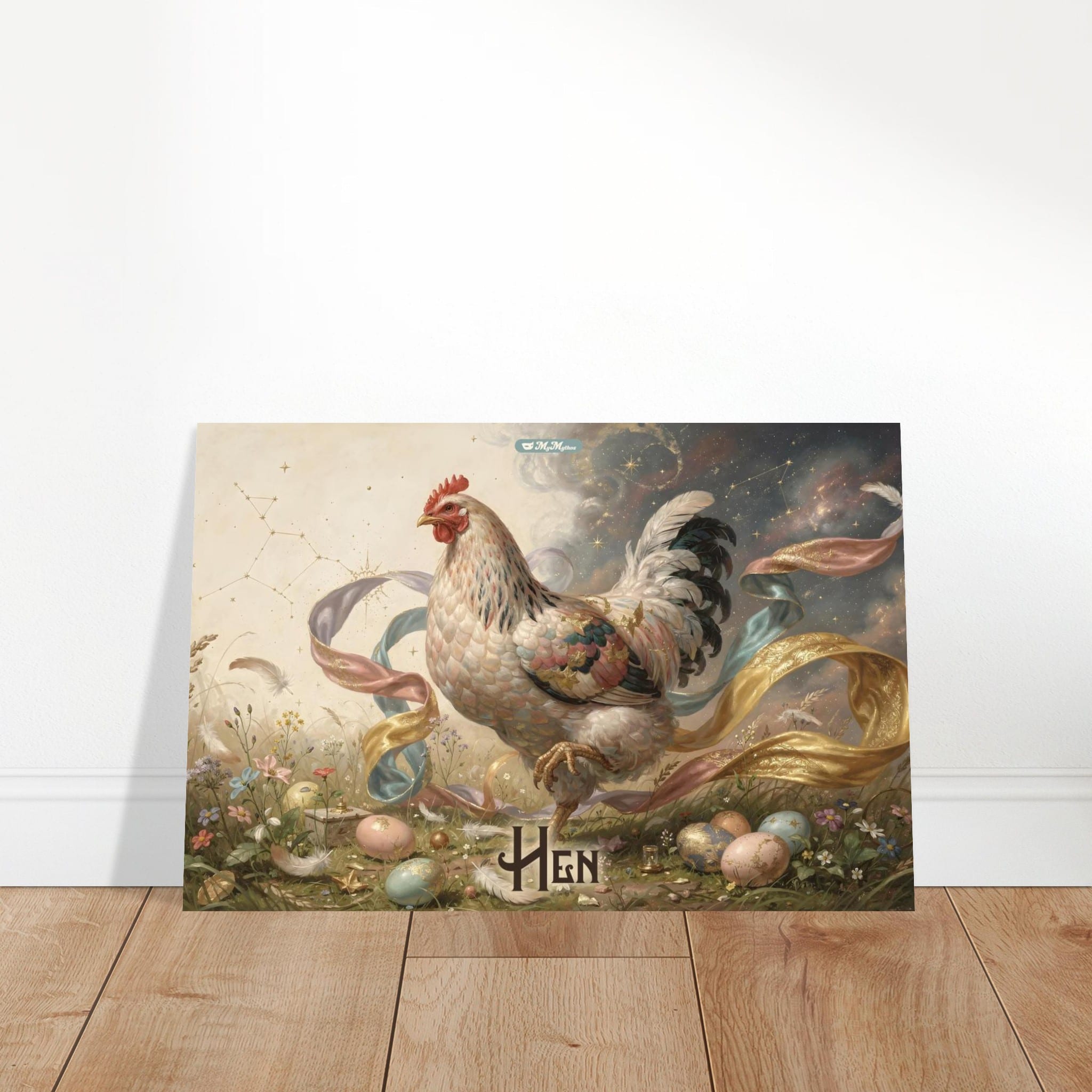
On your wall
Material
Sale! Was $19.00, now $14.25
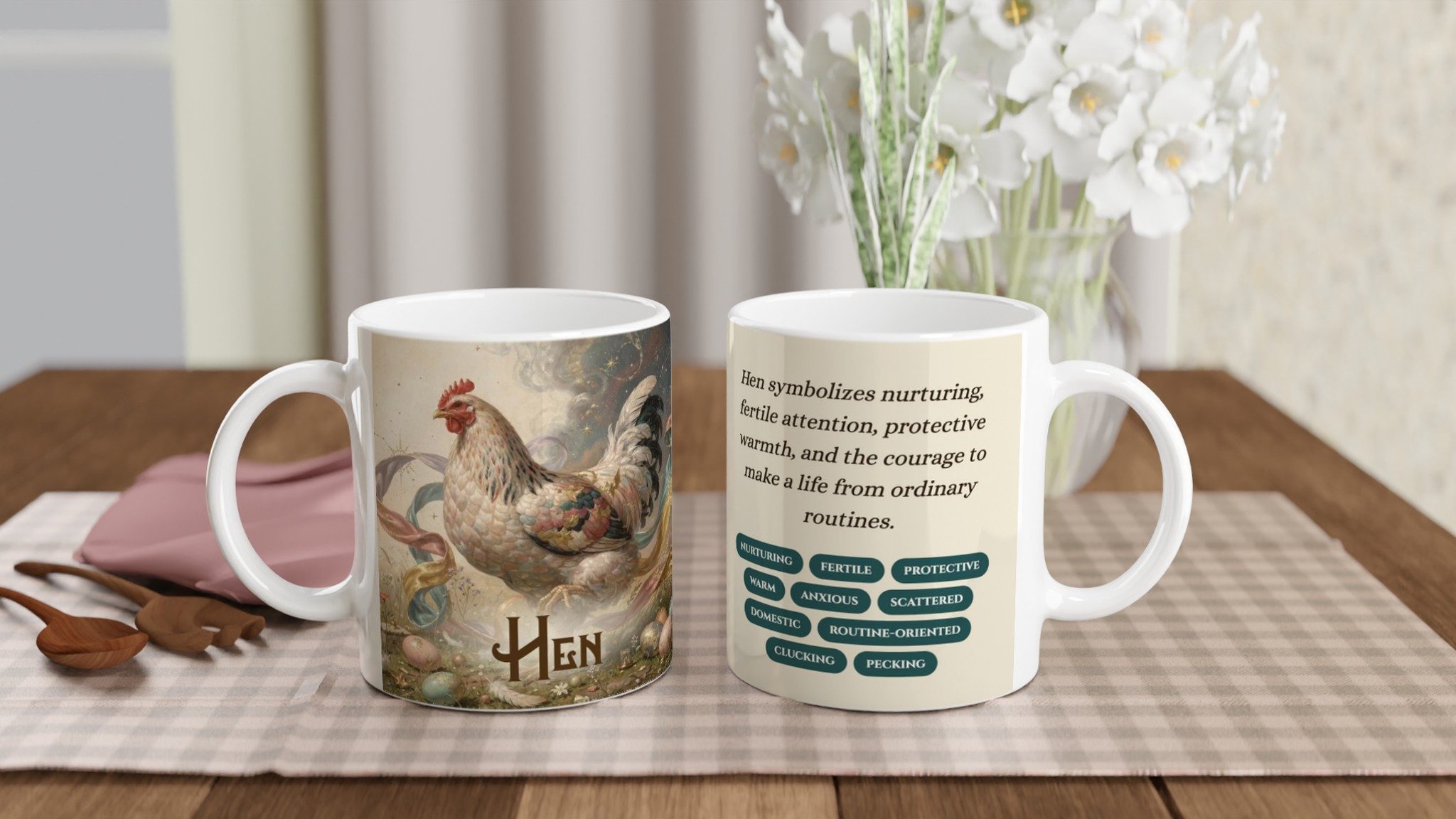
In your hands
Size
Color: White
Sale! Was $18.00, now $13.50
From elsewhere
Paid links: if you buy through these, MyMythos earns a small commission at no cost to you.