

Dream meaning
Dreaming of a Dead Relative Visiting
What it could mean, and what it might be pointing at
This page talks plainly about death and dying.
In short
Dreaming of a dead relative often points to grief, memory, unfinished feeling, or a changing bond with the past. The relative's behavior, your waking emotion, and what is happening in your life usually change the reading most.
- Alive again: A memory, wish, or old relationship may be active in you.
- Hugging: You may be longing for comfort, contact, or reconciliation.
- Talking: Your mind may be working through words left unsaid.
- Angry or sad: Guilt, conflict, or grief may still need attention.
- Giving money: The dream may connect inheritance with help, duty, or family pressure.
By MyMythos, read against the dream research in our sources.
While you slept
The reading
What Dreaming of a Dead Relative Visiting Could Mean
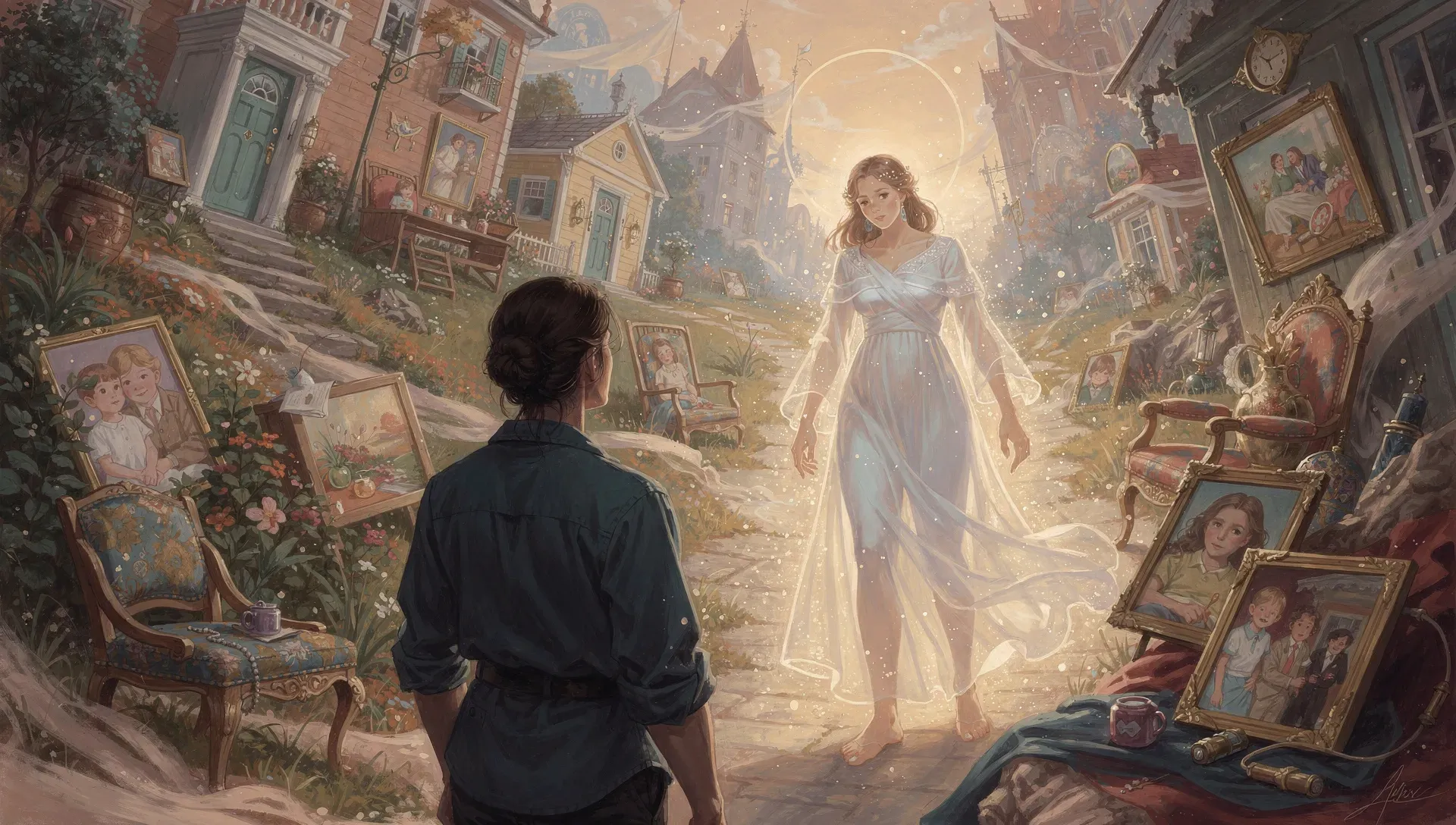
A dead relative visiting in a dream can feel startlingly ordinary. They may sit at the kitchen table, call your phone, drive beside you, or enter through a door as though death had not happened. That ordinary quality may be the point. Memory does not keep people in a sealed room. It brings back their voice, habits, face, and the particular feeling of being known by them.
Psychologically, the dream could be part of grief, but grief is not the only possibility. It may point to an unfinished conversation, regret about the last years, a quality you learned from that person, or a family role you now carry yourself. A relative who has been dead for decades can appear when a current event resembles an older one. A new baby, a move, an 
What happened in the dream matters less than the relationship it stirred. A smiling relative may bring comfort or a memory of ease. An angry relative may reflect your 
Notice how you felt on waking. Relief may suggest that the dream gave you a moment of connection. Fear may show that the death still feels raw, or that the relative's manner was threatening. Sadness may simply be love meeting absence. Two people can dream of the same dead relative and wake differently because the dream is carrying each person's relationship, not delivering a fixed message.
The myth beneath it

I am
I only feel close to people who have lost someone too.

The world is
What you owe outlives the reason you owed it.
I am
My old life still shows in how I live now.
The world is
The people you lose stay with you in how you live.
I am
I would rather see people's best than see them plainly.

What is coming
I will always know the exact date someone left my life.
I am
The version I carry of the one I lost is the truest.
The world is
Nothing that mattered ends cleanly.
I am
I mourn the lives I did not choose.
The world is
Never borrow from family.
I am
I would rather keep going than stop to grieve.

Other people are
Family keeps score quietly.
I am
I grieve the version of myself I had to leave behind.
I am
I would rather build for later than live for now.
The most vivid version
Dreaming of a Dead Relative Coming Back to Life
Dreaming of a dead relative alive again may express the mind's refusal to reduce a person to the fact of their death. For a while, the dream can restore the familiar world: their laugh, their opinions, the way they occupied a chair. That does not mean the person has returned in the physical world. It may mean the relationship remains active in memory.
The dream could also belong to a present change. You may be taking on a parent's duties, becoming the older generation, or facing a choice that relative once helped you make. Their return may let you test what you would say to them now. If they seemed well and ordinary, the scene may offer comfort. If they returned injured, silent, or dying again, the dream may be revisiting the shock of loss rather than bringing a warning.
What to notice
- Their condition: Healthy and familiar may feel different from ill, silent, or dying again.
- Your response: Relief, fear, joy, and disbelief each point toward different personal associations.
- The setting: A childhood home may bring family memory; a new place may reflect present change.
What happened
What Happens Between You and a Dead Relative
The action in a dream often gives the feeling somewhere to go. These versions are not fixed codes. They are starting points to compare with the relationship, the recent week, and the emotion that stayed after waking.
Hugging
Hugging a dead relative may point to missing physical closeness, forgiveness, or the comfort that person once gave. If the embrace felt peaceful, it could be a gentle memory. If it felt desperate, the dream may show grief that has not found words.
Talking
Talking to a dead relative may give form to an unfinished conversation. You might be asking for advice, defending a choice, or hearing your own remembered version of their voice. Write down the exact words, then ask what they connect to in your life now.
Smiling
A dead relative smiling may carry warmth, approval, or a memory of their ordinary humor. It need not be a supernatural message. Your mind may have selected the expression that best captures what you miss, especially during a stressful or lonely period.
Angry or crying
A dead relative mad at you, or crying in a dream, may reflect guilt, old conflict, or your fear of disappointing them. It could also be your own grief wearing their face. Look for a current situation where you feel judged, helpless, or unable to repair something.
Giving money
A dead relative giving you money may connect material help with

Driving together
Driving with a dead relative may place an old relationship beside a direction you are taking now. Who was driving matters, but so does the

A phone call
A dream phone call from a dead relative may make distance and longing feel immediate. You may be trying to reach a memory, receive reassurance, or say what could not be said. A missed call can fit the painful fact that contact is no longer possible.
A warning
A dead relative warning you in a dream may represent caution already present in your own thinking. Check the practical issue behind it, such as a difficult relationship or risky choice, but do not treat the dream as a forecast. Its urgency may come from love, fear, or memory.
The place matters
A Dead Relative Knocking on the Door or Riding in a Car
A dead relative knocking on your door may frame the dream as something from the past asking for attention. The door could stand for a boundary between private memory and present life, especially if you felt reluctant to open it. If the relative simply walked in, the memory may already feel close and uninvited.
Driving with a dead relative places the relationship inside movement. You may be leaving a stage of life, repeating a family pattern, or wondering how that person's advice fits your choices now. The car's control, speed, and destination can tell you more than the relative's presence alone.

Your own dream
Write Down Your Dream
Dreams fade by breakfast. Write yours on your page while it is still clear: what happened, where you were, how it felt. It is free, and it stays yours.
Morpheus, keeper of dreams, reads the dreams you have written down for members on a paid plan. Meet Morpheus
Why it keeps coming
Why You Keep Dreaming of a Dead Relative
The body can make dreams more vivid when sleep is disrupted by illness, pain, medication, alcohol, hormonal change, or irregular hours. Waking briefly during REM sleep may help you remember a dream that would otherwise disappear. Check the physical conditions around the dream before treating every detail as a message.
The mind also returns to people who carried strong emotion. Grief, guilt, relief, anger, and love do not move in a straight line. An 
Life changes can bring the dead into dreams because they change your place in the family. Parenthood, caring for an older person, divorce, an inheritance, moving house, or a serious decision may make you compare your present self with the person you knew. The dream could be asking you to recognize what you carry from them, what you reject, and what you still wish you could say. "



When you wake
What to Do After Dreaming of a Dead Relative
- Write the dream and the feeling on waking before adding an interpretation.
- Name the recent event, date, object, or family conversation that may have stirred the memory.
- If it feels right, speak to the relative in a letter, prayer, photograph, or private conversation, without treating the dream as a prediction.
- If nightmares persist or grief is disrupting sleep and daily life, speak with a therapist or doctor.
Spiritual meaning
The Spiritual Meaning of Dead Relative Dreams, and How Faiths Read Them
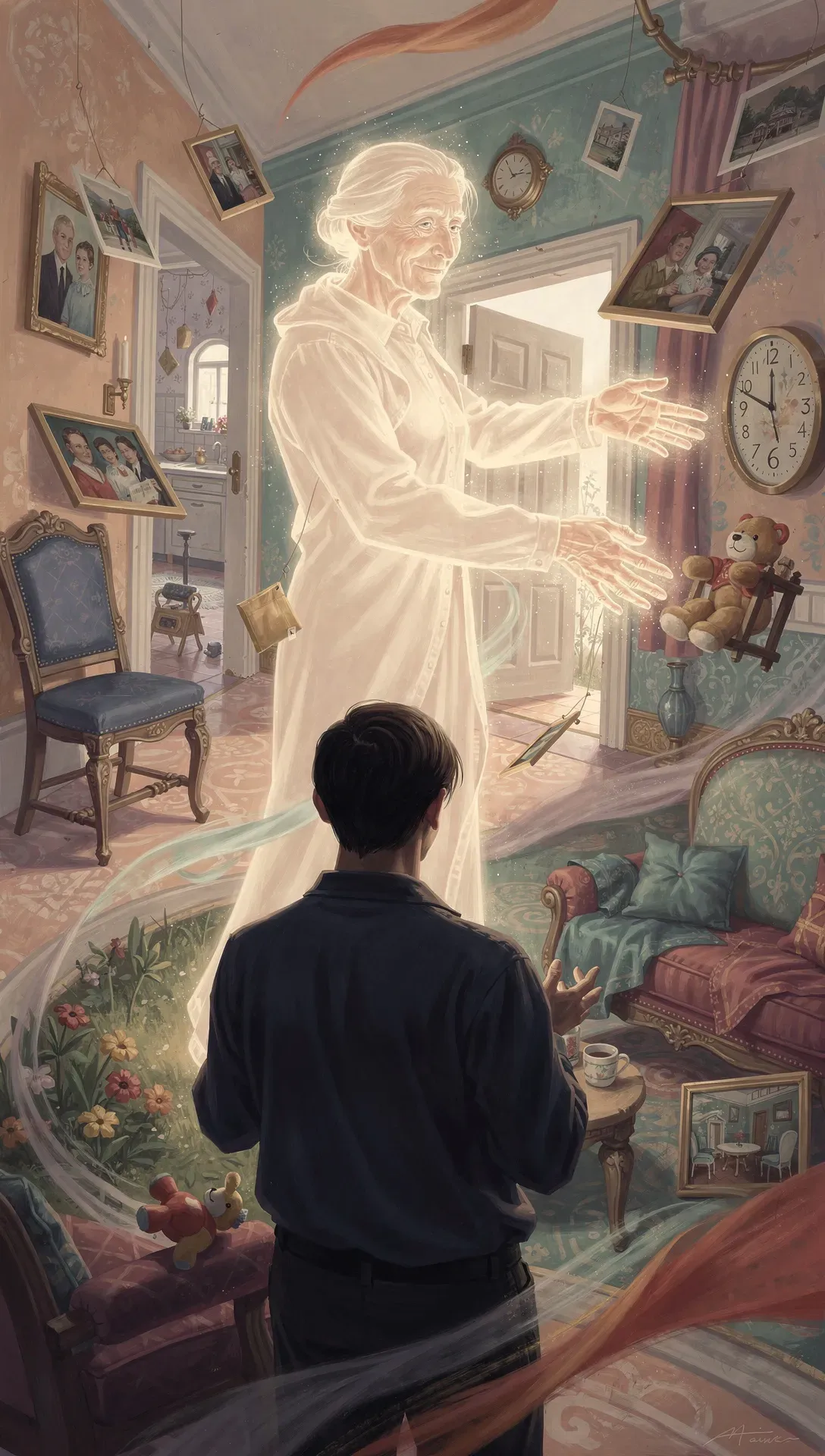
Folklore has often treated a dead relative visiting as a meeting between memory and the unseen, especially when the visitor is calm, recognizable, or carrying words of comfort. A spiritual reading may be meaningful if it helps you honor the relationship, pray, remember, or live out something good you learned. It remains a matter of belief, not evidence that the dead have physically returned.
Older traditions also warn against making every dream an oracle. Artemidorus's Oneirocritica treated dreams as dependent on the dreamer's circumstances and associations, not as one-image predictions. Freud argued that dreams could express wishes and unresolved feeling. These are interpretive views, not proof of contact. A spiritual reading should leave room for psychology, uncertainty, and the simple fact of missing someone.
Each faith's own reading, in its own terms and credited to its source. These are theirs, not ours. The book under each is a paid link: MyMythos earns a small commission if you buy through it.
In Christianity
The Bible does not give a direct rule for interpreting a dead relative visiting in a dream. Ecclesiastes 5:3 connects dreams with many cares, so Christian readers may understand such a dream as arising from grief, worry, and memory rather than as a guaranteed message from the dead.
Ecclesiastes 5:3
In Islam
Islam has no teaching on this dream by name, but Sahih Muslim 1631 addresses the image of a dead person and what remains after death. It says, “When a man dies, his acts come to an end, but three”: ongoing charity, useful knowledge, or a pious child who prays for him. Readers have taken this as support for prayer and charity for the dead.
Sahih Muslim 1631
In Hinduism
In the Katha Upanishad, the Self is compared to a reflection in a mirror and to a dream in the world of the manes, or ancestors. Hindu readers have taken this as placing dreams where the departed may be met. The passage presents this as a way the Self is seen in different worlds.
Katha Upanishad 2.3.5
In Buddhism
Buddhism has no teaching on this dream by name, but the Tirokuddha Sutta describes departed relatives, reborn as hungry ghosts, returning to their former homes and waiting beside the door posts. Many Buddhist teachers point to this image when discussing the dead returning. The text says gifts given in their name help, while weeping does not.
Khuddakapatha 7 (Tirokuddha Sutta, 'Outside the Walls'), Sujato translation
What dream research says
What Dream Research Says About Dead Relative Dreams
The continuity hypothesis, associated with G. William Domhoff in The Scientific Study of Dreams, holds that dream content reflects a person's waking concerns, relationships, and emotional preoccupations. That view fits a dead relative appearing after an anniversary, family conflict, or life change, without requiring the dream to predict anything.
Antti Revonsuo's threat simulation theory, proposed in 2000 in Behavioral and Brain Sciences, argued that dreams may rehearse threatening situations. A dream of a dead relative dying again, warning you, or becoming angry could therefore reflect emotional rehearsal, although the theory is not a personal decoding system and does not establish what any one dream means.
Krakow and colleagues' 2001 study in JAMA found that imagery rehearsal therapy reduced nightmares in sexual assault survivors by having them rewrite the frightening dream and rehearse the new version while awake. It is not specific to bereavement, but it offers a practical treatment when a recurring dead-relative dream is frightening rather than comforting.
The book links are paid links: if you buy through them, MyMythos earns a small commission at no cost to you. Papers link to the paper itself.
- Krippner, Bogzaran and de Carvalho, Extraordinary Dreams and How to Work with Them, SUNY Press, 2002.
- G. William Domhoff, The Scientific Study of Dreams, 2003
- Antti Revonsuo, Behavioral and Brain Sciences, 2000
- Barry Krakow et al., JAMA, 2001
- American Academy of Sleep Medicine, Position Paper for the Treatment of Nightmare Disorder in Adults, 2018
- Artemidorus, Oneirocritica, second century
The waking mind
Readers' dreams
Have You Had This Dream?
No one has shared a a dead relative visiting dream here yet. Tell yours, in your own words, and it may help the next person who has one.
Share your dreamBeyond the dream
Archetypes Close to This Dream
Common Questions About Dreaming of a Dead Relative Visiting
- What does seeing a dead relative in a dream mean?
- Dreaming of a dead relative often points to grief, memory, unfinished feeling, or a changing bond with the past. The relative's behavior, your waking emotion, and what is happening in your life usually change the reading most.
- What does it mean when a dead relative comes to you in a dream?
- A dead relative coming to you may reflect longing, a memory brought back by current events, or words you still wish you could exchange. It may feel spiritual, but it does not prove that the relative is visiting or predict another death.
- Is dreaming of a dead relative a good or bad sign?
- It can feel good when the dream brings comfort, affection, or a sense of connection. It can feel bad when it revives guilt, fear, or the shock of loss. Neither feeling makes the dream a forecast or a fixed sign.
- Can the deceased hear us when we talk to them?
- Different faiths and families answer this differently, and research cannot establish that the deceased hear private conversations. Talking to someone who died can still help you express love, grief, gratitude, or anger and can give memory a place in your present life.
- How do you know a passed loved one is with you?
- A vivid dream, familiar smell, coincidence, or sudden memory may feel like the person's presence. You can honor that feeling without claiming certainty. The safest reading is personal and compassionate: something about the relationship is alive in your memory.
- How do I stop dreaming about a dead relative?
- Check sleep disruption, medication, alcohol, stress, anniversaries, and grief during the day. Write the dream, then try imagery rehearsal therapy by rewriting it and rehearsing the new version awake. Krakow and colleagues studied this approach, and the American Academy of Sleep Medicine recommended it for recurring nightmares in 2018.
- What does it mean to have a lucid dream about a dead relative?
- A lucid dream about a dead relative may give you unusual awareness and a chance to ask questions or change the scene. The clarity can make the meeting feel spiritual, but lucidity shows awareness during dreaming, not proof that the person has crossed into the dream.