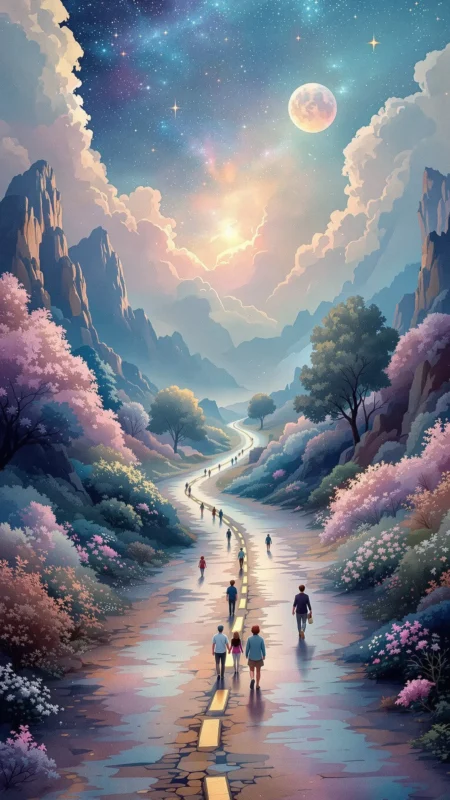


Road

Archetype Meaning & Symbolism

Connecting, Transitory, Linear, Winding, Indifferent, Ancient, Paved, Unforgiving, Direct, Expansive

  • The destination is a rumor whispered by the wind; the truth is only ever the texture of the ground beneath your feet.

If Road is part of your personal mythology, you may...

Believe

  • That the journey is always, without exception, more illuminating than the destination.

    That to stand still is to decay; life is synonymous with movement and change.

    That 'home' is not a place you find, but a feeling of rightness on the path you are currently walking.

Fear

  • Reaching a final, absolute dead end from which there is no escape and no alternative route.

    The creeping suspicion that you are not on a journey of discovery, but are merely running away from yourself.

    Being forced to stop, to settle, to unpack your bags forever and watch the road from a window.

Strength

  • A profound adaptability. You can make a temporary home anywhere and navigate unexpected changes with a grace born of constant practice.

    A unique and expansive perspective. Having seen many places and ways of being, you are less likely to fall into dogmatic or narrow-minded thinking.

    An unshakeable self-reliance. You have learned to depend on your own resources, ingenuity, and resilience to see you through.

Weakness

  • A chronic rootlessness. This can manifest as an inability to form deep, lasting commitments or a persistent feeling of being an outsider.

    A restless dissatisfaction. The constant need for movement can prevent you from appreciating the beauty and value of the present moment and place.

    A tendency toward escapism. The road can become a way to outrun problems, avoiding the difficult internal work that requires one to stand still and face oneself.

The Symbolism & Meaning of Road

In personal mythology, the Road is the literal and metaphorical thoroughfare of one's life. It is the structure upon which the narrative of the self is built. Your mythos may be a story of a long, straight highway, a direct pursuit of a singular, distant goal, visible from the outset. Or perhaps it is a tangled network of country lanes and unmarked trails, a life defined by exploration, serendipity, and the willingness to get lost. The quality of the Road reflects the perceived nature of your existence: is it smooth and paved, suggesting a life of relative ease and known conventions, or is it a rutted, gravel track, implying a path of struggle, authenticity, and hard-won progress? The Road does not judge; it simply is. It exists before you and will remain after you, a silent witness to the passage of your personal story.

The archetype also speaks to the nature of time and transition. To be on the Road is to exist in a liminal space, a state of perpetual becoming. You are neither here nor there, but in the potent space of in-between. This could be the essence of your identity: a person most themselves when in motion. The milestones and rest stops along your path—jobs, relationships, homes—are not destinations in themselves, but temporary shelters on a much larger pilgrimage. The meaning of your life is not found in any single place you arrive, but is woven from the accumulated texture of the entire journey: the sun-scorched asphalt, the treacherous mountain passes, the quiet, tree-lined avenues.

Furthermore, the Road is a symbol of fate and free will. It may represent a pre-determined path, a destiny laid out that one must follow. Yet, at every fork, every intersection, every unexpected detour, the choice of the traveler comes into play. You may feel that your road was chosen for you, a legacy or circumstance you cannot escape. Or, you might see yourself as a road-builder, carving a new path through untamed wilderness where none existed before. The tension between the path that is given and the path that is chosen is central to the Road's power in shaping a personal myth, forcing a constant negotiation between destiny and determination.


Road Relationships With Other Archetypes

The Traveler:

The Road and the Traveler are inextricably linked: one is the path, the other is the one who walks it. The Road is the context that shapes the Traveler’s identity. A difficult, winding road may forge a resilient, adaptable Traveler, while a straight, easy road might create one who is focused but perhaps untested. For the Traveler, the Road is a teacher, a taskmaster, and a silent companion. For the Road, the Traveler is a fleeting presence that gives it temporary purpose, a story imprinted upon its surface before the wind and rain wash it clean for the next sojourner.

The Bridge:

The Bridge is a specialized, intensified moment of the Road. It is the Road's answer to an impossible obstacle: a canyon, a raging river, a deep chasm. Where the Road signifies the journey, the Bridge signifies the critical transition, the single, focused act of passage over a point of no return. A personal mythos containing a Bridge suggests a life-altering event, a deliberate and often perilous choice to cross from one state of being to another—from ignorance to knowledge, from dependency to autonomy—while the Road is the longer, more sprawling narrative that contains these crucial crossings.

The Destination:

The Destination is the Road's eternal, and perhaps illusory, purpose. It is the city, the home, the mountaintop that pulls the traveler forward. The relationship is one of promise and tension. The Road exists to lead to the Destination, yet the experience of the Road is what constitutes the life. If the Destination is reached, the Road’s purpose for that particular journey ends. In some personal myths, the Destination is a fixed point of arrival and rest. In others, influenced by the Road archetype, any destination is merely a waypoint, a place to catch one's breath before hearing the call of another road leading to another horizon.

Using Road in Every Day Life

Navigating a Career Shift:

When faced with a professional crossroads, you might invoke the Road archetype not to find the 'right' path, but to appreciate the landscape of possibility. Instead of a ladder, your career becomes a map of intersecting highways and scenic byways. One road may be a direct interstate to a specific goal, while another might be a winding country lane offering unexpected discoveries. The archetype encourages you to consider the quality of the journey itself: what skills will you gather on this route versus another? Who are your fellow travelers? The pressure to choose the single correct path dissolves into a more fluid exploration of which journey will best shape the traveler you wish to become.

Healing a Personal Rupture:

In the aftermath of a deep-running argument or betrayal, the Road may serve as a potent metaphor for reconciliation. The distance between two people is a chasm, and forgiveness is the act of building a new road across it, plank by plank. It could be a precarious rope bridge at first, requiring careful, deliberate steps. The process is not about instantly arriving back where you were, but about the shared, often difficult, work of paving a new way to connect. This archetype reframes healing not as a return to the past but as the construction of a new, perhaps more resilient, connection forged through the labor of understanding.

Embracing a New Phase of Life:

Whether it’s an empty nest, retirement, or a profound change in identity, life transitions can feel like being left at an unmarked trailhead. The Road archetype provides a framework for embracing this uncertainty. You may consciously choose to see yourself as an explorer embarking on an unmapped journey. This isn’t about having a destination; it's about the courage to take the first step into the fog. The mythos shifts from 'what have I lost?' to 'what landscape will I discover now?' You might begin a new practice, travel to a place you've never been, or learn a skill, each acting as a new mile marker on a road you are paving yourself, in real time.

Road is Known For

The Journey

It represents the process, the movement between a beginning and an end. The Road is the container for all the events, trials, and transformations that occur not at the destination, but along the way. It is the narrative thread of life itself.

Connection:

The Road is the fundamental link between disparate points. It joins towns, cultures, and ideas. On a personal level, it represents the pathways that connect us to others, to our past, and to our potential futures.

Choice:

The fork in the road is its most potent symbol. It is the distillation of a moment of decision, where one path must be chosen and others left behind, forever altering the trajectory of the journey and the traveler.

How Road Might Affect Your Personal Mythology

How Road Might Affect Your Mythos

When the Road is a central feature of your personal mythos, your life story is framed as a perpetual journey. It is less a series of static chapters and more a continuous, unfolding travelogue. Major life events are not endings or beginnings but forks, detours, or the merging of your path with another's. The narrative drive of your story is forward momentum. The central conflict may not be about conquering a foe but about navigating the terrain ahead: the unexpected washout, the seductive but ultimately stagnant scenic overlook, the courage to leave a comfortable, well-trodden path for an unknown trail.

Your personal mythology might eschew the idea of a 'homecoming' or a final arrival. Instead, the climax of your story could be a moment of profound realization that occurs mid-journey, perhaps at a dusty crossroads at twilight or while looking in the rearview mirror. The defining virtues in your myth are not stability and rootedness, but resilience, adaptability, and the wisdom gained from constant movement. Your tale is one of pilgrimage, of quest, or perhaps of exile, where meaning is found not in arrival, but in the act of faithfully walking the path, wherever it may lead.

How Road Might Affect Your Sense of Self

Your sense of self may be fluid, defined by motion rather than location. You might identify as a 'seeker,' a 'wanderer,' or a 'pilgrim,' feeling most authentic when you are in a state of transition. This can create a self-concept that is highly adaptable and resilient; you are not defined by any single job, relationship, or community because you see them as places you pass through on a longer trek. Your identity is cumulative, a collection of all the landscapes you have traversed and the people you have met along the way. You are a story in progress, not a finished work.

This could also engender a feeling of restlessness or a subtle alienation from those who seem content with a stationary existence. You may struggle with the question 'Where are you from?', as 'from' implies a point of origin you feel you have long since left in the dust. The self is perceived as a vessel for experience, and its primary purpose is to keep moving, to see what is around the next bend. This can be liberating, freeing you from the confines of a fixed identity, but it can also be lonely, a quiet sense that you are merely a visitor everywhere you go.

How Road Might Affect Your Beliefs About The World

The world, through the lens of the Road, is not a collection of static destinations but an infinite, interconnected network of pathways. You may see life as a series of open loops rather than closed circles, where every point is accessible from another if one is willing to make the journey. This worldview could foster a deep sense of universal connection and possibility. Borders and boundaries, both geographical and ideological, may seem arbitrary constructs, temporary roadblocks on a much larger, shared human road. The world is a map to be explored, not a territory to be owned.

This perspective may also cultivate a certain philosophical detachment. You might see conflicts, triumphs, and disasters as temporary conditions of the terrain rather than permanent states of being. The wisdom of the Road is that everything passes: the storm, the stretch of beautiful scenery, the treacherous patch of ice. This can lead to a profound patience and a long-term perspective, but it could also risk slipping into a kind of indifference, a sense that engaging too deeply with any one place is futile, as the journey requires you to inevitably move on.

How Road Might Affect Your Relationships

Relationships are often perceived as fellow travelers met along your path. Some may join you for a short leg of the journey, sharing a campfire for a night before your roads diverge. Others might walk alongside you for miles, their pace matching yours for a season. The most profound connections are with those whose own road merges with yours, creating a shared path forward for a time. The health of a relationship may be measured by its ability to navigate the journey together: to handle detours, to compromise at forks, and to appreciate the changing scenery as a team.

However, this archetype can introduce a transient quality to all connections. The core imperative to 'keep moving' might create a subconscious barrier to deep, lasting commitment. You may be hesitant to fully unpack your bags, metaphorically speaking, in any relationship, always keeping one foot on the road. This can lead to a series of intense but temporary bonds, or a feeling of being a 'lone traveler' even when in partnership. The challenge is to learn that a shared road does not mean a loss of one's own journey, but rather the creation of a richer, more resilient path forward, together.

How Road Might Affect Your Role in Life

Your perceived role in life may be that of the scout, the pioneer, or the messenger. You are the one who goes ahead to see what lies beyond the horizon and returns, perhaps, with news. Your function is not to build a city or tend a field, but to forge the path, to connect disparate communities, to be a conduit for information and experience. You may feel your purpose is to facilitate movement in others, to open up new routes of thought or opportunity, to show people the way out of a place where they feel stuck.

Alternatively, your role could be more introspective: the perpetual pilgrim whose journey has no external goal but is instead a path toward self-understanding. In this case, your life is not about where you go, but about how the act of going transforms you. Your role is simply to walk your path with integrity, serving as an example to others that the most profound destination one can seek is a deeper knowledge of oneself. You are not leading anyone anywhere, but your dedication to your own road may inspire others to find the courage to walk theirs.

Dream Interpretation of Road

In a dream, a Road appearing in a positive context often symbolizes your life path and your progress upon it. A wide, open, and clearly marked road stretching toward a sunlit horizon may suggest clarity of purpose, confidence, and a feeling that you are on the right track. Driving effortlessly along this road could reflect a sense of agency and control over your destiny. Discovering a new, beautiful road might symbolize a new opportunity or a phase of life opening up before you. The feeling associated with the dream is key: if there is a sense of joyful anticipation, freedom, and ease, the Road is affirming your current journey.

Conversely, a Road in a negative dream context can evoke feelings of being lost, stuck, or headed toward danger. A road that is blocked, crumbling, or leads to a dead end may represent obstacles in your waking life, a sense of futility, or a path that is no longer viable. Being caught on a road that loops back on itself could signify feeling trapped in a repetitive, unfulfilling cycle. A dark, winding, and confusing road through a menacing landscape might reflect anxiety about the future, a fear of the unknown, or the sense that you have lost your way and your moral compass. The dream may be highlighting a need to re-evaluate your direction and choices.

How Road Archetype Might Affect Your Needs

How Road Might Affect Your Physiological Needs

The Road archetype may manifest in your physiological needs as a literal, bodily imperative for motion. You might feel a profound restlessness, a 'road fever,' when you stay in one place for too long. This isn't mere boredom; it can feel like a physical constriction, an ache in the muscles for the rhythm of walking, driving, or simply being in transit. Your body's baseline state of comfort may be movement. The need for food, water, and shelter are framed by the journey: they are fuel, hydration, and temporary respite necessary to continue moving forward, not ends in themselves.

This constant state of potential or actual motion could also attune your body to a state of heightened awareness. Your senses may be sharper, always scanning the environment for changes in the terrain, for potential dangers or opportunities. This can lead to a wiry, energetic constitution, but also to a nervous system that is perpetually 'on,' making deep, restorative rest a challenge. The body itself is your primary vehicle, and you may feel a deep-seated need to keep it lean, efficient, and ready to move at a moment's notice.

How Road Might Affect Your Ideas of Belonging

Belongingness is not found in a geographical place or a single tribe, but with fellow travelers. You may feel a powerful kinship with others who are also 'on the road,' whether literally or metaphorically. The bond is forged in the shared understanding of the journey's hardships and joys. Intimate conversations in bus stations, the silent nod between backpackers, the camaraderie of those pursuing a similar, difficult path in life—these are your moments of belonging. Love and friendship are about finding someone whose pace matches yours, and whose destination, for a time, aligns with your own.

This can make traditional forms of community feel alienating. The idea of settling down in one place and putting down deep roots may feel like a kind of death. You might struggle to feel a part of families or groups that are defined by stasis and tradition. Your sense of love and connection is dynamic; it must be able to move and adapt with you. The fear is that if you stop, or if your partner stops, the connection will be broken by the divergent paths. True belonging is the freedom to travel together.

How Road Might Affect Your Feelings of Safety

For one whose mythos is the Road, safety is not found in walls, but in momentum. A fixed position can feel like a trap, making you an easy target for the dangers of the world or the stagnation of the soul. True security lies in the ability to keep moving, to stay one step ahead of whatever pursues you, be it a literal threat, a painful memory, or an existential crisis. Your safety strategy is evasive and adaptive. You trust your ability to navigate, to find a new route when the old one becomes perilous, rather than fortifying a single position.

This can lead to a paradoxical sense of security. While you may lack the conventional safety nets of a permanent home or a stable community, you might possess a deep, abiding faith in your own resilience. You feel safe because you believe you can handle whatever the road throws at you. The greatest threat to your safety is not the danger outside, but the internal failure of will that would cause you to stop moving: apathy, despair, or the exhaustion that makes the illusion of a permanent, safe harbor seem more appealing than the inherent risk and freedom of the open road.

How Road Might Affect Your Views of Esteem

Self-esteem is sourced directly from the journey itself. It is built not on titles, possessions, or social standing, but on the distance you have covered and the obstacles you have overcome. Every mile traveled, every storm weathered, every mountain crossed is a testament to your strength and endurance. Your self-worth is reflected in the dust on your boots and the wisdom in your eyes. You respect yourself for your adaptability, your courage in the face of the unknown, and your resilience in picking yourself up after a fall.

This means your esteem can be vulnerable to periods of stagnation. When you feel stuck, unable to move forward, your self-worth may plummet. You might equate a lack of progress on your path with personal failure. The esteem is not in 'being,' but in 'becoming,' in the forward momentum of your personal narrative. Therefore, you must constantly seek new challenges and new horizons to maintain your sense of value, which can be both a powerful motivator for growth and a relentless, exhausting demand.

Shadow of Road

The shadow of the Road emerges when the journey ceases to be a path of growth and becomes a desperate flight. This is the Road as escapism, where movement is not a choice for discovery but a compulsion to avoid intimacy, responsibility, or the inner void. The person in this shadow is the aimless wanderer, collecting experiences not for wisdom but as distractions. They are on a road to nowhere, burning through relationships and opportunities in a frantic, joyless momentum. Their motion is a frantic circle, always ending up in the same lonely place, mistaking the hum of the engine for a sign of progress.

Another manifestation of the shadow is the tyrannical Road: the rigid, unbending path of dogma or ambition. This is the 'my way or the highway' mentality. The journey is no longer about the experience but about the brutal efficiency of reaching a predetermined goal. Anyone or anything that suggests a detour or a moment of rest is seen as an obstacle to be bulldozed. This is the road that is paved over delicate ecosystems and human connection, a testament not to progress but to a hollow and relentless will that has lost all perspective, forgetting that the map is not the territory.

Pros & Cons of Road in Your Mythology

Pros

  • You may cultivate an incredible resilience, viewing life's challenges as mere bumps in the road rather than insurmountable walls.

    Your life is likely to be rich with diverse experiences, people, and perspectives, leading to a broader, more compassionate understanding of the world.

    You may possess a deep sense of freedom and autonomy, unburdened by conventional expectations of how a life should be lived.

Cons

  • You might experience a profound and persistent loneliness, a sense of being a perpetual visitor in the lives of others and in the world itself.

    There is a risk of becoming a dilettante, skimming the surface of many things—places, skills, relationships—without ever achieving the depth that comes from sustained commitment.

    You may suffer from a deep weariness of the soul, an exhaustion born from constant transition and the lack of a true place to rest and recover.