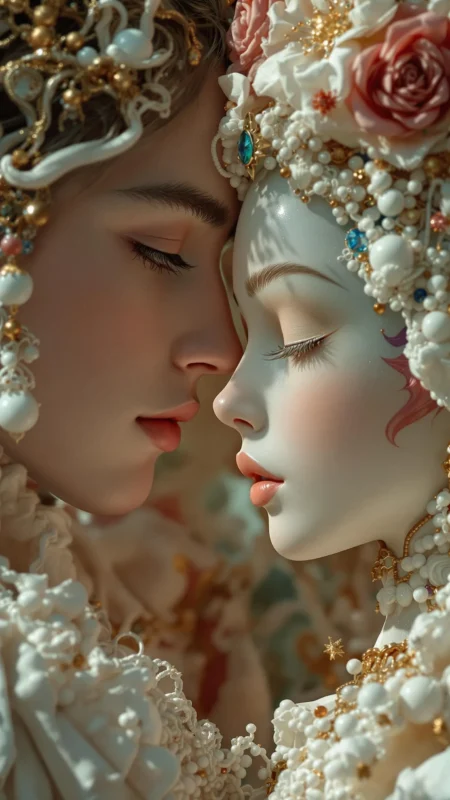
Porcelain Doll

Archetype Meaning & Symbolism

Fragile, pristine, ornamental, silent, observed, curated, delicate, hollow, timeless, breakable

  • My stillness is a choice: a canvas for the world's projections, and a mirror for its gaze.

If Porcelain Doll is part of your personal mythology, you may...

Believe

  • My value is inextricably linked to my beauty, stillness, and composure.
  • To be handled with care is the greatest form of love, and to be broken is the ultimate failure.
  • My quietness is a form of power; by being a perfect observer, I can understand and control my world without engaging in its messiness.

Fear

  • Being dropped, emotionally or metaphorically, by those who are meant to protect me.
  • A single, visible flaw that will reveal my supposed hollowness and render me worthless.
  • Being overlooked, or worse, being seen as common, just another object on a crowded shelf.

Strength

  • A profound capacity for observation, allowing you to understand social dynamics from a position of serene detachment.
  • A deep appreciation for aesthetics, harmony, and the quiet power of beauty.
  • A resilient composure that allows you to remain a point of calm and grace in the midst of chaos.

Weakness

  • A debilitating fear of imperfection that can lead to paralysis and an avoidance of life's messy realities.
  • A tendency towards passivity, a habit of waiting to be acted upon rather than initiating action yourself.
  • A fragile sense of self-worth that is perilously dependent on the admiration and careful handling of others.

The Symbolism & Meaning of Porcelain Doll

In the personal mythos, the Porcelain Doll may symbolize the curated self, the version of you that has been polished, perfected, and placed on a shelf for admiration. It speaks to a life lived under a gaze: the gaze of a parent, a society, or the self as its own harshest critic. This archetype navigates the perilous space between being cherished and being owned, between being beautiful and being an object. Its existence is a testament to the quiet power of stillness, the art of being a perfect, unmoving canvas in a chaotic world. To have this in your mythology might mean your life story is deeply concerned with appearances, with the maintenance of a flawless facade that both protects and imprisons the soul within.

The symbolism also delves into the nature of value. The doll is precious because it is fragile. Its worth is intrinsically linked to its potential for destruction. This could translate to a belief that one's own sensitivity or vulnerability is the most valuable part of the self, the very thing that must be protected at all costs. It might foster a mythology where the central quest is to build a life, a metaphorical display case, that can safely house this delicate nature. The doll's hollow core is also significant: it can represent a feeling of inner emptiness hidden behind a beautiful exterior, or it could symbolize a sacred void, a space of pure potential waiting to be filled with spirit and agency.

Ultimately, the Porcelain Doll archetype is a profound metaphor for the tension between objectification and subjecthood. It asks uncomfortable questions: Is my worth conditional on my beauty and composure? Do I exist for my own sake, or as an object of admiration for others? The journey of one whose mythos contains the doll is often the journey from inanimate perfection to animate, flawed, and vibrant life. It is the story of the doll learning to step off the shelf, to risk the cracks and chips that come from truly living, and to find a beauty not in static flawlessness, but in the kintsugi of a life well-lived and bravely broken.


Porcelain Doll Relationships With Other Archetypes

The Caretaker:

The Caretaker is inexorably drawn to the Porcelain Doll. This relationship is one of maintenance and protection. The Caretaker finds purpose in dusting the doll's pristine surfaces, adjusting its position in the light, and guarding it from any harm. For the Caretaker, the doll is the ultimate vessel for their nurturing instinct, a perfect, passive recipient of their devotion. However, the shadow of this dynamic is suffocation. The Caretaker's constant polishing may prevent the doll from ever gathering the dust of real-world experience, and their protection may become a cage, however gilded, that denies the doll any chance at agency.

The Trickster:

The Trickster finds the Porcelain Doll's silent perfection an irresistible target. Where the Caretaker preserves, the Trickster disrupts. The Trickster's impulse is to tap the glass of the display case, to see if the doll will flinch, to knock the shelf just to watch it wobble. This relationship is not always malicious; it is a challenge to stasis. The Trickster is the force of chaos that tests the doll's composure, a wind that blows through the curated room. For the individual, this dynamic may represent the internal or external forces that push them out of their comfort zone, forcing a confrontation with messiness, imperfection, and the unpredictable nature of life itself.

The Collector:

The Collector sees the Porcelain Doll not as a being to be cared for, but as an asset to be acquired. The relationship is defined by value, rarity, and possession. The Doll's identity is subsumed into the collection as a whole; it is 'the 19th-century German bisque' or 'the one with the blue eyes.' Its worth is determined by its provenance and its place among other, similar objects. For a person living this archetype, this relationship may manifest as a tendency to seek validation by 'fitting in' with a prestigious group, or feeling their value is contingent on their pedigree, social standing, or their place within a family dynasty, rather than on their own unique, intrinsic self.

Using Porcelain Doll in Every Day Life

Navigating Social Pressure:

When faced with a social environment that demands conformity or a specific performance, embodying the Porcelain Doll allows one to create a boundary of serene detachment. You may adopt a posture of quiet observation, presenting a calm, curated exterior that deflects unwanted intrusion. This isn't about being fake; it's a strategic use of stillness, allowing you to participate on your own terms, as an observer rather than a reactive participant, preserving your inner world from the chaos.

Understanding Performance of Self:

The archetype may serve as a potent tool for exploring the different roles you play. By consciously recognizing the moments you put on a "porcelain face"—for a job interview, a family gathering, a first date—you can begin to distinguish the performance from the self. It becomes a meditation on authenticity, questioning which parts of the curated identity serve you and which parts confine you, prompting a journey to integrate the flawless exterior with the complex, messy, and living interior.

Setting Boundaries:

The inherent "do not touch" quality of a precious doll can be translated into a powerful form of boundary setting. For those who struggle to say "no," this archetype offers a non-verbal alternative. It is the practice of inhabiting your space with a quiet dignity that signals you are not to be trifled with, handled carelessly, or taken for granted. Your energy becomes the display case, communicating value and the need for careful, respectful engagement without a single word being spoken.

Porcelain Doll is Known For

Uncanny Stillness

A profound quietude, an existence as a fixed point around which the world moves. This is not emptiness but a held space, a physical manifestation of watchfulness and patience.

Extreme Fragility:

The constant, ambient threat of being broken. Its value and its danger are one and the same: a single misstep, a careless hand, could result in an irreparable shatter, making its perfect existence a thing of high stakes.

Vessel of Projection:

A blank, beautiful face onto which others project their own stories, desires, and nostalgias. It is known less for what it is, and more for what it is perceived to be by the onlooker, serving as a mirror for the human heart.

How Porcelain Doll Might Affect Your Personal Mythology

How Porcelain Doll Might Affect Your Mythos

When the Porcelain Doll is a central figure in your personal mythos, your life story may be framed as a narrative of display and observation. The inciting incidents of your tale are perhaps not actions you took, but moments you were seen, chosen, or placed upon a new shelf. Your personal history might be chronicled by the different rooms and display cases you have inhabited: the perfect daughter in the family home, the quiet, exemplary student in the classroom, the beautiful, placid partner in a relationship. The central conflict of your mythos is almost always the awakening: the moment the doll begins to question the shelf, the moment a crack appears in the glaze, revealing the living, breathing entity within. Your epic journey is the harrowing quest to step off the pedestal without shattering completely.

The narrative arc is one of moving from object to subject. Your allies might be those who see past the porcelain and speak to the person within, while your antagonists are those who insist on keeping you in your place, who admire your beauty but fear your animation. The climax of your story is not a great battle, but a subtle, terrifying act of will: choosing to speak when silence is expected, choosing to move when stillness is required, or choosing to show a flaw when perfection is demanded. Your personal myth is the story of learning that true value is not in being flawless and breakable, but in being whole and resilient, even with the scars to prove it.

How Porcelain Doll Might Affect Your Sense of Self

Your view of self may be filtered through the lens of an external observer. You might perceive yourself as a composition, an aesthetic arrangement that must be maintained. This can lead to a profound sense of dissociation, a gap between the inner, feeling self and the outer, performing self. There may be a persistent, quiet anxiety that your worth is tied entirely to this performance. A stray hair, a tear, a clumsy word—these are not minor imperfections, they are existential threats to your perceived value. You might feel a strange sense of pride in your own composure, in your ability to remain serene while chaos erupts around you, seeing it as a unique strength, a form of control in a world that feels uncontrollable.

This can also foster a self-concept rooted in fragility. You may believe, on a deep level, that you are inherently breakable and must be handled with extreme care, by yourself and others. This could lead to a highly risk-averse nature, an avoidance of passionate, messy, or unpredictable situations for fear they will crack your carefully constructed persona. The self is perceived as a precious artifact, and life's primary goal becomes a curatorial one: to keep the artifact safe, pristine, and behind glass. The journey toward self-actualization, then, involves the radical belief that you are more durable than you appear, and that your true self is not the doll, but the spirit that animates it.

How Porcelain Doll Might Affect Your Beliefs About The World

The world, through the eyes of the Porcelain Doll archetype, may appear as a grand, and often dangerous, gallery. People are curators, critics, or clumsy patrons, and every interaction is a moment of being appraised. You may see society as a collection of shelves and pedestals, with individuals vying for the most visible and protected spots. There could be a heightened awareness of surfaces, aesthetics, and the silent language of presentation. You might believe that success and safety are achieved not through action and assertion, but through achieving a state of such perfect, undeniable beauty and composure that others have no choice but to admire and protect you. Chaos, strong emotions, and spontaneous behavior are seen as threatening forces, like rogue tremors in the museum.

This perspective can foster a cynical or detached view of human motivation. You may believe that people are primarily drawn to surfaces, and that what they love is not the real you, but the idea of you. The world is not a playground for exploration, but a stage for exhibition. There's a fundamental belief that a single flaw can lead to being devalued and discarded. This worldview, while providing a certain kind of safety in its predictability, can also drain the color from life, reducing the vibrant, chaotic dance of existence to a series of static poses under the harsh, judging light of an imagined audience. The world becomes a place to be looked at, rather than a place to live in.

How Porcelain Doll Might Affect Your Relationships

In relationships, you may unconsciously seek the role of the admired object. You might attract partners who see you as a prize to be won, a beautiful thing to be displayed, or a fragile being to be protected. These dynamics can feel safe and validating initially, as they confirm the mythos that your value lies in your aesthetic perfection and delicate nature. You might find a certain comfort in the role of the quiet, beautiful listener, the serene presence that calms and beautifies a partner's life. The unspoken contract is often: I will be perfect and untroubled for you, and in return, you will keep me safe on the shelf.

The challenge arises when the desire for true intimacy emerges, as intimacy is inherently messy, flawed, and unpredictable. A relationship built around the Porcelain Doll archetype can struggle to accommodate real vulnerability, conflict, or the less-than-perfect aspects of human nature. You may fear that showing anger, neediness, or imperfection will cause your partner to see the cracks and devalue you. This can lead to a profound loneliness even within a partnership, a feeling of being cherished but not truly known. The path to healthier relationships involves the terrifying risk of revealing the chips and cracks, and trusting that someone will see them not as flaws, but as part of a beautiful, authentic whole.

How Porcelain Doll Might Affect Your Role in Life

Your perceived role in life, be it within your family, community, or career, may be that of the ornament. You might feel your primary function is to be pleasing to the eye and calming to the spirit. As a child, you may have been the 'easy one,' the quiet and pretty one who never caused a fuss. In your work life, you may be valued for your composure and grace under pressure, yet overlooked for leadership roles that require assertive, disruptive action. In your social circle, you may be the 'serene friend,' the one who listens but rarely shares your own turmoil. This role is a double-edged sword: it offers a kind of passive power and acceptance, but at the cost of your own agency and full self-expression.

This can create a life trajectory defined by passivity, one in which you are often acted upon rather than acting. You may wait to be chosen, promoted, or discovered, believing that your worth should be self-evident and that asserting yourself is somehow vulgar or unbecoming. The developmental task is to redefine your role from ornamental to instrumental. This doesn't mean abandoning your grace or composure, but integrating it with intention and will. It is the shift from being the static centerpiece of the room to being the architect of the room itself, learning that your purpose is not just to be beautiful, but to create, influence, and act in the world.

Dream Interpretation of Porcelain Doll

In a positive context, dreaming of a Porcelain Doll, particularly one that is cherished, whole, and beautifully displayed, may symbolize a connection to a part of yourself that you value for its innocence, purity, and grace. It can represent a period of quiet contentment, where you feel safe in your environment and appreciated for your unique, delicate qualities. The dream might be an affirmation from your subconscious that it is okay to embrace stillness and to protect your sensitive nature. If you animate or speak to the doll in the dream, it could signify a burgeoning integration of your curated self with your authentic, agentic self—a sign that you are learning to give voice and life to your own beauty.

Conversely, dreaming of a Porcelain Doll in a negative light can be deeply unsettling. A cracked or shattered doll may represent a fractured sense of self, a feeling that your persona has been broken by criticism, trauma, or overwhelming pressure. It points to a fear that your value is gone now that your perfection is marred. Seeing a doll with menacing eyes or one that moves in a creepy, unnatural way can symbolize a feeling of being trapped by a false persona. It suggests that the role you are playing has become alien and threatening to your true self, a hollow shell that now haunts you. It is a powerful warning from the psyche that the performance has become unsustainable and that the repressed life within is turning monstrous.

How Porcelain Doll Archetype Might Affect Your Needs

How Porcelain Doll Might Affect Your Physiological Needs

From a mythological perspective, the Porcelain Doll archetype can deeply inform one's baseline physiological needs, translating them through a lens of aesthetics and control. The need for shelter becomes a need for a 'display case': an environment that is not just safe, but also pristine, orderly, and aesthetically controlled. A messy room or a chaotic space may feel like a direct threat to one's physical well-being, creating a physiological stress response. The body may crave stillness, quiet, and predictability. Rhythmic, gentle routines—the careful application of makeup, the methodical arrangement of objects—might feel as essential as nourishment, providing a somatic sense of calm and order.

This can also manifest as a heightened sensitivity to sensory input. Loud noises, jarring movements, and unpleasant textures may feel like physical assaults, chipping away at one's composure. The body itself might be treated like a porcelain object, subject to rigid control regarding diet, posture, and movement, all in an effort to maintain a state of flawless, static grace. The physiological drive is not just for survival, but for survival in a state of perfection. Comfort is found not in letting go, but in holding a perfect pose, a state of tension that can be both centering and exhausting.

How Porcelain Doll Might Affect Your Ideas of Belonging

The need for love and belonging, when filtered through the Porcelain Doll mythos, may be pursued through a strategy of becoming the perfect, desirable object. One might believe that the way to secure love and find a place in a group is to be beautiful, agreeable, and flawless. Belonging is earned by being an exquisite and untroublesome addition to the social tableau. You might become a master at mirroring the expectations of others, presenting a version of yourself that is guaranteed to be admired and accepted, thus securing your place in the 'collection' of a family, friendship circle, or partner's life.

However, this can lead to a profound and secret loneliness. The love received may feel conditional, directed at the porcelain facade rather than the complex person within. You might feel like an imposter, constantly afraid that if you show a real need, a flaw, or a difficult emotion, you will be deemed 'cracked' and your belonging will be revoked. True intimacy requires the courage to be seen in one's imperfection. The struggle for this archetype is to learn that authentic belonging is not about being a perfect fit, but about finding those who will love you even when, and perhaps because, you don't fit perfectly.

How Porcelain Doll Might Affect Your Feelings of Safety

Safety needs, under the influence of this archetype, are transformed from a concern with physical harm to a preoccupation with psychological or aesthetic 'breakage.' The primary fear is not of being attacked, but of being 'dropped.' This could mean being emotionally mishandled, subjected to harsh criticism, or abandoned by a protector. As a result, one might construct a life designed to minimize all forms of risk. Safety is found on the metaphorical shelf: in predictable jobs, stable but perhaps passionless relationships, and routines that prevent any chance of a 'fall.'

This pursuit of safety can lead to a state of hyper-vigilance, a constant scanning of the environment for potential threats to one's composure. The individual might avoid any situation that could lead to being 'seen' in a moment of imperfection—a heated argument, a vulnerable confession, a clumsy attempt at a new skill. True security is equated with being untouched and unblemished. This creates a paradox where, in the quest to avoid being broken, one might also avoid being truly touched by life, creating a sterile, shatter-proof existence that is safe but profoundly un-lived.

How Porcelain Doll Might Affect Your Views of Esteem

Esteem needs may become dangerously tethered to external validation, specifically admiration for one's appearance, grace, and composure. Self-worth is not generated from within; it is reflected back from the eyes of others. A compliment on one's beauty or elegance can feel like a profound affirmation of one's entire being, while being ignored or criticized can feel like a shattering blow. Esteem is a fragile construct, as delicate as the porcelain itself, requiring constant, careful handling from the outside world.

This external locus of esteem creates a life of performance. One might pursue accomplishments, relationships, and even hobbies based on how they will be perceived. The goal is to build a life that looks impressive from the outside, a collection of achievements that prove one's value. The deeper work for this archetype is to shift the source of esteem inward. This involves the radical act of valuing the self when no one is looking, of finding worth in the messy, internal world of thoughts and feelings, and of learning to believe that one's value is inherent and unbreakable, regardless of any external cracks or chips.

Shadow of Porcelain Doll

When the shadow of the Porcelain Doll takes hold, it manifests as a terrifying petrification. The need for perfection becomes absolute, creating a brittle rigidity that is no longer graceful but deathlike. The individual becomes a living statue, terrified of any spontaneous movement, emotion, or word that might cause a crack. Relationships wither, as authentic connection is impossible with a person who cannot risk the messiness of intimacy. They may create an environment of extreme, suffocating control, demanding flawlessness not only from themselves but from everyone around them. This is the doll in a vacuum-sealed case, preserved but utterly cut off from the oxygen of life, a beauty that has become its own prison.

The other face of the shadow is the shatter. After years of repressed agency and silent endurance, the pressure becomes too much. The doll does not just crack; it explodes. This is not a controlled response but a violent, chaotic rebellion against its own confinement. The individual may erupt in acts of shocking self-destruction or lash out with the sharp, dangerous edges of their broken persona. The once-silent being becomes a source of shrapnel, hurting themselves and those around them indiscriminately. It is the terrifying rage of the object that will no longer be an object, a destructive force born from the profound violation of being treated as a thing for too long.

Pros & Cons of Porcelain Doll in Your Mythology

Pros

  • You may cultivate a serene and graceful presence that others find calming and deeply attractive.
  • You can develop a masterful ability to observe your environment, granting you unique insights into human nature and social dynamics.
  • You might inspire a quality of gentleness and care in others, teaching them, by example, how to handle precious things.

Cons

  • You may feel that your worth is entirely external, leading to a constant, anxious performance for an invisible audience.
  • You may be so averse to risk and imperfection that you miss out on the most vibrant, passionate, and meaningful experiences of life.
  • You may attract relationships that objectify you, in which you are cherished as a possession but never truly known as a person.