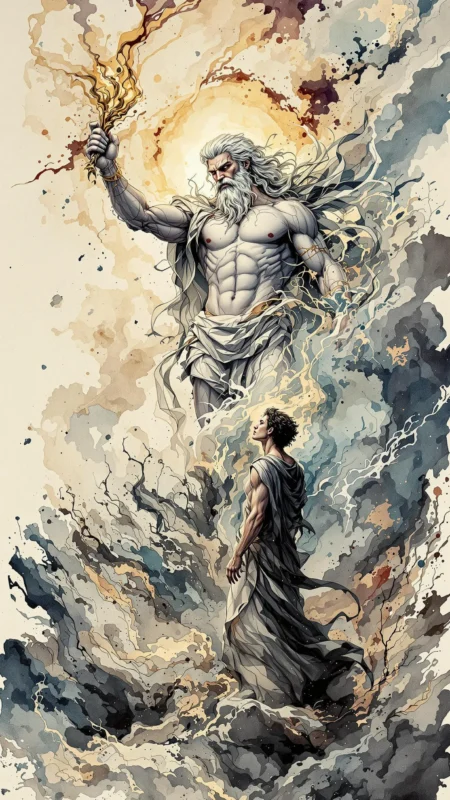
Zeus

Archetype Meaning & Symbolism

Authoritative, commanding, visionary, generative, philandering, tempestuous, just, strategic, ambitious, patriarchal

  • Do not mistake the storm for chaos. It is merely the sky rearranging itself to make room for a new sun. Create your own weather.

If Zeus is part of your personal mythology, you may...

Believe

  • That you are ultimately responsible for creating the order and meaning in your own life and the lives of those you care for.
  • That power is not inherently corrupt, but a necessary and noble tool for enacting justice and building a better world.
  • That a grand, overarching vision is the most valuable asset a person can possess, and that all actions should be in service of its realization.

Fear

  • A total loss of control, being subjected to another's authority, or seeing your creations descend into chaos.
  • Betrayal and usurpation from those within your inner circle, the 'Brutus' who was once a trusted friend.
  • Irrelevance and impotence; the terror of your authority waning, your legacy crumbling, and your rule coming to an unceremonious end.

Strength

  • An unparalleled ability to perceive the 'big picture,' to devise long-term strategies, and to organize complex systems toward a singular, ambitious goal.
  • A profound sense of responsibility and natural leadership that inspires confidence and creates stability for those around you.
  • A potent creative and generative force, capable of bringing new ideas, projects, and entire organizations into existence through sheer will and vision.

Weakness

  • A tendency toward arrogance, authoritarianism, and the dangerous belief that your position places you above the rules that apply to others.
  • An emotional detachment and a difficulty with vulnerability, which can foster isolation and prevent truly reciprocal, equal partnerships.
  • A restless, insatiable ambition that, if unchecked, may disregard the emotional and ethical cost of its conquests.

The Symbolism & Meaning of Zeus

To find the Zeus archetype within one's personal mythology is to connect with the primal impulse to create order from chaos. This is the internal architect, the part of the self that looks upon the messy, untamed wilderness of potential and feels the need to build a city, to draw a map, to write a constitution. In the modern psyche, this may manifest as the drive of the entrepreneur who builds an empire from a single idea, the parent who establishes the unshakable culture of a family, or the artist who imposes a rigorous and elegant form upon their turbulent emotions. It is the belief in hierarchy, not necessarily as a tool of oppression, but as a natural structure for stability. This archetype carries the weight of final authority, the burden and the privilege of having the last word, of being the sky above that sees all and, in theory, judges justly.

The thunderbolt he wields is perhaps the most potent symbol, and its meaning is twofold. It is, of course, a symbol of immense power: sudden, terrifying, and transformative. In a personal mythos, this can represent the capacity for decisive, world-altering action—the choice to quit the job, end the relationship, or launch the venture. But the thunderbolt is also a flash of light, a moment of searing, undeniable clarity. It is the epiphanic moment, the satori, the instant where the entire pattern of a problem is revealed in a brilliant flash. Living with the Zeus archetype means you may be punctuated by these bolts of insight, which demand that you act upon them, rearranging your world to align with this new, shocking truth.

The perspective of Zeus is always from above. He is the sky-god, enthroned on a mountain, watching the movements of mortals and immortals alike. This translates to a psyche that is perhaps predisposed to strategic, big-picture thinking. It is the ability to detach from the immediate, emotional fray and see the entire chessboard. This grants a powerful advantage in long-term planning and leadership, but it contains a seed of danger. The view from such a height can render the details on the ground insignificant. The plights of individuals can blur into abstract patterns, and empathy can be sacrificed for the sake of a grand, impersonal vision. The challenge of this archetype is to rule from the sky without losing touch with the earth.


Zeus Relationships With Other Archetypes

The Matriarch

The Zeus archetype may find its most complex and defining relationship not in a rival, but in its counterpart, the Matriarch. They are two pillars holding up the same gilded roof, a shared sovereignty that is perhaps less a partnership and more a treaty, constantly being renegotiated in the silent language of gazes and gestures. Where Zeus represents the explosive, outward projection of power—the thunderbolt that splits the sky—the Matriarch could be seen as the sky itself, the vast and patient institution that contains his fury and gives it context. Their union is the grand, often tragic, opera of power: the tension between the edict and the ecosystem, the public decree and the private consequence. She may be the keeper of the hearth, but that hearth is the volcanic core of the kingdom, and her stillness is not submission, but the quiet gravity that holds the entire celestial court in its orbit.

The Rebel

In the figure of the Rebel, the Zeus archetype confronts not an enemy to be conquered, but a question to be answered. This relationship is the primordial clash between the architect and the arsonist, between the rigid perfection of the celestial blueprint and the messy, fervent warmth of a stolen flame. The Rebel, in his defiance, does not necessarily seek the throne; rather, he challenges its very foundation, suggesting that the order imposed from on high is a cold and sterile thing compared to the chaotic, striving vitality of what grows below. For Zeus, the Rebel is a maddening paradox: an act of profound disobedience that is also, perhaps, an act of profound creation. This dynamic is the engine of myth and history—the unyielding mountain of authority that, in its resistance to the single, subversive spark, may inadvertently reveal the first crack in its own facade.

The Solitary Peak

Perhaps the most intimate relationship Zeus has is with the archetype of the Solitary Peak, the very seat of his power. It is more than a throne; it is a state of being, a consciousness shaped by altitude. To rule from such a height is to see the world as a map, a grand and beautiful abstraction where individuals blur into landscapes and their pleas become the indistinct murmur of the wind. This perch is a form of exile, the price of a panoramic view. The air up there is thin, too thin for the easy breath of camaraderie or the warmth of mundane connection. The peak, then, is both ally and antagonist: it grants Zeus his unparalleled perspective and dominion, but it also carves out a profound loneliness in his soul, a cold and silent throne of stone from which all the world is visible, but nothing can be touched.

Using Zeus in Every Day Life

Navigating Corporate Power Structures

To embody the Zeus archetype in a professional setting is to cultivate the vision of the Sky-God, seeing the entire corporate Olympus rather than just the confines of your cubicle. It is not about brute force but about strategic oversight: understanding the alliances, the hidden currents of power, and the ultimate objectives of the organization. This perspective allows you to act with decisive authority, making moves that align with the grander scheme, positioning yourself not merely as an employee, but as a sovereign force shaping the climate of your domain.

Founding a Creative Project

The act of creation, of bringing something from nothingness into being, is a Zeus-like thunderbolt. To harness this energy for a new project—a business, a novel, a community—is to gather the formless clouds of inspiration and give them structure. It requires the will to declare “let there be,” and the authority to establish the laws and principles that will govern this new world. This archetype provides the confidence to not just have an idea, but to build the institutional and intellectual scaffolding that allows it to stand and endure.

Establishing Personal Boundaries

The power of Zeus is not only for ruling kingdoms, but for defining their borders. When this archetype informs your mythos, personal boundaries cease to be apologetic suggestions and become sovereign decrees. It is the act of wielding authority not as a weapon against others, but as a tool to define the sacred ground of your own well-being and autonomy. This is the quiet, unshakeable declaration of what is and is not permissible in your personal territory, enforced not by anger, but by the calm, undeniable weight of self-sovereignty.

Zeus is Known For

King of the Gods

His primary role as the supreme ruler of Olympus, the arbiter of justice among gods and mortals, and the force who maintains cosmic order against the forces of chaos.

Wielder of the Thunderbolt

His signature weapon, forged by the Cyclopes, symbolizing immense and sudden power, divine retribution, and the flash of revelation that can irrevocably alter a landscape or a life.

Serial Infidelity

His countless extramarital affairs and the myriad divine and heroic offspring they produced, representing a boundless, potent, and often destructive creative impulse that bypasses established order for the sake of generation.

How Zeus Might Affect Your Personal Mythology

How Zeus Might Affect Your Mythos

When Zeus is a dominant force in your personal mythology, your life story may cease to be a wandering journey and become an epic of ascension and dominion. The narrative arc is not one of finding yourself, but of building your kingdom. Key life events are interpreted as either the strategic consolidation of power or as titanic battles against forces that challenge your rule. A career promotion is not just a new job; it's the conquest of a new province. A successful marriage is the establishment of a royal dynasty. The central plot of your life may be the relentless effort to establish, expand, and defend the sovereign territory of your existence, be it your company, your family, or your creative legacy.

Your mythos will likely be punctuated by thunderbolts: sudden, dramatic, and irreversible events. These are not seen as random acts of fate but as pivotal narrative devices, often of your own making. A sudden, radical career change, an idea that arrives in a flash and consumes your life, a confrontation that permanently alters a relationship—these are the moments your story hinges upon. They are the divine interventions of your inner sky-god, forcing the plot in a new, more expansive direction. Your story is not a gentle, flowing river; it is a landscape shaped by lightning strikes and the subsequent, fertile growth that follows.

How Zeus Might Affect Your Sense of Self

Your self-concept may be built around the pillar of sovereignty. The core identity is that of the ruler, the ultimate authority within the domain of your own mind and life. This can foster a profound sense of responsibility and capability. You may see yourself as the final arbiter of your choices, the lawgiver for your own ethical code, and the architect of your own destiny. The self is not a passive observer but an active, commanding presence, a king or queen on a throne at the center of the psyche, tasked with maintaining justice and order among the warring factions of desires, fears, and ambitions.

This self-perception can also cultivate a kind of divine isolation. The view from the throne is vast but lonely. There may be an internal pressure to always be decisive, infallible, and strong, leaving little room for the expression of doubt, weariness, or vulnerability. The self can become a magnificent but cold statue of authority, admired by others but difficult to connect with intimately. You may feel a disconnect from the more 'mortal' parts of yourself—the fear, the uncertainty, the neediness—viewing them as unruly subjects to be controlled rather than integral aspects of your being to be understood and integrated.

How Zeus Might Affect Your Beliefs About The World

The world, seen through a Zeus-tinted lens, may appear as a grand, hierarchical cosmos of interlocking systems and power structures. You might perceive society, nature, and even relationships as territories governed by laws, some visible and some unseen. Life is not a random series of events but a cosmic chessboard, and the primary objective is to understand the rules in order to dominate the game. In this worldview, chaos is the ultimate evil, a primordial threat to be perpetually pushed back by the imposition of structure, meaning, and will. The highest moral calling may be to bring order where there is disarray.

Consequently, you may not believe in coincidence. Events, both fortunate and unfortunate, are interpreted as part of a system of cosmic justice or strategic consequence. A successful outcome is a testament to your masterful strategy; a failure is a challenge from a rival power or a consequence for a lapse in judgment. The universe is not a cold, indifferent machine but a responsive kingdom. It rewards strength, vision, and order, and it punishes weakness, shortsightedness, and chaos. This view imbues life with a tremendous sense of meaning and stakes, as every action has a resonant consequence within the grand order of things.

How Zeus Might Affect Your Relationships

In the realm of relationships, the Zeus archetype may compel you to view connections through the framework of alliance, court, and dynasty. Partners, friends, and family are not simply companions; they are members of your kingdom. This can inspire a powerful, fierce loyalty and a profound sense of protectiveness. You may see it as your duty to provide for, elevate, and defend those within your circle. In your family or social group, you might naturally assume the role of the patriarch or matriarch, the central pillar of stability to whom others turn for decisions, support, and judgment. Love is expressed as benevolent, and sometimes authoritarian, stewardship.

However, the notorious flaw in Zeus’s character—his boundless and indiscriminate desire—can cast a long shadow over intimacy. This may manifest not just as romantic infidelity, but as a perpetual restlessness that resists deep, singular commitment. The drive to conquer and generate can make you see partners as new territories to explore and rule rather than as sovereign worlds to cohabit. The need for a top-down power dynamic can preclude the possibility of a truly equal, reciprocal partnership, making vulnerability feel like abdication. The great challenge is learning to descend from the throne and meet another at eye level, without a scepter in hand.

How Zeus Might Affect Your Role in Life

Your perceived role in life, your vocation, may be that of the Founder, the Architect, or the Lawgiver. You might feel a deep, internal calling to be the one who creates and maintains the systems that support others, whether that means founding a company, establishing a school of thought, or being the unshakable bedrock of a family. This is the role of the person who not only has the vision but also possesses the will to translate that vision into a tangible, lasting structure. You are the one who draws the blueprint, oversees the construction, and feels personally responsible for the integrity of the entire edifice.

This archetype also carries the mantle of the Judge. You may find that others naturally turn to you to mediate disputes, to make difficult calls for the collective good, and to provide a clear, decisive verdict when ambiguity reigns. This role requires a broad, detached perspective and a commitment to principle over personal feeling. While this can be a great service to others, it can also lead to a dangerous sense of being above the very laws you impose, creating a separate set of rules for the ruler and the ruled. The challenge is to wield judgment with humility, recognizing your own fallibility.

Dream Interpretation of Zeus

To dream of Zeus in a positive light—perhaps seeing him nod in approval, being gifted a thunderbolt, or finding yourself atop a mountain surveying a vast landscape—may symbolize a significant integration of personal power. The unconscious could be signaling that you are ready to step into a larger role of authority and responsibility in your waking life. It might represent a moment of profound clarity, a 'thunderbolt' of insight that will illuminate your path forward. Such a dream could be a call to action: to launch the venture, to take the lead, to finally build the structure you have only envisioned. It is an affirmation of your capacity to create and command your own reality.

Conversely, a negative dream involving Zeus can be a potent warning from the psyche. To be pursued by a wrathful Zeus, to be struck by lightning, or to see him as a terrifying, tyrannical figure may represent a confrontation with your own shadow. It could suggest that your ambition has become hubris, your authority has morphed into tyranny, or your power is being used destructively. Such a dream might also symbolize a feeling of powerlessness before an oppressive external authority figure—a boss, a parent, a societal system. It is a dream that asks you to examine your relationship with power: are you abusing it, or are you being crushed by it?

How Zeus Archetype Might Affect Your Needs

How Zeus Might Affect Your Physiological Needs

The Zeus archetype, when integrated into the personal mythos, may demand a body that commands physical presence and space. This is not necessarily about size, but about bearing. There can be a deep, physiological need for a vantage point, a literal high ground. You might feel an instinctual pull toward the corner office, the head of the table, the penthouse apartment, or the house on the hill. The body itself may feel like a vessel for a kind of storm-like energy, requiring significant outlets—intense exercise, massive projects, loud debates—to prevent this force from turning inward and manifesting as hypertension, anxiety, or a constant, restless agitation.

The drive for dominion can shape one's approach to the body's basic needs. Sustenance might be viewed as fuel for the empire, with meals chosen for maximum efficiency and performance rather than for sensual pleasure or communion. Rest is not a surrender to exhaustion but a strategic retreat to consolidate energy for the next day's campaign. The body is an instrument of the will, and its needs are often met with the detached efficiency of a quartermaster. This can lead to a neglect of the body's more subtle signals, a tendency to push through illness or fatigue, seeing them as insubordination rather than vital feedback.

How Zeus Might Affect Your Ideas of Belonging

Belongingness, within a Zeus-informed mythos, is often experienced from a position of centrality rather than inclusion. You may not seek to fit into a group so much as you seek to create and define the group that others belong to. Love and connection are frequently expressed through a kind of benevolent rule: you show you care by providing, protecting, and establishing the cultural norms of your chosen tribe. You feel you belong because you are the indispensable gravitational center around which your family, friends, or team orbits. The feeling of connection is derived from being the source of order and stability, the one on whom others depend.

This dynamic can, however, foster a profound and chilly isolation. You may be surrounded by a court, but lack a single peer. The inherent top-down nature of the archetype makes true, vulnerable, eye-to-eye partnership a significant challenge. Love given and received can feel like a transaction of loyalty and magnanimity, a bond between ruler and subject, rather than a messy and unpredictable union of equals. The deep-seated fear is that if you were to ever step down from the throne, to show weakness or need, you would not be loved for who you are, but would simply be abandoned.

How Zeus Might Affect Your Feelings of Safety

For a personal mythos governed by Zeus, safety is synonymous with control. A sense of security is not found in being cared for by others, but in creating an impregnable fortress of order and sovereignty. The primary drive is to insulate oneself from the chaos and unpredictability of the world by establishing dominion over one's environment. This often translates into a focus on accumulating resources: financial wealth, powerful alliances, influential positions, and robust systems. Safety is an actively constructed and constantly patrolled reality. The walls of the kingdom must be high, the treasury full, and the sentries loyal. Security is the peace that comes from knowing you are in command.

The greatest threat to this safety, therefore, comes not from barbarian hordes at the gate, but from insurrection within the walls. The primal fear is of betrayal, of a challenge to one's authority from a trusted lieutenant, or the emergence of a repressed internal 'Titan'—a doubt, a guilt, a secret weakness—that could topple the regime. The Zeus archetype is paradoxically most vulnerable to what it creates and controls. The very structures built for safety—the business, the family, the personal code—hold the potential for rebellion. True paranoia for this archetype is the suspicion that your own creation will turn against you.

How Zeus Might Affect Your Views of Esteem

Self-esteem in the Zeus archetype is inextricably tied to dominion, accomplishment, and the effective exercise of authority. Your self-worth is likely measured by the scale and success of the kingdom you preside over. This could be your list of career achievements, the prosperity and unity of your family, or the influence and impact of your ideas. You feel valuable when your judgment proves sound, your vision is made manifest, and your world operates according to the order you have imposed. Esteem is not an innate feeling but something constructed daily upon the scaffolding of tangible proof that you are capable of shaping reality to your will.

As a result, this esteem can be perilously fragile, entirely dependent on remaining on the throne. A significant failure, a public mistake in judgment, a loss of control, or a successful challenge to your authority can feel like a complete collapse of self. If your core identity is 'the Ruler,' then being overthrown or proven wrong is not just a humbling experience; it is an existential threat. The esteem is that of a king who is nothing without his crown. This makes it incredibly difficult to admit fault or to change course, as doing so can feel like a negation of your entire being.

Shadow of Zeus

The primary shadow of Zeus is the Tyrant. This is what happens when authority curdles into dictatorship, when the ego mistakes its personal will for divine law. In this shadow expression, the leader who once inspired loyalty now rules by fear. The strategic mind becomes a manipulative machine, viewing people as pawns to be positioned for personal gain, rather than as subjects to be cared for. The thunderbolt of creative insight is no longer used to illuminate, but to smite any form of dissent, questioning, or perceived threat to the throne. This is the Zeus who chains Prometheus for daring to bring fire to mortals; it is the boss, partner, or parent whose love and approval are conditional upon absolute, unquestioning obedience. It is a brittle, terrified grip on power, born from the fear of the very chaos it claims to have conquered.

The other face of the Zeus shadow is born from his generative power becoming cancerous. His notorious philandering speaks to a shadow that cannot be contained by any structure, even one of its own making. This manifests as a chronic and destructive inability to commit—not just romantically, but to a single project, a specific path, or a core set of values. It is the creative impulse gone wild, constantly starting new ventures at the expense of nurturing what already exists. This shadow leaves a wake of half-finished masterpieces, abandoned businesses, broken promises, and neglected relationships. It is the tragedy of the king who can build countless kingdoms but finds himself unable to live in any of them, forever driven by an insatiable hunger for the next conquest.

Pros & Cons of Zeus in Your Mythology

Pros

  • You may possess a natural and compelling authority, allowing you to lead effectively and build lasting, stable structures that benefit yourself and others.
  • You are likely driven, visionary, and capable of achieving tremendous goals, leaving a significant legacy through your ambition and force of will.
  • You can provide a profound sense of security, order, and decisive guidance to those in your orbit, acting as a reliable and reassuring pillar of strength in turbulent times.

Cons

  • You may be prone to hubris and arrogance, developing a blind spot where you believe your perspective is the only one that matters, leading to autocratic and alienating behavior.
  • Your focus on the grand scheme and your tendency toward emotional detachment can make you seem remote, cold, or unsympathetic in your personal relationships.
  • A deep-seated need for control and a fear of chaos can result in rigidity, an inability to adapt to change, and a disproportionately aggressive reaction to any challenge to your authority.