 Believe
 Fear
Fear Strength
 Weakness
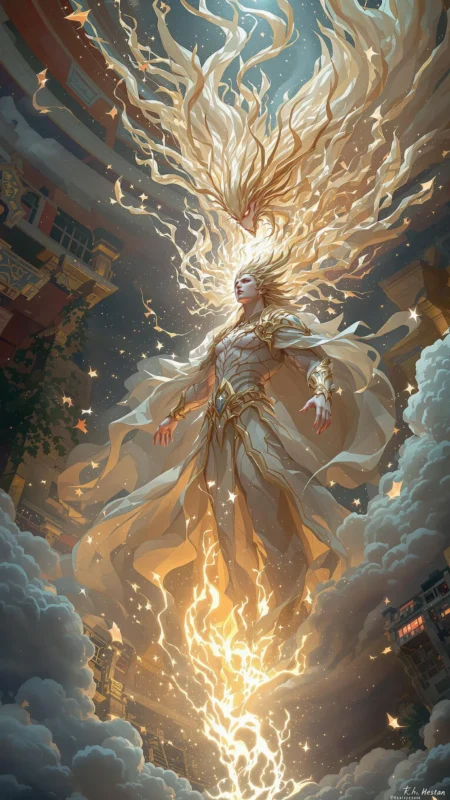
To have Zenitsu Agatsuma as a fixture in one's personal mythology is to court a paradox: that the most profound power is rooted in the most profound fear. He is the patron saint of the high-strung and the hyper-competent, a symbol that our greatest gifts may be hidden behind a wall of our own perceived inadequacies. His existence suggests that potential is not always a seed to be consciously nurtured into a great tree, but perhaps a lightning strike, a phenomenon of nature that lies dormant in the storm clouds of our own anxiety, waiting for the right atmospheric pressure to be unleashed. He represents the specialist, the savant who, by focusing on a single point of light in a universe of darkness, makes that point brilliant enough to eclipse the sun.
The archetype speaks to a fundamental division of the self. There is the waking self: loud, insecure, a frantic monologue of self-deprecation. Then there is the sleeping self: silent, swift, a vessel of pure, unadulterated skill. This is not about developing a persona, but about acknowledging a resident genius that operates outside the ego’s jurisdiction. The symbolism of lightning is key: it is an instantaneous, brilliant flash of power that illuminates everything before vanishing. To live with this archetype is to accept that your moments of greatness may be just that: moments, uncontrollable and perhaps unremembered, leaving you to grapple with the mundane terror of the everyday in their wake.
Ultimately, Zenitsu symbolizes a strange and potent form of hope. It is not the hope of the brave, but the hope of the terrified. It is the belief that even if we feel useless, even if we believe we will fail, something within us has been training for this exact moment. It reframes mastery not as a confident performance but as a bodily instinct, a muscle memory so deep it operates without permission from our cowering consciousness. He is the whisper that says: you are more capable than you know, but you may have to be knocked out to prove it.