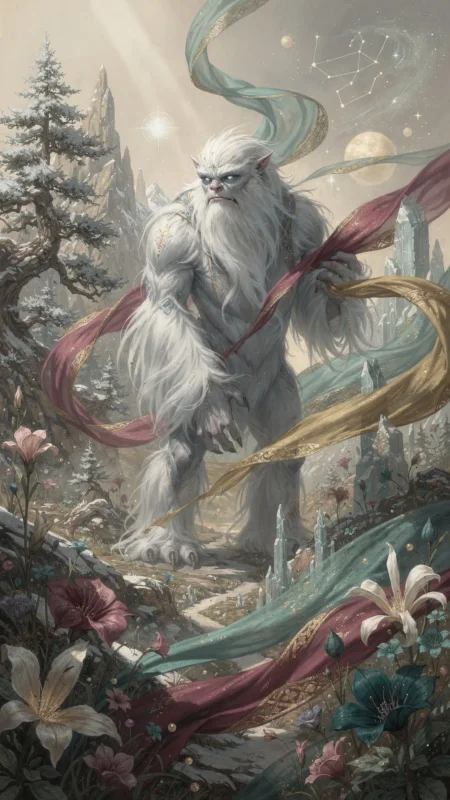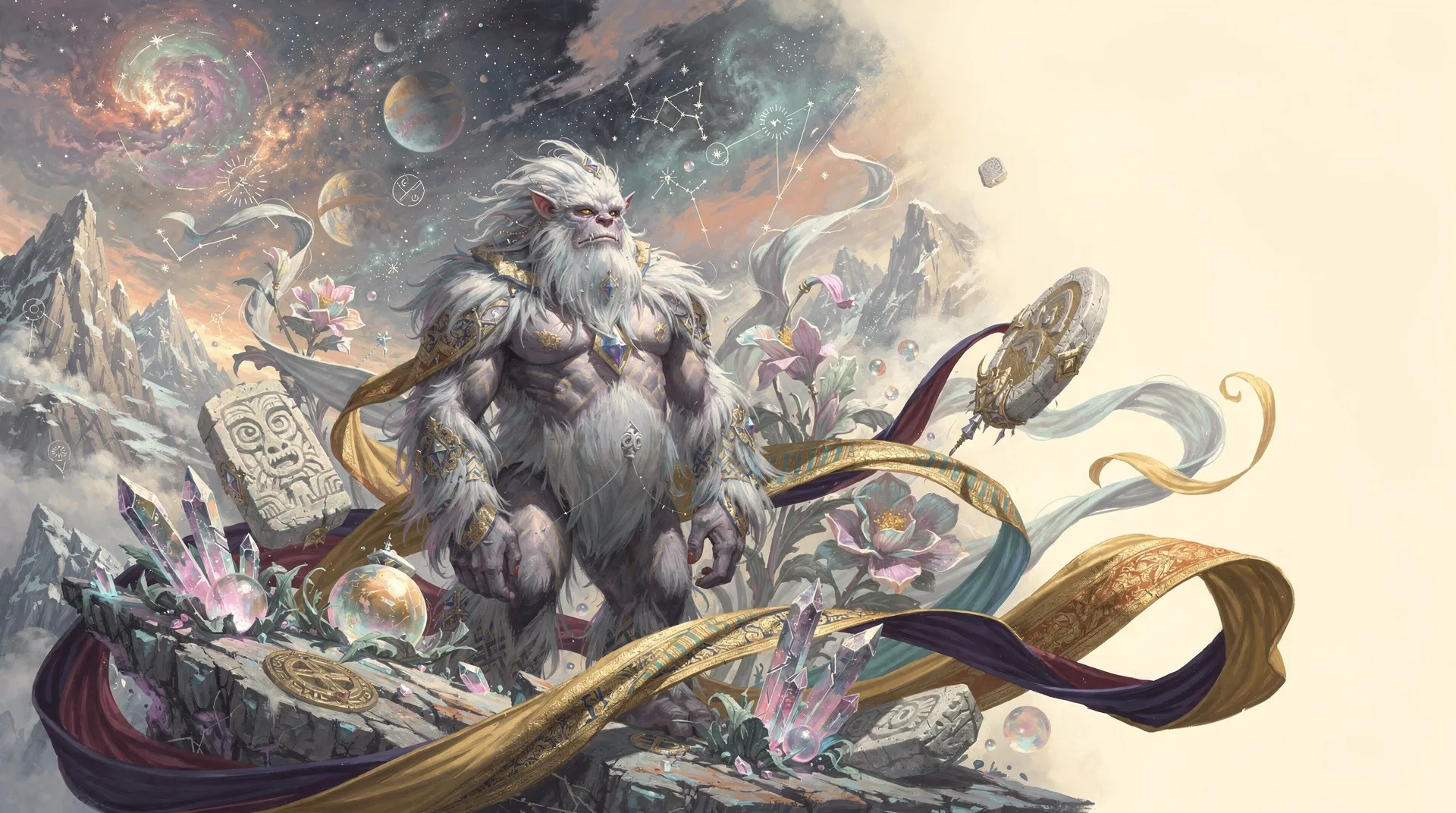


Yeti

Archetype Meaning & Symbolism

Solitary, elusive, self-sufficient, misunderstood, resilient, primeval, intimidating, resourceful, silent, watchful

  • The loudest truths are found in the silences between heartbeats, in the vast quiet of a world you alone inhabit.

If Yeti is part of your personal mythology, you may...

Believe

  • You may believe that true understanding of oneself is only found in profound solitude, far from the echoes of other people's opinions.
  • You may believe that some things are true whether or not they can be proven, and that the world's greatest secrets are kept in its wildest places.
  • You may believe that self-sufficiency is the highest form of security and freedom.

Fear

  • You may fear that your solitude will become permanent, an icy prison from which you can never escape back to human warmth.
  • You may secretly fear that you are, in some fundamental way, monstrous or 'abominable,' and that if people saw your true nature, they would be terrified or repulsed.
  • You may fear being 'discovered' or 'captured'—that being fully seen and understood by the world would mean the death of your mysterious, wild essence.

Strength

  • Your greatest strength is a profound and unshakable self-reliance; you are a complete ecosystem unto yourself.
  • You possess a rare form of resilience, an ability to endure and even thrive in conditions of emotional or social scarcity that would break others.
  • You have the strength of a unique perspective, an ability to see the world from a high-altitude vantage point, far from the biases and groupthink of the valley below.

Weakness

  • Your self-reliance can become a weakness, making it incredibly difficult to ask for help, show vulnerability, or accept support.
  • Your comfort with solitude may lead to social awkwardness or an intimidating presence that unintentionally pushes away those who genuinely wish to connect.
  • You may possess a stubborn refusal to compromise your path, even when a bit of flexibility or collaboration would be beneficial or even necessary.

The Symbolism & Meaning of Yeti

The Yeti in personal mythology is the cartographer of the soul's undiscovered continents, the embodiment of that which is untamed within. It symbolizes a profound comfort with solitude, not as loneliness, but as a chosen state of sovereignty. To have the Yeti as an inner figure is to carry a private wilderness, a vast, snow-swept expanse where one can retreat to find clarity. It represents the parts of ourselves that refuse to be categorized, documented, or tamed by social convention. This archetype speaks to a resilience forged in harsh conditions, a strength that is quiet, self-contained, and needs no audience for its validation. It is the silent guardian of our most authentic, un-socialized self.

Furthermore, the Yeti stands as a monument to mystery in an age of supposed omniscience. It is the grand 'perhaps' that lives just beyond the edge of our satellite maps and data points. In a personal mythos, this translates to an embrace of the unknown aspects of one's own character and potential. You may have a capacity for something primal, a strength or insight that defies logical explanation, a connection to a more ancient rhythm of being. The Yeti reminds you that not everything about you needs to be explained, either to yourself or to others. Some parts of your personal landscape are meant to remain wild, glimpsed only by their tracks in the snow.

This archetype is also a powerful symbol of boundaries. The Yeti's habitat is a natural fortress, its elusiveness a behavioral one. For an individual, this may manifest as an innate understanding of personal space, both physical and psychic. You may have a low tolerance for intrusion and a deep need for autonomy. The Yeti's power is not aggressive, but defensive: its intimidating presence is a passive deterrent, a silent declaration of its territory. As such, the Yeti spirit animal may guide you to establish healthier, more formidable boundaries, teaching that your energy is a finite resource, to be conserved and protected in your own high-altitude sanctuary.


Yeti Relationships With Other Archetypes

The Unsent Letter

The Yeti’s kinship with the Unsent Letter may be one of sealed potential, a truth held in abeyance. Like a missive folded into a mountain’s crevasse, the creature could be a message—penned in footprints, with ink of melted snow—that never reaches its intended recipient, which is, of course, the whole of the civilized world. Its existence is a persistent rumor of content, a confession of being that yellows with time but never arrives. This relationship is not one of failure, but of a sacred, perhaps even necessary, incompletion. The letter’s value, and the Yeti's, could lie precisely in its undelivered state, allowing it to remain a vessel for pure possibility, a story we are forever on the verge of reading.

The Echo

Perhaps the Yeti does not exist as a body, but as an echo—a resonance in the valley’s throat that proves a sound has been made. Its being could be understood not as a solid form to be captured, but as the after-image of a presence, the mountain’s own voice talking back to itself. Where a direct cry is an act of revelation, the echo is an act of suggestion, a sonic ghost that proves a source only by articulating the shape of the space it has just vacated. In this way, the Yeti may not be the creature itself, but the palpable silence that follows its rumored passing, a story that exists only in the telling and retelling, each version a fainter, more distorted reverberation of an original call that no one truly heard.

The Lighthouse

One might perceive the Yeti as a kind of terrestrial antithesis to the Lighthouse, a dialogue between a fixed point of light and a moving point of shadow. The Lighthouse is a monument to certainty, an unwavering eye of reason that carves the chaotic sea into lanes of safe passage. The Yeti, in contrast, is a beacon of mystery, a symbol of the interior wilderness that resists mapping and defies illumination. Where the Lighthouse casts a spear of legibility into the darkness, the Yeti could be the darkness that quietly absorbs it, reminding us that not all landscapes are meant to be tamed. Their silent, distant conversation may be the very axis on which our world turns: the ceaseless effort to know, and the profound, humbling necessity of the unknown.

Patterns of The Yeti Spirit Animal, Totem, or Archetype

Signs that the Yeti is connected to your personal mythos often appear as a persistent, magnetic pull towards the Earth's quiet, formidable places. You may find yourself inexplicably drawn to mountains, even if you live in a flat landscape, feeling a sense of 'home' when looking at images of snowy peaks. A recurring feeling of being most alive and clear-headed during winter, or a preference for cold, crisp air over summer's heat, could be a whisper from this archetype. Synchronicities may appear in the form of footprints: you might notice a single set of tracks in the snow, sand, or mud that seems significant, a symbol of your own solitary journey. An unusual fascination with cryptozoology, unexplored territories, or stories of lone survivors could also be an indicator that this archetype is active in your psyche.

Internally, the connection may manifest as a lifelong feeling of being an 'outsider,' not in a painful, ostracized way, but as a simple, objective fact of your existence. You might feel as though you operate on a different frequency from most people, comfortable in silences that make others anxious. A recurring thought pattern might be the intense need to retreat and 'disappear' for periods to recharge your energy. You may feel that your true self is something vast, ancient, and not entirely civilized, a feeling that you must keep partially hidden to navigate the social world. When you hear stories of hermits, lone explorers, or misunderstood geniuses, you may feel a sense of recognition rather than pity. This is the landscape of a Yeti spirit animal.

Events in your life may conspire to reinforce this archetypal pattern. You might find that you are repeatedly placed in situations that require extreme self-reliance, forcing you to develop the very resilience the Yeti embodies. Perhaps relationships have ended because partners could not honor your need for autonomy, or career paths have shifted because you could not tolerate the noise and conformity of a traditional workplace. You might look back on your life and see a trail of solitary decisions that, while difficult, led you to a place of greater authenticity. These are not coincidences; they are the curriculum of your personal mythos, designed to sculpt you into the formidable, self-possessed being that the Yeti represents. It is the universe's way of guiding you back to your own mountain.

Using Yeti in Every Day Life

Navigating Social Burnout

When the noise of the collective becomes a blizzard, the Yeti archetype offers a map to a personal summit. It is permission to seek high ground, not as an act of antisocial retreat, but as a necessary pilgrimage for psychic survival. You may learn to schedule solitude with the same seriousness as a business meeting, recognizing that in the quiet of your own high-altitude sanctuary, you are not avoiding the world but replenishing your capacity to engage with it on your own terms.

Facing Misunderstanding

To feel the Yeti within is to accept that your essence may be a myth to others: rumored, debated, but rarely understood. When you are mischaracterized or your motives are questioned, the Yeti counsels a profound stoicism. It does not descend to the valley to correct the villagers' stories. Its existence is validated not by their belief, but by the tracks it leaves in its own path, the certainty of its own breath frosting in the thin air. This archetype teaches you to be the sole, unwavering authority on your own truth.

Cultivating Radical Resilience

In the barren landscapes of personal or professional hardship, the Yeti archetype serves as a guide to radical self-reliance. It asks what inner resources persist when the external world freezes over. It is about foraging for sustenance in the pantry of the soul, finding warmth in the fire of one's own will. This is not mere survival: it is the art of thriving in a personal climate that others would deem uninhabitable, discovering a profound and rugged capability you never knew you possessed.

Yeti is Known For

Elusiveness

Its very existence is a debate, a whisper in the high passes, known more by its absence and the footprints it may leave behind than by direct observation.

Himalayan Habitat:

It is inextricably linked to the world's highest, most inhospitable peaks, a symbol of life thriving at the absolute limits of the known world.

Fearsome Reputation:

Often called the 'Abominable Snowman,' it carries an aura of primal fear and untamed wildness, a raw power that exists beyond human control or comprehension.

How Yeti Might Affect Your Personal Mythology

How Yeti Might Affect Your Mythos

When the Yeti becomes a feature of your personal mythology, your life story may shift from a communal narrative to an epic of solitude. The central quest is no longer about finding your place in the tribe, but about charting the vast, unknown territory of the self. You may see your life not as a linear progression through societal milestones, but as a series of ascents and descents on a private mountain range. Moments of isolation are reframed: they are not failures of connection, but deliberate expeditions into the high country of your own soul, undertaken to discover something rare and essential. Your personal history becomes populated by fewer characters, but the landscape itself, the inner wilderness, becomes the most significant character of all.

The narrative arc of your mythos may be one of misunderstanding and eventual self-acceptance. You are the creature of myth, the one about whom stories are told but who is rarely known. Key plot points might revolve around moments when you chose your own path over the well-trodden one, when you embraced your 'strangeness' rather than trying to excise it. The climax of your story may not be a public victory, but a moment of profound, quiet integration: the instant you stand on your own inner summit, breathing the thin, clean air of self-knowledge, and feel no need for anyone else to witness it. Your legend is one written for an audience of one.

How Yeti Might Affect Your Sense of Self

To integrate the Yeti is to fundamentally alter your relationship with yourself. You may cease to see your need for solitude as a flaw and begin to view it as your greatest source of strength and clarity. The parts of you that feel 'other' or out of step with the mainstream are no longer liabilities to be hidden, but hallmarks of your unique nature. There could be a growing comfort in your own skin, a sense of being profoundly 'at home' when you are alone. This archetype fosters a quiet confidence that is not dependent on external praise or recognition. Your self-worth becomes anchored in your resilience, your self-sufficiency, and your courage to walk a path that is yours alone.

This self-view might also contain a dose of intimidating power. You may become aware of a primal, untamed force within you, a capacity for immense endurance and a stoicism that can be unsettling to others. You learn to respect this inner power, to neither fear it nor wield it carelessly. The Yeti spirit animal doesn't roar to prove its strength; its silent, massive presence is enough. Similarly, you may find you no longer need to argue your point or prove your worth. You learn to simply 'be,' allowing your quiet authenticity to be its own formidable statement. This fosters a self-perception rooted in deep, unshakable integrity.

How Yeti Might Affect Your Beliefs About The World

With the Yeti as a guide, your view of the world may become layered with mystery and unseen possibilities. You may look at a map and see not just roads and cities, but the vast, blank spaces in between where unknown things might live. This fosters a healthy skepticism toward consensus reality and a belief that there are truths that exist beyond the reach of data and empirical proof. The world is not a solved equation; it is a wild, sprawling poem, with entire stanzas hidden in the high snows. This perspective cultivates a sense of wonder and a deep respect for the unknown, both in the external world and in the people who inhabit it.

This worldview also tends to prioritize nature and wilderness as sacred spaces. You may see civilization not as the pinnacle of existence, but as one ecosystem among many, and perhaps a noisy, crowded one at that. The 'real world' might be the one found in the silence of a forest, the stark beauty of a desert, or the immense scale of the mountains. Your philosophy could shift to value that which is enduring, ancient, and untamed over that which is new, fashionable, and manufactured. You might measure progress not by technological advancement, but by the preservation of wildness, both on the planet and within the human soul.

How Yeti Might Affect Your Relationships

In relationships, the Yeti archetype manifests as a need for 'sacred space.' You may require significant solitude and autonomy, even within the most intimate partnerships. Your love is deep, but it is not clinging. Potential partners must understand that your withdrawals are not rejections, but necessary acts of self-preservation, like a mountaineer returning to base camp. You offer a profound, unwavering loyalty to the few you let into your inner circle, but you will always maintain a part of yourself that is solely your own: your private mountain. This can be challenging for partners who require constant togetherness, but for those who value independence, it can form the basis of a resilient, respectful bond.

The Yeti's influence may mean you have fewer friends, but the connections you do have are built on a foundation of authentic understanding. You are drawn to people who are not intimidated by silence, who can sit with you in companionable quiet without needing to fill the space with noise. You eschew superficial social gatherings in favor of deep, one-on-one communion. You value friends who see your elusiveness not as aloofness, but as a sign of a rich inner world. With the Yeti as your guide, you seek relationships that are like well-spaced, ancient trees: strong, deep-rooted, and with enough space between them to let the light in.

How Yeti Might Affect Your Role in Life

Your perceived role in life may shift from being a participant to being a watcher, a guardian. You might not see yourself as an actor on the center stage of society, but as the quiet observer in the wings, or perhaps the groundskeeper of the entire theater. This is not a passive role; it is one of immense responsibility. You may feel called to protect what is fragile, to preserve forgotten wisdom, or to simply hold a space of quiet sanity in a chaotic world. Your purpose is not to lead the charge, but to ensure the base camp is secure and the ancient landmarks are not forgotten. Your role is one of substance over style, silence over noise.

You may also see your role as that of a scout or a pioneer, not of land, but of consciousness. You are the one who ventures into the 'unexplored territories' of thought, feeling, and being, returning with cryptic reports that others may or may not understand. You might be an artist, a philosopher, a scientist, or simply a deeply introspective individual whose life is a testament to an alternative way of being. Your contribution is not in conforming, but in providing a living example that other paths exist. Your role is to be the footprint in the snow that makes someone else wonder, 'What lies beyond that ridge?'

Dream Interpretation of Yeti

To dream of the Yeti in a positive context is often to receive a visitation from your own deep, untapped power. If the creature appears as a guide, calmly leading you through a snowy landscape, it may signify that you are ready to explore your own inner wilderness and have the resilience to face what you find there. Seeing the Yeti from a distance, majestic and peaceful, can be an affirmation of your path of solitude and self-reliance. It is a message from your subconscious that your independence is a source of profound strength and integrity. A dream of sheltering with a Yeti could suggest a newfound comfort and safety in being alone, turning isolation into a sanctuary.

In a negative context, a dream of being pursued or threatened by a Yeti may point to a fear of your own primal instincts or a shadow self you have refused to acknowledge. The 'Abominable Snowman' aspect comes to the fore, representing a part of you that feels monstrous, isolated, and dangerously untamed. This could be a warning that your healthy solitude is curdling into bitter alienation, cutting you off from vital human connection. If you are hiding from the Yeti in your dream, it may symbolize an avoidance of a hard, uncomfortable truth about yourself. The dream is an urgent call to turn and face this powerful, intimidating aspect of your own nature before it consumes you.

How Yeti Archetype Might Affect Your Needs

How Yeti Might Affect Your Physiological Needs

The Yeti's influence on your personal mythology may ground your physiological needs in a primal simplicity. You might feel a deep disconnect from complicated diets, bio-hacking trends, and regimented fitness schedules. Instead, your body's wisdom speaks in a more ancient language. Sustenance is about fuel, not flavor or fad. You may gravitate towards whole, unprocessed foods, things that feel foundational and elemental. There's a satisfaction in simple fare that provides lasting energy for the long trek, a kind of internal 'hard tack' for the soul's expeditions. Your body may not crave the stimulation of a spin class but the deep, rhythmic work of a long walk, the feeling of your own engine burning steadily in the cold.

Rest, too, is governed by internal seasons rather than the clock. The Yeti does not adhere to a 9-to-5 schedule. You may find you need periods of deep hibernation, psychic or physical, to recover from the exertions of the world. Your energy is a resource to be conserved, not spent frivolously. This could manifest as a deep need for sleep, a sensitivity to overstimulation, and an intuitive understanding of your own energy cycles. You learn to listen to the subtle cues of your body: the need for quiet, for nourishment, for stillness. In this, you honor the creature's wisdom of surviving harsh climates by mastering the art of energy conservation.

How Yeti Might Affect Your Ideas of Belonging

Belonging, through the lens of the Yeti, is a radical revision of the concept. It is not about fitting in, but about finding your 'native habitat.' This may not be a group of people, but a place, an idea, or a state of being. You may feel you belong more to the mountains, the winter, or the quiet pre-dawn hours than to any social club or community. Your sense of connection is deep, but selective. It is a belongingness defined by authenticity, not proximity. The Yeti spirit animal doesn't seek a herd; it belongs to the entire mountain range. Similarly, you may feel a sense of kinship with all who walk a solitary path, a silent fraternity of outsiders across time and space.

The need for love and intimacy is not absent, but it takes a unique form. It is a love that honors sovereignty, that understands the sacredness of solitude. To be loved, in this mythos, is to have your wilderness seen, respected, and given space to thrive. It's finding the rare soul who is not afraid of your silences, who can walk alongside you for a time without demanding you descend from your mountain. It is a partnership of two self-sufficient kingdoms who choose to align their borders, not merge their territories. This creates a powerful, resilient bond, free from the desperation of codependency.

How Yeti Might Affect Your Feelings of Safety

From a Yeti perspective, safety is not found in the fortress of community or the reassurance of social norms. Safety is competence. It is the quiet confidence that comes from knowing you have the inner resources to survive the blizzard, to navigate by the stars of your own intuition when all other landmarks are obscured. This archetype may compel you to cultivate practical skills, but more importantly, to develop a rugged psychological resilience. Safety is the knowledge that even if you are misunderstood, cast out, or left entirely alone, you possess a core of self-sufficiency that cannot be taken from you. It's a portable sanctuary, an internal base camp you carry within.

This redefinition of safety may also involve a recalibration of fear. The small social anxieties that plague others might seem trivial from your high-altitude perspective. The fear of missing out is replaced by a fear of losing oneself in the crowd. True danger, in the Yeti mythos, is not being alone; it is being inauthentic. The greatest threat is not the harshness of the external world, but the possibility of betraying your own inner nature. Therefore, you may take social risks that others would not—such as speaking an unpopular truth or walking away from a secure but soul-crushing situation—because you understand that psychic safety is paramount.

How Yeti Might Affect Your Views of Esteem

Esteem, in the Yeti's world, is forged in the crucible of self-reliance. It is not a reflection in the mirror of public opinion, but a deep, internal knowing, solid as mountain rock. Your self-worth is built upon the evidence of your own resilience: the personal storms you have weathered alone, the inner peaks you have scaled without applause. Every act of self-sufficiency, every moment you chose your own truth over social comfort, is another stone in the foundation of this esteem. It is a quiet, unshakeable confidence that needs no external validation because it has been tested against the harshest elements of your own inner and outer world.

This can lead to a profound detachment from the economy of likes, shares, and social approval. You may become immune to both flattery and criticism, as your sense of self is anchored in something far more permanent. The need for achievement is reframed: success is not about winning accolades, but about maintaining your integrity. You might take quiet pride in your ability to be alone, to think for yourself, to resist the pull of the herd. Your esteem comes from the knowledge that you are the undisputed sovereign of your own inner kingdom, a ruler whose authority is absolute and whose presence is enough.

Shadow of Yeti

The shadow of the Yeti emerges when its defining traits are twisted by fear or imbalance. The healthy solitude of the archetype can metastasize into a crippling, paranoid isolation. Here, the individual is not merely self-reliant; they are aggressively, defensively alone. They may see connection as a threat and push away loved ones with a coldness that borders on cruelty, mistaking their icy fortress for a sanctuary. This shadow figure is the true 'Abominable Snowman,' a being so consumed by its own isolation that it becomes a monster, haunting the fringes of its own life, terrified of both its loneliness and any potential cure for it. Its strength becomes brittleness, its silence becomes a void.

Conversely, the shadow can manifest as a desperate, failed attempt to escape the Yeti nature. This is the Yeti who tries to come down from the mountain and live in the village. It is a painful, clumsy spectacle. The individual may betray their own need for solitude, over-committing to social engagements that drain them, adopting opinions that are not their own, and performing a version of 'normalcy' that feels hollow. This shadow aspect fears its own otherness and will do anything to hide it, resulting in a profound sense of self-betrayal and inauthenticity. The power of the Yeti spirit animal, in this case, is not integrated but violently suppressed, leading to a life of quiet desperation and psychic friction.

Pros & Cons of Yeti in Your Mythology

Pros

  • You possess a profound sense of inner peace and clarity that is unavailable to those constantly immersed in social noise.
  • Your self-sufficiency grants you an immense freedom to live life on your own terms, unbound by the need for external validation or support.
  • Your unique, outsider's perspective allows you to see truths and solutions that are invisible to the consensus.

Cons

  • You may struggle with deep, persistent feelings of loneliness and alienation, even when you choose your solitude.
  • Your elusive and intimidating nature can lead to being profoundly misunderstood, making it difficult to form the few, deep connections you truly crave.
  • Your fierce independence may prevent you from participating in collaborative efforts or accepting help, limiting your potential achievements and deepening your isolation.