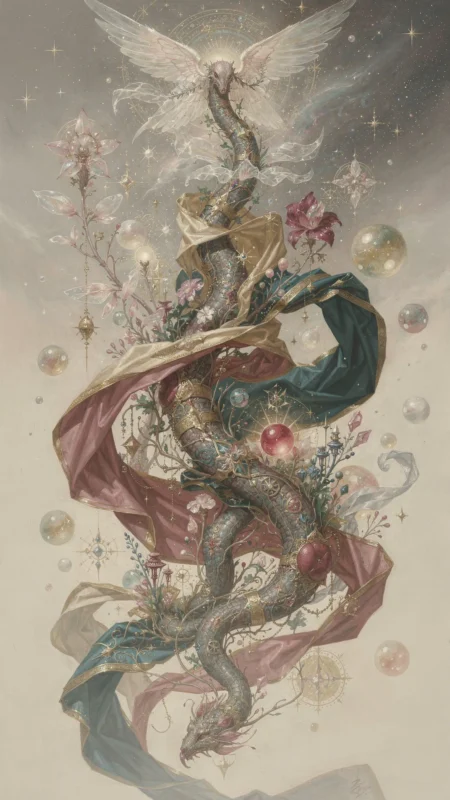
The Bird
The relationship between the Worm and the Bird may be the primordial dialogue between the subterranean and the celestial. It is not merely a drama of predator and prey, but perhaps a metaphor for the fraught dependency of the transcendent on the immanent. The Bird, with its perspective of the whole, its song that punctuates the sky, could represent the soaring ideal, the flash of insight, the spiritual aspiration. Yet, to sustain itself, it must descend and pluck from the earth the very creature that embodies the humble, the blind, and the earthbound. In this, one might see a profound truth: our highest thoughts and most divine inspirations are, perhaps, nourished by the quiet, unglamorous processing of the muck and decay of lived experience, a truth the high-flying Bird must consume to even exist.
The Gardener
In the cultivated world of the Gardener, the Worm is an unwitting and unsung collaborator. The Gardener may embody the conscious will, the grand design, the force that seeks to impose order and beauty upon the chaos of nature. Yet, this meticulous planning—the careful placement of seeds, the strategic watering—could be for naught without the blind, tireless industry of the Worm. The Worm represents a deeper, more ancient intelligence; the subconscious process that aerates the soil of the psyche, that breaks down the compacted griefs and forgotten traumas into fertile ground for new growth. The Gardener may claim the rose, but the Worm could be said to be the silent, hidden author of its vitality, a reminder that the most deliberate creations are often contingent on unconscious, instinctual forces we can neither command nor fully comprehend.
The Ruin
Where the Ruin stands as a monument to entropy and the fragility of human ambition, the Worm may act as its quiet, digestive counterpart. The Ruin is a testament to a grand narrative that has ended, its broken arches and fallen columns memorials to a past glory. The Worm, however, is not an agent of mere destruction but of transformation. It is the humble engine that pulls the great stones back into the soil, that consumes the dust of empires not with malice, but with a blind, regenerative purpose. This relationship could suggest that history is not a collection of static artifacts to be preserved, but a compost heap to be turned. The Worm, in its slow, ceaseless work, perhaps ensures that the end of one story is never a true end, but merely the quiet preparation of the soil from which the next, unknown story will inevitably grow.

 Believe
 Fear
Fear Strength
 Weakness