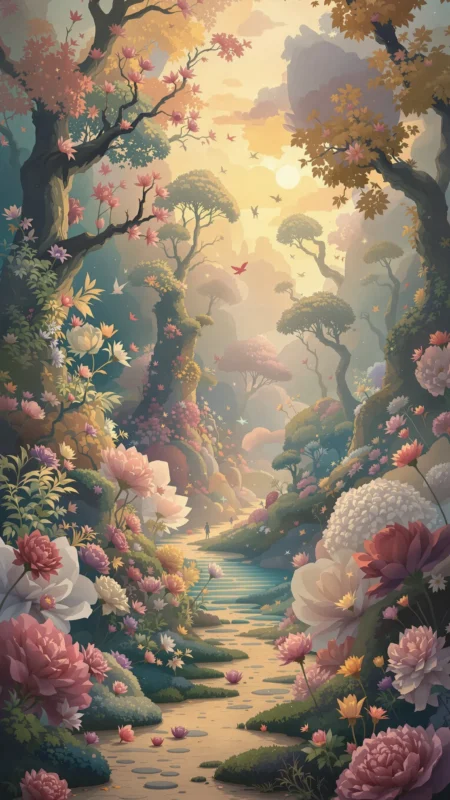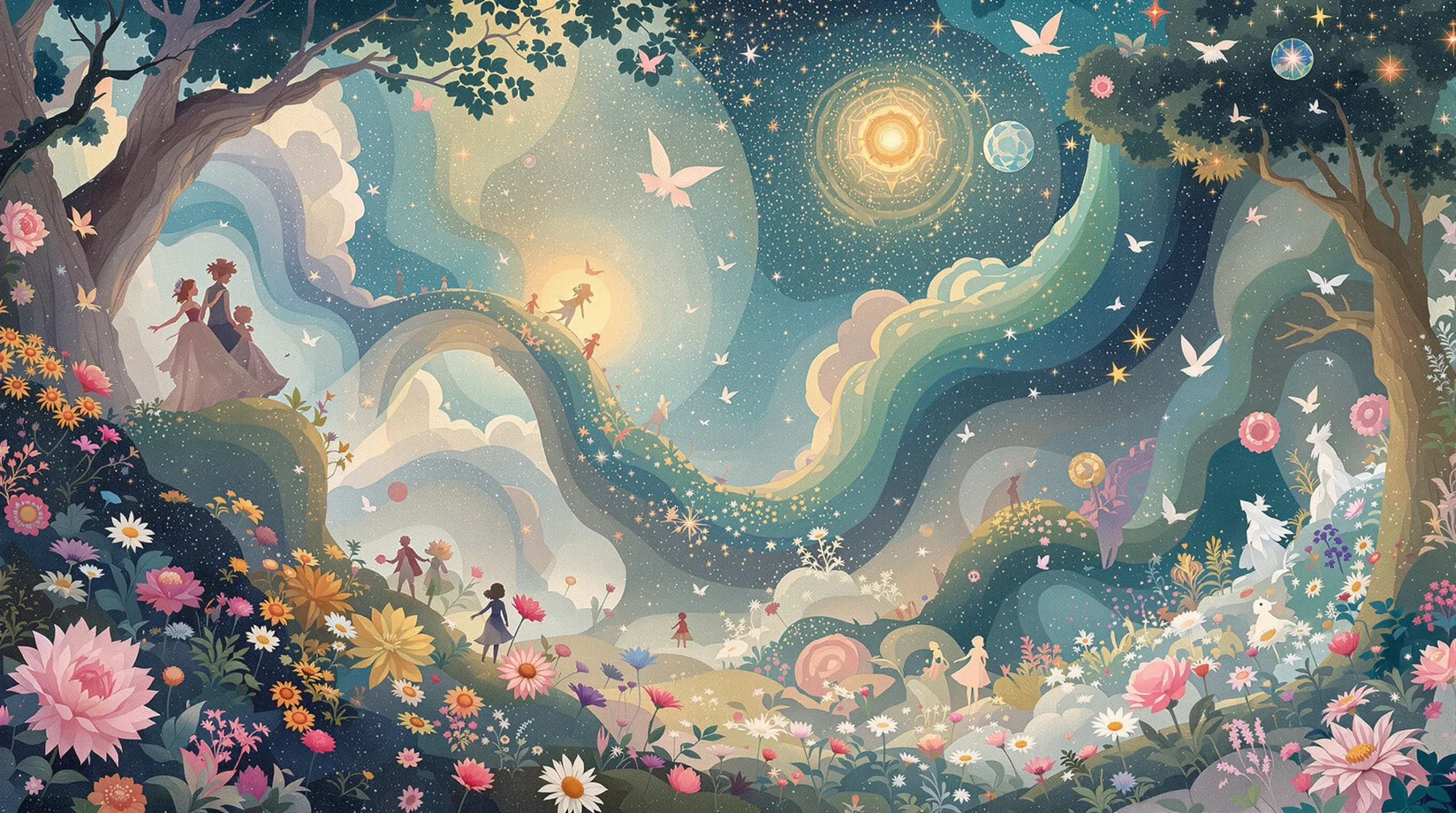


Wonderland

Archetype Meaning & Symbolism

illogical, paradoxical, whimsical, chaotic, enchanting, disorienting, surreal, playful, nonsensical, profound

  • Stop trying to make sense. Sense is a cage built of straight lines in a world that is curved. The only rule here is that the rules will change, especially when you think you've learned them.

If Wonderland is part of your personal mythology, you may...

Believe

  • You may believe that logic is a beautiful and useful tool, but it is a flashlight in an infinite cavern, illuminating only a tiny, predictable patch of a vast and mysterious dark.
  • You may believe that the most important conversations are the ones that end with more questions than answers, and that a riddle without a solution is a gift to the imagination.
  • You may believe that getting lost is not a failure of navigation, but an essential part of any worthwhile journey, the prerequisite for discovering a place you never knew you were looking for.

Fear

  • You may fear that you will fall so far down your own rabbit hole that you lose the thread connecting you to the shared reality of those you love, becoming permanently isolated in your own wonder.
  • You may fear being fundamentally misunderstood, of having your playful curiosity misdiagnosed as madness or your profound insights dismissed as mere nonsense by a world that values only the literal.
  • You may fear that beneath all the enchanting absurdity and captivating paradoxes, there is no deeper meaning at all, only an endless, chaotic void, and that your search for wonder is just a way of avoiding that terrifying emptiness.

Strength

  • Your greatest strength may be an almost supernatural creativity, an ability to generate novel ideas and solutions by connecting concepts that, to others, exist in separate universes.
  • You may possess a profound resilience in the face of chaos and uncertainty, viewing upheaval not as a crisis but as an interesting change in the weather, an opportunity to learn a new kind of dance.
  • You may have a deep and abiding sense of wonder, a playful curiosity that keeps you engaged with the world and allows you to find magic and delight in the most mundane of circumstances.

Weakness

  • You may struggle with the mundane but necessary tasks of everyday life: paying bills on time, following a recipe, or adhering to a linear project plan can feel like speaking a foreign language.
  • You may have a tendency toward escapism, preferring the enchanting complexities of your inner world or theoretical problems to the often messy and demanding realities of the physical world and interpersonal relationships.
  • You may unintentionally alienate others, as your non-linear communication style and comfort with ambiguity can be deeply frustrating or intimidating to those who prefer clear, direct, and practical interaction.

The Symbolism & Meaning of Wonderland

In the personal mythology of the modern individual, Wonderland may represent the subconscious mind made manifest: a sprawling, illogical landscape where the suppressed, the whimsical, and the terrifying are given form and voice. To have this realm as a cornerstone of your inner world suggests a psyche that values the dream-state as much as the waking one. It is a symbol of permission: permission to be confused, to not have a map, to follow the white rabbit of intuition down a hole that promises nothing but uncertainty. It is the psychic territory you enter when you abandon the tyranny of the “shoulds” and the rigid grid of rationality, choosing instead to engage with the world through metaphor, feeling, and a kind of radical, playful curiosity.

Furthermore, Wonderland symbolizes the deconstruction of the ego. The journey through it is a series of encounters that destabilize one's sense of identity, importance, and knowledge. The caterpillar's pointed question, “Who are you?” is the central theme of the realm. Within your personal mythos, this landscape could represent those periods in life where your established identity dissolves, forcing you to confront the raw, unformed self beneath. It is a necessary chaos, a psychic wilderness that breaks down old structures so that a more authentic, less rigid self can emerge. It suggests a belief that true wisdom isn't accumulated knowledge, but the comfortable acceptance of perpetual bewilderment.

The archetype also speaks to the profound in the nonsensical. It suggests that the greatest truths are not found in sober pronouncements but in riddles without answers, in the chaotic energy of a mad tea party, or the unnerving grin of a disappearing cat. For the individual whose mythos includes Wonderland, life’s meaning may not be a singular, discoverable thing but a collage of beautiful, strange, and contradictory experiences. This realm champions the idea that the point of the journey is not to arrive at a destination or to solve the puzzle, but to learn to dance with the delightful, maddening mystery of it all.


Wonderland Relationships With Other Archetypes

The Innocent:

Wonderland may serve as the primary crucible for The Innocent archetype. It is the world that The Innocent, typified by Alice, tumbles into. This landscape does not coddle naivete; it assaults it with relentless paradox and existential questioning. The relationship is one of forced growth. Wonderland is the chaotic, unpredictable teacher that strips The Innocent of their simple, black-and-white view of the world, forcing them to develop resilience, adaptability, and a more sophisticated understanding of reality. It takes the trusting hand of The Innocent and leads it through a disorienting hall of mirrors until it learns to trust its own strange reflection.

The Trickster:

Wonderland is the Trickster's native habitat, its kingdom and its playground. Figures like the Cheshire Cat or the Mad Hatter are not just residents; they are personifications of the realm's core principles. The Trickster’s function is to shatter calcified thinking and expose absurdity through absurdity itself, and Wonderland is the grand stage for this cosmic joke. For a person with Wonderland in their mythos, their own inner Trickster may feel most at home there. The landscape grants the Trickster its power, providing an environment where its nonsensical wisdom is the only kind that has any currency, turning its disruptive energy from mere chaos into a tool for profound revelation.

The Sovereign:

The relationship between Wonderland and The Sovereign is one of deep antagonism. The Sovereign, an archetype of order, law, and rational control, is rendered completely impotent within Wonderland. The Queen of Hearts is a parody of The Sovereign: her commands of “Off with their heads!” are exercises in frustration because the rules of her own court are fluid and nonsensical. She represents the ego’s desperate attempt to impose order on the chaotic subconscious. For an individual, the presence of Wonderland in their mythos may represent a deep skepticism toward rigid authority and a belief that true power lies not in making rules, but in the ability to play and thrive when all rules have dissolved.

Using Wonderland in Every Day Life

Navigating Creative Blocks

When faced with a creative impasse, you may intentionally invoke Wonderland. Instead of brainstorming logically, you could try juxtaposing completely unrelated concepts: what does the color blue have to say about financial planning? If your project were a teapot, what would it pour? This practice of structured nonsense can shatter rigid thought patterns, allowing unexpected solutions to pour from the cracks in your certainty.

Embracing Life Transitions

During periods of profound uncertainty, like a career change or the end of a relationship, you might reframe the experience not as a crisis but as a fall down the rabbit hole. This perspective allows you to see the disorientation as part of the journey. Instead of fighting for control, you could begin to look for the strange new rules of this new world, finding a kind of playful curiosity in the free fall and trusting that a new, albeit bizarre, ground will eventually appear.

Challenging Social Conventions

In social or professional settings where rules feel arbitrary and stifling, you might embody the spirit of the Mad Hatter's tea party. This doesn't mean acting erratically, but rather asking the deceptively simple, nonsensical questions that expose the absurdity of convention. You might ask why a meeting is scheduled for a full hour when the topic needs only seven minutes, or why a particular dress code exists. This challenges the unthinking acceptance of norms and invites a more imaginative, human-centered approach.

Wonderland is Known For

Logic Inversion

A place where causality is optional, paradoxes are conversational, and the answers to questions are often more baffling than the questions themselves. It's known for a cognitive landscape where one must run as fast as they can just to stay in the same place.

Distortion of Natural Law

Wonderland is famous for its playful disregard for physics and biology. Scale is fluid, with people, places, and things shrinking and growing without warning. Time is not a river but a tangled knot, and animals and inanimate objects possess a sophisticated, often frustrating, consciousness.

The Journey of Descent

It is known not for a heroic ascent to the heavens, but for the disorienting fall into the earth, into the self. The entry point is always a mundane place that gives way to the miraculous, symbolizing the sudden psychic shifts that plunge one from the surface of consciousness into the deep, surreal realms of the subconscious.

How Wonderland Might Affect Your Personal Mythology

How Wonderland Might Affect Your Mythos

When Wonderland is a key landscape in your personal mythos, your life story may not follow the linear progression of a traditional hero's journey. Instead of a clear call to adventure, a path of trials, and a triumphant return, your narrative might be a series of bewildering episodes, each a self-contained universe of meaning that doesn't necessarily connect logically to the next. Your mythos could be a collage of curious encounters, unexpected transformations in scale and purpose, and profound revelations arriving in the form of riddles. The central plot is not about conquering an external dragon but about navigating the labyrinth of your own perception. Your key life events might be marked not by external achievements, but by moments of profound, reality-shifting disorientation that taught you something essential about the nature of your own mind.

This archetypal realm suggests a personal history defined by its detours. The most significant moments are perhaps the ones where you got lost, where the map failed, where you followed a whim down a rabbit hole into a strange new subculture, career, or relationship that made no sense to anyone else. Your mythos values the fall, the confusion, and the eventual, piecemeal reassembly of self in a new, stranger configuration. The narrative arc is not a rising line of progress but a spiral, constantly revisiting old questions from new, more bizarre angles. The ultimate victory in your story is not finding the way out of the maze, but learning to call it home.

How Wonderland Might Affect Your Sense of Self

Your sense of self could be wonderfully fluid and resistant to categorization. Like Alice, who is constantly changing size and struggling to remember who she was that morning, you may perceive your identity as a temporary state rather than a fixed entity. This could foster a deep humility, an awareness that your current perspective is not the final one. You may be more comfortable with the phrase “I don't know” than most, seeing it not as a sign of ignorance but as an honest appraisal of a delightfully complex reality. This archetype may grant you a certain detachment from your own ego, allowing you to observe your thoughts and feelings with a sense of curious amusement, as if they were peculiar creatures in a strange garden.

This fluidity, however, might also create a persistent feeling of being an outsider, a visitor even in your own life. You might feel like a perpetual tourist in the land of consensus reality, observing its customs with a polite but distant fascination. Your self-concept may be less about a solid core and more about your capacity for adaptation and wonder. You may define yourself not by your accomplishments or roles, but by your relationship with mystery. You are the one who fell down the rabbit hole, and the experience has marked you, leaving you fundamentally changed, forever seeing the world through a looking-glass.

How Wonderland Might Affect Your Beliefs About The World

Your worldview may be one where reality is fundamentally porous, playful, and subjective. You might suspect that the universe is far more mysterious and whimsical than conventional science or philosophy allows. The laws of physics might seem more like polite suggestions, and you may look for the “glitches in the matrix,” the moments of synchronicity and surrealism in everyday life, as evidence of a deeper, more chaotic order. You could see society's rules and institutions not as solid structures but as a shared, fragile dream, a game of croquet played with flamingos that could dissolve into absurdity at any moment.

This perspective fosters a deep skepticism toward anyone who claims to have all the answers. You might believe that certainty is a kind of cognitive trap and that the most honest intellectual position is one of curious bewilderment. Your worldview is not nihilistic; it does not claim there is no meaning. Instead, it proposes that meaning is not something to be found, but something to be created through playful interaction with a reality that is itself a grand, unsolvable riddle. You see the world not as a problem to be solved, but as a poem to be experienced.

How Wonderland Might Affect Your Relationships

In relationships, you may be drawn to the eccentric, the unconventional, and the people who don't fit neatly into social categories. You might value conversations that spiral into absurdity and speculation over purely practical or transactional exchanges. The ideal relationship for you could be a “mad tea party” for two, a safe space where both of you can be your most illogical, playful selves. You may seek partners who are not afraid of the unknown, who can sit comfortably with you in shared confusion without needing to immediately find a solution. The bond is forged in a mutual appreciation for the strange beauty of each other's inner worlds.

However, this can also create a rift between you and those who are more grounded in a conventional reality. You may struggle with partners who require certainty, predictability, and linear communication. Your tendency to answer a question with another question or to find a tangent more interesting than the main point could be perceived as evasive or frustrating. You might feel a profound loneliness at times, a sense that very few people can or want to visit the peculiar landscape of your mind. The challenge is to build a bridge from your Wonderland to theirs, translating your insights without losing their magical essence.

How Wonderland Might Affect Your Role in Life

Your perceived role in life might be that of the “Questioner” or the “Perceiver of the Absurd.” You may not see yourself as a builder of systems, but as a playful deconstructor of them. In a group, a company, or a family, you could be the one who points out that the emperor has no clothes, not with malice, but with genuine, childlike curiosity. Your purpose may be to inject a dose of healthy chaos into stagnant environments, to remind people of the arbitrary nature of their routines and beliefs, and to open up new possibilities by simply refusing to accept that things must be the way they are.

This role is not one of leadership in the traditional sense. You are not the king who sets the laws, but perhaps the court jester whose riddles hold more wisdom than the king's decrees. Your contribution is not in providing answers but in refining the questions. You may feel your life's work is to curate wonder, to create art, theories, or experiences that give others a brief, safe glimpse into Wonderland, reminding them that the world is far stranger and more magical than they are often led to believe. Your role is to be a guardian of the rabbit hole.

Dream Interpretation of Wonderland

To dream of Wonderland in a positive context may be an invitation from your deep subconscious to loosen your grip on control and embrace creativity. The dream could be a signal that you are ready to explore new, unconventional ideas or to approach a problem in your waking life with more playfulness and imagination. Seeing a disappearing Cheshire Cat might suggest that you should trust your intuition, even if it seems illogical. A dream of a mad tea party could be your psyche telling you to seek out community in unconventional places and to value joy and connection over productivity. It is your inner world giving you permission to be gloriously, creatively mad.

Conversely, a negative dream of Wonderland could symbolize feelings of being overwhelmed, powerless, and disconnected from reality. If the dream landscape feels threatening, if the Queen of Hearts is screaming for your head, or if you are perpetually falling without landing, it might indicate that the chaos in your life has become destructive rather than creative. This dream could be a warning that you have become unmoored from your responsibilities or your sense of self. It may be a cry from your subconscious for grounding, for a thread of logic and stability to hold onto amidst a sea of confusion. It represents the shadow of Wonderland: not a place of creative discovery, but a terrifying labyrinth of meaninglessness.

How Wonderland Archetype Might Affect Your Needs

How Wonderland Might Affect Your Physiological Needs

When Wonderland is a primary landscape in your mythos, your basic physiological needs might be treated as curious afterthoughts. The demands of the body: hunger, thirst, sleep, can feel like mundane interruptions to the far more compelling journey of the mind. You may be prone to falling so deep into a creative or intellectual rabbit hole that you forget to eat for hours, or work through the night, running on the sheer adrenaline of an idea. The body can feel like a clunky vehicle for the consciousness, its maintenance a tedious chore that distracts from the real work of exploring the impossible.

This archetype could also foster a peculiar relationship with physical sensation. The world of Wonderland is one of distorted perceptions, and this might translate into a hyper-awareness of, or a strange detachment from, physical reality. You might experience the world with a synesthetic quality, where sounds have colors and ideas have textures. Or, you might live so profoundly in your head that the physical world feels muted and distant. The physiological imperative is not for comfort or sustenance in the traditional sense, but for experiences that jolt the senses and disrupt the ordinary, whether through intense stimuli or a profound lack thereof.

How Wonderland Might Affect Your Ideas of Belonging

Your sense of belongingness may be unconventional and deeply selective. You might not find comfort in large tribes, national identities, or mainstream social groups. Instead, your need for love and connection is met in small, eclectic circles of fellow travelers: the other “mad” ones who speak your language of metaphor and paradox. Belonging is not about shared backgrounds or beliefs, but a shared orientation toward mystery. Your true family could be the handful of people with whom you can have a conversation that feels like a game of conceptual chess played with flamingoes and hedgehogs.

This can create a feeling of profound connection within your chosen circle, a “mad tea party” where you are all joyfully celebrating your shared exile from the mundane world. However, it can also lead to a persistent sense of isolation from the wider culture. You may feel a pang of loneliness when observing the easy camaraderie of those who operate on a more conventional wavelength. Your challenge is not to find a group where you fit in perfectly, but to cultivate a love so strong within your small band of outsiders that it becomes its own world, a portable Wonderland that provides all the belonging you need.

How Wonderland Might Affect Your Feelings of Safety

Your need for safety may be defined in psychological rather than physical terms. A predictable environment with a steady job and a locked door might feel more like a cage than a sanctuary. For you, safety is not the absence of risk, but the presence of resilience. True security could be the confidence that you can navigate any amount of chaos and disorientation without losing your core sense of self. Wonderland teaches that rules constantly change, allies can be adversaries, and the ground can literally disappear from under your feet. Therefore, safety is an internal quality: the ability to adapt, to remain curious in the face of fear, and to find a strange comfort in not knowing what comes next.

This can lead you to court instability, to see change and disruption as opportunities for growth rather than threats to be neutralized. You might feel most unsafe in environments that are rigid, dogmatic, and intellectually stagnant, as these are the places where wonder dies. Your personal mythos may equate safety with the freedom to be bewildered. The greatest danger is not the Jabberwock, but the suffocating certainty of a world that believes it has everything figured out. Your safe harbor is the paradox, the question, the open door to the unknown.

How Wonderland Might Affect Your Views of Esteem

Esteem, for you, is likely not derived from conventional metrics of success like wealth, status, or public approval. The Queen of Hearts may scream for adoration, but you know her power is an illusion. Instead, your self-worth could be built on your ability to think differently, to solve a riddle no one else is even asking, or to navigate the landscapes of your own imagination with courage and grace. You might take deep pride in your intellectual and creative independence, valuing your unique perspective even when it is misunderstood or dismissed by others.

Your esteem is nourished by moments of genuine insight, by the successful translation of a piece of your inner world into a form that another can appreciate, be it a work of art, a strange business idea, or a perfectly timed, absurd joke. It is the self-respect that comes from being authentically yourself in a world that often rewards conformity. Your confidence is not the bluster of the ego, but the quiet, smiling assurance of the Cheshire Cat, who knows that even when you disappear, your grin, your unique mark on reality, remains.

Shadow of Wonderland

The shadow of Wonderland emerges when the journey into the surreal becomes a one-way trip. When the escape from the mundane hardens into a pathological rejection of all reality, the archetype turns from a source of creativity into a prison of dissociation. In its shadow form, the playful nonsense curdles into a genuine inability to communicate or connect. The individual may become so enamored with their own internal landscape that they neglect their health, their relationships, and their responsibilities. The creative chaos becomes just chaos, a mental static that drowns out the signals of the external world. The Cheshire Cat’s grin becomes a mocking sneer, and the tea party is no longer a celebration of joyful madness, but a lonely table set for one in a world of ghosts.

Furthermore, the shadow can manifest as a kind of intellectual arrogance. The individual might use their comfort with paradox and ambiguity as a weapon, deliberately confusing others to feel superior. They become a caricature of the Trickster, using riddles not to enlighten but to belittle and control. In this state, the curiosity of Alice is replaced by the tyranny of the Queen of Hearts, demanding that the world conform to their bizarre internal logic. The archetypal landscape, meant to be a place of ego-dissolution, becomes the ultimate ego-fortress, a maze built of self-serving nonsense designed to keep everyone else out and to protect a fragile self from the challenges of a shared, coherent world.

Pros & Cons of Wonderland in Your Mythology

Pros

  • Living with Wonderland in your mythos cultivates an unparalleled ability for innovation and creative problem-solving, as you are not constrained by conventional ways of thinking.
  • It fosters a deep resilience to life's uncertainties and an ability to not just tolerate, but genuinely thrive in, ambiguity and chaos.
  • It imbues life with a constant sense of magic and wonder, allowing you to find profound joy and fascination in the everyday mysteries of existence.

Cons

  • There is a significant risk of becoming ungrounded, leading to difficulties with practical matters, financial stability, and long-term planning.
  • It can lead to social and professional isolation, as your worldview and communication style may be incomprehensible or frustrating to the majority of people.
  • An over-identification with this archetype may lead to a dangerous flirtation with mental instability, blurring the line between creative eccentricity and a genuine disconnect from reality.