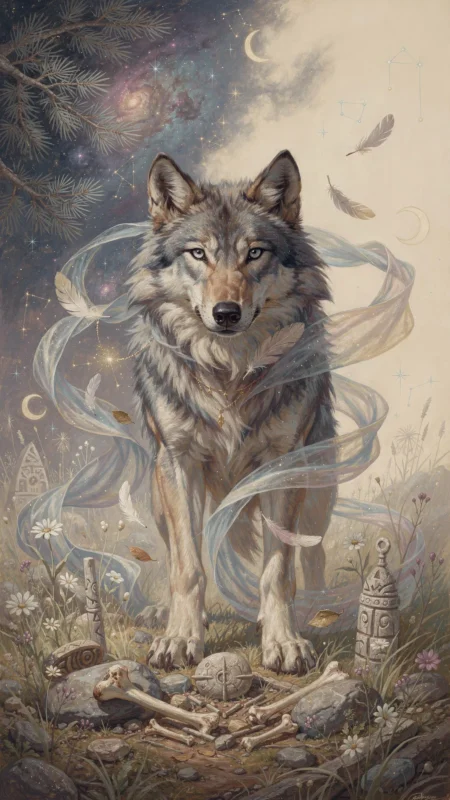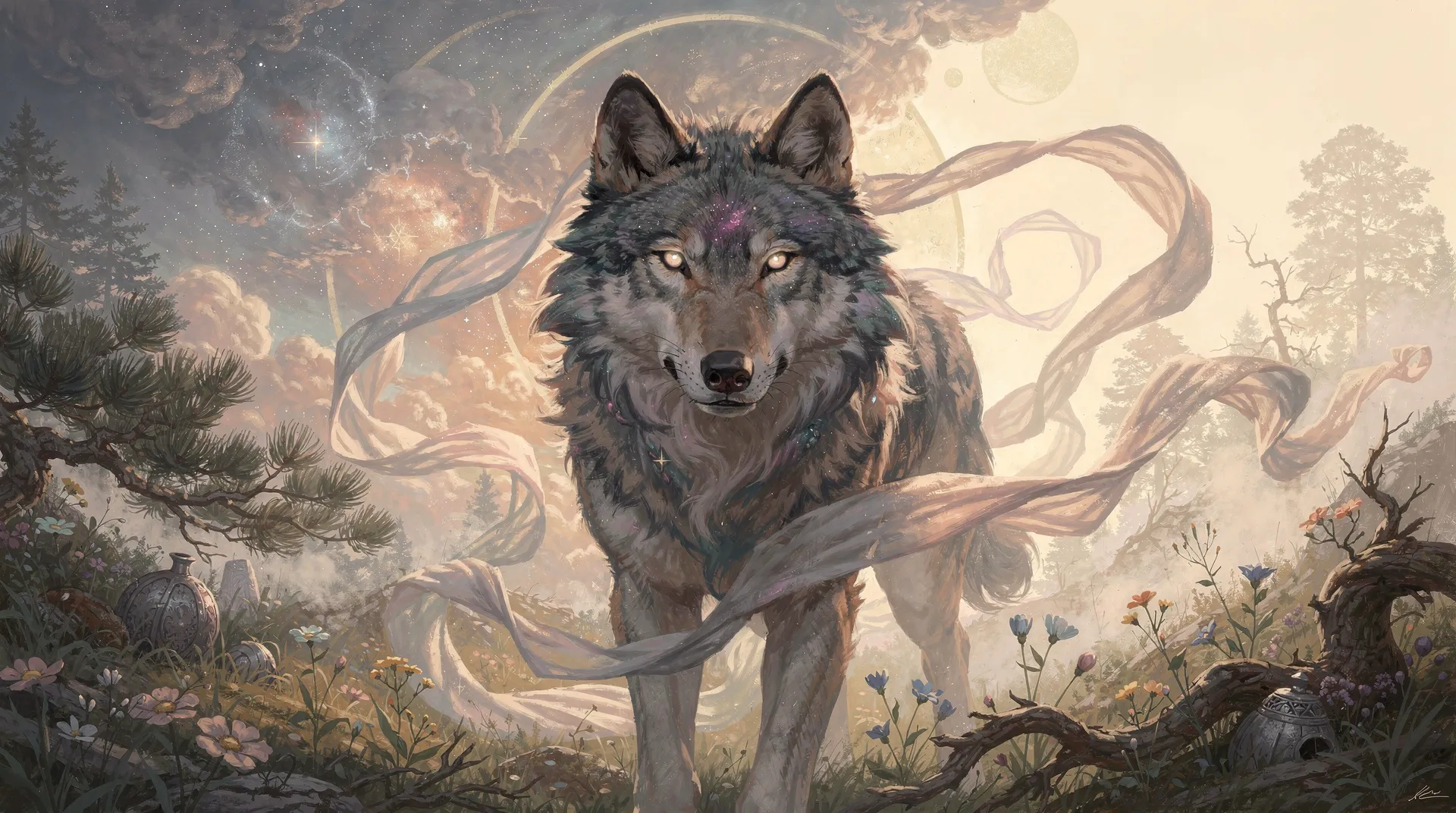


Wolf

Archetype Meaning & Symbolism

Intuitive, Loyal, Wild, Misunderstood, Fierce, Instinctual, Social, Solitary, Resilient, Communicative

  • Trust the moon within your bones: the path reveals itself not to the seeking eye, but to the listening heart.

If Wolf is part of your personal mythology, you may…

Believe

  • That intuition is a reliable guide, often more trustworthy than logic alone.
  • In the sacredness of loyalty and the unbreakable bonds of chosen family or ‘pack.’
  • That true freedom lies in living authentically, in harmony with one’s deepest nature.

Fear

  • Betrayal by those considered part of your inner circle or ‘pack.’
  • Losing your connection to your instincts or your inner ‘wildness.’
  • Being misunderstood, ostracized, or forced into a conformity that stifles your true self.

Strength

  • Profound intuition and keen observational skills.
  • Fierce loyalty and protectiveness towards loved ones and deeply held values.
  • Resilience and adaptability in the face of adversity.

Weakness

  • A tendency towards suspicion or difficulty trusting those outside a very small circle.
  • An independent streak that can sometimes lead to isolation or difficulty asking for help.
  • A potential for ruthlessness or an overly black-and-white view of loyalty and justice if unchecked.

The Symbolism & Meaning of Wolf

The Wolf, a silhouette against the moon of our collective psyche, speaks to an intricate dance between fierce independence and profound communal reliance. In one’s personal mythology, its presence may signal a call to examine the landscapes of instinct, intuition, and the often-misunderstood territories of our inner wildness. It is not merely an emblem of predatory prowess, but a complex symbol of guardianship, loyalty that runs bone-deep, and a communication that transcends mere words, echoing in the chambers of the heart. The modern invocation of the Wolf spirit animal often speaks to a yearning for untamed authenticity, a desire to shed the ill-fitting skins of societal expectation and to live by a more primal, honest code. This archetype could invite a re-evaluation of what it means to be ‘civilized,’ perhaps suggesting that true civilization incorporates, rather than eradicates, our instinctual wisdom.

To integrate the Wolf into your personal narrative is perhaps to acknowledge the parts of you that thrive in the liminal spaces: the twilight zones between solitude and society, intellect and instinct, the domesticated and the feral. It may be about recognizing the teacher in the shadow, the guide in the growl. The Wolf doesn’t ask for conformity; it demands integrity to one’s own nature. Its symbolism might urge you to track your own truths, to hunt for meaning with persistence, and to protect what is sacred to you – be it family, creative vision, or personal freedom – with an unwavering, intelligent ferocity. This archetype doesn’t offer easy answers but instead, a compass pointing towards the wilderness within, a place of potential and untamed power.

Furthermore, the Wolf’s symbolism often encompasses themes of teaching and learning, of passing down ancient wisdom. In your mythos, this could manifest as a pull towards mentorship, either seeking it or offering it, or a draw to ancestral knowledge and the stories that shape your lineage. The Wolf’s journey is one of survival, yes, but also of legacy: the continuation of the pack, the perpetuation of vital lessons. It may challenge you to consider what wisdom you are meant to embody and share, what unique ‘howl’ you are meant to contribute to the ongoing song of existence, ensuring that the essential echoes of your being resonate for others.


Wolf Relationships With Other Archetypes

The Moon

The Wolf’s relationship with The Moon may be one of the soul’s most ancient and private arrangements. It is less a kinship and more a form of gravitational fealty, an ineluctable pull on the blood’s tide. The Moon, in its silent, silver eminence, could be seen as the celestial counterpart to the Wolf’s earthbound instinct—a vast, cold eye that validates the wildness below. The Wolf does not howl *at* the moon, perhaps, but *with* it, answering a frequency that travels not through the air but through the hidden waterways of the spirit. This communion is a dialogue of pure being, a recognition that the most profound parts of the self are those that awaken only when the rational world is asleep, bathed in a borrowed, spectral light.

The Forest

With The Forest, the Wolf shares a symbiotic grammar, a language of broken twigs and lingering scent. The Forest is not merely a habitat; it is an extension of the Wolf’s own senses, a verdant labyrinth that is both sanctuary and map. One might say the tangled roots and shadowed glades mirror the Wolf’s own complex psyche, its capacity for both deep concealment and sudden, startling revelation. To move through the woods is, for the Wolf, a form of thought, and the rustling canopy above may be the sound of its own untamed consciousness. The Forest is a living entity that offers a conditional embrace, demanding a deep, intuitive knowledge in exchange for its secrets, a pact of mutual respect between two masters of survival.

The Outcast

The Wolf and The Outcast are bound by a shared sentence, often condemned to the periphery by the very communities they circle. The Wolf frequently serves as a walking repository for communal anxieties, a convenient vessel for the darkness a village wishes to expunge from itself. Its fangs and shadow become a metaphor for the feral nature society fears within its own heart. In this, the Wolf’s solitude is not always the proud isolation of a predator, but could be the profound loneliness of the scapegoat. It is the necessary shadow that gives the firelight its meaning, a figure whose banishment paradoxically defines the borders of belonging, forever pacing the edge of a world that both needs and rejects it.

Patterns of The Wolf Spirit Animal, Totem, or Archetype

If the Wolf pads silently into the periphery of your awareness, it may be through a tapestry of subtle signs, whispers from the wild edge of your consciousness. You might find its image recurring: in art, media, or the sudden, startling appearance of a dog that strikingly resembles its lupine ancestor, crossing your path at a pivotal moment. These aren’t necessarily grand, cinematic pronouncements, but rather quiet nudges, a feeling of being ‘seen’ by something ancient and knowing. Perhaps you experience an inexplicable pull towards learning about wolves, their behaviors, their habitats, a fascination that feels less like a hobby and more like a homing instinct. The appearance of what one might call their Wolf spirit animal in such forms could be a call to pay closer attention to your intuition, that subtle, internal ‘scent’ guiding you towards or away from certain situations or people.

Synchronicities may also take the form of overheard conversations where wolves are mentioned at a moment you’re pondering a significant life choice, or finding a shed canine tooth or a piece of folklore about wolves that seems to speak directly to your current dilemma. The key is the feeling of resonance, the sense that the universe is using the symbolism of the Wolf to communicate something vital. It could be an encouragement to trust your instincts in a complex social dynamic, much like a wolf navigates pack hierarchy, or a reminder of the importance of your ‘pack’ – your chosen family or community – and the loyalty you owe them, and they, you. These signs often invite introspection: where in your life are you being called to be more fiercely protective, more deeply loyal, or more authentically wild?

Consider also the internal landscape: dreams where wolves feature prominently, not as threats, but as guides or companions, can be potent indicators. Or perhaps a sudden, inexplicable urge to spend time in nature, to walk under the full moon, to listen to the silence of the wilderness until you can hear your own heartbeat sync with something older, more elemental. These experiences, if the Wolf is indeed a significant archetype for you, will often carry a particular charge, a feeling of profound, almost pre-verbal understanding. It’s less about seeking omens and more about recognizing a pattern, a symbolic language that your deeper self uses to converse with the wider world, hinting at the path where your true nature can roam free.

Using Wolf in Every Day Life

Navigating Career Crossroads with Wolfish Instinct

When faced with a seemingly impenetrable forest of career options, the Wolf archetype might encourage you to sniff the air for the scent of true purpose, rather than merely following well-trodden trails. It could mean trusting a gut feeling about an unconventional path, one that promises not necessarily ease, but a profound sense of alignment. Perhaps you decline the prestigious offer that feels like a gilded cage, drawn instead to the nascent venture that whispers of wild potential, of building something from the ground up with a trusted few, a small, dedicated pack.

Reclaiming Your Voice in a Cacophonous World

If your personal mythology finds you often silenced or unheard, the Wolf could emerge as a symbol of vocal reclamation. This isn’t about aggressive shouting, but the clear, resonant howl that establishes presence and communicates essential truths. It might manifest as finally articulating a long-held boundary in a relationship, or presenting a creative idea with unapologetic conviction, even if it challenges the status quo. The Wolf teaches that your unique call has a place in the chorus of the world, a note only you can contribute.

Finding Your Pack: The Art of Belonging

For those whose life story involves a search for genuine connection, the Wolf archetype offers insights into the dynamics of pack and solitude. It may guide you to discern between superficial associations and the deep bonds of loyalty and mutual support that define a true pack. This could involve courageously stepping away from groups that diminish your spirit, and patiently, instinctively seeking out those individuals with whom your soul resonates, individuals who understand the unspoken language of shared values and reciprocal care, much like a wolf pack moving in silent, coordinated grace.

Wolf is Known For

  • The Howl: A complex vocalization used for communication over long distances, assembling the pack, and asserting territory.
  • Pack Dynamics: Living and hunting in highly organized social groups with clear hierarchies and cooperative strategies.
  • Endurance and Instinct: Capable of covering vast distances and relying on keen senses and innate understanding for survival.

How Wolf Might Affect Your Personal Mythology

How Wolf Might Affect Your Mythos

When the Wolf enters your personal mythos, it often rewrites the narrative from one of passive observation to active, instinctual participation. Your life story may begin to feel less like a pre-ordained script and more like a territory to be explored, claimed, and fiercely protected. The Wolf archetype could introduce themes of the ‘lone wolf’ who is, paradoxically, always connected to a larger spiritual pack, or the ‘alpha’ who leads not through domination but through wisdom and a deep understanding of the collective good. Your past experiences of feeling like an outsider or misunderstood might be reframed: not as failures of conformity, but as hallmarks of a unique path, a testament to an unwillingness to compromise core truths for the sake of superficial belonging. This archetype doesn’t smooth out the rough edges of your story; it sanctifies them as evidence of a life lived with teeth and claws, with heart and howl.

The presence of the Wolf may also weave into your mythos a profound respect for cycles: the rhythm of solitude and social engagement, the ebb and flow of energy, the life-death-life continuum. Your personal narrative might then emphasize resilience, the ability to endure harsh ‘winters’ of the soul and emerge leaner, wiser, more attuned to the subtle signals of survival and renewal. Challenges could be reinterpreted as initiations, moments that hone your instincts and strengthen your resolve. The Wolf, as a figure in your inner landscape, ensures your story is one of courage, loyalty to your own path, and an enduring connection to the wild, untamable core of your being, perhaps reflecting the deep connection one feels with their Wolf spirit animal.

How Wolf Might Affect Your Sense of Self

Embracing the Wolf archetype can fundamentally reshape your perception of self, potentially unearthing a deep well of instinctual intelligence you may have previously undervalued. You might begin to see your intuition not as a fleeting fancy, but as a reliable compass, a primal wisdom honed by millennia of survival. This could foster a greater sense of self-trust, an understanding that your gut feelings, your inner ‘growls’ or ‘purrs’ in response to situations, are valid and vital data. The Wolf within may encourage a shedding of societal conditioning that has perhaps led you to suppress your authentic desires or your unique way of perceiving the world. The journey with this archetype is often one of reclaiming the ‘wild’ self, not as something savage or uncontrolled, but as something deeply authentic, attuned, and alive. It’s possible the idea of a Wolf spirit animal resonates with this emerging self-acceptance.

Furthermore, the Wolf’s influence may cultivate a more nuanced understanding of your own strengths and vulnerabilities. You might recognize a capacity for fierce loyalty and protection, not just towards others, but critically, towards your own well-being and boundaries. Conversely, you may also become more aware of a need for solitude, for periods of withdrawal to recharge and reconnect with your inner landscape, understanding this not as anti-social behavior but as a vital part of your energetic rhythm. This archetype can teach you to honor both your social nature – your need for a pack – and your individual sovereignty. The self that emerges may be more resilient, less afraid of showing its teeth when necessary, but also more capable of profound, unspoken connection.

How Wolf Might Affect Your Beliefs About The World

Adopting the Wolf into your personal mythology may subtly yet profoundly shift your worldview, tinting it with an awareness of unseen connections and the intricate, often ruthless, beauty of natural law. You might find yourself looking beyond the surface of societal structures, sensing the primal currents that still flow beneath the veneer of civilization. The world may appear less as a machine to be controlled and more as a living ecosystem, full of complex relationships, predator-prey dynamics (both literal and metaphorical), and the constant interplay of creation and destruction. This perspective doesn’t necessarily breed cynicism, but rather a kind of earthy realism, an acceptance of life’s inherent wildness and its cyclical nature. It could foster a deeper respect for the environment and a more critical eye towards systems that exploit or disregard the delicate balance of nature.

Your worldview might also become more attuned to the importance of hierarchy, not in the oppressive sense, but in terms of earned respect, natural leadership, and the functional roles within any group or system. The Wolf’s perspective could illuminate the ways in which true strength often lies in cooperation, strategic thinking, and an unwavering commitment to the well-being of the collective, be it family, community, or even the planet itself. There may be a heightened sense of justice, not based on abstract legal codes, but on an intuitive understanding of fairness and balance. The world, through the eyes of the Wolf, is a place that demands keen senses, adaptability, and a courageous heart willing to engage with its inherent mysteries and challenges.

How Wolf Might Affect Your Relationships

When the Wolf archetype informs your approach to relationships, it may instill a profound emphasis on loyalty, authentic connection, and the unspoken bonds that define a true ‘pack.’ Superficial acquaintanceships might lose their appeal, replaced by a yearning for connections that are rooted in mutual respect, shared purpose, and fierce protectiveness. You may become more discerning about whom you allow into your inner circle, valuing quality over quantity, and seeking those who understand the language of your soul without needing constant translation. Within these chosen bonds, you might find yourself fiercely devoted, willing to go to great lengths for those you consider family, whether by blood or by choice. This doesn’t mean relationships will be devoid of conflict, but that conflict may be approached with a desire for resolution that strengthens the pack, rather than fracturing it.

However, the Wolf’s influence could also bring challenges. Your need for independence and occasional solitude might be misunderstood by partners or friends who crave constant togetherness. Setting boundaries, a crucial lupine skill for maintaining pack harmony and self-preservation, might feel harsh to others if not communicated with awareness. There may be a tendency towards a clear in-group/out-group dynamic, making it harder to trust newcomers or forgive perceived betrayals. The key is to temper the Wolf’s fierce loyalty with compassion and to remember that human relationships, unlike wild pack dynamics, often require more nuanced communication and a greater capacity for forgiveness and understanding of individual complexities beyond simple pack roles.

How Wolf Might Affect Your Role in Life

The Wolf archetype can significantly reshape your perceived role in life, moving you from a position of perhaps passive acceptance to one of active, instinctual agency. You may feel a calling to be a guardian: of your family, your community, your values, or even of a particular piece of wisdom or tradition. This role isn’t necessarily about overt leadership in the conventional sense, but about embodying a protective, guiding presence. There might be a sense of responsibility to ‘howl’ a warning when danger is sensed, or to use your voice to speak for those who cannot speak for themselves. Your role could become that of the scout, the one who ventures into unknown territory – be it intellectual, spiritual, or emotional – and returns with knowledge that benefits the collective.

Furthermore, the Wolf might call you to the role of the teacher or the storyteller, passing on the ‘lore’ of survival, resilience, and deep connection. This could manifest in formal teaching, mentorship, or simply in the way you live your life, embodying the lessons of the wild. There’s a profound sense of purpose that can come with this archetype: a feeling that your life is not just about personal survival or comfort, but about contributing to something larger than yourself, ensuring the well-being and continuity of your ‘pack.’ You might find your role involves bridging worlds, navigating the space between the ‘civilized’ and the ‘wild,’ reminding others of the importance of instinct, intuition, and our primal connection to the natural world.

Dream Interpretation of Wolf

When a wolf appears in your dreams in a positive context, it may be a potent symbol of your own emerging intuition, strength, and connection to your instincts. Perhaps the wolf guides you through a dark forest, suggesting that your inner wisdom is leading you through a period of uncertainty. It might appear as a calm, observant presence, reflecting a growing self-awareness and a comfortable relationship with your own power and autonomy. A dream of running with a pack of wolves could signify a harmonious integration into a supportive community or a successful collaboration where your unique talents are valued. If the wolf communicates with you, it might be your subconscious, or perhaps what you feel is your Wolf spirit animal, offering direct guidance or reassurance, urging you to trust your gut feelings or to embrace a path of greater freedom and authenticity. Such dreams often leave a feeling of empowerment and a deeper connection to your untamed self.

Conversely, a wolf appearing in a negative dream context – perhaps as a threatening, aggressive pursuer, or a lone, wounded animal – could symbolize perceived threats in your waking life, either from external sources or from your own unacknowledged ‘shadow’ aspects. A menacing wolf might represent overwhelming primal urges, unchecked ambition, or a fear of your own predatory instincts. It could also point to feelings of social isolation, betrayal, or a ‘dog-eat-dog’ mentality you’re experiencing or perpetuating. If you are being hunted by a wolf, it may suggest you are feeling vulnerable, or that you are running from a difficult truth about yourself or your situation. A wounded wolf might mirror your own feelings of being hurt, weakened, or cut off from your vital life force or community. These dreams often call for an honest examination of your fears, your relationships, and how you are wielding your personal power.

How Wolf Archetype Might Affect Your Needs

How Wolf Might Affect Your Physiological Needs

From a personal mythology perspective, the Wolf archetype, when active in your psyche, may heighten your awareness of your body’s fundamental needs for sustenance and rhythm, much like a wild creature attuned to its environment. You might find yourself more sensitive to the quality of your food, craving whole, natural nourishment that fuels endurance and vitality, rather than processed comforts. There could be an intuitive pull towards cyclical patterns of activity and rest, mirroring the wolf’s bursts of intense energy for the hunt followed by periods of recuperation. This isn’t about rigid dietary rules or exercise regimens, but a more instinctual listening to your body’s signals: the genuine pang of hunger, the deep call for sleep, the need for movement that feels powerful and purposeful, like a long, loping run across an open field of the mind.

This archetype might also foster a deeper connection to your primal physical self, an appreciation for your body not just as an aesthetic object, but as a resilient, capable organism. You may develop a keener sense of your physical boundaries, an almost animalistic awareness of your personal space and a need to protect it. The Wolf’s influence could encourage you to honor your body’s limits while also pushing them in ways that build strength and stamina, not from a place of ego, but from a deep-seated drive for survival and thriving. There’s a potential for rediscovering the simple, profound pleasure of embodiment: the feeling of muscles working, lungs breathing clean air, the sun on your skin – a raw, unfiltered connection to your physical existence.

How Wolf Might Affect Your Ideas of Belonging

The Wolf archetype, woven into your personal mythology, profoundly influences your need for belongingness, emphasizing the deep, instinctual drive for a ‘pack’: a cohesive unit bound by loyalty, mutual support, and shared understanding. This isn’t just about social interaction; it’s about finding your tribe, those with whom you share an almost telepathic connection, where roles are understood, and each member contributes to the well-being of the whole. You may feel a visceral need for relationships that are authentic and unwavering, where you can be your true self, wild edges and all, and still be accepted and valued. Superficial connections may feel unsatisfying, even alienating, as you seek the profound security that comes from knowing you have allies who will stand with you, hunt with you, and mourn with you.

However, this deep need for true belonging, as defined by the Wolf, can also make navigating the complexities of human social landscapes challenging. The high value placed on loyalty means that betrayal can feel catastrophic, a wound that cuts to the core. You might struggle with groups that lack clear purpose or genuine cohesion, or feel like an outsider if your instincts tell you a ‘pack’ is dysfunctional or inauthentic. The Wolf also honors solitude as a necessary rhythm, so your need for belonging might be punctuated by periods of withdrawal, which can be misunderstood by others. The quest is to find or create a pack where both fierce connection and individual sovereignty are respected, a place where your howl is answered by kindred spirits.

How Wolf Might Affect Your Feelings of Safety

When the Wolf archetype shapes your personal mythology, your approach to safety may become more instinctual and territory-focused. You might develop a heightened awareness of your surroundings, an almost sixth sense for potential threats or imbalances in your environment, much like a wolf constantly vigilant for the security of its pack and den. This isn’t necessarily about paranoia, but a pragmatic, grounded alertness. Your home, your personal space, and the well-being of your loved ones could become paramount, leading you to establish clear boundaries and to be fiercely protective of what you deem sacred. Safety might be less about accumulating material possessions and more about cultivating resilience, resourcefulness, and a trusted network of allies – your ‘pack’ – who offer mutual support and protection.

This heightened sense of vigilance could also translate into a more cautious approach to new situations or individuals, a tendency to observe and assess before fully committing or trusting. The Wolf within encourages you to trust your gut feelings about people and places, even if those feelings lack logical explanation. While this can be a powerful protective mechanism, it may also require conscious effort to ensure that caution doesn’t morph into undue suspicion or isolation. The goal, from a Wolf perspective, is not to live in fear, but to live with awareness, prepared to defend what matters, and secure in the knowledge of one’s own capacity to navigate challenges and ensure the sanctuary of self and chosen kin.

How Wolf Might Affect Your Views of Esteem

When the Wolf archetype influences your personal mythology, your esteem needs may become intricately linked to notions of competence, instinctual knowing, and your role within a trusted ‘pack.’ Self-worth might be derived less from external validation or societal accolades and more from an internal sense of your own capabilities: your ability to navigate challenges using your intuition, to protect what you value, and to contribute meaningfully to your chosen community. There’s a quiet pride in self-reliance, in knowing you can trust your senses and your inner wisdom to guide you. Esteem is also found in loyalty given and received; being a valued, respected member of your pack, and recognizing the strength and integrity of those bonds, can be a profound source of self-acceptance.

The shadow side of this is that your esteem might suffer if you feel your instincts have failed you, or if you perceive yourself as having fallen short in your loyalty or protective duties. If you feel alienated from your ‘pack’ or if your contributions are not recognized, it could deeply impact your sense of self-worth. The Wolf archetype encourages an esteem built on authenticity and resilience, rather than perfection. It’s about honoring your unique strengths, recognizing your capacity to learn from mistakes (the ‘failed hunts’ of life), and understanding that true status within the pack comes from integrity and wisdom, not dominance for its own sake. Your Wolf spirit animal, as a concept, may encourage a self-esteem rooted in this untamed authenticity.

Shadow of Wolf

When the Wolf’s shadow falls across your personal mythology, its admirable traits can become distorted, leading to isolation rather than healthy solitude, or aggression rather than protective strength. An overabundance of Wolf energy, unchecked, might manifest as a hyper-vigilant suspicion of others, a ‘lone wolf’ stance that rejects all connection and views the world as inherently hostile. This individual may become overly territorial, not just of physical space but of ideas and relationships, unable to collaborate or trust. The fierce loyalty can curdle into possessiveness or a vindictive ‘us vs. them’ mentality, where anyone perceived as an outsider or a threat is met with unwarranted hostility. The howl, meant for communication and bonding, can become a snarl of constant discontent or a cry of perpetual victimhood if the Wolf feels perpetually wounded or misunderstood.

Conversely, a deficiency or suppression of Wolf energy can lead to a different set of shadows. One might become overly dependent, losing their instinctual compass and their ability to stand on their own. Boundaries may become porous, easily violated, leading to a sense of being preyed upon or a chronic inability to say ‘no.’ The voice, the howl, may be silenced, resulting in a failure to advocate for oneself or for what is right. There might be a profound disconnect from one’s intuition, leading to poor judgment and a feeling of being lost or adrift. The vibrant wildness of the Wolf becomes a domesticated passivity, a fear of taking risks or embracing the unknown, leading to a life that feels muted, constrained, and lacking the vital spark of its true nature.

Pros & Cons of Wolf in Your Mythology

Pros

  • Enhanced intuition and ability to trust your gut feelings.
  • Deep capacity for loyalty and forming strong, meaningful bonds.
  • Increased resilience and resourcefulness in navigating life’s challenges.

Cons

  • Potential for isolation if independence becomes extreme.
  • May struggle with trust, leading to suspicion of outsiders.
  • A fierce protective instinct that can sometimes manifest as aggression if not managed.