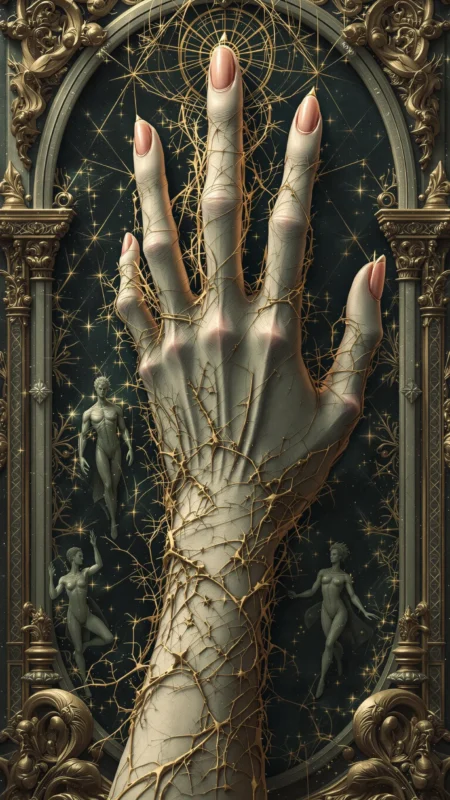
Withered Hand

Archetype Meaning & Symbolism

Atrophied, inert, delicate, historical, cursed, receptive, symbolic, forgotten, knowing, still

  • What I cannot grasp, I can still point toward.

If Withered Hand is part of your personal mythology, you may...

Believe

  • True power lies not in what you can grasp, but in what you can release.

  • Some wounds are not meant to heal but to serve as maps, guiding you to a different territory of the soul.

  • Stillness is not emptiness; it is a state of profound attention.

Fear

  • That you will be utterly helpless in a moment of crisis, a passive observer to a tragedy you might have prevented.

  • That your inaction will be perpetually mistaken for apathy or indifference, alienating those you love.

  • That you will be defined solely by what you lack, your entire identity eclipsed by this one single trait.

Strength

  • A profound capacity for patience and observation, allowing you to see the subtle patterns others miss.

  • The wisdom to accept what cannot be changed, granting you a rare and powerful form of peace.

  • A unique perspective, unburdened by the need to act, which can be a source of novel insight and creativity.

Weakness

  • A tendency towards passivity that can shade into paralysis, preventing you from acting when it is necessary and right.

  • Difficulty in establishing and defending personal boundaries, as the instinct to 'push back' is weakened.

  • A vulnerability to being overlooked, underestimated, or exploited by those who equate stillness with weakness.

The Symbolism & Meaning of Withered Hand

To carry the Withered Hand in your personal mythology is to be tattooed with a question mark. It is the archetype of potential denied, of action arrested. On the surface, it speaks of lack, of what has been lost or was never there to begin with: the strength to build, the dexterity to create, the warmth to comfort. It is the empty sleeve in the portrait, the silent instrument in the orchestra. Its presence in one’s life story might signify a core wound, a place of deep and seemingly permanent inability that shapes all subsequent endeavors. It is the narrative anchor of helplessness, the constant reminder of a fundamental vulnerability that cannot be trained or willed away.

Yet, a mythology built around a void is never truly empty. Where action is impossible, perception may flourish. The Withered Hand could symbolize a profound release from the tyranny of doing. If one cannot grasp, one is freed from the responsibility of holding on. If one cannot shape the world, one is gifted with the clarity to see it as it is, uncolored by the desire to change it. This archetype may foster a strange and quiet power: the power of the witness. It is the wisdom that grows in the shadow of limitation, a sensitivity born from the impossibility of intervention. The hand that cannot strike may become a sacred object, a thing not of use but of meaning.

The symbolism may also twist into the territory of the oracle or the seer. What is taken from the physical plane may be returned on the metaphysical. The Withered Hand cannot participate in the world's mundane transactions, and so it might become sensitive to its subtle energies. It could be the part of you that feels the shift in the emotional weather, that points toward a truth others are too busy to notice. It is a sacrifice of worldly competence for a different kind of knowing. It represents the part of the self that has paid a price, and in doing so, has perhaps purchased a rare and unsettling form of insight.


Withered Hand Relationships With Other Archetypes

The Scribe

The Withered Hand shares a poignant relationship with The Scribe. Where The Scribe’s purpose is to record, to create, to give form to thought through the motion of the pen, the Withered Hand represents the ultimate writer's block, the physical impossibility of the act. Yet, they are not opposites so much as complements. The Withered Hand may be the silent muse, the embodiment of the story that cannot yet be told, its stillness a challenge that compels The Scribe to find new ways to articulate truth. It is the unwritten page, the pause between sentences, and The Scribe may find that the most profound stories are not about what the hand can do, but what this specific hand cannot.

The Healer

For The Healer, the Withered Hand is a crucible. It may present itself as The Healer’s greatest failure: a condition that cannot be mended, a wound that will not close. A young Healer might try every poultice, every prayer, only to be met with the same cool, unresponsive flesh. A mature Healer, however, may come to understand that not everything broken is meant to be fixed. The Withered Hand could teach The Healer the limits of their power and the difference between curing and healing. Healing, in this context, might mean helping the individual integrate the reality of the hand, to see it not as a flaw but as a sacred characteristic, a source of a different, deeper wholeness.

The Jester

The Jester, or The Trickster, might find the Withered Hand to be a tool of sublime potential. In a world that equates strength with ability, the utter lack of ability is the perfect misdirection. The Jester may use the hand to garner pity, only to reveal a sharp mind and a cunning plan. It becomes a prop in a grand performance of expectations. The Jester understands that everyone projects their own fears and assumptions onto the hand, and can use this as a mirror, reflecting the foolishness of a world that judges by appearances. It is the ultimate straight man in a cosmic joke, its passivity making the active folly of others all the more apparent.

Using Withered Hand in Every Day Life

Navigating a Setback:

When faced with a career path that has closed, a project that has failed, or a skill that has been lost, the Withered Hand archetype may suggest a period of non-action. Instead of immediately seeking a new way to 'grasp' success, one might embrace the stillness. It's a time for observing the landscape from this new, perhaps unwanted, vantage point. The 'withering' is not an end but a re-calibration, a moment to learn what remains when the primary tool is set aside, allowing for unexpected solutions to reveal themselves not through force, but through reception.

Releasing Control in Relationships:

In a dynamic where one feels compelled to fix, manage, or direct a loved one, invoking the Withered Hand can be a powerful act of surrender. It is the conscious choice to retract the impulse to meddle. This passivity is not apathy; it is a profound form of trust. It allows the other person the dignity of their own struggle and their own journey, creating space for them to find their own strength. The relationship may then shift from one of control to one of witness, where presence becomes the gift, not intervention.

Cultivating a Non-Transactional Worldview:

The Withered Hand may challenge the belief that every action must have a productive or profitable outcome. To live with this archetype is to practice being in the world without constantly needing to act upon it. This could mean sitting in a park without a phone, listening to a conversation without formulating a reply, or appreciating a piece of art without needing to interpret it. It is an antidote to the relentless demand for engagement, fostering an appreciation for the intrinsic value of things, separate from their utility or one's ability to manipulate them.

Withered Hand is Known For

Inability to Act

Its primary characteristic is a lack of function, an inability to grasp, hold, or shape. This is its most obvious trait, a symbol of impotence or loss that defines its initial impression.

A Mark of History

The hand is often perceived as a record of a past event: a wound, a curse, a disease, or a congenital condition. It is a physical manifestation of a story, forever carrying the past into the present moment.

A Channel for Other Forces

Because it cannot act on its own accord, the Withered Hand may become a conduit for other energies or meanings. It might be seen as a sign from a deity, a vessel for prophetic insight, or a focal point for the projections of others.

How Withered Hand Might Affect Your Personal Mythology

How Withered Hand Might Affect Your Mythos

When the Withered Hand is a central object in your personal mythos, your life story may not follow the traditional hero’s journey of acquiring power. Instead, it could be a narrative of accommodation, of learning to navigate the world with a fundamental piece missing. The central quest might be the search for meaning in its absence, a pilgrimage toward acceptance rather than a battle for restoration. Your great trials may be internal: wrestling with envy for the able-bodied, battling the despair of helplessness, and finally, perhaps, discovering the unique landscape that is only visible from a position of perceived disadvantage. Your story is not about slaying the dragon, but about learning to live beside it, to understand its nature because you lack the sword to do otherwise.

The mythology could also be one of a sacred wound. The event or condition that created the Withered Hand becomes your origin story, the 'big bang' of your personal cosmos. It's the moment that separated you from the ordinary, marking you for a different path. Allies in your story might be those who can see beyond the hand, while antagonists are those who define you by it. The ultimate boon is not a magical cure, but a profound shift in perspective: the realization that the hand is not an obstacle to your destiny, but the very instrument that shapes it, forcing you toward a unique and perhaps more contemplative fate.

How Withered Hand Might Affect Your Sense of Self

Your sense of self may be intrinsically linked to a feeling of being incomplete or flawed. The Withered Hand is a constant, physical reminder of limitation, which could foster a deep-seated insecurity. You may define yourself by what you cannot do, leading to a hesitant, apologetic engagement with the world. This can create a fragile self-concept, one that is vulnerable to the pity or judgment of others. The internal monologue might be a recurring litany of 'I can't,' creating a self-identity built on a foundation of perceived lack. This may lead to a withdrawal from challenges, a pre-emptive surrender in the face of difficulty.

Alternatively, the archetype could forge an identity of profound resilience and observation. Released from the expectation of being a 'doer,' you may cultivate a rich inner world. Your sense of self might be rooted not in accomplishment, but in awareness, perception, and endurance. You might see yourself as a witness, a keeper of stillness in a frantic world. This could lead to a quiet confidence, a self-concept that is independent of external validation or performance. You are not the actor on the stage, but the one who understands the entire play, precisely because you are not caught up in the action. Your identity is shaped around being, not doing.

How Withered Hand Might Affect Your Beliefs About The World

Your view of the world may be filtered through a lens of skepticism toward power and action. You might see the constant striving, building, and competing of society as a kind of frantic, perhaps meaningless, motion. The world may not appear as a resource to be exploited or a project to be improved, but as a vast, unfolding tapestry that you are privileged to observe. This can lead to a worldview that values conservation over development, listening over speaking, and patience over ambition. You may see the profound violence inherent in many forms of 'progress,' as your own body holds the truth that not everything can be forced to bend to will.

This archetype could also cultivate a worldview deeply attuned to unseen forces and subtle dynamics. When you cannot physically interact with the world in a conventional way, you may become more sensitive to its other languages: emotional currents, symbolic events, the weight of history. You might believe that the most important things are invisible and intangible. Your philosophy may lean toward determinism or fatalism, a sense that larger patterns are at play and human agency is less significant than most people believe. The world becomes a place of signs and portents, and your role is not to change its course, but to read its meaning.

How Withered Hand Might Affect Your Relationships

In relationships, you may struggle with a perceived imbalance of power. Fearing you have less to offer, you might become a chronic people-pleaser in other areas, overcompensating with emotional labor or intellectual support. Or you may withdraw, assuming others will see you as a burden. The Withered Hand can create a dynamic where you feel you are always the recipient of care, which may chafe against a desire for reciprocity. This could lead to a pattern of attracting partners who need to be 'fixers' or, conversely, pushing away those who offer help, seeing it as a confirmation of your own inadequacy.

However, this archetype could also allow for relationships of extraordinary depth and presence. Your connections may be forged not on the basis of shared activities or mutual utility, but on a foundation of pure being-with. You might offer a space of non-judgmental listening, a quiet harbor for others. The inability to 'fix' a partner's problems may become your greatest gift, as it forces you to simply be present with their pain. This can cultivate relationships of profound emotional intimacy, where the currency is not action, but attention and acceptance. Your friendships and partnerships might be fewer, but they may be built on a rare and resilient kind of love.

How Withered Hand Might Affect Your Role in Life

The Withered Hand may effectively bar you from roles that require physical capability, control, or aggressive action. The archetypal roles of the Warrior, the Builder, or the Leader (in a traditional, commanding sense) might feel utterly alien. This could lead to a sense of being misplaced in a society that valorizes these functions. You might feel relegated to the sidelines, an observer of a game you can never play. This can result in a crisis of purpose, a feeling of being without a useful role in your family, community, or career.

Conversely, this limitation could propel you into roles that are often undervalued but culturally vital. You may find your place as the Counselor, the Sage, the Historian, or the Oracle. Your inability to act in one sphere may become your primary qualification for another. Because you cannot impose your will, you might be trusted with secrets. Because you cannot build the new, you may become the keeper of the old. Your role could be to provide perspective, to hold the collective memory, or to point toward the subtle truths that movers and shakers are too busy to see. You are not the hand that steers the ship, but you may be the one who reads the stars.

Dream Interpretation of Withered Hand

In a positive context, dreaming of a Withered Hand—your own or another's—may signify a necessary and welcome surrender. It could be your psyche telling you to stop fighting a battle you are not meant to win, to release a goal that is no longer serving you, or to let go of the need to control a person or situation. The dream is an invitation to peace through acceptance. It may suggest that a new kind of power is becoming available to you, one based in stillness, observation, and receptivity. To touch or accept the Withered Hand in a dream could be a profound act of self-integration, making peace with your own limitations and finding freedom within them.

In a negative context, the Withered Hand in a dream is a potent symbol of impotence, fear, and atrophy. It may represent a part of your life or your self that you have neglected to the point of decay: a talent left unused, a relationship left to wither, a part of your spirit that is not being nourished. It can be a manifestation of a deep-seated fear of helplessness, of being unable to act in a moment of crisis or to protect yourself or your loved ones. The dream might be a warning that your passivity has become dangerous, or that you are allowing a vital part of your potential to die from inaction.

How Withered Hand Archetype Might Affect Your Needs

How Withered Hand Might Affect Your Physiological Needs

The presence of the Withered Hand in one's mythos may create a complicated relationship with the body's basic needs. It could lead to a form of asceticism or neglect, a sense that the body is a flawed or secondary vessel. If the hand is a source of shame, the entire physical self might be treated with a similar disdain, leading to a disregard for nutrition, rest, or exercise. The body's signals of hunger or fatigue may be ignored as just another sign of its inherent weakness, another chain binding the spirit to a disappointing material form.

On the other hand, the intense focus on one area of physical lack might heighten the awareness of all other physiological processes. Every breath, every heartbeat, every sensation in the 'good' hand could become a source of profound gratitude and attention. You may develop a hyper-attunement to the body, not as a machine for performance, but as a delicate, living ecosystem. This could foster a meticulous care for one's health, a way of honoring the parts of the body that are functional. Physiological needs are not just met; they are attended to with a reverence born from an intimate knowledge of physical fragility.

How Withered Hand Might Affect Your Ideas of Belonging

The archetype may create a profound sense of otherness, making belonging feel like a distant shore. You might feel fundamentally different from your peers, marked by a flaw that precludes true inclusion. This can lead to a lonely path, a feeling of being perpetually on the outside looking in, unable to participate fully in the shared activities and rituals that forge communal bonds. Love and friendship might seem conditional, always at risk of being withdrawn if you become too much of a 'burden.' The fear of rejection can become a self-fulfilling prophecy, causing you to hold back from connection.

Yet, the Withered Hand can also be the key to a unique and powerful form of belonging. It may act as a filter, repelling superficial connections and attracting those capable of seeing past the physical. You might find your tribe not in the bustling center of society, but in its quiet margins, among other mystics, artists, and thinkers who value depth over dexterity. Love, when it comes, may be exceptionally strong, as it is built on an acceptance of the whole self, including the parts that are broken or incomplete. You might forge bonds of incredible loyalty with those who understand that your stillness is a form of solidarity.

How Withered Hand Might Affect Your Feelings of Safety

A sense of safety may be perpetually elusive. The Withered Hand is a constant, tangible symbol of vulnerability. The world may feel like a dangerous place filled with threats you are unequipped to fend off. This could manifest as hyper-vigilance, a chronic anxiety, or a reliance on others for protection. The need for safety might dominate your choices, leading you to build a small, highly controlled world to minimize risk. Safety is sought through avoidance, by making oneself small and inconspicuous, hoping that danger will pass you by as unimportant.

Alternatively, a different definition of safety may emerge. If physical defense is not an option, safety may be found in intellectual or spiritual realms. You might build your fortress out of knowledge, wit, or faith. Safety could also be located in radical transparency and non-resistance. By presenting no threat and having nothing to defend, you may paradoxically become safer. Your apparent weakness could act as a shield, disarming aggression by refusing to participate in its logic. Safety is not about having a better lock, but in realizing you have nothing worth stealing.

How Withered Hand Might Affect Your Views of Esteem

Esteem can be a barren field when the Withered Hand dominates the mythos, especially in a culture that ties self-worth to achievement and capability. You may struggle with a constant internal critic that measures you against an able-bodied standard and always finds you lacking. Accomplishments may feel hollow, overshadowed by the one thing you cannot do. Esteem becomes a fragile thing, dependent on the praise of others because a strong, internal source of self-worth is difficult to cultivate when you feel fundamentally 'less than.'

However, this archetype may force you to uncouple esteem from the machinery of production entirely. If you cannot base your worth on what you do, you must learn to base it on who you are. Esteem may be painstakingly built from your character: your resilience, your compassion, your wisdom, your integrity. It becomes a much more stable, immovable structure, because it is not dependent on external success. You might develop a quiet pride in your unique perspective, in your ability to endure, in the richness of your inner life. It is the esteem of the ancient mountain, which does not need to do anything to know its own value.

Shadow of Withered Hand

The shadow of the Withered Hand emerges when its passivity sours into a tool for manipulation. This is weaponized helplessness. Here, the individual does not simply accept their limitation; they wield it like a cudgel, making their inability the central, demanding fact of every relationship. They may cultivate a state of perpetual crisis to command the attention and labor of others, their inaction becoming a form of tyranny. It is a subtle despotism of pity, where the needs of the 'able' are always secondary to the demands of the 'unable.' The hand is no longer a symbol of a private wound but a public accusation, a constant, silent guilt trip aimed at anyone who is not catering to their needs.

In its other shadow form, the archetype can manifest as a profound, corrosive bitterness. This is not passive acceptance, but a rigid and resentful refusal to engage with life. The world and everyone in it is judged and found wanting from a throne of inaction. The individual with the shadow hand may develop a contempt for the striving of others, seeing it all as meaningless folly. They project their own sense of decay onto everything, sucking the life and joy from any room they enter. This is not the quiet of the witness but the chilling silence of the void, an inertia so profound it seeks to extinguish the motion of all life around it.

Pros & Cons of Withered Hand in Your Mythology

Pros

  • It may foster a deep and authentic empathy for the limitations and suffering of others, making you a compassionate friend and counselor.

  • It can liberate you from the immense societal pressure to be constantly productive, allowing for a life of greater presence and less anxiety.

  • It may cultivate a rich inner life and a talent for profound observation, leading to wisdom and creativity in non-physical domains.

Cons

  • It may lead to a dangerous passivity in the face of injustice or personal threat, mistaking acceptance for acquiescence.

  • It can create chronic feelings of isolation and being misunderstood by a world that overwhelmingly values action and capability.

  • There is a significant risk of becoming trapped in a narrative of victimhood or helplessness, stunting personal growth.