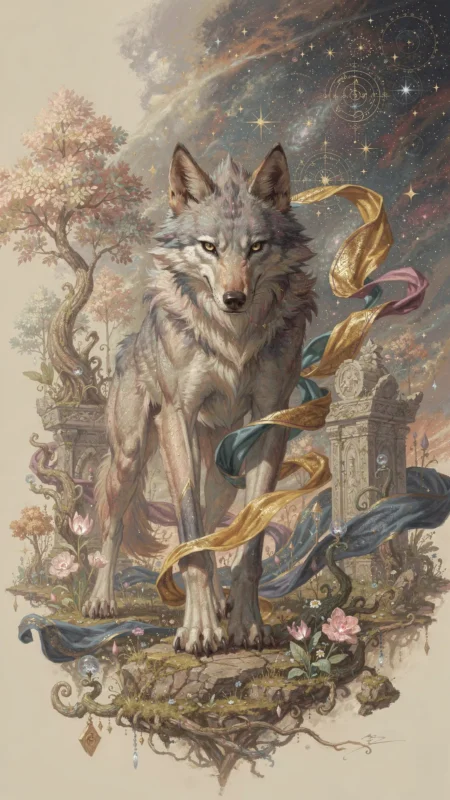
Werewolf

Archetype Meaning & Symbolism

Primal, cyclical, instinctual, untamed, protective, liminal, transformative, misunderstood, loyal, raw

  • Do not fear the wildness that rises with the moon: it is the oldest, truest part of you. The beast does not destroy, it reveals.

If Werewolf is part of your personal mythology, you may...

Believe

  • You may believe that every person has a hidden, wild nature, and that true wisdom lies in acknowledging and integrating it, not denying it.
  • You may believe that instinct is a form of intelligence as valid and powerful as logic, and that the body's wisdom often speaks more truth than the conscious mind.
  • You may believe that transformation is often a violent, necessary, and cyclical process, and that the most profound growth comes from the tearing down of a former self.

Fear

  • You may hold a deep-seated fear of losing control, of your own intensity becoming a destructive force that harms the people you are most driven to protect.
  • You may fear that your true nature is fundamentally monstrous, and that if others were to see all of you, you would be irrevocably ostracized and left utterly alone.
  • You may fear being trapped, either by the expectations of a civilized world that demand you suppress your essence, or by your own primal nature, leaving you unable to connect with the human world.

Strength

  • Your greatest strength may be a fierce, incorruptible loyalty. Once someone is accepted into your pack, you will protect them with a ferocity that others find both awesome and terrifying.
  • You may possess a powerful connection to your intuition and physical instincts, allowing you to sense danger, deception, and opportunity with an animalistic clarity.
  • You may have an immense capacity for resilience, able to endure profound, painful transformations and emerge with a deeper understanding of yourself and the world.

Weakness

  • Your cyclical nature and emotional intensity can be a weakness in a world that demands steady, linear performance, leading to periods of volatility or withdrawal that disrupt your personal and professional life.
  • You may have a deep-seated difficulty with trust, making it hard to form new bonds or to be vulnerable even with those you care about, leading to a default state of isolation.
  • You may have a tendency to see the world in black-and-white terms of threat or safety, ally or enemy, causing you to preemptively push people away or react to perceived slights with excessive force.

The Symbolism & Meaning of Werewolf

At its heart, the Werewolf is a story about integration. It is the perpetual, often violent, negotiation between our civilized selves: the part that pays taxes, holds doors, and makes polite conversation: and the primal, instinctual self that lies beneath. This other self is not evil, merely untamed. It speaks in the language of gut feelings, of sudden fury, of inexplicable passion, of the desire to run through the woods at night. To claim the Werewolf as part of one's mythos is not about a literal transformation but a psychic one, an initiation into the mysteries of the self that the Werewolf spirit animal so powerfully represents. It suggests a life lived in conscious relationship with this duality, honoring the beast not as something to be caged, but as a source of immense power, intuition, and vitality.

The Werewolf may also symbolize the ultimate outsider. Feared for its power and misunderstood for its nature, it lives on the fringes, belonging fully to neither the world of humanity nor the world of animals. For the individual whose personal mythology includes the Werewolf, this could translate to a persistent feeling of alienation, of carrying a secret that, if revealed, would lead to ostracization. Yet, this liminal state is also a place of power. It allows for a unique perspective, a capacity to see the hypocrisy in the civilized world and the raw honesty in the wild. It is the archetype of the person who must forge their own path and create their own definitions of belonging.

Furthermore, the Werewolf archetype is a profound meditation on the nature of control. The transformation is often depicted as involuntary, a surrender to a force far greater than the individual's will. This could illuminate a person's relationship with their own triggers, their emotional cycles, and the parts of their life that feel ungovernable. The mythology of the Werewolf doesn't necessarily promise mastery over these forces. Instead, it might suggest a different kind of wisdom: the wisdom of knowing when the tide is coming in, of preparing for the change, and of learning to navigate the raw power that emerges, rather than trying in vain to stop it.


Werewolf Relationships With Other Archetypes

The Moon

The relationship between the Werewolf and the Moon may be the most profound form of subjugation imaginable, a kind of gravitational enslavement of the soul. The Moon is not a conspirator, but rather a cold, celestial catalyst, an unblinking eye whose gaze is a silver key, unlocking a door within the flesh that the conscious mind would forever keep bolted. It is, perhaps, a terrible and one-sided love affair. The Werewolf is pulled into its feral state by a cosmic body that feels nothing, that simply hangs in the void, placid and perfect. This lunar pull is the rhythm of the Werewolf’s curse, a monthly appointment with a self it cannot recognize, suggesting that our most monstrous transformations are often orchestrated not by malice, but by an indifferent and immutable law of nature.

The Forest

The Forest is the only cathedral that would have him. In the brittle architecture of the town, the Werewolf is a monster, a violation of order, but in the tangled, breathing chaos of the woods, it could be perceived as a restoration of it. The relationship is one of deep, amoral communion. The Forest offers a sanctuary of shadows, a nave of silent trees where the Werewolf’s terrible truth is not a sin but simply a sound in the night, no more or less monstrous than an owl’s call or the crack of a falling branch. Here, among the patient roots, the self that is shed is the human one, a constricting skin left at the forest’s edge. The Forest, in turn, may claim the Werewolf as its own dark heart, given legs and teeth—the final, frightening expression of a world without mankind’s consent.

The Mirror

With the Mirror, the Werewolf archetype engages in a dialogue of pure fracture. The polished surface is a silent, unforgiving witness to the fault line running through the self. For the human, the reflection is a constant source of dread, a placid lake over an abyss, where one’s own familiar eyes might, for a fleeting moment, hold a glint of yellow, a premonition of the beast waiting in the blood. The mirror is a promise of a future horror. For the beast, however, the reflection is meaningless, an impotent flicker of light and shadow, unworthy of notice. This relationship could represent the abject failure of the self to cohere into a single, trustworthy image, a perpetual, unresolvable argument between a man and the ghost he carries inside him.

Patterns of The Werewolf Spirit Animal, Totem, or Archetype

Signs that the Werewolf archetype is calling to you may first appear in the external world, like whispers from a parallel reality. You might find yourself inexplicably drawn to the moon, noticing its phase and feeling its pull in your moods and energy levels without consciously trying. The figure of the wolf or the dog may appear with unusual frequency: in media, in encounters that feel strangely significant, or in art that you feel compelled to acquire. You might feel a resonance with stories, films, or myths about transformation, secret identities, and the struggle between civilization and wildness. These synchronicities are not mere coincidences: they are invitations, breadcrumbs leading you from the sunlit path into the deeper, more mysterious forest of your own psyche.

The call may also be an internal one, a persistent feeling that has been with you for much of your life. It could be a sense that there is a 'real you' hidden beneath the persona you present to the world, a self that is more intense, more passionate, and perhaps more dangerous. You might experience your emotions not as gentle waves but as powerful tides that can overwhelm you, followed by periods of quiet introspection. There could be a deep kinship with your own physical body, a trust in your gut feelings, and a recurring sense that you don't quite fit in, that you are guarding a secret or a power that others would not understand. A person who feels a connection to the Werewolf spirit animal might find these feelings familiar, as if recognizing a native language of the soul they had forgotten they spoke.

Finally, the pattern may be written in the very structure of your life's events. You may find that your life is not a steady climb but a series of dramatic deaths and rebirths, where you have had to shed old identities, relationships, or careers completely to make way for the new. You might have a history of being drawn to the fringes, of finding your true 'pack' among other misfits and outsiders who value authenticity over appearances. Perhaps your life's work, consciously or not, involves bridging two worlds: therapist and client, artist and audience, the spoken and the unspoken. Look for the moments where you were forced to transform, where you had to summon a primal strength to survive. It is in these moments of rupture and rebirth that the Werewolf leaves its clearest tracks.

Using Werewolf in Every Day Life

Navigating Intense Emotions:

When confronted by waves of rage, grief, or passion that feel overwhelming, the Werewolf archetype offers a framework for containment, not suppression. You might visualize a sacred, internal space, a deep forest where the beast can run, howl, and exhaust its fury without causing harm to your external life. It is an acknowledgment that such powerful feelings need territory to roam, that their energy, once expressed, can be understood and reintegrated, rather than allowing them to fester and erupt uncontrollably in your civilized world.

Forging Deeper Intimacy:

In relationships, the fear of revealing one's 'monstrous' or less palatable side can create profound distance. The Werewolf mythos encourages a courageous vulnerability. It could be about sharing a difficult truth, an unpopular opinion, or a raw emotional need, trusting that your chosen 'pack' member can witness your full self without flinching. This archetype teaches that true intimacy is not found in perpetual harmony, but in the trust that allows both the human and the beast to be seen and loved.

Embracing Cyclical Change:

In a world that demands linear progress, the Werewolf champions the power of cycles. During periods of professional or personal transition that feel like a regression or a tearing down of identity, this archetype provides a different narrative. You may be in a necessary phase of destruction before a powerful rebirth. This isn't failure: it's the transformation. It’s the shedding of a skin, a life, that no longer fits, preparing you for the hunt that lies ahead under a new moon.

Werewolf is Known For

The Transformation

The violent, painful, and uncontrollable shift from human to beast, symbolizing the agony and inevitability of profound change.

Lunar Connection

The Werewolf’s power and curse are inextricably tied to the phases of the moon, representing a deep bond with natural, primal cycles over which the conscious mind has no dominion.

The Pack

A complex dynamic of fierce loyalty, rigid hierarchy, and instinctive communication, representing the deep human need for a tribe that understands our most feral instincts.

How Werewolf Might Affect Your Personal Mythology

How Werewolf Might Affect Your Mythos

When the Werewolf enters one’s personal mythos, the life story ceases to be a simple, linear progression. It becomes a cyclical narrative, punctuated by dramatic transformations. Past versions of the self are not merely outgrown: they are shed like a skin in a painful, necessary process. Your life story might be framed by these metamorphoses: the time before you embraced your intensity, and the time after. Major life events may be seen not as building blocks but as full moons, moments of irresistible change where a hidden nature emerges and rearranges the very landscape of your existence. You may see your narrative as a constant dance between two worlds, the quiet, sunlit path of conformity and the chaotic, moon-drenched forest of your soul.

Your personal mythos might also become a story of the misunderstood guardian. You may cast yourself as the protector of a boundary, the one who is fierce, even monstrous when necessary, to defend what is sacred: your family, your principles, your territory. The story is no longer about being liked, but about being respected and, perhaps, a little feared. This narrative accommodates the parts of you that are not gentle or polite. It gives a noble purpose to your sharp edges, framing your intensity not as a flaw but as a necessary tool for survival and protection in a world that often encroaches on the vulnerable.

How Werewolf Might Affect Your Sense of Self

Incorporating the Werewolf archetype could fundamentally alter your perception of self, particularly your relationship with what society deems 'negative' emotions. Anger, rage, and intense passion are no longer character defects to be suppressed. They are, perhaps, the emergence of the beast, a valid and powerful part of your being, signaling that a boundary has been crossed or a deep need has been ignored. You might learn to see your own cyclical moods not as instability but as a natural rhythm, a personal tide pulled by an invisible moon. This allows for a more compassionate and integrated self-concept, one that has room for both the lamb and the wolf.

Furthermore, a person whose personal narrative is touched by the Werewolf spirit animal may begin to see their own intense emotions not as flaws but as a source of profound energy and information. The inner beast becomes an ally. Its keen senses translate to sharp intuition. Its physical power becomes a metaphor for resilience and vitality. This perspective fosters a quiet confidence that is not dependent on external validation. It is the confidence of knowing you possess a hidden strength, a survival instinct that will see you through the darkest of nights. You may no longer strive to be perfectly polished, finding a strange beauty and authenticity in your own untamed edges.

How Werewolf Might Affect Your Beliefs About The World

A worldview shaped by the Werewolf archetype is one that constantly looks beneath the surface. You may become skeptical of polished exteriors, both in people and in institutions, always sensing the feral, self-interested creature that lurks beneath the veneer of civility. The world is no longer seen as a safe, orderly place governed by rational rules, but as a wild territory of competing instincts, hidden agendas, and primal urges. This is not necessarily a cynical view: rather, it is a deeply realistic one, acknowledging the full, untamed spectrum of life, not just the sanitized version presented in daylight.

This perspective may also attune you to the cycles of power, decay, and rebirth that govern everything. You might see the rise and fall of corporations, political movements, and social trends not as isolated events, but as the great, lupine hunt of history: the strong feed, the weak scatter, and the landscape is forever changed by the struggle. You may develop a profound appreciation for the night, for shadows, for the hidden places where true natures are revealed. The world becomes a far more interesting, if more dangerous, place, a forest of secrets waiting to be sniffed out by a keen and wary nose.

How Werewolf Might Affect Your Relationships

In relationships, the Werewolf mythos fosters a craving for an almost impossible depth of acceptance. You may feel a constant, low-level anxiety about whether your partner, your friends, your family, could handle the 'real' you if they ever saw it. This can lead to two extremes: either keeping others at a safe distance to protect them (and yourself from rejection), or forming intensely loyal, almost possessive bonds with the very few people you allow into your inner circle. For these chosen few, you may be the most devoted and fiercely protective ally they will ever have.

The dynamic of the 'pack' becomes central. Relationships are not casual affiliations: they are alliances. Trust is paramount and, once broken, is nearly impossible to repair. Communication might be less about eloquent words and more about shared instincts, comfortable silences, and a gut-level understanding of one another’s moods and boundaries. The challenge is navigating the moments of transformation: the periods of emotional intensity where you might unintentionally lash out. A successful relationship, in this view, is one where your pack is not afraid of your howl, but knows how to give you the space to let it out.

How Werewolf Might Affect Your Role in Life

If the Werewolf informs your personal mythology, you may feel your role is that of the 'liminal guardian.' You stand on the threshold between worlds: civilization and wilderness, consciousness and instinct, order and chaos. Your purpose is not to choose a side, but to mediate between them, both within yourself and in your community. You might be the person in a group who speaks the uncomfortable truth, the one who brings a dose of primal reality to an overly intellectualized discussion. You guard the border, reminding the civilized of the wild they have forgotten and reminding the wild of the lines that cannot be crossed.

Alternatively, you may see your role as the 'alpha of your own life.' This isn't about dominating others, but about achieving a fierce self-sovereignty. Your purpose is to carve out your own territory, a life that is authentically yours, and to defend it against all incursions. This role requires a radical self-reliance and the courage to be misunderstood. You may feel a responsibility to live out your untamed nature as an act of defiance against a homogenizing world, serving as a beacon for others who feel the call of their own inner wildness but are too afraid to answer it.

Dream Interpretation of Werewolf

In a positive context, dreaming of a Werewolf, or of becoming one, could symbolize a powerful integration of your own instinctual nature. It may suggest that you are successfully tapping into a source of vitality, intuition, and primal power that you previously suppressed. The dream might feel frightening, but the underlying emotion is one of liberation and strength. To run as a wolf through a dreamscape forest could be your psyche's way of telling you to trust your gut, to embrace your physical body, and to express your authentic self without fear of judgment. It can be a call to break free from constraints and to reclaim a part of you that has been caged.

In a negative context, a Werewolf dream can speak to a terrifying loss of control. If the dream-transformation is agonizing and you proceed to cause destruction and chaos, it may reflect a waking-life fear of your own suppressed anger or passions. It could be a manifestation of 'shadow' elements: impulses that you have so fiercely denied that they now threaten to erupt in destructive ways. Being pursued by a Werewolf might symbolize an aspect of yourself, an unacknowledged rage or a deep-seated wound, that is chasing you and demanding to be confronted. It is a warning from your subconscious to face the beast within before it consumes you.

How Werewolf Archetype Might Affect Your Needs

How Werewolf Might Affect Your Physiological Needs

When the Werewolf archetype is active in one's mythos, the physiological self demands acknowledgment. There may be a profound need for physical expression that goes beyond simple exercise: a need to run, to push the body to its limits, to feel the blood pumping and the muscles straining. A sedentary life can feel like a cage, leading to a sense of restlessness and agitation that no amount of mental stimulation can soothe. There may also be a heightened sensitivity to natural cycles, particularly the lunar cycle, with energy levels, moods, and even physical appetites waxing and waning in a noticeable rhythm.

This connection also manifests as a deep reliance on sensory information. Gut feelings are not just emotions: they are experienced physically, as a knot in the stomach or a prickling on the skin. You may feel a deep-seated need for a 'den,' a physical space that is safe, private, and entirely your own, where the nervous system can settle. The body is not a vehicle for the mind: it is the primary instrument for navigating the world, and its needs for intense exertion, deep rest, and sensory clarity are paramount.

How Werewolf Might Affect Your Ideas of Belonging

The need for belongingness is perhaps the most acute and painful point for the Werewolf archetype. It is a paradox: a deep, instinctual craving for a pack, coupled with a profound sense of being too different or too dangerous to truly belong anywhere. This can create a life characterized by a lonely orbit around social groups, never fully joining, always feeling like an outsider looking in. The fear of rejection is not just about being disliked: it is about being cast out, a primal terror of being left to fend for oneself in the wilderness. The desire is for a bond that transcends social niceties, a pack that sees your claws and fangs and is not afraid.

When this belonging is found, it is absolute. For the person whose mythology is shaped by this archetype, love and loyalty are not gentle affections: they are fierce, all-consuming, and unconditional. They may not have many friends, but the ones they do have are family, bound by an unspoken pact of mutual protection. To be loved, for them, is to be fully seen, beast and all, and to be accepted without reservation. Anything less feels like a betrayal. Because of this, this person may find that the presence of the Werewolf spirit animal in their mythology informs a deep-seated need for a 'pack' that can withstand the cyclical transformations of the soul.

How Werewolf Might Affect Your Feelings of Safety

Safety, for one who identifies with the Werewolf, is defined by territory and awareness. There is a primal need to establish and maintain clear boundaries, both physical and energetic. Uninvited intrusions into one's personal space or private life may feel like a direct threat, provoking a disproportionately fierce, protective response. Safety is a well-defended perimeter. This can manifest as a preference for homes in secluded areas, a wariness of crowds, or a meticulous curation of one's social circle. The world is perceived as a place of potential threats, and a state of hyper-vigilance can feel like a basic survival necessity.

This need for safety also extends to the 'pack.' The well-being of loved ones becomes a primary concern, and the individual may assume the role of the vigilant protector, constantly scanning the horizon for danger on their behalf. True safety is not merely the absence of threat, but the presence of a loyal, trusted few who have your back. This can create a powerful sense of security within the small pack, but it may also foster a general distrust of the world outside of it, a belief that the only real safety is that which you create and defend yourself.

How Werewolf Might Affect Your Views of Esteem

Esteem, within the Werewolf mythos, is not found in public accolades or social status. Those are the trappings of the human world, often perceived as fragile and insincere. Instead, self-esteem is forged in the crucible of self-mastery. It is the quiet pride that comes from learning to ride the wave of one's own intensity without being destroyed by it. It is the confidence born from surviving a painful transformation and realizing you are stronger on the other side. Esteem is the ability to look your own inner beast in the eye and see an ally, not a monster.

This kind of self-worth is deeply resilient because it is not contingent on the opinions of others. In fact, being misunderstood or even feared by the mainstream can become a source of secret strength, a confirmation of one's authenticity. The respect that matters is the respect of the self and of the chosen few in one's pack. Achievement is measured not by external milestones, but by internal ones: successfully navigating a bout of rage, trusting an intuitive hit that proves correct, or courageously defending a personal boundary. It is the esteem of the survivor, the guardian, the one who walks in two worlds and is master of their own soul.

Shadow of Werewolf

When the Werewolf archetype falls into shadow, integration fails, and the result is a psychic civil war. The individual may swing violently between two extremes. One is the over-civilized human: repressed, anxious, and joyless, a person who has caged their beast so effectively they have also caged their vitality. They may be rigid, controlling, and terrified of any authentic emotional expression. Life becomes a sterile performance of normality, but beneath the surface, the caged beast grows more and more enraged, its pressure building towards an inevitable and catastrophic explosion.

The other side of the shadow is the person who has been consumed by the beast. Here, the human consciousness is lost, and the person acts purely on impulse, rage, and appetite. This is not the noble wildness of the integrated archetype: it is a portrait of raw, untempered id. They may be consumed by paranoia, seeing threats everywhere and lashing out with destructive force. Relationships are impossible, as they lack the capacity for empathy or control, driven only by a moment-to-moment storm of instinct. The shadow of the Werewolf spirit animal is a chilling portrait of integration denied: a life that is either a prison or a rampage, with no territory for a soul in between.

Pros & Cons of Werewolf in Your Mythology

Pros

  • You may possess a profound connection to a deep well of instinctual wisdom and vitality, giving you a resilience and energy that others lack.
  • You experience and inspire a level of loyalty that is nearly unbreakable, creating intensely deep and meaningful bonds with your chosen 'pack.'
  • You have the courage to face the darkness, both in the world and within yourself, granting you a level of authenticity and self-knowledge that is rare.

Cons

  • You may live with a persistent feeling of alienation, of being fundamentally different and misunderstood by mainstream society.
  • You must constantly manage a level of emotional and instinctual intensity that can be exhausting and, at times, frightening to yourself and others.
  • Your cyclical nature may put you at odds with the demands of a modern world that prizes consistency, making it challenging to maintain steady careers and routines.