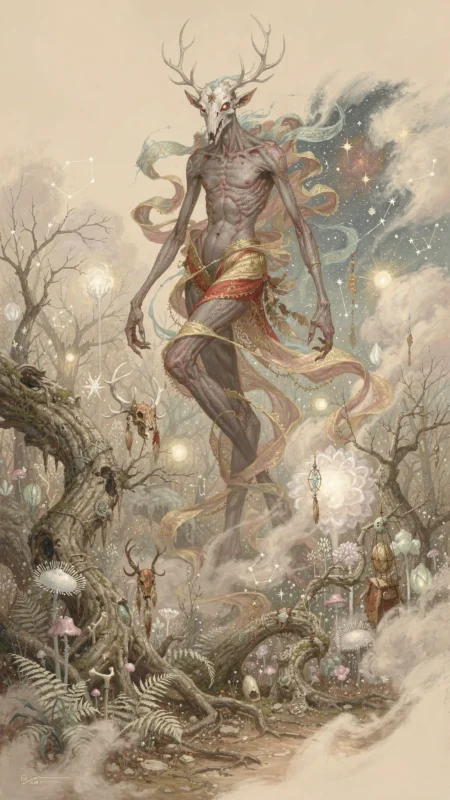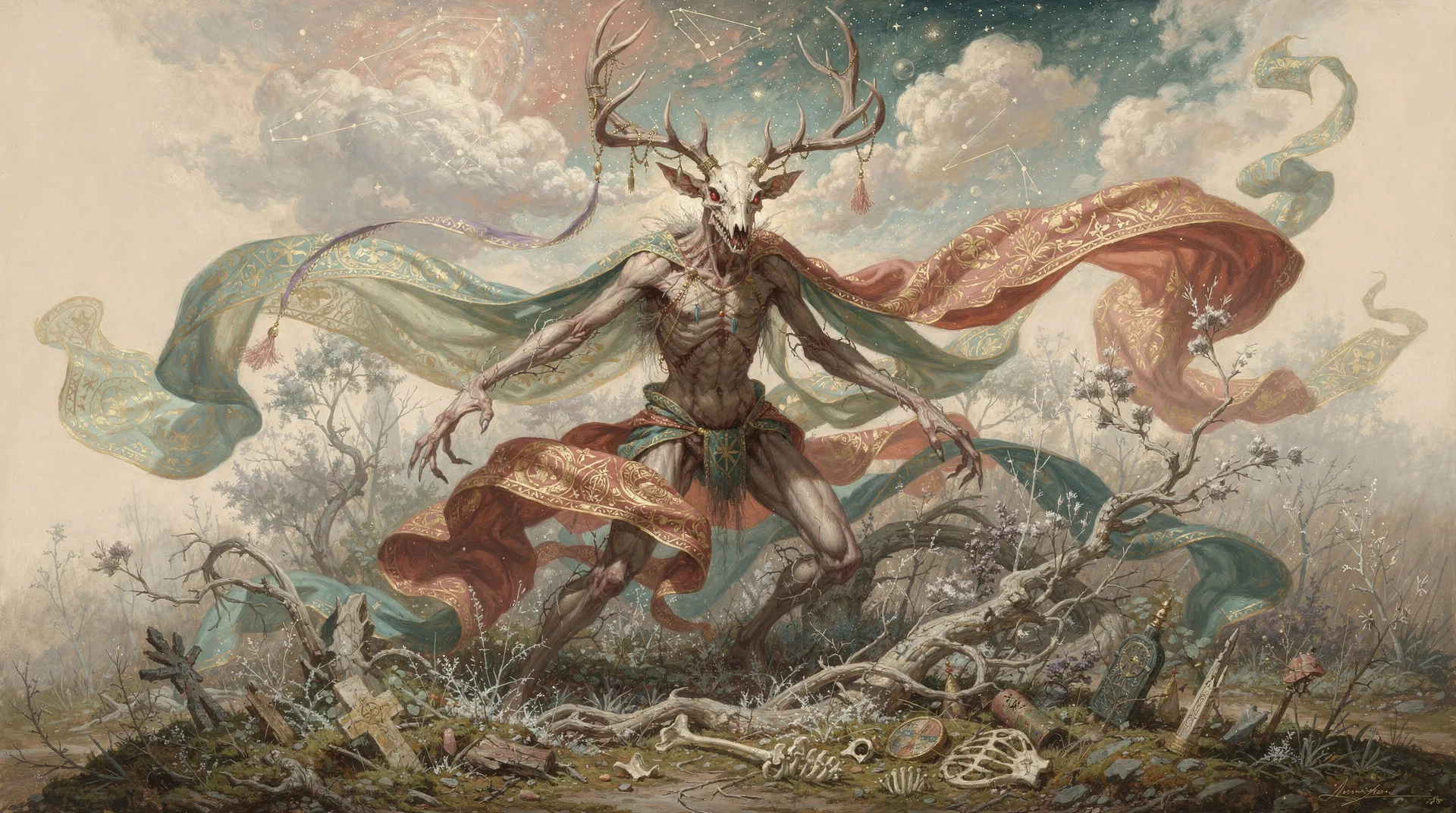


Wendigo

Archetype Meaning & Symbolism

Insatiable, Isolating, Voracious, Restless, Haunting, Primal, Transformative, Austere, Enduring, Resilient

  • The void you feel is not an absence to be filled, but a space to be understood. Do not feed it; listen to what it craves.

If Wendigo is part of your personal mythology, you may...

Believe

  • That the primary conflict of humanity is between our communal nature and our insatiable individual desires.
  • That true strength is forged not in comfort, but in prolonged periods of austerity and isolation.
  • That beneath every civilized person lurks a hungry ghost, and it is wise to never forget it.

Fear

  • That your own ambition is a monstrous thing that will one day consume you and everyone you care about.
  • That you are fundamentally, irrevocably alone, and that any attempt at connection is doomed to fail.
  • That the emptiness inside you is a bottomless pit, and that you will spend your entire life trying to fill it, only to die starving.

Strength

  • An almost supernatural endurance. You can survive metaphorical winters that would break others.
  • A profound and unflinching self-awareness. You are not afraid to look into your own darkness.
  • A powerful drive that, when harnessed, can lead to incredible creation and achievement.

Weakness

  • A tendency toward self-imposed isolation that can curdle into bitterness and paranoia.
  • A vulnerability to obsessive or addictive cycles as a way to soothe the inner emptiness.
  • A chronic dissatisfaction that makes it difficult to appreciate the present moment or find simple joy.

The Symbolism & Meaning of Wendigo

In the modern psyche, the Wendigo stalks the silent corridors of our digital and corporate lives. It is no longer just a specter of the frozen north, but the very spirit of unchecked consumption that defines our age. It may be the algorithm that demands endless scrolling, the corporate ladder that asks for your evenings and weekends, the gnawing feeling of inadequacy that can only be soothed by the next purchase. To have the Wendigo as part of one's personal mythology is to be intimately acquainted with this insatiable spirit, to recognize its whisper in the hum of the server farm and the silence of an empty shopping cart.

This archetype is the patron saint of the perpetually starving, even amidst plenty. It is the hunger for a meaning that material success cannot provide, the loneliness that persists in a crowded room. Your mythos might involve a constant negotiation with this void. You may see this dynamic not as a curse, but as a diagnostic tool, a spiritual barometer. The Wendigo’s presence could indicate where your life has become imbalanced, where you are feeding a ghost instead of nourishing your soul. The Wendigo spirit animal is not a guide to predation, but a stark illustration of its consequences.

Ultimately, the Wendigo symbolizes a profound transformation born of desperation. It is what happens when survival instincts override humanity. In your story, this might not be about physical survival, but psychological or spiritual. It's the moment you compromise a core value for a promotion, or sacrifice a genuine connection for fleeting validation. The Wendigo’s tale is a cautionary one, a reminder that the line between human and monster is thin, and it is paved with the small compromises we make when we are starving for something we cannot name.


Wendigo Relationships With Other Archetypes

The Hearth

The Hearth, as an archetype, may represent a small, defiant sun against the encroaching wilderness, a nucleus of shared warmth and story. The Wendigo, then, is not merely its opposite but its utter negation; it is the gravity of the self collapsing inward, a personal winter so profound it extinguishes all light. The relationship is one of mutual exclusion. Where the communal fire crackles, telling tales of cooperation and shared bread, the Wendigo cannot persist. Its hunger is perhaps a phantom memory of that warmth, a desperate and violent attempt to consume the very light it can no longer generate. The Hearth is a pact against the cold, while the Wendigo is the chilling consequence of that pact's solitary betrayal.

The Hoarder

One might see in the Hoarder a strange, sedentary cousin to the Wendigo. Both are born from a terror of lack, a deep psychic wound of scarcity that blossoms into a pathological need for more. Yet where the Hoarder builds a static fortress of things, a bulwark of decaying paper and forgotten objects to wall out the emptiness, the Wendigo becomes a kinetic storm of consumption, attempting to fill that same void by devouring the world. The Hoarder’s collection is a slow, quiet suffocation under the weight of yesterday; the Wendigo’s path is a howling erasure of life. They could be two forks in the same desolate road, one a desperate attempt to preserve against loss, the other a surrender to the abyss of insatiable want.

The Winter

The Wendigo does not simply exist within the Winter; it could be understood as the season’s own will made manifest, its most articulate and terrifying impulse. Winter itself is a vast, indifferent stage of quiet desperation and stark beauty, a landscape asleep under snow. The Wendigo, however, is its fever dream. It is the active, predatory principle within the passive cold, the gnawing hunger of the starving forest given teeth and terrible purpose. That keening howl, carried on the wind, may not be an intruder upon the season’s silence but its very soul, the sound of the world’s quiet, frozen hunger finally learning to scream a name.

Patterns of The Wendigo Spirit Animal, Totem, or Archetype

If the Wendigo archetype is calling to you, the signs may be less about literal animal encounters and more about a persistent atmospheric resonance in your life. You might find yourself repeatedly drawn to stories, films, or art depicting survival in stark, frozen landscapes. Perhaps you notice a synchronicity around antlers, bones, or the feeling of a sudden, inexplicable chill in a warm room. The 'weather' of your inner world might feel like a perpetual late autumn, a time of preparing for a long, hard winter, regardless of the season outside. These are the quiet knocks of an archetype that deals in scarcity, endurance, and the primal forces that stir when we are stripped of comfort.

Internally, the signs are more pronounced. A recurring thought pattern might be a deep meditation on hunger: not for food, but for knowledge, experience, power, or meaning. You may feel a gnawing sense that 'more' is the only answer, while simultaneously knowing it will never be enough. There might be a profound, almost painful empathy for the outcast, the addict, the lonely, because you recognize the same potential for a great, consuming emptiness within yourself. The subtle guidance of the Wendigo spirit animal might be felt in moments of intense, solitary ambition, where you feel both powerful and terribly alone.

In the unfolding of your life, the pattern may become clear. You might experience recurring events that force you into periods of isolation or scarcity, which act as transformative crucibles. Relationships might follow a pattern of extreme intensity followed by a cold, lonely distance. You might find yourself in professional roles that require a 'predatory' instinct, forcing a confrontation with your own ethics. The path of the Wendigo spirit animal is often marked by these dramatic cycles of famine and feast, of voracious engagement with the world followed by a necessary, and often painful, retreat into the self. It's a path of learning to live with a great hunger, and choosing to let it make you wise rather than monstrous.

Using Wendigo in Every Day Life

Navigating Ambition

When professional hunger threatens to alienate you from your colleagues or compromise your ethics, the Wendigo archetype serves as a chilling reminder. It prompts the question: Does this pursuit nourish me, or merely feed a bottomless craving for more? It encourages a sustainable ambition, one that builds rather than consumes.

Confronting Addiction

In the throes of any compulsive behavior, be it substance, screen, or validation, the Wendigo mythos provides a powerful mirror. It personifies the moment of transformation, where desire ceases to be a choice and becomes a consuming identity. Contemplating this archetype may offer the strength to starve the compulsion by recognizing it as a foreign hunger, not a part of your true self.

Embracing Solitude

For those who feel a deep, almost painful need for isolation, the Wendigo offers a framework beyond mere introversion. It suggests that this solitude could be a sacred, albeit dangerous, wilderness. It is a space for confronting the self in its most raw state, a necessary winter to test your resilience and discover what truly sustains you when all else is stripped away.

Wendigo is Known For

Insatiable Hunger

A defining characteristic that transcends physical appetite, representing a profound, unquenchable craving for something more

power, wealth, knowledge, or life itself. It symbolizes greed and excess in their most terrifying forms.

The Frozen Heart

This is not merely a physical coldness but a spiritual one. It represents the loss of humanity, empathy, and compassion, replaced by a shard of ice that drives the creature's solitary and ravenous existence.

Taboo of Cannibalism

The Wendigo is famously born from a human who resorts to consuming another. This act is a metaphor for any transgression that consumes the soul, where one destroys another's humanity (or one's own) for survival or gain.

How Wendigo Might Affect Your Personal Mythology

How Wendigo Might Affect Your Mythos

When the Wendigo haunts the edges of your personal narrative, your life story may become a tale of epic appetite and its containment. Your mythos is not one of gentle growth, but of wrestling with a primordial force within. Milestones may be marked not by what you acquired, but by what you resisted consuming. Your ‘hero’s journey’ might be an inward one: a descent into the frozen landscape of your own deepest hungers to confront the creature waiting there. It’s a story about learning the difference between ambition that builds and appetite that devours.

Your personal history might be interpreted through this lens of famine and feast. Periods of intense productivity and success could be seen as voracious hunts, followed by isolating winters of burnout and emptiness. Friendships and romances that ended might be framed as cautionary tales of consumption, where your own needs or your partner's threatened to devour the relationship itself. The central conflict of your mythos could be the struggle to build a warm hearth of community and self-acceptance in a world that constantly tempts you with the cold, solitary power of more.

How Wendigo Might Affect Your Sense of Self

To see the Wendigo in the mirror is to acknowledge a capacity for immense, perhaps terrifying, drive. You may view yourself as someone who feels things more acutely: hunger, ambition, loneliness. There is an awareness of a great void within, a space that echoes. This doesn't have to be a source of shame; it could be the wellspring of your greatest creative or professional power. You might see your ambition not as simple desire, but as a force of nature that must be respected and managed, like a controlled burn.

This self-perception might also foster a feeling of being fundamentally different, an outsider looking in at the warmth of easy contentment. You may feel that your appetites make you dangerous or 'too much' for others. This can lead to a carefully constructed persona of control and austerity, a stark contrast to the ravenous presence you feel within. Self-acceptance, then, is not about eliminating the hunger, but about building a self strong enough to house it without being consumed by it, treating the Wendigo spirit animal not as an invader but as a permanent, powerful resident.

How Wendigo Might Affect Your Beliefs About The World

A worldview informed by the Wendigo may be one that sees civilization as a thin veneer over a state of perpetual, ravenous competition. You might be acutely aware of the consumerism, greed, and spiritual emptiness that drives modern society. You see the world not as a garden, but as a frozen forest where everyone is, in some way, starving. This can lead to a cynical perspective, a belief that altruism is a mask for self-interest and that all systems are designed to feed the few at the expense of the many.

However, this stark view could also cultivate a profound and specific form of empathy. Seeing the world's hunger, you might be moved to genuine acts of nourishment, not just charity. You might champion causes that address systemic greed or spiritual poverty. Your worldview, shaped by the awareness of the great cold, could drive you to become a source of warmth. You may understand better than anyone that the only antidote to a world of Wendigos is to foster relentless, defiant community and share what little you have.

How Wendigo Might Affect Your Relationships

In the realm of relationships, the Wendigo archetype can cast a long, isolating shadow. There may be a persistent fear of your own needs overwhelming a partner. You might worry that your love is a form of consumption, that you will drain them of their energy, their time, their very essence until nothing is left. This could lead to keeping partners at a distance, creating a solitary 'buffer zone' to protect them from the intensity of your own inner world, or from what you perceive as your unquenchable need for affection and validation.

Conversely, you might be drawn to relationships that promise to finally 'fill the void.' This can create a pattern of intense, all-consuming partnerships that burn bright and fast, only to collapse into a cold emptiness when the other person inevitably fails to be your salvation. True progress in relationships, for someone with this mythos, involves learning to approach connection not as a hungry ghost, but as a fellow traveler. It requires the brave act of revealing your emptiness to another, not so they can fill it, but so you can sit together in its presence, sharing the warmth of a common fire.

How Wendigo Might Affect Your Role in Life

Your perceived role in life might be that of the eternal outsider, the lone figure silhouetted against the snow, observing the firelight of community from a distance. You may feel destined to walk a solitary path, believing your intensity or your unique perspective makes you unfit for the tribe. This can be a role of profound observation and wisdom, the hermit who sees the truth of the village precisely because they are not in it. You might become a keeper of uncomfortable truths, the one who points out the rot beneath the floorboards.

Alternatively, your role could be that of the healer who has tamed their own demon. Having stared into the abyss of your own consumption, you may feel called to guide others back from the brink. You might be the therapist who specializes in addiction, the artist whose work explores themes of emptiness, or the mentor who teaches young, ambitious people how to build a career without losing their soul. Your role becomes that of the fire-keeper: you do not offer to slay the beast for others, but rather to show them how to survive their own winter and find their own warmth, guided by the hard-won lessons of your internal Wendigo spirit animal.

Dream Interpretation of Wendigo

In a positive context, dreaming of the Wendigo may not be a simple nightmare, but a powerful summons from the subconscious. It could be a call to acknowledge a great, untamed ambition you have been suppressing. The creature's appearance might signal a need to enter a period of solitude and deep introspection, to strip away the superficial and discover what you are truly hungry for. Seeing it from a safe distance, or even taming it, could symbolize that you are beginning to integrate this powerful, primal energy, turning a potentially destructive force into a source of immense drive and focus.

More commonly, a Wendigo dream carries a heavy warning. It often manifests as being chased by the creature or, most terrifyingly, realizing you are becoming it. This is the shadow in stark relief. The dream may be a direct confrontation with a consuming aspect of your life: an addiction, a toxic relationship, a soul-crushing job, or unchecked greed. It is a visceral alarm bell from your psyche, warning that you are on a path toward losing your compassion, your community, and your essential humanity. The dream begs you to stop, to turn around, and to starve the monster before it consumes you entirely.

How Wendigo Archetype Might Affect Your Needs

How Wendigo Might Affect Your Physiological Needs

When the Wendigo is a cornerstone of your personal mythos, your relationship with your body’s basic needs may be fraught with tension. The archetype’s core of insatiable hunger can manifest in literal ways. This might not be simple gluttony, but a profound disconnect from the signals of satiety. You might eat a full meal and still feel a phantom emptiness, a psychic hunger that no food can touch. This could lead to cycles of extreme dieting and bingeing, asceticism and indulgence, as you try to control or placate a hunger that isn't truly physical.

The archetype’s connection to the frozen wilderness can also translate into your physiological experience. You may feel a persistent internal chill that no sweater can warm, a somatic manifestation of spiritual or emotional isolation. Your body might operate in a state of high-alert, a survival mode, leading to exhaustion, poor sleep, and a constant, low-level hum of anxiety. Comfort and physical contentment may feel foreign or undeserved, as if your very cells believe they are still weathering a blizzard, perpetually on the brink of starvation.

How Wendigo Might Affect Your Ideas of Belonging

The Wendigo archetype strikes at the very heart of the need for love and belonging. Its defining trait is isolation, a state born of a terrible transformation that makes it an outcast. If this is part of your mythos, you may carry a profound sense of being 'other,' fundamentally set apart from the warmth of the human circle. You might yearn for intimacy and community with a desperate intensity, yet simultaneously fear it. The core belief is a tragic one: to get close to others is to risk consuming them, and to be loved is to risk being devoured.

This conflict can create a painful push-pull dynamic in relationships. You might sabotage intimacy as it deepens, creating distance to 'protect' the other person from your perceived intensity or neediness. Alternatively, you might feel that you are the one at risk of being consumed, your individuality lost to the demands of a group or a partner. Belongingness feels like a paradox. The very thing you crave, community, is the thing your inner archetype tells you that you are destined to destroy or be destroyed by. The path to belonging involves the terrifying act of trusting that you can be part of a fire without extinguishing it.

How Wendigo Might Affect Your Feelings of Safety

Your need for safety, as filtered through the Wendigo mythos, may be defined by a haunting sense of precarity. The world does not feel like a stable, reliable place. Instead, it is a wilderness where resources are scarce and the next devastating winter is always just around the corner. This can manifest as a deep-seated financial anxiety, even in times of abundance. You might hoard resources, work obsessively to build a fortress of security, and yet never feel truly safe. The fear is not of poverty, but of annihilation; the complete depletion of all that sustains you.

This can also corrupt your sense of personal safety. Trusting the world or other people may feel naive. You might operate with a constant, low-grade paranoia, believing that everyone is driven by a hidden, voracious self-interest. To feel safe, you might believe you must become the most formidable creature in the forest, adopting a predatory stance in your career or personal dealings as a defensive measure. Safety isn't found in community or trust, but in solitude and a self-sufficiency so absolute that you need nothing from anyone, a truly cold comfort.

How Wendigo Might Affect Your Views of Esteem

Esteem, within a Wendigo-inflected mythology, may be a fragile and transactional affair. Your sense of self-worth might be inextricably linked to acquisition and consumption. You feel valuable only when you are achieving, winning, accumulating: more accolades, more money, more influence. Yet, like the Wendigo’s hunger, this need for validation is insatiable. Each achievement provides only a fleeting moment of satisfaction before the emptiness returns, demanding another, bigger accomplishment. It is a treadmill of esteem, powered by a fear of being worthless if you ever stand still.

True, lasting self-esteem for a person with this mythos cannot come from external sources. The journey toward it is an arduous one, requiring you to turn inward and confront the void. It is the process of learning to value yourself not for what you can acquire, but for your resilience, your insight, and your capacity to endure. Esteem is found not in feeding the hunger, but in understanding it and choosing not to be ruled by it. It is the quiet, powerful realization that you are enough, even in the depths of the coldest winter, even when you feel you have nothing.

Shadow of Wendigo

When the shadow of the Wendigo takes complete control, the metaphor dies and the monster is born. This is no longer a nuanced struggle with inner hunger; it is a full surrender to it. In this state, a person becomes a black hole of need. They are the narcissist who devours the emotional energy of their family, leaving them husks. They are the corporate raider who liquidates a company for personal gain, indifferent to the thousands of lives they destroy. The shadow Wendigo justifies its consumption as necessity, its cruelty as strength, its isolation as superiority.

Here, the frozen heart is complete. Empathy is not just absent; it is viewed as a contemptible weakness. Relationships become purely transactional, tools for acquisition. The shadow Wendigo pathologically fears stillness and silence, for in those moments, the terrifying scale of its own emptiness might become apparent. It must always be hunting, consuming, and growing, because its only sense of self is derived from what it takes. This is the tragic endpoint of the archetype: a being of immense power, trapped in a solitary, frozen hell of its own making, forever starving.

Pros & Cons of Wendigo in Your Mythology

Pros

  • You may possess a relentless drive that, if channeled constructively, can fuel immense success and innovation.
  • You likely have a deep, nuanced understanding of human nature's darker side, granting you a wisdom that is rare and powerful.
  • Your experience with profound isolation can forge a radical self-reliance and an unbreakable inner resilience.

Cons

  • You may be plagued by a persistent existential dissatisfaction that makes contentment feel impossible.
  • You might find it exceptionally difficult to form deep, trusting relationships due to a fear of consumption, either by you or of you.
  • Your intensity and perceived coldness can lead to being misunderstood, feared, or ostracized by others.