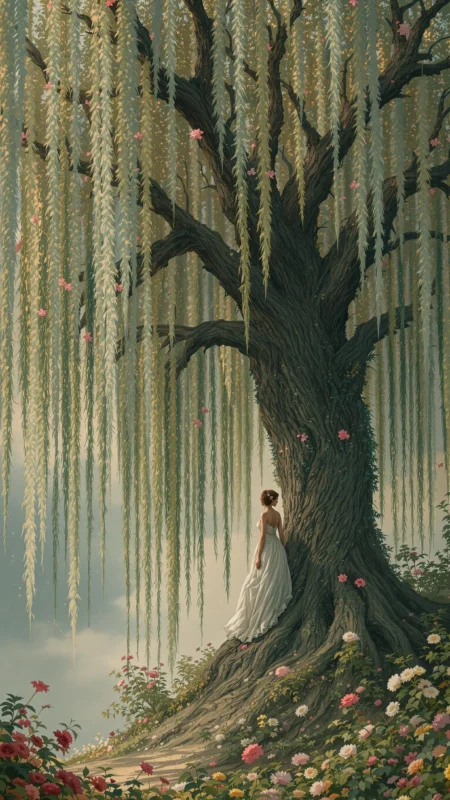
Weeping Willow

Archetype Meaning & Symbolism

Resilient, melancholic, yielding, graceful, secretive, patient, sheltering, enduring, expressive, introspective

  • Do not mistake my weeping for weakness; it is the rain that softens the earth, allowing my roots to grow ever deeper.

If Weeping Willow is part of your personal mythology, you may...

Believe

  • You may believe that true strength is not rigid, but pliable and that the ability to yield is a form of power.

    You may believe that sorrow is not an emotion to be conquered or cured, but a sacred landscape to be traversed and honored.

    You may believe that the most profound forms of beauty are often tinged with melancholy and that vulnerability is the source of all true connection.

Fear

  • You may fear being emotionally uprooted by a sudden, violent change that you cannot adapt to.

    You may fear emotional drought: a state of being unable to feel or release your emotions, becoming brittle and dry inside.

    You may fear having your protective veil of privacy torn away, leaving your innermost self completely exposed and judged by the world.

Strength

  • You may possess a deep and genuine empathy, along with the rare ability to create truly safe emotional spaces for other people.

    You may have immense resilience, a capacity to bend under immense pressure without breaking, weathering life's greatest storms with grace.

    You may have a rich inner life and a profound connection to your own emotional world, which can be a powerful engine for creativity and self-awareness.

Weakness

  • You may have a tendency towards melancholy or a passive resignation, sometimes mistaking inaction for patience.

    You may become so engrossed in sheltering others that you consistently neglect your own needs, leading to emotional exhaustion.

    You may have difficulty with direct confrontation, preferring to yield and absorb conflict even in situations where you should stand firm.

The Symbolism & Meaning of Weeping Willow

In the personal mythos, the Weeping Willow is the sacred embodiment of grief processed with grace. It stands as a testament that sorrow need not be a frantic, jagged wound, but can be a long, quiet rain. Its drooping branches are not a sign of defeat but of release, a constant, gentle letting go. To have the Willow in your story is to understand that emotions, especially the heavy ones, must be given a beautiful form and a safe place to fall. It suggests a life lived in close communion with the heart's tides, where melancholy is not a pathology but a color in a rich palette, a source of poetry, and a quiet companion in moments of deep thought.

The Willow also symbolizes a unique form of shelter. Its cascading leaves create a hidden space, a natural room veiled from the harsh gaze of the outer world. For an individual, this may translate into a psychological need for a rich inner life, a sanctuary of the mind where one can retreat to feel, think, and regenerate. This isn't an antisocial fortress but a sacred grove. It represents the ability to be self-soothing, to create one's own comfort. This archetype suggests you may be a person who offers this same quality of shelter to others, a safe harbor where friends and loved ones can confess their own sorrows without fear of judgment.

Beyond grief and shelter, the Willow is a profound teacher of resilience. It is deeply rooted, drawing sustenance from the emotional waters it lives by, yet its genius is in its flexibility. It does not defy the storm; it dances with it. This imparts a wisdom: survival and strength may not come from unbending will or rigid opposition, but from the ability to yield, adapt, and move with the forces that assail you. It is the myth of enduring not through force, but through fluidity, a quiet testament that the softest things in the world can overcome the hardest.


Weeping Willow Relationships With Other Archetypes

The River:

The Willow and the River are entwined kin, sharing a language of flow and feeling. The River is the endless current of life, time, and emotion, and the Willow is its constant, devoted witness. The Willow draws its life from the River, translating its silent, moving water into a visible, tangible form: its leaves, its weeping posture, its very essence. In a personal mythology, this relationship suggests a person deeply connected to the flow of their own emotional life, one who doesn't just experience feelings but embodies and expresses them, finding sustenance in what might drown others.

The Stone:

The relationship between the Weeping Willow and the Stone is one of profound contrast and complementarity. The Stone is permanence, rigidity, and immemorial silence. The Willow is fluidity, change, and expressive grace. Where the Stone endures by being impervious, the Willow endures by yielding. In a personal narrative, they may represent two parts of the self: the unchangeable core values (Stone) and the adaptable personality that navigates the world (Willow). A life mythos that contains both may speak of a person who is both grounded and flexible, capable of holding firm to principles while gracefully adapting to circumstance.

The Storm:

The Storm is the Willow’s great antagonist and its most intimate partner. The Storm arrives with violent force, chaos, and the intent to break. Yet the Willow, in its wisdom, does not meet this force with its own. It surrenders its form, letting the wind comb through its branches, letting its trunk sway. This is not submission but a dynamic, active engagement. The Storm tests the Willow's roots and the integrity of its flexibility. For an individual, the Storm archetype represents life's unavoidable crises. A relationship with the Willow suggests that one's response to crisis is not to fight it head-on, but to have the resilience and adaptability to weather it, learning its rhythms and emerging not broken, but perhaps pruned and ready for new growth.

Using Weeping Willow in Every Day Life

Processing Grief:

When faced with loss, the Weeping Willow archetype allows for a mythology of mourning that does not demand haste. Instead of 'getting over it,' one may inhabit the feeling fully, creating a sanctuary of sorrow. This could manifest as setting aside specific times for reflection, creating art that expresses the loss, or simply allowing tears to flow without judgment, viewing them not as a sign of breaking down but as a necessary, cleansing rain that nourishes the roots of a new self.

Navigating Conflict:

In a disagreement, embodying the Willow suggests a strategy beyond fighting or fleeing. It is the art of yielding: absorbing the force of another's argument, bending with it to understand its shape, and responding with flexibility rather than rigidity. This might look like active listening that seeks the emotion beneath the words, deflecting aggression with calm, and subtly redirecting the conversation towards common ground, surviving the storm of conflict by refusing to be a rigid target.

Cultivating Creativity:

For the artist, the writer, the musician, the Weeping Willow is a muse of profound depth. It sanctions access to the melancholic, bittersweet strata of human experience. Tapping into this archetype might mean allowing oneself to sit with complex, sorrowful feelings and transforming them into a poem, a melody, or a painting. It is the understanding that the most moving art often grows from the damp, shaded soil of introspection and acknowledged pain, finding beauty in the graceful expression of what hurts.

Weeping Willow is Known For

Graceful Form

The iconic, cascading branches that droop towards the ground, creating a curtain-like effect that is both beautiful and evocative of sorrow or shelter.

Association with Water:

Its natural habitat near ponds, rivers, and lakes links it inextricably to the element of water, and by extension, to the world of emotion, intuition, and the subconscious.

Flexibility in Storms:

The tree is famous for its pliable wood and branches that bend and sway in high winds without breaking, a powerful metaphor for resilience through adaptability rather than rigidity.

How Weeping Willow Might Affect Your Personal Mythology

How Weeping Willow Might Affect Your Mythos

If the Weeping Willow is a central object in your personal mythos, your life story may not follow the traditional arc of the hero’s journey, with its emphasis on conquest and external victory. Instead, your narrative is likely one of endurance, reflection, and profound internal transformation. The key events of your life may be marked not by mountains climbed but by storms weathered. Your personal history could be measured in emotional epochs: the long season of quiet sorrow, the period of slow healing by the water's edge, the moment you learned to bend instead of break. Your myth is less an epic and more a lyric poem, rich with atmosphere and the beauty of resilience.

Your narrative may also be characterized by a deep appreciation for the cycles of loss and renewal. The falling leaves of the Willow are not a death, but a necessary release to prepare for winter, a promise of spring. In this way, endings in your life story are not failures but sacred, necessary transitions. The loss of a relationship, a job, or a dream may be framed as a 'weeping' period, a time that, while painful, is essential for washing away the old and allowing new roots to take hold. Your personal myth becomes a testament to the idea that one can grow stronger and more beautiful not in spite of loss, but because of it.

How Weeping Willow Might Affect Your Sense of Self

Your sense of self may be intricately woven with your emotional landscape. You might perceive your sensitivity not as a vulnerability but as a finely tuned instrument of perception. Like the Willow whose leaves can feel the slightest change in the breeze, you may be acutely aware of the emotional currents in a room or in a person. This can foster a self-concept as an intuitive, empathetic being, someone whose strength lies in feeling deeply rather than in emotional detachment. You might see yourself as a living sanctuary, a person capable of holding your own sorrows and those of others with a quiet, sheltering grace.

This identification could also lead to a self-concept that is fluid and adaptable. You may not believe in a fixed, static 'self' but see your identity as something that is constantly, subtly changing in response to life's experiences, much like the Willow's form shifts with the wind. Your self-worth may be tied to your resilience, your ability to bend without breaking. The danger, perhaps, is in over-identifying with the 'weeping' aspect, potentially crafting a self-image that is defined by melancholy or a beautiful sadness, rather than the profound strength that underlies it.

How Weeping Willow Might Affect Your Beliefs About The World

Your worldview might be colored by a deep-seated understanding that life is inherently cyclical and suffused with a kind of beautiful sorrow. You may not subscribe to narratives of endless progress or perpetual happiness, instead seeing the world as a place of constant flux, where joy and grief are two sides of the same coin, like sun and rain on the Willow's leaves. This perspective could foster a profound sense of patience and acceptance. You may see wisdom in processes that are slow, organic, and rooted in emotional truth, rather than in quick fixes or superficial solutions.

Furthermore, you might view strength and weakness through an unconventional lens. To you, overt power, rigidity, and aggression may appear brittle and fragile, while vulnerability, flexibility, and emotional expression could seem like signs of true, enduring strength. You may look at the world and see not a battlefield to be conquered, but a great, flowing river of experience to be navigated. Your philosophy might be one of graceful participation rather than forceful domination, finding power in yielding and wisdom in quiet observation from beneath a sheltering canopy.

How Weeping Willow Might Affect Your Relationships

In relationships, you may naturally assume the role of the confidant and the emotional anchor. People are likely drawn to your calming presence, sensing that you can hold their heaviest feelings without judgment or a need to immediately 'fix' things. You offer the gift of sanctuary. A friendship or partnership with you could feel like a safe harbor, a place where vulnerability is not only accepted but honored. You likely build intimacy through shared emotional depth and quiet understanding, valuing the silent communion of sitting together in a storm as much as a sunny-day conversation.

However, the Willow archetype can also complicate relationships. Your tendency to provide shelter might lead to an imbalance, where you become the perpetual caretaker of others' emotions while neglecting to express your own needs. The very 'curtain' of leaves that provides comfort can also be a barrier, making it difficult for others to see the real you, to reach your core. There could be a risk of your relationships becoming defined by your role as a comforter, or a tendency to attract partners who need 'saving,' potentially trapping you in a cycle of compassionate exhaustion.

How Weeping Willow Might Affect Your Role in Life

Your perceived role in life, in your community, or in your family may be that of the quiet observer, the keeper of secrets, the emotional ballast. You might not see yourself as the protagonist driving the action, but as the one who provides the context, the depth, and the space for healing. This could be the role of the artist, the therapist, the poet, the trusted friend, or the family member who remembers the stories and honors the ancestors. Your purpose may feel less about doing and more about being: being present, being a source of comfort, and reflecting the emotional truth of a situation with grace.

This role, while noble, carries the potential for passivity. The Willow yields to the storm, but it does not move. You may find yourself becoming a beautiful, sorrowful fixture in the lives of others, facilitating their growth but remaining in one place yourself. There could be a danger of mistaking inaction for patience, of allowing your sheltering nature to prevent you from taking necessary risks or pursuing your own active path. Your life's work may be to learn when to simply weep and when to use your deep-rooted strength to actively change the landscape around you.

Dream Interpretation of Weeping Willow

In a positive context, to dream of a lush and healthy Weeping Willow, perhaps by a clear, flowing stream, is a powerful symbol of emotional health and healing. It may suggest that you are successfully processing grief or navigating a difficult emotional period with grace and resilience. Sitting under the Willow's branches in a dream could signify that you have found or created a much-needed sanctuary in your waking life, a space for introspection and peace. The dream could be an affirmation from your subconscious that your sensitivity is a strength and that your ability to 'weep'—to release emotion—is cleansing and life-affirming.

Conversely, a dream featuring a dying, brittle, or uprooted Weeping Willow can be a potent warning. It might signal a state of emotional stagnation, a 'drought' where tears and feelings are suppressed, leading to brittleness and fragility. An uprooted Willow could symbolize a profound sense of instability, a loss of connection to your emotional foundations or your core self. If the Willow is being battered by a relentless storm and its branches are snapping, it may suggest that your usual coping mechanism of flexibility is failing, and you are feeling overwhelmed to the point of breaking. It is a call to tend to your emotional roots before you collapse.

How Weeping Willow Archetype Might Affect Your Needs

How Weeping Willow Might Affect Your Physiological Needs

When the Weeping Willow is part of your mythos, your physiological needs may be deeply intertwined with your emotional state. The fundamental need for water could translate into a psychic need for a regular, healthy flow of emotional expression. Feeling emotionally 'parched' or 'dammed up' might manifest as genuine physical thirst, fatigue, or a sense of inner dryness. Similarly, the need for air and space could be felt as a desperate requirement for solitude and psychic breathing room, a physical imperative to retreat behind your curtain of leaves to avoid suffocation by external demands.

Your body may act as a barometer for your emotional well-being. A period of unprocessed grief or stress might register physically as a heavy, drooping posture, a literal weight on your shoulders that mimics the Willow's form. Headaches could be unshed tears. Conversely, a cathartic experience, such as a deep conversation or a good cry, may feel physically liberating, as if a fever has broken. You may instinctively seek out environments with literal water and gentle sounds to regulate your nervous system, recognizing on a cellular level that your body needs the same conditions as your archetypal tree to thrive.

How Weeping Willow Might Affect Your Ideas of Belonging

Your need for belongingness and love is likely fulfilled by depth rather than breadth. You may not feel a sense of belonging in a large, loud crowd, but find it profoundly in the quiet, shared understanding with a single trusted soul. For you, love and friendship are akin to two trees growing near the same river, drawing from the same emotional source. Belonging is the feeling of being able to be fully yourself, including your melancholic and vulnerable aspects, without fear of rejection. It is the shared shelter, the unspoken pact to protect each other's inner worlds.

This specificity can make finding a true sense of belonging a challenge. You may feel a persistent, quiet loneliness even when surrounded by people, if the connection lacks the required depth. There is a risk of feeling perpetually misunderstood, like an exotic tree admired for its form but whose essential nature is unknown. The quest for belonging becomes a search for that rare individual or small group who is willing to sit with you in the shade, in silence, and understand that your weeping is not a cry for help, but a state of being.

How Weeping Willow Might Affect Your Feelings of Safety

For you, safety is likely defined less by physical fortifications and more by emotional and psychic integrity. A true sense of security may come from having a reliable inner sanctuary, a mental space you can retreat to that is impervious to the judgment and chaos of the outside world. This is the shelter of the Willow's canopy. Danger, therefore, is perceived not just as a physical threat, but as an emotional intrusion: unsolicited advice, forced vulnerability, or the violation of your psychic space. You may feel most unsafe when you are emotionally exposed and unable to retreat.

This need for emotional safety can shape your life choices. You might build a home that is a true sanctuary, quiet and filled with calming elements. You may choose professions that allow for introspection and control over your environment. The shadow side of this is that the world can often feel abrasive and threatening. A perceived lack of emotional safety could lead to avoidance and isolation, as you retreat further behind the Willow's curtain, mistaking solitude for true security and cutting yourself off from the potentially nourishing, if unpredictable, outside world.

How Weeping Willow Might Affect Your Views of Esteem

Self-esteem, within a Willow-centric mythos, is often built upon a foundation of quiet resilience and emotional integrity. You may derive a deep sense of worth from your ability to withstand life's emotional storms with grace, to feel profound sorrow without being destroyed by it. Your pride might come from being a source of comfort and stability for others, from being the person others turn to for solace. Esteem is not found in applause or external accolades, but in the quiet, internal knowledge of your own emotional depth and endurance.

This basis for esteem can be precarious. If your self-worth is too heavily dependent on your ability to shelter others, you may feel like a failure when you cannot soothe their pain or when you yourself are in need of shelter. There is also the danger of aestheticizing your own sadness, building an identity around being a beautiful, tragic figure. True, stable esteem may require a shift in focus: from pride in 'weeping gracefully' to pride in the deep, unseen roots that allow for that grace in the first place.

Shadow of Weeping Willow

When the Weeping Willow falls into shadow, its grace curdles into a performance of sorrow. The cleansing weeping becomes a perpetual, draining state of victimhood. This Shadow Willow uses its melancholy as a tool of subtle manipulation, its drooping branches becoming a cage that traps others through guilt and emotional obligation. It fosters a learned helplessness, refusing to take action for its own well-being because its identity is now fused with its suffering. Its flexibility devolves into spinelessness, an absolute refusal to take a stand, justifying a profound passivity as a form of enlightened endurance. It creates a swamp of self-pity around itself, pulling others down into its murky waters.

The other shadow aspect emerges from the denial of the Willow's nature. When forced to be constantly strong, stoic, and unfeeling, the Willow becomes brittle. Its branches, stiff with unshed tears, are no longer flexible and can snap under the slightest pressure. This Shadow Willow is emotionally arid and remote, its protective canopy now an impenetrable fortress of ice. It secretly judges the emotional expression of others as weakness because it has been forced to condemn it in itself. It is a lonely, haunted figure, cut off from the very emotional waters that give it life, exuding a coldness that chills anyone who comes near.

Pros & Cons of Weeping Willow in Your Mythology

Pros

  • You possess a rare emotional depth and are a source of genuine comfort and sanctuary to those you care about.

    You are incredibly resilient, able to weather personal crises and emotional turmoil with a grace and flexibility that others admire.

    Your introspective and sensitive nature fosters a rich inner life, which can be a wellspring for profound creativity, insight, and self-awareness.

Cons

  • You may be prone to bouts of deep melancholy and can risk getting 'stuck' in sorrow, finding it difficult to access joy and lightness.

    Your inherently yielding nature can be mistaken for weakness or devolve into passivity, causing you to be overlooked or taken advantage of.

    You might isolate yourself behind a protective curtain of introspection or sorrow, making it difficult for others to form a truly reciprocal connection with you.