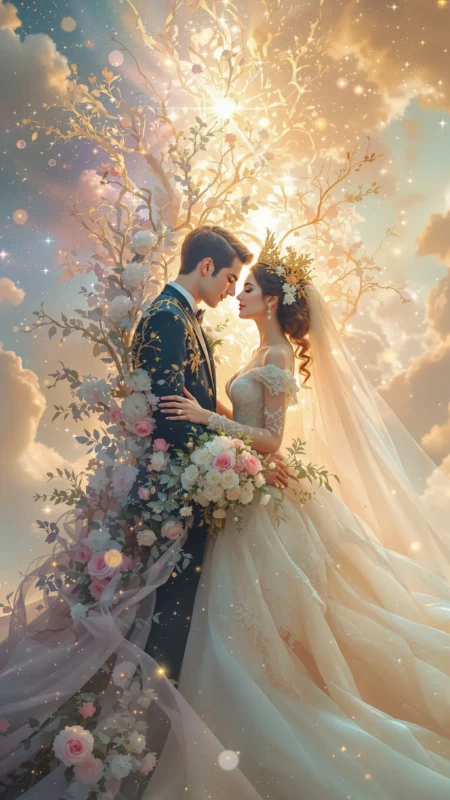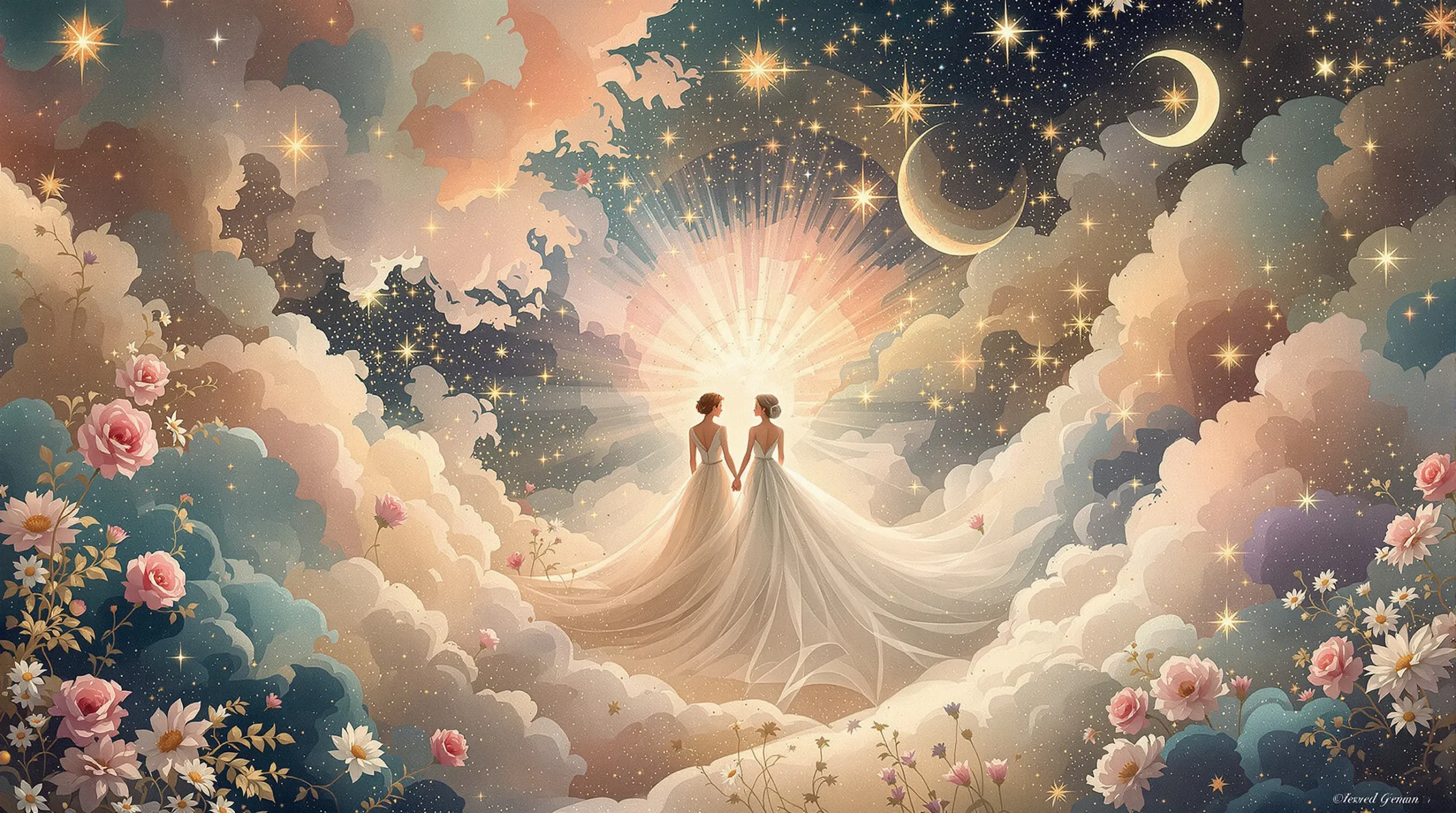


Wedding

Archetype Meaning & Symbolism

commitment, union, ceremony, transition, obligation, celebration, performance, covenant, contractual, ephemeral

  • I am the moment a private truth becomes a public spectacle, the beautiful and terrifying instant when two stories are wagered on a single, shared future.

If Wedding is part of your personal mythology, you may…

Believe

  • A promise is not truly real until it is witnessed by a community.

    The most important journey in life is the one taken toward another person.

    Two aligned souls can create a reality more powerful than any individual could achieve alone.

Fear

  • The dissolution of a sacred bond, which feels like the universe itself breaking a rule.

    Making the ultimate commitment to the wrong person, idea, or path.

    Living a life without a defining, central partnership, a story with no co-star.

Strength

  • An extraordinary capacity for loyalty, devotion, and long-term commitment.

    The ability to create harmony and synthesis between opposing people or ideas.

    A talent for ritual and celebration, for marking life’s transitions with meaning and gravity.

Weakness

  • A dependency on partnership for a sense of self or security.

    A tendency to formalize relationships prematurely or inappropriately.

    An idealism that can lead to profound disillusionment when reality fails to match the ceremonial fantasy.

The Symbolism & Meaning of Wedding

In personal mythology, the Wedding is rarely just about romance. It symbolizes the Grand Conjunction, the alchemical moment where two separate elements are irrevocably joined to create a third, entirely new substance. This could be the union of a person with their calling, an idea with its perfect expression, or the conscious mind with the depths of the unconscious. When this archetype is active in your mythos, your life may be punctuated by these moments of profound synthesis. You might find yourself drawn to partnerships of all kinds, not just romantic ones, seeing them as the primary vehicle for growth and creation. The narrative of your life isn’t a solo hero’s journey, but a series of sacred duets.

The Wedding also represents the performance of commitment. It understands that a vow whispered in secret is a different creature from one declared before a gathering. For you, a commitment may not feel entirely real until it has been witnessed, until it has been given a formal structure and a public face. This can be a source of great integrity, a way of holding yourself accountable to your highest intentions. It suggests a belief that personal truth gains its power when it is integrated into the social world, when the inner landscape is mapped onto the outer one. Your mythology might be a story of declarations, of standing before the world and stating, “This is who I am, this is what I join myself to.”

Furthermore, the archetype carries the weight of transition. It is a threshold, a doorway between one state of being and another: from single to partnered, from apprentice to master, from private citizen to public figure. This is not a gentle, gradual evolution but a sharp, ceremonial severing from the past. For a person whose mythos is informed by the Wedding, life might feel like a series of distinct chapters, each beginning with a definitive act of commitment. There may be a deep psychological need for these clear markers, these rituals that say “what came before is finished, what comes now is new.” The past is not something that fades away, it is a room you formally exit before closing and locking the door.


Wedding Relationships With Other Archetypes

The Contract:

The Contract is the Wedding’s skeletal framework, the unadorned logic beneath the lace and flowers. While the Wedding speaks of mystery, soul-union, and destiny, the Contract speaks of terms, obligations, and consequences. For a mythos guided by the Wedding, the relationship with the Contract archetype may be a source of tension. You might seek the transcendent union but recoil from the mundane practicalities that make it possible. Or, perhaps, you find beauty in the way the cold, hard lines of the Contract give structure to the wild, effusive heart of the Wedding, believing that the most profound love requires the clearest boundaries.

The Threshold:

The Wedding is a specific, highly decorated form of the Threshold archetype. While any doorway marks a passage, the Wedding is a threshold you cross with a partner, and with an audience. It isn’t a simple step from one room to another, it is a grand procession. If the Threshold is about the anxiety and potential of change, the Wedding is about formalizing that change, giving it a name and a date. In your personal story, you may feel that transitions are not to be slipped through quietly, but must be announced, celebrated, and consecrated, turning every major life change into a ceremonial event.

The Sovereign:

The Wedding can have a complex relationship with the Sovereign, the archetype of individual autonomy and rule over one’s own life. A wedding, in its essence, is the voluntary ceding of some personal sovereignty to create a new, joint entity. For someone with a strong Sovereign archetype, the Wedding might feel like a threat, an abdication of the throne of the self. Conversely, one whose mythos is shaped by the Wedding might see this act not as a loss, but as the only true way to rule: by forming a strategic, sacred alliance, creating a kingdom of two that is stronger than any kingdom of one.

Using Wedding in Every Day Life

Navigating a Business Merger:

When two companies or creative ventures decide to merge, you might invoke the Wedding archetype to navigate the process. This isn’t just a financial transaction: it’s a union of cultures, values, and histories. You could approach the negotiation not as a battle for dominance but as the crafting of vows. What core principles will this new entity publicly commit to? How will the integration be celebrated to honor both lineages and create a shared identity for all stakeholders, transforming a simple contract into a meaningful covenant?

Committing to a New Life Path:

If you are making a significant life change, such as moving to a new country, changing careers, or adopting a new philosophy, the Wedding archetype provides a framework for marking the transition. You could create a personal ceremony, a ritual to solemnize your commitment to this new self. This might involve writing a declaration of intent, gathering ‘witnesses’ who support your journey, or acquiring a symbolic object that represents the union. It’s a way of making the internal shift an external, witnessed reality, solidifying your resolve.

Healing a Divided Self:

For those feeling internally fragmented, with warring parts of their personality or conflicting desires, the Wedding offers a model for integration. You could use journaling or meditation to stage a symbolic wedding between these opposing aspects: your ambition and your need for rest, your analytical mind and your intuitive heart. What vows would they need to make to each other to coexist peacefully? This act of conscious, ceremonial union can reframe internal conflict as a dynamic partnership, fostering a new sense of wholeness.

Wedding is Known For

The Vow

This is the archetype’s spoken heart, a public performance of a private promise. It is the moment potential energy becomes kinetic, where intention is crystallized into a binding, witnessed word.

The Ceremony:

The structured ritual that contains the transformative moment. It is the stage, the script, and the audience that elevates a personal decision into a communal event, sanctioned and recorded.

The Celebration:

The communal affirmation of the union. It is the feast, the dance, the collective joy that validates the new reality and welcomes the newly formed entity into the social fabric.

How Wedding Might Affect Your Personal Mythology

How Wedding Might Affect Your Mythos

When the Wedding archetype shapes your personal mythos, your life story is likely not plotted as a solitary ascent but as a series of profound, defining unions. The major acts of your narrative are not battles won or peaks conquered alone, but covenants made and partnerships forged. Your personal history might be remembered not by years, but by the great commitments that defined each era: the ‘marriage’ to a certain city, the sacred ‘vow’ to a creative project, the deep, abiding ‘union’ with a spiritual path. Betrayal, in this mythos, is not merely being wronged, but the breaking of a sacred pact, an act of cosmic perjury.

The central quest in your story may be the search for the perfect partner, but this partner is not necessarily a romantic one. It is the other half of the whole, the missing piece that allows for true creation. Your mythos could be a telling of this search, detailing the near-misses, the flawed unions, the lessons learned in each attempt to merge. The ultimate triumph is not self-actualization in isolation, but the achievement of a syzygy, a perfect alignment with another person, idea, or destiny, which in turn unlocks your fullest potential. The story isn’t “I became,” but rather, “We became.”

How Wedding Might Affect Your Sense of Self

Your sense of self may be fundamentally dyadic. You might understand who you are primarily through your reflection in a chosen other. Identity is not a static, internal monument, but a dynamic interplay, a dance that requires a partner. This can lead to a profound capacity for empathy and compromise, a self that is flexible, relational, and adept at harmony. You might feel most yourself not when you are alone, but when you are in a state of active, committed partnership. The phrase “my other half” may feel less like a cliché and more like a simple statement of fact.

Conversely, this can also lead to a fragile or diffuse sense of self. If identity is contingent upon the union, what happens when you are alone? There may be a persistent fear of dissolution, a feeling of being incomplete or even non-existent without the defining partnership. You might struggle to make decisions or formulate opinions in a vacuum, always needing a sounding board, a co-signer. The work of self-discovery, then, is not about finding a core, singular identity, but about learning to be a good partner to yourself, to wed the disparate parts of your own psyche into a stable, internal union.

How Wedding Might Affect Your Beliefs About The World

You may perceive the world as a vast, intricate network of covenants, both seen and unseen. Society, for you, is not a collection of individuals, but a web of marriages: the marriage of citizen and state, of artist and muse, of scientist and subject. Success and failure in the world are matters of successful or failed unions. You might see conflict, from global politics to neighborhood disputes, as a form of divorce, a tragic tearing of what was meant to be joined. Your worldview is one of interdependence, where nothing and no one truly exists in isolation.

This perspective could foster a deep reverence for institutions and traditions that uphold commitments: legal systems, religious ceremonies, and social contracts. You might believe that civilization itself is a grand, ongoing wedding ceremony, a continuous effort to bind people to each other and to shared ideals. There could be a corresponding skepticism towards radical individualism, which might appear chaotic, lonely, and ultimately unsustainable. The universe, in your eyes, doesn’t favor the lone star, but the constellation, the galaxy, the beautiful and orderly dance of celestial bodies bound by invisible forces.

How Wedding Might Affect Your Relationships

In your relationships, you may gravitate towards immense depth and definition. Casual connections might feel trivial or even disingenuous, as you are always subconsciously assessing a relationship for its potential for a ‘wedding’: a moment of ultimate, formalized commitment. You might be the friend who champions loyalty above all else, who believes in pacts and promises, and who feels a friend’s betrayal as keenly as a spouse’s. You bring a ceremonial gravity to your connections, imbuing them with significance and ritual.

This can be a magnificent gift, creating relationships of incredible strength and endurance. However, it may also create pressure. You might rush relationships towards a state of formal definition, uncomfortable with ambiguity or open-endedness. The weight of the ‘forever’ implicit in the Wedding archetype can be placed on connections that are not built to bear it. There could be a tendency to see relationships in black and white: either they are on the path to union, or they are a waste of time. This can prevent you from enjoying the fluid, undefined beauty of more temporary or circumstantial connections.

How Wedding Might Affect Your Role in Life

You may feel your role in life is that of a Uniter or a Celebrant. You might be the person who brings disparate people together, who forges alliances within families, workplaces, or communities. Your purpose could feel tied to the creation and maintenance of bonds. You might be a natural mediator, a host, a matchmaker, or a community organizer, instinctively understanding that the whole is greater than the sum of its parts and seeing it as your job to perform the sacred addition.

Alternatively, your role might be that of the Witness. You may be called to observe, validate, and uphold the commitments of others. People might seek you out to share their most important decisions, not for advice, but for the quiet, solemn power of your attention. In this role, you become a keeper of stories, a living archive of the vows and pacts that structure your community. You provide the crucial element of the audience, without which the Wedding ceremony would be merely a private conversation. Your presence makes the promise real.

Dream Interpretation of Wedding

In a positive context, dreaming of a wedding could symbolize a powerful act of integration within your own psyche. You may be successfully uniting conflicting parts of yourself: your creative impulses with your practical needs, your past with your present, your masculine and feminine energies. The dream is a celebration of this newfound inner harmony. If you are marrying a stranger, that person might represent a hidden aspect of yourself that you are now ready to embrace and commit to. The joyous atmosphere of the dream wedding reflects a deep sense of rightness and impending wholeness in your waking life.

In a negative context, a wedding in a dream can signal a forced or unwanted union. You might feel pressured by external forces or internal anxieties to make a commitment that violates your true self. A dream where you are late to your own wedding, have lost the ring, or do not know the groom could point to a profound ambivalence or fear about a path you are on. It may also symbolize a loss of individuality, a fear that a relationship or a new role is demanding you sacrifice an essential part of who you are. The dream is a warning from your subconscious: this merger is not a holy union, but a hostile takeover.

How Wedding Archetype Might Affect Your Needs

How Wedding Might Affect Your Physiological Needs

The Wedding archetype could link your most basic physiological needs—food, water, shelter, sleep—to a state of partnership. You might feel a deep, almost cellular belief that survival is a team sport. This could manifest as a literal inability to cook or eat properly when alone, or a sense of physical unease sleeping in a bed by yourself. Your body may interpret solitude as a state of emergency, a famine or a threat, only returning to a state of homeostasis and proper functioning when in the presence of a committed partner. Sustenance, for you, is not just about nutrients, but about the act of sharing.

This profound connection between partnership and physical well-being can be a powerful motivator for creating stable bonds. However, it can also create a dangerous dependency. Your body’s stress response could be perpetually activated during periods of solitude or relational conflict, potentially leading to physical ailments. The mythos tells your body that two are required for survival, which means the absence of the other can register as a direct threat to life itself. Learning to self-soothe and to convince your own nervous system that you are safe and complete on your own becomes a critical physiological task.

How Wedding Might Affect Your Ideas of Belonging

The Wedding archetype may concentrate your need for love and belonging into the single, intense focal point of the dyad. For you, true belonging is found in the exclusive, sacred space created by a committed couple. This is the primary team, the core unit, the place you are known and accepted. This can foster a love of extraordinary depth and intimacy, a feeling of having found your one true place in the universe. Your partner is not just a lover, but your family, your community, and your country, all in one.

However, this intense focus can also lead to isolation. You might neglect wider friendships and community ties, pouring all of your relational energy into the central partnership. The ‘we’ of the couple can become so powerful that it eclipses the individual ‘I’ and the communal ‘us’. If the primary relationship falters, it can trigger a catastrophic crisis of belonging, as there is no broader network to catch you. You may feel like an exile, cast out not just from a relationship, but from the only place you ever truly belonged.

How Wedding Might Affect Your Feelings of Safety

Your need for safety and security may be entirely woven into the fabric of formal, recognized union. You might feel that true safety is a house built for two, a fortress of commitment with the world held at bay. A legal document, a public ceremony, a shared name—these are not just romantic trifles, they are the very walls and ramparts that protect you from the chaos of life. Safety is not a feeling you can generate on your own; it is something conferred upon you by a stable, recognized partnership.

This can lead you to build incredibly secure and resilient domestic worlds. But the shadow of this is a pervasive fear of instability and dissolution. The prospect of a breakup or divorce might feel like more than just emotional heartbreak; it could feel like total annihilation, the crumbling of your only shelter. You may prioritize the security of the union above personal happiness or authenticity, staying in a partnership that no longer serves you because the alternative feels like facing a blizzard without a coat. Your quest for safety may inadvertently lead you to build a beautiful, secure cage.

How Wedding Might Affect Your Views of Esteem

Your self-esteem could be deeply connected to the concept of being ‘chosen’. The Wedding is the ultimate ritual of selection, a public declaration that you are wanted, valued, and worthy of lifelong commitment. Your sense of worth may not be something you can easily generate from within, but rather something that is activated or validated when reflected in the eyes of a committed partner. The act of being chosen for the sacred union is what makes you feel valuable.

This can be a source of great joy and confidence within a stable partnership. But it also makes your self-esteem dangerously contingent on external validation. You may live with a persistent, low-grade fear of being ‘unchosen’, and the experience of a rejection or breakup could be utterly devastating to your sense of self-worth. It wouldn’t just be the loss of a person, but the loss of your status as ‘the chosen one’, which can feel like a fundamental invalidation of your entire being. The journey, for you, is to learn how to choose yourself with the same solemnity and celebration with which you would wish to be chosen by another.

Shadow of Wedding

The shadow of the Wedding archetype emerges when the ceremony eclipses the substance, when the performance of union becomes more important than the union itself. This can lead to a life of performative commitments, relationships maintained for the sake of appearance, for the social validation they provide. It is the hollow marriage, the business partnership that is rotten at the core but maintains a glossy public facade. In this shadow expression, you might become obsessed with the aesthetics of commitment—the ring, the title, the anniversary party—while neglecting the daily, unglamorous work of actual connection. The vow becomes a script you recite, not a truth you live.

Another shadow aspect is the terror of being the unchosen one, which can curdle into a desperate need to secure a partner at any cost. This fear can drive you into ill-advised unions, forcing a connection where none exists, projecting the entire Wedding fantasy onto an unwilling or unsuitable other. It can also manifest as possessiveness and control within a relationship, a frantic attempt to lock down the commitment and prevent the partner from ‘escaping’. Here, the sacred bond becomes a gilded cage, and the desire for union transforms into a demand for ownership, a tragic misunderstanding of the archetype’s collaborative soul.

Pros & Cons of Wedding in Your Mythology

Pros

  • You are capable of building relationships of profound depth, stability, and enduring loyalty.

    You possess a natural gift for creating meaning, ritual, and celebration around life’s most important moments.

    Your belief in the power of partnership allows you to forge powerful alliances and achieve collaborative successes others cannot.

Cons

  • Your self-worth and security may be overly dependent on your relationship status.

    You may struggle with ambiguity, forcing connections into formal boxes where they might not belong.

    The ideal of the perfect union can set you up for disappointment and make it difficult to appreciate the imperfect beauty of real-world relationships.