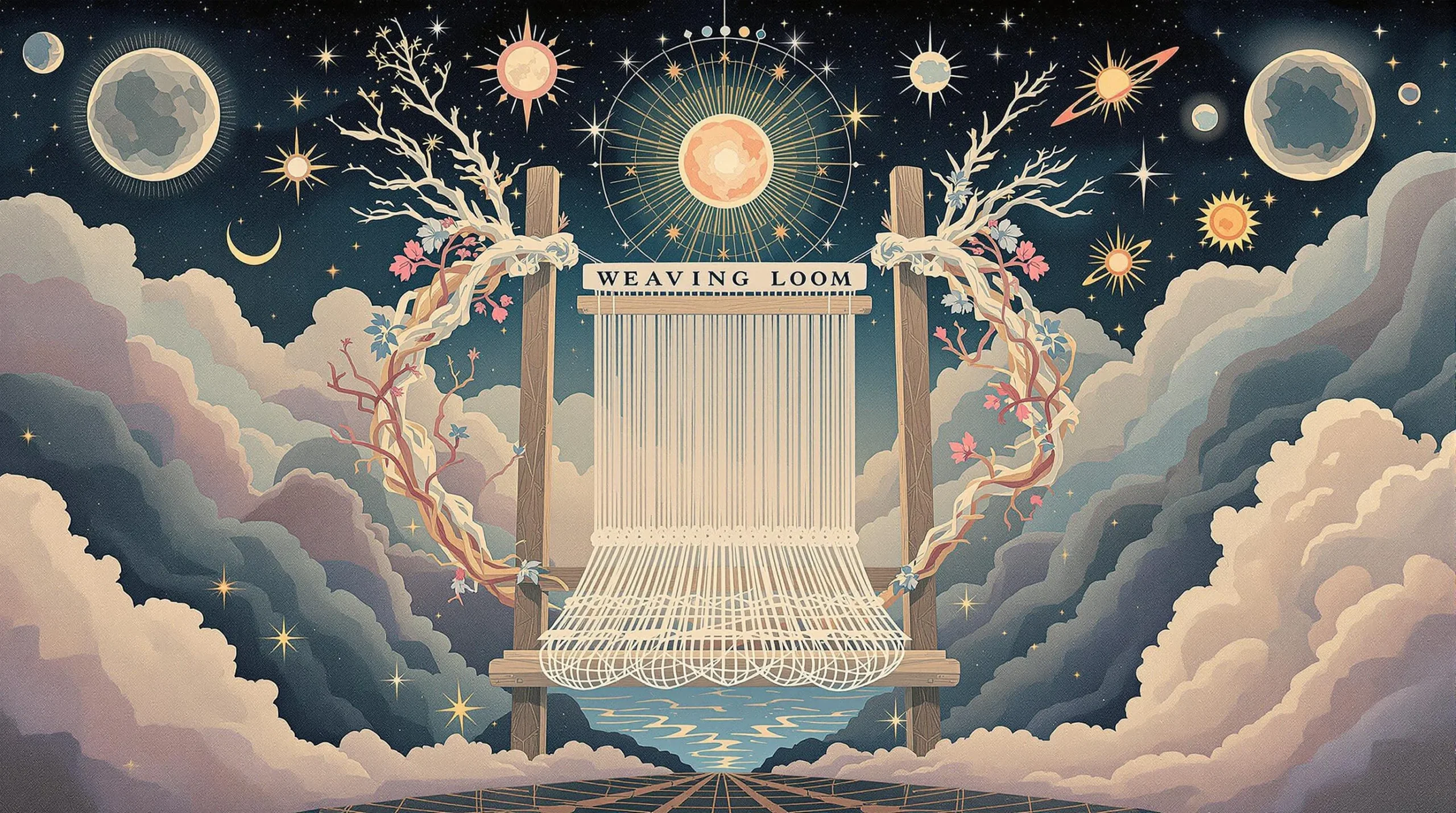


Weaving Loom

Archetype Meaning & Symbolism

Interconnected, patient, creative, complex, structural, rhythmic, meticulous, fated, deliberate, entangling

  • Each thread believes it travels a straight line, yet together they create a world.

If Weaving Loom is part of your personal mythology, you may...

Believe

  • You may believe that every event and every person in your life is part of a larger, interconnected pattern, even if the design is not yet clear.

    You may believe that true, lasting creation is almost always a slow, patient, and methodical process, and that there are no shortcuts to quality.

    You may believe that you possess the power to shape your life story, but that this agency must be exercised within the unchangeable constraints of reality.

Fear

  • You may fear the sudden, catastrophic tear: a loss, betrayal, or chaotic event that unravels years of your careful work in an instant.

    You may fear discovering a fundamental flaw woven deep into the fabric of your life—a toxic relationship, a misguided career choice—that is too late to correct without destroying the whole piece.

    You may fear running out of thread before the design is complete: a terror of depleting your time, energy, health, or resources before you have finished your life's work.

Strength

  • You likely possess an extraordinary capacity for patience and long-term vision, allowing you to dedicate yourself to complex projects that would overwhelm or bore others.

    You may have a rare talent for synthesis, an ability to see the hidden connections between disparate ideas, people, or events and integrate them into a coherent, meaningful whole.

    You probably have a methodical and disciplined mind, capable of breaking down dauntingly complex problems into a sequence of manageable steps.

Weakness

  • You may suffer from a debilitating rigidity, an inability to improvise or deviate from your plan when faced with unexpected circumstances.

    You may have a tendency toward emotional detachment, viewing people and relationships as components in a system rather than as unique, unpredictable beings in their own right.

    You might become so entangled in the intricate details and causal chains of a situation that you fall into analysis paralysis, unable to make a simple decision.

The Symbolism & Meaning of Weaving Loom

In personal mythology, the Weaving Loom may stand as the central metaphor for narrative construction. Life is not a series of disconnected events but a textile you are actively creating. You select the threads of memory, relationship, and belief, and through the rhythmic shuttle of choice and action, you weave them into the story of who you are. The loom reminds you that you are the artisan of your own existence, that the texture of your life is the direct result of the materials you chose and the skill with which you combined them. It suggests a world where meaning is not found, but meticulously made.

The loom is also a potent symbol of interconnectedness and consequence. Each warp thread held in tension represents a constant: your past, your genetics, the unchangeable facts of your life. The weft thread, which you guide, is your free will, your response to those constants. A single pull, a single choice, sends reverberations across the entire cloth. This perspective fosters a profound awareness of causality. A kindness done today may become a vibrant fleck of color years down the line; a past trauma may be a dark, structural thread that the entire pattern must accommodate.

Furthermore, the Weaving Loom embodies the elegant tension between destiny and agency. The very structure of the loom, its physical limitations, represents the constraints of fate, society, or reality. You cannot weave a cloth wider than the loom itself. Yet, within that structure, the choice of color, pattern, and texture is entirely yours. This archetype suggests that freedom is not the absence of limits but the creative mastery of working within them. Your mythos becomes a story of ingenious artistry within a given framework, a dance between the possible and the pre-ordained.


Weaving Loom Relationships With Other Archetypes

The Spinner

The Spinner and the Weaving Loom exist in a necessary, symbiotic sequence. The Spinner archetype is the keeper of raw potential: it takes the raw fleece of experience, chaos, and pure feeling and twists it into a coherent thread. But a thread, no matter how strong, is just a line. The Weaving Loom takes these individuated threads from the Spinner and gives them a collective purpose and a structural reality. If your mythos contains a strong Spinner, you may be brilliant at generating ideas or processing emotions into insights. But without the Weaving Loom, these insights remain isolated. The Loom provides the framework to integrate them into a larger, functional understanding of your life, turning individual potentials into a tangible, unified whole.

The Scissors

The Scissors represent the archetype of endings, severance, and finality, and its relationship with the Weaving Loom is one of terrifying necessity. The weaver works tirelessly to create a perfect, continuous cloth, yet the work is meaningless until The Scissors arrive to cut it free. This archetype might manifest as the force that ends a relationship, a job, or a phase of life, releasing you from the structure you have so carefully built. This act can feel violent and destructive, an undoing of careful work. Yet, it is also the act of completion. Without The Scissors, the tapestry remains forever attached to the machine, a work-in-progress with no utility. The relationship speaks to the truth that for any creation to have a life of its own, it must be severed from its creator.

The Storyteller

After the Loom has integrated the threads and the Scissors have cut the cloth free, The Storyteller archetype arrives to give it meaning. The Weaving Loom creates the silent artifact: the patterned fabric of a life lived. The Storyteller takes this fabric and translates its visual language into spoken narrative. It points to the dark thread of loss and explains how it makes the gold thread of triumph shine brighter. It traces the recurring motif of a personal flaw and narrates the struggle it represents. The Loom builds the complex, non-linear reality; The Storyteller edits and organizes it into a linear, comprehensible tale. Your personal mythos requires both: the living of the interconnected life and the subsequent act of making sense of it.

Using Weaving Loom in Every Day Life

Navigating Career Transitions

When faced with a career change, the Weaving Loom archetype allows you to see the disparate threads of your past experiences: the forgotten skill from a college job, the passion project from a decade ago, the wisdom gained from a professional failure. The loom provides a framework to intentionally weave these threads together, not as a random collection of jobs, but as a coherent tapestry that reveals a new professional identity, one that was being patterned all along.

Healing from Grief

The loom does not suggest removing the thread of loss. Instead, it offers a way to integrate it. Grief may be a thick, black thread, a stark line that seems to ruin the design. Working with the loom archetype might mean consciously choosing the colors and textures that will surround this dark thread, making it not an absence but a defining element of contrast that gives the brighter colors of joy and memory a new and profound depth. The tapestry becomes richer, truer, for its inclusion.

Overcoming Creative Block

When inspiration feels absent, the loom archetype suggests a return to structure and rhythm. It is not about waiting for a flash of genius. It is about sitting down at the loom, so to speak, and performing the simple, mechanical act of passing one thread through. This could mean committing to writing one sentence, drawing one line, or solving one small part of a problem. The rhythmic, repetitive action can quiet the anxious mind and allow the larger pattern to begin re-emerging, one deliberate movement at a time.

Weaving Loom is Known For

Creating Fabric

Its fundamental purpose: the transformation of individual, often fragile threads into a strong, unified, and functional whole. It turns chaos into order, potential into substance.

Symbolizing Fate:

Its deep mythological connection to deities like the Greek Moirai or the Norse Norns, who weave the destinies of gods and mortals, making the loom an object tied to the very structure of time and causality.

Generating Pattern:

Its ability to produce intricate, repeating designs through a logical, mechanical process. This represents the recurring themes, cycles, and underlying mathematical beauty in life and the cosmos.

How Weaving Loom Might Affect Your Personal Mythology

How Weaving Loom Might Affect Your Mythos

When the Weaving Loom is a cornerstone of your personal mythos, your life story ceases to be a linear path and transforms into a complex, ever-expanding tapestry. Events are no longer seen as sequential but as interconnected. A childhood fascination with maps, a seemingly random conversation with a stranger, a professional failure: these are not disparate points on a timeline but threads that cross and re-cross, creating the unique pattern of your existence. Your narrative may be filled with moments of seeing the whole cloth, of realizing how a decision made a decade ago was essential for the triumph of today. This perspective lends your mythos a sense of profound, intricate design, as if your life were a novel where every detail, no matter how small, was placed with deliberate intent.

This archetype also shapes your mythos into a story of active creation. You are not a hero at the mercy of fate; you are the artisan of your fate. Your personal myth is the story of your great work, the magnum opus of your life's weaving. Challenges are not obstacles but creative problems to be solved with the materials at hand. A period of scarcity might mean weaving with plainer, rougher threads, but the act of weaving continues. This instills the narrative with a sense of agency and resilience. The core drama of your mythos is not whether you will win or lose, but what kind of tapestry you will choose to create with the threads you have been given.

How Weaving Loom Might Affect Your Sense of Self

A self-concept informed by the Weaving Loom may be one of patient, methodical power. You might see yourself as a creator, a builder, someone whose worth is tied to the slow, deliberate accumulation of skill and effort. There may be a quiet pride in your own process, a deep satisfaction in the rhythmic work of building a life, a career, or a body of knowledge. This view of self is less concerned with flashes of inspiration or sudden success and more grounded in the integrity of the work itself. You may identify as a systems-builder, an integrator, someone who finds their essence in the act of bringing order and beauty to disparate elements.

Conversely, this archetype could foster a view of the self as being defined, or even confined, by the patterns you have already woven. You may look at your life and see the choices of your younger self as binding precedents, threads that dictate the course of the entire remaining pattern. This can lead to a sense of being trapped in a role or identity of your own making, a feeling that your own past creations limit your future freedom. The self can feel like a component part of a machine, subject to the tensions and structures it has built, leading to a struggle between honoring past work and the need for radical change.

How Weaving Loom Might Affect Your Beliefs About The World

Your perception of the world may be filtered through a lens of profound interconnectedness. History, politics, ecology, and social dynamics appear not as separate fields but as a single, impossibly vast tapestry. A political decision in one country is a thread that pulls on the economic fabric of another; a technological innovation sends ripples that change the pattern of daily human interaction. This worldview fosters a holistic, systems-thinking approach. It could lead to a deep empathy born from the understanding that no individual acts in a vacuum and that the structure of our collective lives is woven from the choices of billions.

This perspective may also cultivate a belief in an emergent, almost mechanical, form of destiny. Not a fate dictated by a deity, but a causality so complex and interwoven that it becomes predictable at a macro scale. The world operates according to a certain logic, a set of structural rules inherent in the loom of reality. Success and survival in such a world are not about breaking the rules but about understanding the loom's mechanics so well that you can weave creatively within them. The universe is not random; it is an intricate machine for producing patterns, and wisdom lies in learning to work with its rhythm.

How Weaving Loom Might Affect Your Relationships

Relationships, through the lens of the Weaving Loom, are seen as the conscious and collaborative creation of a shared fabric. A partnership is not something you find; it is something you build, one thread at a time. Each person brings their own history, their own colors, their own textures. The relationship's health depends on the rhythmic give-and-take, the willingness to adjust to the other's thread, to create a pattern that honors both individuals while creating a new, unified whole. Conflicts are snags in the weave, moments that require both partners to stop, assess the pattern, and work together to repair the tear before it compromises the entire cloth.

This archetype may also introduce the risk of viewing others instrumentally. A person might be seen primarily as a thread to be used in one's own grand tapestry: 'This person provides stability,' 'this one provides excitement.' While this can foster an appreciation for what others contribute, its shadow is a utilitarian approach to love and friendship. The challenge is to recognize that every other person is also a weaver at their own loom, creating their own tapestry. True connection happens not when you use their thread, but when your two actively weaving tapestries intersect, overlap, and create a beautiful, complex pattern in the space between.

How Weaving Loom Might Affect Your Role in Life

You might naturally assume the role of the integrator, the quiet force who ties everything together. In a company, you may not be the star innovator, but you are the project manager who ensures all the brilliant, disparate parts coalesce into a finished product. In a family, you are the keeper of the histories, the one who organizes the gatherings, the central hub that maintains the integrity of the familial web. Your perceived purpose is to create coherence. You find your calling in taking the threads of other people's talents, ideas, and energies and weaving them into something stronger and more beautiful than they could be alone.

Another potential role is that of the life-cartographer or personal historian. You feel a deep need to understand the pattern of your own existence. This may manifest as a meticulous journaler, a genealogist, or simply a highly reflective individual who constantly traces the threads of causality in their life. Your role, as you see it, is to interpret the tapestry for yourself and others. You explain why the dark times were necessary, how an apparent detour was actually a crucial part of the design, and how the entire piece tells a meaningful story. You are the custodian of the pattern.

Dream Interpretation of Weaving Loom

In a positive dream context, seeing a Weaving Loom that is operating smoothly, with vibrant threads creating a beautiful pattern, may be a powerful symbol of integration and mastery. This dream could suggest that you are successfully harmonizing the different domains of your life: your work, your relationships, your inner world. It can be an affirmation from your subconscious that your current efforts are fruitful and that you are skillfully manifesting your intentions. The dream may leave you with a feeling of competence and creative power, a sense that you are in control of the design of your life.

In a negative context, a dream of a Weaving Loom that is broken, tangled, or has snarled threads can be deeply unsettling. It might point to a feeling of being overwhelmed by the complexity of your life, where your obligations and problems are knotted together in an intractable mess. The shuttle may be stuck, symbolizing a creative or professional block. The threads may be snapping, representing relationships or plans that are falling apart under strain. Such a dream may be a potent warning that your current approach is not working and that you must stop, simplify, and patiently untangle the threads before you can proceed.

How Weaving Loom Archetype Might Affect Your Needs

How Weaving Loom Might Affect Your Physiological Needs

Physiological needs for shelter, food, and rest may be met with the same methodical forethought one uses to set up a loom. Before the creative weaving can begin, the structural warp threads must be securely in place. This translates to a life where foundational security is paramount. You might build your life around a stable career, meticulous financial planning, and a well-ordered home environment. These are not just comforts; they are the non-negotiable framework that makes all other, more ambitious, life-weaving possible. The body's basic needs are the anchor points of the entire tapestry.

There may also be a deep physiological attunement to rhythm. The steady, repetitive clatter of the shuttle and heddles on a loom finds its echo in a life structured by consistent routines. Regular sleep cycles, planned mealtimes, and scheduled exercise are not seen as restrictive but as the grounding beat that conserves energy and allows for sustained, complex work. Disruption to this rhythm can feel physically jarring, throwing the entire system out of balance. Your body is the loom itself, and it functions best when its operations are predictable and harmonious.

How Weaving Loom Might Affect Your Ideas of Belonging

Belongingness and love are not seen as passive states but as active, creative processes. To belong is to intentionally weave your life-thread into the fabric of a family, a community, or a partnership. It requires patience, skill, and a willingness to adjust your own pattern to accommodate others. You may show love by creating shared traditions, by maintaining lines of communication, by being the one who remembers the connections that bind the group together. Love is the act of co-weaving a shared life, creating a pattern that is unique to the people involved.

This need for belonging may also manifest as a desire to locate oneself within a larger historical or cultural tapestry. A sense of connection may come from understanding your place in a long line of ancestors, or from feeling part of a social movement or artistic tradition that stretches back for generations. You find your tribe by recognizing your thread's color and texture in the great cloth of human history. Belonging is not just about present company; it is about finding your context in the grand, ongoing story.

How Weaving Loom Might Affect Your Feelings of Safety

Safety needs are likely met through the meticulous construction of a predictable and well-ordered world. The Weaving Loom archetype fosters a desire for security that is built, not hoped for. This translates into a life fortified by insurance policies, emergency funds, contingency plans, and clear personal boundaries. Safety is found in the integrity of the structure. You may feel most secure when you can see the logical connections between your actions and your long-term stability, when you feel that you have woven a safety net for yourself, thread by careful thread.

A threat to safety, then, is not just a danger but a violation of the established pattern, a tear in the fabric of reality. A sudden job loss, an unexpected illness, or a betrayal can feel catastrophic, as it proves the structure is not as secure as you believed. The response may be an intense, almost frantic, effort to re-weave the damaged section, to patch the hole and restore the sense of order. There may be a deep fear of chaos, of randomness, of any force that can unravel the carefully woven protections you have put in place.

How Weaving Loom Might Affect Your Views of Esteem

Esteem needs may be satisfied by the tangible results of your labor: the finished tapestry. Respect from others and self-respect are earned through demonstrated competence and the creation of something of value, beauty, and complexity. A completed project, a successful business, a well-raised family—these are the artifacts that prove your worth. Your self-esteem is built on the evidence of your mastery, on the objective quality of the fabric you have woven with your life.

Alternatively, or perhaps additionally, esteem is derived not just from the product but from the process. Deep self-worth can be found in the discipline, focus, and skill required to operate the loom of your life. The ability to hold a complex pattern in your mind, to work patiently through challenges, to maintain rhythm and precision over a long period—these capacities themselves are a source of profound pride. Your esteem is rooted in the knowledge that you are a master of your craft, regardless of the recognition your creations receive.

Shadow of Weaving Loom

The shadow of the Weaving Loom manifests as a cold, calculating puppet master. The weaver ceases to be an artist and becomes a manipulator. Other people are no longer fellow weavers but are demoted to the status of threads, raw material to be arranged to serve the weaver's self-serving pattern. Relationships become transactional, conversations are gambits, and life is a grand strategy of control. This shadow weaver seeks absolute power over their narrative and the narratives of others, reacting with cold fury or subtle sabotage when a 'thread'—a person with free will—refuses to lie flat or stay in its assigned place in the design.

Another shadow emerges as a prison of one's own making. The weaver becomes so identified with and invested in their creation—the career, the family, the identity they have so painstakingly built—that they become completely entangled within it. The fear of unraveling even one thread, of admitting a mistake or desiring a change, is so great that they choose stasis over growth. The beautiful, orderly tapestry becomes a gilded cage. Life loses its vitality and becomes the joyless, mechanical reproduction of the same row, over and over, in a pattern that has become a monument to past choices rather than a living creation.

Pros & Cons of Weaving Loom in Your Mythology

Pros

  • You possess a powerful ability to create order, meaning, and beauty from the chaotic threads of experience, building stable and coherent structures in your life.

    You have a deep appreciation for process and causality, allowing you to learn from the past and plan effectively for a future of your own design.

    You are a natural synthesizer, capable of seeing the big picture and bringing together diverse people and ideas to create something far greater than the sum of its parts.

Cons

  • You can be rigid and struggle with spontaneity, finding it deeply unsettling when unexpected events disrupt your carefully woven plans.

    There is a significant risk of becoming overly controlling or emotionally detached, viewing the world and its inhabitants as a system to be managed for your own ends.

    You may become trapped by your own past successes and choices, so invested in the existing pattern that you resist necessary change and growth, leading to stagnation.