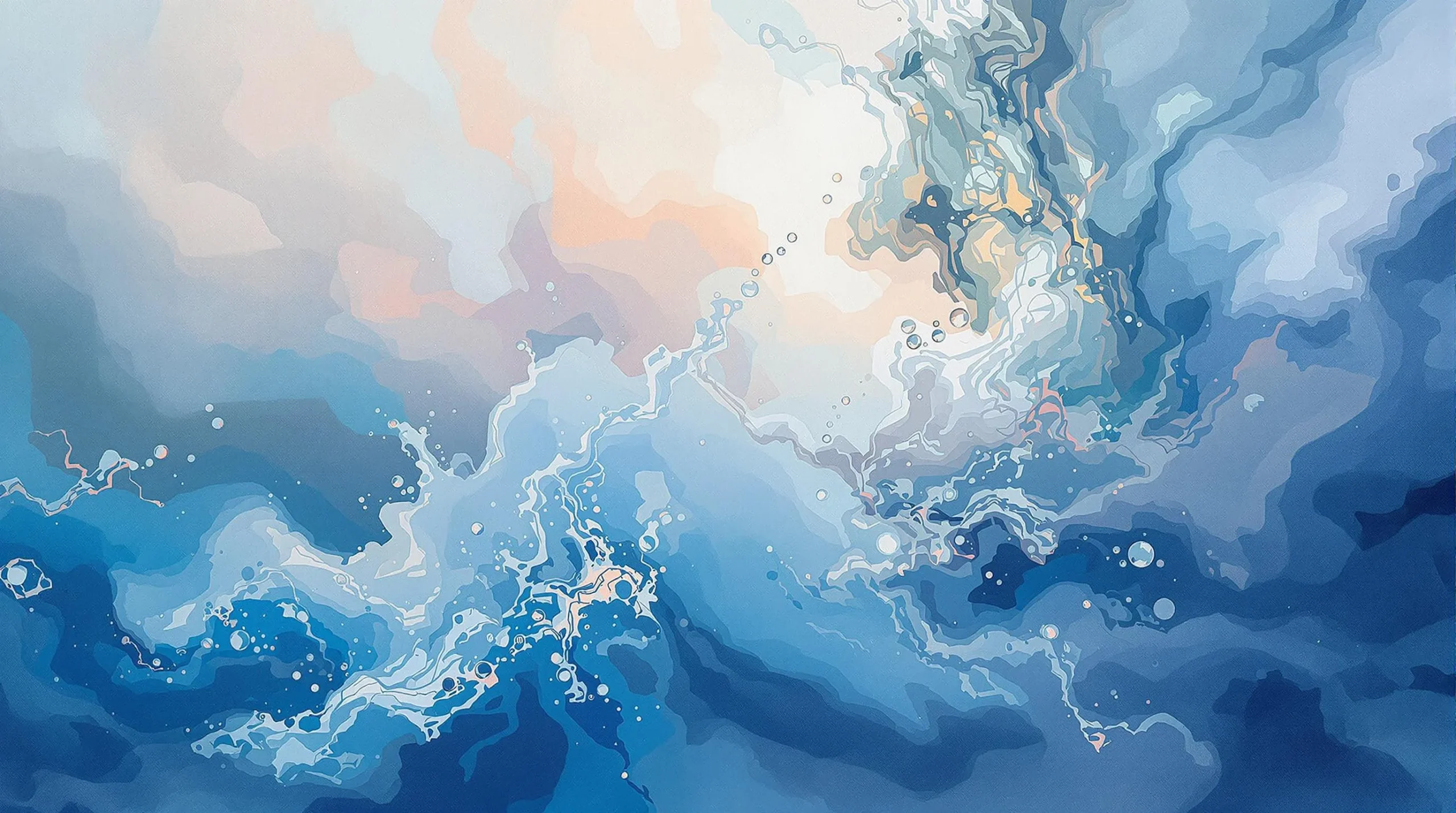


Water

Archetype Meaning & Symbolism

fluid, deep, reflective, cleansing, overwhelming, mutable, yielding, powerful, cyclical, transparent

  • Do not resist the shape of the container; become the container itself, and you will know limitlessness.

If Water is part of your personal mythology, you may...

Believe

  • You may believe that surrender is not weakness, but the highest form of wisdom and strength.
  • You may believe that emotions are not problems to be solved or symptoms to be managed, but vital intelligence from the soul.
  • You may believe that all things are porous and interconnected, and that the separation between self and other is largely an illusion.

Fear

  • You may fear stagnation: becoming a fetid, motionless pond, cut off from the flow of life.
  • You may fear dissolution: losing your identity completely in the feelings of others, in a relationship, or in a collective cause.
  • You may fear the abyss: the terrifying, unknown, and potentially monstrous depths of your own unconscious.

Strength

  • Empathy: Your ability to feel and understand the emotional state of others is not just a skill but an innate way of being, creating profound connections.
  • Adaptability: You possess a profound capacity to change your approach, shape, and form to fit any new circumstance, making you incredibly resilient.
  • Intuition: You have access to a deep well of non-linear, non-rational knowing that allows you to perceive the truth of a situation beyond the surface facts.

Weakness

  • Impressionability: Your porous nature can make you highly susceptible to the emotional climate and opinions of others, leading to a weak sense of self.
  • Formlessness: You may struggle to create and maintain firm boundaries, concrete plans, and a stable identity, which can be perceived as passivity or indecisiveness.
  • Emotional Volatility: When your inner waters are stirred, you can be prone to overwhelming emotional states, from melancholic depressions to dramatic tempests.

The Symbolism & Meaning of Water

In the personal mythos, Water could represent the vast, often unnavigable, territory of the unconscious mind. It is the stuff of dreams, the deep well of intuition, the ocean from which all creative impulses are born. To have Water as a central element in your story is to be on intimate terms with what lies beneath the sunlit surface of rational thought. Your life may not be a linear path across solid ground but a voyage across, or through, this inner sea. You might understand that the most significant events are not the visible achievements, but the silent, seismic shifts in the deep, the moments when you learn to breathe underwater.

The symbolism of Water is profoundly tied to emotion. It is the tears of sorrow and of joy, the sweat of effort, the blood of lineage. Where some archetypes intellectualize or act, the Water archetype feels. This is not the ephemeral weather of mood, but the deep climate of the soul. Your personal mythology might be a chronicle of emotional transformations: the flash flood of first love, the long drought of grief, the slow melt of forgiveness. You may see feelings not as inconvenient interruptions to life, but as life itself, the very medium through which your story unfolds and gains its meaning.

Furthermore, Water symbolizes a radical acceptance of formlessness and change. It is the ultimate adaptable entity, taking the shape of whatever contains it, from a teacup to a canyon. A mythos informed by Water may eschew the pursuit of a fixed identity. Your narrative might be one of serial selves, of fluidly shifting roles and beliefs, all held together not by a rigid spine of dogma, but by a consistent current of being. You may find power not in resistance, but in yielding, understanding that the softest thing in the world can, over time, wear away the hardest.


Water Relationships With Other Archetypes

The Earth Archetype

Earth is the vessel to Water's essence. A river needs its banks; an ocean, its floor. In a personal mythology, this relationship speaks to the necessary partnership between emotion and structure. Without the grounding influence of Earth, the Water individual may become a boundless, chaotic flood, emotionally overwhelming themselves and others. Without the life-giving flow of Water, the Earth individual can become parched, rigid, and infertile. Their dynamic is the dance of feeling and form. The river carving the canyon is a perfect metaphor: emotion and intuition (Water) shaping the very structure of one's life (Earth) over time.

The Fire Archetype

Fire and Water are the primal opposites, their meeting a dramatic event of steam and sizzle. Fire is passion, will, and explosive action; Water is intuition, being, and gradual absorption. In a mythos, their relationship could be one of conflict or of powerful synthesis. An excess of Fire may boil away Water's emotional depth into reactive steam. An excess of Water may quench Fire's vital spark, leading to passivity. But when balanced, they create something new. Think of a hot spring: a place where the earth's inner fire warms the healing waters. This could symbolize a person who marries deep empathy with passionate conviction, a truly formidable and generative combination.

The Air Archetype

Air is intellect, communication, and the world of abstract ideas. Water is feeling, empathy, and the world of lived experience. Their relationship can be seen in the sky reflected on a still lake: a perfect, albeit illusory, union of thought and feeling. Air creates the waves on Water's surface, just as a cutting remark can disturb emotional tranquility. Water, as vapor, rises into the Air, becoming clouds that carry moisture and potential. A person with this archetypal pairing might be a poet who can give language to the ineffable, or a therapist who can articulate the complex currents of the human psyche. The danger lies in a disconnect: the intellect of Air hovering above the emotional depths of Water, unable to truly connect, resulting in a state of alienated observation.

Using Water in Every Day Life

Navigating Interpersonal Conflict

When faced with a rigid argument or an immovable opinion, you may invoke Water not to batter it down, but to flow around it. Instead of meeting force with force, you might yield, listen, and absorb the other's perspective. This does not mean agreement, but rather a strategic dissolution of tension. Water finds the cracks in any structure. By remaining fluid, you may discover the unspoken vulnerability or the hidden point of entry in a conversation that allows for a gentle, yet inexorable, shift toward understanding.

Overcoming Creative Stagnation

A creative block can feel like a dam. The Water archetype suggests that the solution is not always to force the dam open, but to allow the reservoir behind it to rise. This could mean stepping away from the project and immersing yourself in new emotional or sensory experiences: visiting a museum, listening to a new genre of music, walking by the sea. It is about replenishing the inner wellspring, trusting that when the water level is high enough, it will find its own new, surprising channels to flow through, spilling over the old obstruction in an unexpected way.

Processing Grief or Trauma

Water teaches that emotion must move. To embody this in times of sorrow is to permit the storm: to allow for tears, for periods of deep quiet, for the unpredictable tides of feeling. Instead of building levees of distraction or denial, you might create a safe vessel for your grief to exist within, like a sacred lake. This approach honors the cleansing power of emotional release, trusting that the murky waters of pain, if allowed to flow, will eventually run clear, depositing fertile silt on the banks of your new landscape.

Water is Known For

The Cycle

Water is known for its perpetual journey: from ocean to vapor to cloud to rain, feeding the river that returns to the ocean. This may symbolize a deep, personal understanding of life, death, and rebirth, not as finalities, but as transformative states within a single, continuous process.

Universal Solvency

Water has the ability to dissolve other substances, to break them down to their constituent parts. This can represent a capacity for analysis that is not sharp and cutting, but gentle and immersive. It is the power to break down rigid ideologies, integrate disparate ideas, or cleanse old psychic wounds by subsuming them.

Reflectivity

A still surface of water mirrors the sky, the trees, the face of the one who gazes into it. This points to a capacity for profound introspection and self-awareness. It also suggests a way of being in the world that is about reflection rather than projection, a quiet mirroring of the truth of a situation or the soul of another.

How Water Might Affect Your Personal Mythology

How Water Might Affect Your Mythos

If Water is a core element of your personal mythos, your life story may not read like a hero's journey toward a single treasure, but more like a long, meandering river's journey to the sea. The narrative would prioritize process over destination. The key moments of transformation might not be battles won, but dams breaking, droughts ending, or learning to navigate treacherous rapids. Your mythos may be less about what you built and more about what you allowed to flow through you. The central theme could be one of surrender, of learning that true power lies in aligning with a current larger than your individual will, even if you cannot see where it leads.

The characters in your mythos, including yourself, may be defined by their emotional depth and transparency. Villains may not be those who are overtly evil, but those who are stagnant, polluted, or who attempt to dam the natural flow of life for their own gain. Heroes might be those who cleanse, who connect, who dive deep for hidden truths. Your personal narrative might be filled with symbolism of wells, rain, oceans, and tears. The ultimate victory in your story might not be a throne or a crown, but the wisdom of the ocean: a state of being that contains all storms and all calms within a vast, abiding peace.

How Water Might Affect Your Sense of Self

Your sense of self may be unusually fluid and mutable. You might not identify strongly with a job title, a social role, or even a consistent personality. Instead, you could perceive your 'self' as a process, a current of awareness and feeling that is constantly shifting and adapting. This can be liberating, freeing you from the pressure of maintaining a rigid persona. You might feel a deep, quiet confidence that comes from this lack of a fixed center, knowing that you can absorb life's changes without breaking. The self is not a statue to be carved and perfected, but a body of water to be experienced.

This fluidity, however, may also be a source of anxiety. At times, you could feel formless, undefined, and painfully impressionable, too easily taking on the emotional color of your environment or the people around you. The challenge for your sense of self is to be the river, not the puddle. The river has direction and banks, however winding, while the puddle merely evaporates. You may constantly be negotiating the boundary between healthy adaptability and a total loss of personal distinction, seeking a self that is both permeable and integral.

How Water Might Affect Your Beliefs About The World

You may view the world not as a collection of discrete objects and individuals, but as an interconnected, flowing whole. Like an ocean, everything is ultimately part of the same body, connected by unseen currents of influence, history, and emotion. You might be less interested in hard facts and more attuned to the undercurrents of a situation: the unspoken feelings in a room, the emotional logic behind a political movement, the cyclical patterns of history. Reality, for you, is less a solid structure and more a dynamic, shimmering medium.

This perspective could foster a profound sense of empathy and a holistic understanding of systems. You might see a global crisis not as an isolated event, but as a symptom of a deeper imbalance in the flow of resources or compassion. However, this same worldview could make it difficult to take decisive, clear-cut action. When everything is connected and constantly in flux, every intervention has endless, unpredictable ripples. You may favor a posture of responsive waiting and subtle influence over bold, unilateral moves, trusting the world's own currents to eventually find their own equilibrium.

How Water Might Affect Your Relationships

In relationships, you are likely the emotional core, the one who senses the subtle shifts in mood and attends to the unspoken needs of others. You might seek and create connections of profound depth and empathy, where boundaries are permeable and a sense of merging can occur. For you, a relationship is a shared body of water. Its health depends on its clarity, its depth, and its ability to flow. You may value shared vulnerability and emotional honesty above all else, believing that true intimacy is found in navigating the depths together.

This capacity for deep connection comes with inherent risks. Your porous boundaries might lead you to absorb the emotional states of your partners, making it difficult to distinguish their feelings from your own. You may be prone to losing yourself in a relationship, your own needs and desires dissolving into the collective 'we'. There is also the danger of becoming the storm: your own powerful emotions, if unchecked, could feel like a tsunami to those around you, creating drama and instability. The lifelong work in your relationships is to be a deep, clear lake, not a swamp or a tempest.

How Water Might Affect Your Role in Life

Your perceived role in life might be less about a title and more about a function. You may not see yourself as 'a manager' or 'an artist', but as 'the one who soothes', 'the one who connects', or 'the one who dreams'. Your purpose could feel channeled rather than chosen, as if you are a conduit for a larger force, be it creativity, healing, or compassion. You might find your place in the spaces between things: mediating disputes, translating emotional experience into art, or simply creating an atmosphere of calm and acceptance wherever you go. Your role is to be the water that allows the seeds of community or creativity to germinate.

This can be a deeply fulfilling way of being, but it may be undervalued in a society that prizes concrete roles and visible achievements. You might struggle with explaining what you 'do' to others, as your contribution is often intangible and atmospheric. There is a risk of feeling directionless or passive, of being the medium for others' ambitions rather than the author of your own. Your challenge is to honor your fluid, functional role while also consciously directing your own current, perhaps by choosing which gardens you wish to water.

Dream Interpretation of Water

When Water appears in your dreams in a positive context, it often speaks of emotional health and psychic rejuvenation. Dreaming of clear, calm lakes or gentle rain may signify a period of inner peace, self-acceptance, and clarity. To be swimming effortlessly in beautiful water could suggest you are in harmony with your emotions and the flow of your life, navigating your unconscious with grace and confidence. A dream of drinking cool, clean water might point to a deep thirst being quenched, a spiritual or emotional need being met. These dreams are affirmations from the psyche that the inner wellspring is full and pure.

Conversely, Water in a negative dream context can be terrifying, symbolizing a state of being overwhelmed. Dreaming of a tsunami, a flood, or drowning suggests you may be consumed by emotions, either your own or those of others. The unconscious is in revolt, threatening to obliterate the conscious ego. Murky, stagnant, or polluted water can represent repressed feelings, psychic toxicity, or a situation in your life that is emotionally unhealthy and stuck. To be lost at sea in a dream may reflect a feeling of directionlessness and existential despair, a terrifying loss of all bearings in the vast, indifferent ocean of being.

How Water Archetype Might Affect Your Needs

How Water Might Affect Your Physiological Needs

If Water informs your personal mythos, your relationship with your body's physiological needs may be deeply intuitive and cyclical. You might not adhere to rigid schedules for eating or sleeping, but instead attune to the subtle tides of hunger, thirst, and fatigue. Thirst, in particular, may be a potent signal, not just for hydration, but as a metaphor for a deeper longing. The act of drinking water could be a small, sacred ritual of replenishment. Crying might be seen not as a weakness, but as a necessary physiological release, a cleansing of the psychic system as vital as any other bodily function.

You may feel an intrinsic connection to the rhythms of your body, seeing your energy levels ebb and flow like tides. The need for rest could be understood as a low tide, a necessary fallow period for psychic and physical renewal. You might be highly sensitive to your internal state, feeling the 'weather' of your body: the calm before a creative burst, the storminess of stress, the drought of burnout. Meeting your physiological needs is less a matter of discipline and more a practice of deep listening and responsive flow.

How Water Might Affect Your Ideas of Belonging

Your need for belongingness and love might manifest as a desire for oceanic merging. You may not just want to be with someone; you may want to dissolve into them, to share a single, undifferentiated emotional space. Belonging is felt as a deep, empathetic resonance, a sense of being part of the same current. You find your tribe not among those with similar interests, but among those with a similar emotional depth, people with whom you can be vulnerable and transparent without fear. Love and connection are about creating a shared pool of feeling, a safe harbor from the often-arid world.

This profound drive for connection can make the experience of loneliness or rejection feel like a catastrophic drought, a parching of the very soul. The risk in your search for belonging is the complete loss of self. You may struggle to maintain your own psychic shoreline in the face of a loved one's powerful emotional tides. The challenge is to learn how to be a distinct river that flows into the same ocean as other rivers, sharing a destination without losing your own course along the way. Belonging must coexist with integrity.

How Water Might Affect Your Feelings of Safety

Your sense of safety may not be found in walls, bank accounts, or fixed plans. Instead, security could be rooted in your capacity for adaptation. You feel safe when you know you can bend, flow, and change shape to meet whatever comes your way. Like water finding its level, you may trust your ability to find equilibrium even after major disruptions. Rigidity is the true danger; brittleness is what breaks. Your safety lies in your ability to absorb shocks and to find the path of least resistance around an obstacle, conserving energy for the long journey.

This can, however, lead to a precarious sense of stability. The shadow side of this adaptive safety is a potential for passivity or avoidance. Instead of dealing with a threat directly, you might simply flow away from it, which is not always a sustainable strategy. Furthermore, the ultimate fear for a Water archetype is not being broken, but being contained against your will (stagnation) or being dissipated entirely (evaporation). Safety, therefore, is a dynamic and sometimes exhausting state of constant, fluid negotiation with the environment.

How Water Might Affect Your Views of Esteem

Your self-esteem may be sourced from internal, often invisible, qualities. It is not built on a foundation of external achievements, awards, or social status, but on your depth of feeling, your capacity for empathy, and your intuitive wisdom. You might feel a quiet pride in your resilience, your ability to weather emotional storms that would shatter more rigid personalities. Esteem is the silent, deep confidence of the vast ocean, which does not need to announce its power. It comes from the knowledge that you are connected to something profound and life-giving.

Because this form of self-worth is intangible, it can be fragile in a world that measures value in concrete terms. You may struggle to feel 'good enough' when your greatest strengths are not easily commodified or displayed on a resume. You might feel unseen or undervalued, leading to periods of self-doubt. The journey to stable esteem involves learning to validate your own inner reality, to trust the truth of your own depths regardless of external recognition. It is about knowing that a deep well is valuable, even if no one is currently drinking from it.

Shadow of Water

The shadow of Water emerges in its extremes. When there is too little Water in the mythos, the personality becomes arid and desiccated. This is the shadow of the desert: a lack of empathy, a cold rationality that is cut off from the heart, and an emotional rigidity that cannot bend or flow. This individual may be brittle, judgmental, and incapable of true intimacy, their inner life a barren landscape. They may fear and suppress all emotion, viewing it as a messy, dangerous contaminant. They are the dry riverbed, holding the shape of flow but devoid of its life.

When there is too much Water, the shadow becomes the deluge. This is the archetype of the flood, which drowns all distinction, boundary, and structure. Here, emotion is not a source of life but a chaotic, destructive force. This can manifest as crippling emotional instability, a personality lost in a constant soap opera of its own making. It can also be weaponized as emotional manipulation, using tears and guilt to engulf and control others. In its most extreme, this is the abyss that gazes back, a complete dissolution into madness or a collective hysteria, where the individual ego is utterly annihilated by the raw, undifferentiated power of the unconscious.

Pros & Cons of Water in Your Mythology

Pros

  • You possess a profound emotional intelligence, allowing for deep, authentic relationships and a rich inner life.
  • You have a natural spring of creativity, able to tap into the unconscious for novel ideas, artistic expression, and intuitive solutions.
  • Your inherent flexibility allows you to navigate life's inevitable changes and crises with a resilience that others may lack.

Cons

  • You are highly vulnerable to emotional turmoil, both your own and that of others, and may feel frequently overwhelmed.
  • You may struggle to establish and maintain healthy boundaries, leading to a weak sense of self or codependent relationships.
  • Your non-linear, fluid nature can be perceived by others as being passive, unreliable, or lacking in direction and ambition.