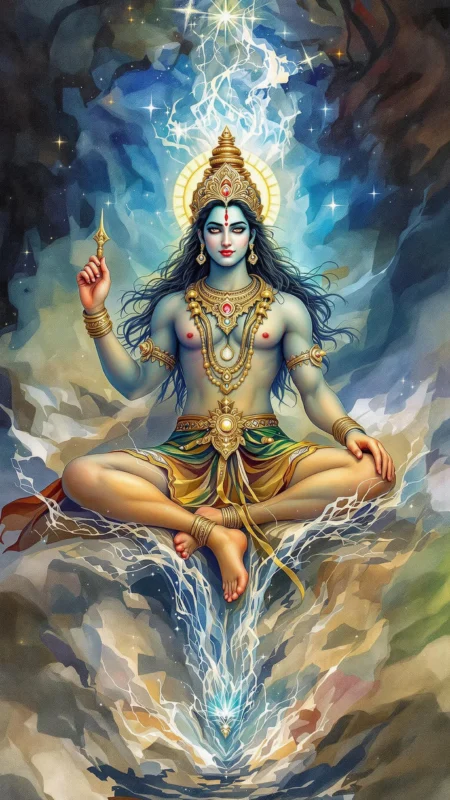
Vishnu

Archetype Meaning & Symbolism

Preserver, steadfast, balanced, dutiful, compassionate, cosmic, patient, intervening, adaptable, righteous, systematic, serene

  • The universe does not ask for your victory, only your participation in its balance. Play your part, for the dream dreams itself through you.

If Vishnu is part of your personal mythology, you may...

Believe

  • Every coherent system, from a friendship to a star, requires a conscious, patient force of preservation to endure against entropy.
  • True, lasting change emerges not from violent revolution, but from slow, deliberate adjustments that honor the integrity of the whole.
  • My identity is not a static thing to be discovered, but a series of roles I must embody to meet the balancing needs of the moment.

Fear

  • That the forces of chaos and decay are ultimately more powerful than your ability to maintain order, and that all your efforts are merely a delay of the inevitable.
  • Losing your true self by perpetually adapting to the needs of others, forgetting your own desires until they no longer exist.
  • The dawning realization that some things are not meant to be saved, and that your duty may require you to let go and allow a necessary end.

Strength

  • An almost supernatural patience, allowing you to take the long view and weather crises that would break others.
  • A profound adaptability, enabling you to become the right person for the moment—the diplomat, the enforcer, the comforter—without losing your core purpose.
  • An unwavering reliability that makes you the bedrock of your family, community, or organization; you are the one people turn to when all else fails.

Weakness

  • A deep-seated resistance to necessary endings, causing you to cling to failing systems, relationships, or beliefs out of a misplaced sense of duty.
  • A tendency to systematically suppress your own needs, wants, and chaotic impulses for the sake of group harmony, leading to burnout or quiet resentment.
  • Difficulty with decisive, disruptive action, even when it is required; you may always favor the path of least immediate disturbance, sometimes at a great long-term cost.

The Symbolism & Meaning of Vishnu

In the fabric of a personal mythology, Vishnu represents the profound responsibility of maintenance. He is the archetype of the steward, the caretaker of systems, the one who ensures the story continues. In a contemporary world that often glorifies disruption and explosive growth, the Vishnu archetype champions the contrary virtues: stability, consistency, and the quiet heroism of preservation. To have Vishnu in your mythos is to feel an innate pull toward creating and maintaining harmony, whether in a family, a community, or a codebase. You may find your purpose not in building the new, but in perfecting and protecting the existing. The conch you carry is the call to duty; the discus, the power to cut through illusion and restore order.

This archetype also embodies a unique form of adaptability. Vishnu’s avatars are not mere disguises; they are distinct personalities emerging to meet the specific needs of an era. For you, this might translate into a fluid sense of self. You could be the compassionate listener for a friend in crisis, the rigorous strategist for a project at work, and the playful teacher for a child. These are not false personas but different facets of your core preservative function, different avatars of 'you' descending to balance the small worlds you inhabit. This makes you a master of context, able to shift your approach without losing your fundamental integrity.

The cosmic sleep of Vishnu offers a powerful metaphor for rest and creation. It suggests that reality is sustained not just by active intervention but by a state of deep, generative dreaming. For the individual, this could mean valuing states of reflection, daydreaming, and contemplation as essential work. It reframes downtime not as laziness but as the vital process of dreaming your own world into being. You may believe that the most potent solutions and the most durable structures emerge from this quiet, internal space, the personal cosmic ocean where you float, sustaining your reality through conscious rest.


Vishnu Relationships With Other Archetypes

The Flood

The relationship between the Vishnu archetype and The Flood is perhaps not one of enmity, but of a profound and necessary dialogue. The Flood is not merely water; it is the great dissolution, the washing away of eras, the return of all complexity to a formless, silent potential. The Vishnu archetype does not stand as a dam against this tide, for it understands that such cycles may be inevitable, even just. Instead, it becomes the vessel, the single, watertight seed carrying the genetic memory of what was. It is the quiet, buoyant principle that ensures not that the world will be saved from the deluge, but that a world will have a chance to re-emerge from it. This archetype is the dream of land held within the heart of the ocean, a quiet insistence that even in the face of total erasure, a narrative of continuity will be preserved and carried to a future shore.

The Trickster

In the grand, solemn court of cosmic order, the Trickster is the jester whose antics threaten to upend the throne. Yet, the Vishnu archetype seems to maintain a curious, almost intimate, relationship with this agent of chaos. It could be that the preserver recognizes a vital truth: that order, left to its own devices, can calcify into tyranny, and that a system too rigid is already broken. The Vishnu archetype may therefore don the Trickster's mask, employing divine mischief and holy deceit to restore a balance that ponderous righteousness alone cannot. This suggests a sophisticated understanding that the fabric of reality is not a static tapestry but a living thing that must be prodded, played with, and sometimes strategically torn, so that it may be rewoven stronger. It is the use of a sacred prank to avert a profane catastrophe, a small subversion in the service of a great stability.

The Anchorite

The Anchorite is the figure of ultimate withdrawal, the soul sealed in a cave or cell, turning its back on the world's ceaseless activity. The Vishnu archetype shares with it a profound connection to stillness, but with a paradoxical twist. Where the Anchorite’s retreat may be a flight from the world, Vishnu’s repose is the very thing that sustains it. This archetype could be seen as the dreamer whose dream *is* the cosmos, resting on the coiled serpent of infinity in a sea of milk. This divine slumber is not an absence of action, but perhaps its most potent form. It suggests that the universe is held together not by constant, frantic intervention, but by a deep, unwavering center of tranquility. The relationship hints at the idea that true preservation is a gravitational force, a quiet, meditative state from which the possibility of all motion, all life, and all drama is allowed to spring forth, secure in the knowledge of a silent, dreaming foundation.

Using Vishnu in Every Day Life

Navigating Corporate Chaos:

When faced with a dissolving team or a failing project at work, your instinct may not be to jump ship. Instead, you could find yourself becoming the quiet center: mediating disputes, archiving institutional knowledge, and reminding colleagues of the original mission. You don't seek to lead the charge so much as to ensure the ship itself, the very structure of your collective effort, remains seaworthy, preserving the potential for a future journey.

Healing Family Rifts:

During a bitter family argument, the Vishnu archetype might manifest as the one who refuses to take a side. Your role is not to prove who is right, but to preserve the family unit. You may be the one who brings up old, happy memories, who gently steers conversations back to shared values, or who simply provides a calm, non-judgmental presence. You absorb the discord, seeking to restore the foundational harmony upon which the family was built, acting as the living memory of its love.

Addressing a Creative Block:

Instead of battling a creative block with frantic effort, you might perceive it as a necessary cosmic pause, a personal form of Yoga Nidra. This fallow period is not failure; it is the fertile void from which the next 'avatar' of your creativity will emerge. You might use this time for gentle input, for dreaming, for resting on the 'cosmic ocean' of your subconscious. You trust that the universe of your art is merely sleeping, and you are its faithful guardian, awaiting its next awakening.

Vishnu is Known For

The Preserver God

As one of the three principal deities in the Hindu Trimurti, Vishnu's primary role is to maintain cosmic order and righteousness (Dharma). He is the balancing force between creation (Brahma) and destruction (Shiva).

Avatars

Vishnu is famous for descending to Earth in various incarnations, or avatars, such as Rama and Krishna, whenever the world is threatened by evil, chaos, and unrighteousness. These interventions restore balance and guide humanity.

Yoga Nidra (Cosmic Sleep)

In between cosmic cycles, Vishnu is often depicted reclining on the serpent Ananta Shesha, adrift on the cosmic ocean. In this state of meditative sleep, he dreams the universe into existence, sustaining all of reality through his consciousness.

How Vishnu Might Affect Your Personal Mythology

How Vishnu Might Affect Your Mythos

When Vishnu is a cornerstone of your personal mythos, your life story may cease to be a linear progression toward a single climax. Instead, it could become a cyclical epic, a series of ages where you are called upon to restore balance. The narrative arc is not about slaying the dragon once, but about repeatedly taming the forces of chaos that threaten your kingdom, be it your inner world or your outer circumstances. Your great heroic moments might not be loud victories but quiet restorations: the mended relationship, the saved project, the preserved tradition. The central theme of your myth becomes endurance through stewardship.

Your personal mythology might be populated by recurring characters or situations that represent fundamental forces of order and disorder. You may see yourself as an 'avatar,' a specific version of you that must emerge to handle a particular challenge. The 'Krishna' in you might emerge to offer charming, wise counsel in a social dilemma, while the 'Rama' in you might appear to uphold a difficult moral duty with unwavering resolve. Your life is not a single character's journey but a pantheon of your own possibilities, all unified by the singular purpose of preservation.

How Vishnu Might Affect Your Sense of Self

Your self-concept may be that of a container, a vessel for cosmic balance. You might see your primary identity as a force for stability in a turbulent world. This can grant you a profound and unshakable sense of purpose, a feeling that your presence matters on a fundamental level. You are the eye of the storm, the calm center around which the drama of life swirls. This perspective can lend you a certain gravitas and an air of serene detachment, as you view your own ego and its desires as secondary to the larger system you are here to maintain.

However, this can also feel like a heavy mantle to wear. The self might feel less like a person and more like a function, an office to be held. Your personal needs, your spontaneous desires, your own chaotic impulses may be consciously or unconsciously suppressed for the sake of the whole. There could be a subtle sadness or loneliness in this role, a feeling of being defined by your utility to others rather than by your intrinsic, un-dutiable self. You might wonder who you would be if you weren't holding something, or someone, together.

How Vishnu Might Affect Your Beliefs About The World

Your worldview could be framed by a belief in a living, cyclical cosmos. You might perceive the universe not as a cold, indifferent machine, but as a dreaming consciousness, and chaos and order not as absolute good and evil, but as the systole and diastole of reality's heart. This perspective engenders a deep patience. You understand that periods of upheaval are inevitable and necessary, but that the impulse toward harmony and structure is just as fundamental. You trust the long arc of time.

This may lead you to value institutions, traditions, and legacies. You see the wisdom in structures that have endured, recognizing them as vessels of accumulated order. You are more likely to reform than to revolt, to mend than to break. Your gaze is fixed on the horizon of continuity, and you may find modern obsessions with fleeting trends and constant disruption to be spiritually exhausting. For you, the world is a garden to be tended, not a wilderness to be conquered or a resource to be extracted.

How Vishnu Might Affect Your Relationships

In relationships, you are likely the anchor. You are the one who remembers the small rituals that bind people together, who mediates when conflict arises, and who provides a steady, reliable presence in times of crisis. Your love is often expressed through acts of service and maintenance: you show you care by ensuring the shared world of the relationship remains stable, harmonious, and secure. Partners, friends, and family may see you as their rock, the person they can always count on to be reasonable and steadfast.

This role, however, can create an imbalance. You might attract partners who are more chaotic, unconsciously seeking your stability to ground them. This can lead to a dynamic where you take on the bulk of the emotional and practical labor required to keep the relationship afloat. There's a risk of your own needs being submerged beneath your preservative function. You may struggle to express your own frustrations or desires if you fear they might disrupt the peace you work so hard to maintain, leading to a quiet resentment that can erode the very foundation you seek to protect.

How Vishnu Might Affect Your Role in Life

You may perceive your role in life, regardless of your profession, as that of a steward. Whether you are a teacher preserving knowledge, a doctor maintaining health, a manager ensuring a team's cohesion, or an archivist protecting history, your underlying function is preservative. You are drawn to roles that allow you to bring order out of chaos, to ensure continuity, and to uphold a standard of quality and ethics. You are the system's immune response, activating when things begin to fall apart.

This means you may not be the celebrated innovator or the daring pioneer. Your contributions could be quieter, more foundational. You are the one who makes the innovator's work possible by creating a stable environment for them to thrive. Your satisfaction comes from seeing the system run smoothly, the community hold together, the project endure. You are the pillar that holds up the roof, essential but often unnoticed until it is gone. Your purpose is not to be the spectacle, but to ensure the show can go on.

Dream Interpretation of Vishnu

In a positive context, dreaming of Vishnu or his symbols—a vast, serene ocean, a spinning discus that restores order, a lotus blooming from murky water—may signify a powerful alignment with your core self. Such dreams could suggest that you are successfully fulfilling your role as a preserver in your waking life. The dream may be an affirmation from your subconscious that your efforts to maintain balance are working and that you are in harmony with your life's purpose. It can feel like a deep, cosmic reassurance, a vision of the universe you are tending in its ideal, dreamlike state.

Conversely, a negative or anxious dream featuring these elements could point to the shadow aspect of the archetype. You might dream of being drowned by an endless ocean, representing the overwhelming burden of responsibility. A dream of a crumbling temple or a failing structure that you cannot repair might reflect a fear of failing in your duty or being consumed by the very chaos you are meant to fight. Seeing a discus fly out of control could symbolize your efforts to impose order becoming destructive. These dreams are signals that the weight of preservation is becoming too much to bear, or that you are clinging to something that must be allowed to end.

How Vishnu Archetype Might Affect Your Needs

How Vishnu Might Affect Your Physiological Needs

For one who resonates with Vishnu, physiological needs are best met through rhythm and predictability, mirroring the cosmic order. You may find that a stable routine—waking at the same hour, eating balanced meals at regular intervals, a consistent sleep schedule—is not merely a preference but a foundational requirement for well-being. These patterns are a microcosm of the universal harmony you seek to embody. Their disruption can feel profoundly destabilizing, a tremor in the bedrock of your reality.

Your body itself may be viewed not as a vehicle for pleasure or a tool for labor, but as a sacred system to be maintained. Health is balance. Illness is a sign of internal chaos that must be gently restored to order. You might be drawn to holistic practices, balanced nutrition, and forms of exercise like yoga that emphasize systemic harmony over brute force. Neglecting your body’s basic needs for rest and sustenance can feel like a spiritual failure, a dereliction of your first and most immediate duty of preservation.

How Vishnu Might Affect Your Ideas of Belonging

Your path to belonging is through becoming indispensable. You foster love and connection by acting as the creator and maintainer of the group's 'container.' You are the friend who organizes the annual reunion, the family member who upholds the holiday traditions, the partner who remembers the small daily rituals that build a shared life. Your love is expressed through dutiful action and unwavering reliability. You create the stable space where others feel safe enough to connect and belong.

Consequently, you feel you belong when your preservative role is acknowledged and valued. You need to feel that your efforts to maintain the group are seen and appreciated. You may struggle to find your place in groups that are inherently chaotic, transient, or lacking a shared purpose to which you can dedicate yourself. Your sense of connection is deeply tied to having a clear, functional role within the social ecosystem; without that role, you may feel adrift and unattached.

How Vishnu Might Affect Your Feelings of Safety

Safety, for you, is synonymous with stability. It is not found in a lack of threats, but in the presence of a robust, well-maintained system capable of withstanding them. You may construct your life as a fortress of predictability: a detailed budget, a secure job, a well-stocked pantry, and comprehensive insurance plans. The unknown is not an invitation to adventure; it is a variable that threatens the integrity of the system. Your instinct is to plan, to prepare, and to create redundancies.

This drive for safety extends beyond the material. You seek psychological and emotional security through reliable relationships and stable social structures. You feel safest when you know the rules of the game and trust that others will play by them. Sudden changes, broken promises, and unpredictable behavior can trigger a deep sense of existential threat, as they suggest that the underlying order of the world, which you rely on for your very security, is beginning to fray at the edges.

How Vishnu Might Affect Your Views of Esteem

Self-esteem is derived directly from the successful fulfillment of your duty. Your sense of worth is not tied to public acclaim or personal enrichment, but to the quiet, internal knowledge that the systems under your care are functioning well. The smoothly running household, the harmonious team at work, the emotionally stable family—these are your trophies. Your pride is in the resilience and longevity of what you tend.

Conversely, feelings of low self-esteem may arise when chaos seems to win. A project's failure, a relationship's collapse, or a period of personal disorder can feel like a deep, personal failing. You may judge yourself harshly not for making a mistake, but for failing to uphold the order you were meant to preserve. Your worth is intrinsically linked to your effectiveness as a stabilizing force, and when that effectiveness is challenged, your self-esteem may crumble with it.

Shadow of Vishnu

The shadow of the preserver is the benevolent tyrant. In this mode, your drive to maintain order becomes a smothering force of control. You refuse to let things die their natural and necessary deaths. This could be a relationship that has run its course, a job that no longer fits, or a belief that has grown stagnant. Your 'preservation' becomes a refusal to allow change, creating a stable but lifeless world around you, a museum of past glories where no new life can grow. You may micromanage others' lives under the guise of helping them, your care becoming a cage.

A deeper, more passive shadow is a complete abdication of the role. Overwhelmed by the sheer scale of chaos in the world or in your life, you might retreat into a detached, 'philosophical' apathy. You recede into your own cosmic sleep, observing the decay but refusing to intervene, telling yourself it is all part of a grand, unknowable plan. Your patience becomes passivity; your long-term view becomes an excuse for inaction. In this state, you allow the systems you are meant to protect to crumble, not with a bang, but with the quiet whisper of your neglect.

Pros & Cons of Vishnu in Your Mythology

Pros

  • You are a source of immense stability and psychological safety for those in your orbit, a calm harbor in a chaotic world.
  • You possess a deep well of resilience and adaptability, able to bend with crises without breaking your essential purpose.
  • Your life is imbued with a clear and enduring sense of meaning; you know your role is to uphold, maintain, and preserve what is good and true.

Cons

  • You can feel crushed by the immense weight of responsibility you place upon yourself, believing you are single-handedly responsible for holding things together.
  • You may be perceived by others as overly conservative, resistant to change, or even controlling in your attempts to maintain stability.
  • Your constant focus on the needs of the system and the collective can lead to a profound neglect of your own individual growth, desires, and well-being.