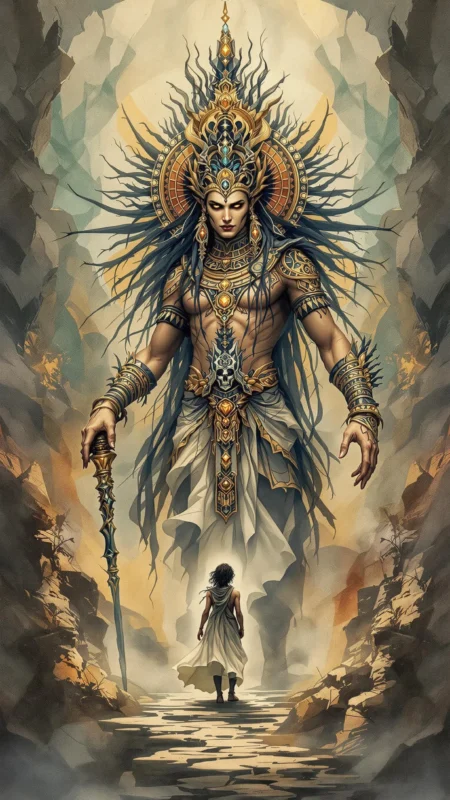
Viracocha

Archetype Meaning & Symbolism

Creator, Wanderer, Civilizer, Enigmatic, Foundational, Distant, Catalyst, Paradoxical, Benevolent, Unpredictable

  • I wept the rivers into existence and thought the mountains into form. Do not mistake your grief for emptiness: it is the clay of worlds.

If Viracocha is part of your personal mythology, you may...

Believe

  • You may believe that chaos is not an ending but the raw, fertile ground from which all new things must be born.
  • You may believe that the most profound and lasting influence is wielded not through overt power, but through quiet teaching and the elegant design of systems.
  • You may believe that your ultimate purpose is to build things—ideas, communities, works of art—that are strong enough to thrive without you.

Fear

  • You may fear that your life's work, the thing you pour your soul into creating, will be corrupted, misunderstood, or dismantled by those who come after you.
  • You may fear a fundamental, cosmic loneliness: the state of the creator who can love and shape the world but can never truly be a simple part of it.
  • You may fear creative barrenness, a 'great drought' where the tears of compassion dry up and you are left unable to bring order or life to the world within or without.

Strength

  • Your strength is a profound, patient vision. You are capable of seeing the cathedral in the unquarried stone and can hold that vision through the long, arduous process of building.
  • Your strength is the quiet authority of a master teacher. People naturally trust your guidance because you lead not by command but by demonstrating a better way, by embodying the principles you espouse.
  • Your strength is a deep, generative resilience. Faced with a 'great flood' or total collapse, you do not despair. You know that this is part of the cycle and that you possess the inherent ability to begin again, sculpting a new world from the mud.

Weakness

  • Your weakness may be an emotional aloofness. In seeing others as projects to be civilized or clay to be molded, you may struggle to connect with them in the messy, unpredictable equality of true intimacy.
  • Your weakness is a vulnerability to profound disappointment. When your creations do not live up to your perfect vision, you may be tempted to withdraw in a great sorrow, abandoning the flawed reality for the purity of your ideas.
  • Your weakness is the tendency to become a 'deus absconditus,' an absent god. You excel at the genesis, but may lose interest and 'walk across the sea' when a project or relationship moves into the less glamorous phase of maintenance and long-term commitment.

The Symbolism & Meaning of Viracocha

In the modern psyche, Viracocha represents the archetype of the quiet creator, the foundational force that establishes the rules of the game and then steps back. He is the patron saint of the system architect, the constitutional scholar, the artist who builds a new genre. He embodies the principle that true, lasting power is not in the crown but in the code, not in the daily governance but in the initial, elegant design. His mythos suggests that the most profound acts of creation are often followed by a period of intentional absence, allowing the creation itself to grow, adapt, and find its own way. He is the potential that exists before the project, the idea before the institution, the silent, organizing principle within the chaos.

The tears of Viracocha are not a symbol of weakness, but of generative empathy. It’s the idea that creation is born from a deep, compassionate sorrow for what is unformed, chaotic, or suffering. The rivers, the sources of life, spring from his weeping eyes. For an individual, this may mean that their greatest contributions to the world might not come from their strengths, but from their deepest wounds. It reframes pain not as an obstacle but as a sacred resource, the water needed to make the clay of a new reality pliable. This archetype asks you to consider what life your own sorrows could nourish if you saw them not as a burden, but as a primordial, life-giving rain.

Finally, Viracocha’s journey as a wandering beggar speaks to the power of unrecognized influence. He is the ultimate insider, the creator of all, choosing the role of the ultimate outsider. This paradox suggests that true change often comes from the margins, from those who have shed the trappings of status and can therefore see the system for what it is. It is an invitation to find power in being underestimated, to know that the wisdom you carry does not depend on the robes you wear. He is a symbol of the immense potential held by the anonymous artist, the quiet mentor, the unassuming stranger who, with a single observation, can alter the course of a life or a culture.


Viracocha Relationships With Other Archetypes

Unfinished Symphony

Viracocha could be seen as the divine composer of an Unfinished Symphony. He may have laid out the grand staves of civilization, assigning parts to the mountains and the rivers, and whispering the opening themes of law and agriculture into the ears of humanity. But then, he puts down the baton and walks away, leaving the orchestra to play on without its conductor. The ensuing music of history, with its soaring triumphs and crashing dissonances, is perhaps the sound of his creation grappling with its own freedom. This relationship is not one of abandonment, but of a profound, almost sorrowful trust, where the composer’s ultimate masterpiece lies in the improvisation of the players he left behind, forever echoing the ghost of his original melody.

The Echo

One might say Viracocha’s truest companion is The Echo. After he spoke the world into being and departed across the water, his words did not vanish but instead became a lingering resonance in the canyons of time. His teachings on civility and creation are not a static text but an echo, a sound that changes its character with every surface it touches, every new generation that hears its fading report. The Echo is therefore a testament to his enduring influence, yet also a constant, melancholic reminder of the original voice's absence. It suggests that his legacy is something that must be actively listened for, a subtle vibration in the cultural air that could, with inattention, dissipate into silence.

The Distant Shore

The relationship between Viracocha and The Distant Shore is one of mutual definition; one is the wanderer, the other is the destination that is also a perpetual horizon. The shore is the thin, liminal space he crossed to depart the known world, a veil between the tangible and the mythic. It may represent the limit of human comprehension, the point at which the creator recedes into a mystery as vast as the sea itself. For those left behind, that shore is a place of memory and of potent, unresolved promise. It is the physical embodiment of his departure and the conceptual space of his eventual, hoped-for return, holding the world in a state of perpetual, patient vigilance.

Using Viracocha in Every Day Life

Navigating a Blank Page

When faced with a paralyzing creative block, the Viracocha archetype doesn't suggest you 'find' inspiration. It suggests you understand that you are the source. The blankness is not an absence of ideas; it is the primordial, unformed chaos. Your role is not to wait for a lightning strike but to perform the first, quiet act of separation: to draw a single line, write a single sentence, divide the silence with a single note. This is how worlds begin, not with a bang, but with a deliberate distinction.

Assuming a Leadership Role

When thrust into a position of authority over a chaotic team or project, this mythos informs a different style of leadership. It is not about issuing commands from on high. It is about walking amongst the people, perhaps in disguise, without title or fanfare. You observe, you listen, and you teach by doing. You introduce one new principle, one civilizing tool, one better way of communicating, and let it take root. Your power is in the knowledge you impart, not the authority you wield. The goal is to build a system so elegant that it no longer requires you.

Coping with Feeling Misunderstood

If you feel like an outsider, a wanderer in a world that doesn't speak your language, the Viracocha archetype offers a reframe. Your otherness is not a deficiency; it is a vantage point. The creator god walked in rags, unrecognized by his own creations. This distance provides clarity. You are not meant to blend in. You are meant to see the patterns, to notice the unexamined assumptions of the culture, and to plant the seeds of a different possibility. Your loneliness is the price of a perspective that can, eventually, reshape the very world that excludes you.

Viracocha is Known For

The Primal Creation

Viracocha is known for bringing forth the world from a state of darkness and chaos. He sculpted giants from stone, but finding them unwieldy, washed them away in a great flood, creating a new, better race of humans from smaller clays. This act establishes a pattern of trial, error, and refinement in the creative process.

The Wandering Teacher

After his creation, Viracocha walked the earth, often disguised as a beggar, to teach his people the arts of civilization: agriculture, language, and culture. He was a hands-on deity, a teacher who imparted wisdom through direct engagement before mysteriously disappearing.

The Departure Over the Sea

His journey ended at the coast, where he walked across the water into the Pacific Ocean, promising to one day return. This departure leaves a legacy of hopeful expectation but also the deep responsibility for humanity to carry on his civilizing work in his absence.

How Viracocha Might Affect Your Personal Mythology

How Viracocha Might Affect Your Mythos

When Viracocha surfaces in your personal mythology, your life story may cease to be a simple narrative of cause and effect and become a creation myth. You might begin to view your past not as a series of accidents but as a primordial phase of darkness and chaos from which you, the creator, are now emerging. Your major life changes—a career shift, a move to a new city, the end of a relationship—may be seen as Great Floods, necessary cataclysms to wash away the flawed first drafts of your life to make way for a more refined creation. Your personal history is no longer just what happened to you; it is the epic tale of how you built your world.

Furthermore, your mythos may be defined by a wandering journey and an ultimate, mysterious purpose. You may feel that you are here to 'teach' something, to instill a certain kind of order or beauty into your corner of the world. This doesn't have to be literal teaching; it could be in how you organize your home, build your company, or raise your family. The narrative arc of your life may bend towards creating a sustainable system and then, in some way, 'disappearing.' This could manifest as a desire to build things that can outlast you, to mentor successors who can carry the torch, and a comfort with the idea of eventually walking away, leaving your creation to thrive on its own, your purpose fulfilled not by staying in the spotlight but by having built the stage.

How Viracocha Might Affect Your Sense of Self

To see oneself through the lens of Viracocha is to cultivate a quiet, foundational sense of self-worth that is independent of external accolades. Your identity may become anchored in your capacity to generate, to order, to bring forth. This is not the ego of a performer who needs applause, but the deep, resonant confidence of the architect who knows the soundness of the structure because they laid the cornerstone themselves. You might feel an ancient quality to your soul, a sense that you carry a wisdom or perspective that transcends your years. This can be a source of profound strength, a wellspring of patience in the face of triviality.

This perspective, however, may also cast a shadow of loneliness. As the creator, you are, by definition, separate from your creation. You might feel a subtle but persistent sense of being an observer of life, even when you are at its center. This is the loneliness of the god who walks in disguise among mortals; you see and understand them, but you feel that they can never truly see or understand the essence of you. You might struggle to find peers who resonate on the same foundational level, leading to a feeling of being a category of one. Your sense of self is powerful but solitary, connected to everything yet intimate with very little.

How Viracocha Might Affect Your Beliefs About The World

With Viracocha as a guide, your worldview may shift from seeing the world as a solid, immutable place to seeing it as a fluid, potential-filled medium. Reality becomes clay. Social structures, personal limitations, and cultural norms are not fixed laws of nature but rather the creations of other, perhaps less intentional, creators. This fosters a belief that everything can be remade, re-sculpted, or washed away to make space for something better. You may look at a broken political system, a toxic work environment, or a personal failure not with despair, but with the appraising eye of a creator asking: what new form wants to be born from this chaos?

This worldview cultivates a profound patience. You understand that creation is a process of stages. There was the darkness, then the stone giants, then the flood, then the people of clay. You do not expect instant perfection. You see failure as a necessary prototype, a 'stone giant' phase that provides crucial data for the next, more successful iteration. This allows you to engage with the world's immense problems without being crushed by them. You are not trying to 'fix' the world in a single lifetime; you are simply taking your turn to sculpt a small part of it, to teach a new technique, before walking toward the sea and letting others continue the work.

How Viracocha Might Affect Your Relationships

In relationships, you may unconsciously assume the role of the benevolent creator or the wandering teacher. You might be drawn to partners or friends whom you perceive as being in a state of chaos, seeing their potential and feeling a deep-seated urge to help them 'civilize' their own lives. This can create powerful, transformative bonds, but it also risks an unhealthy dynamic of teacher-student or sculptor-clay, where true equality is elusive. You give form, you provide structure, you teach a better way, but you might struggle to simply 'be' with someone in their unformed messiness without trying to shape it.

There may also be a pattern of creating deep, foundational connections and then mysteriously withdrawing. Like Viracocha disappearing over the ocean, you might pour your entire being into building a relationship, establishing its culture and rituals, and then, once it feels stable and self-sustaining, you may feel your work is done. This can be bewildering for a partner who believes the journey is just beginning. Your relational mythos is not one of 'happily ever after' but of 'purposefully built and respectfully departed.' The challenge is to learn how to remain present and participate in the world you have helped create, to be not just the creator but also a citizen.

How Viracocha Might Affect Your Role in Life

Your perceived role in life may be that of the silent architect, the First Mover. You may feel you are not meant to be the king, but the kingmaker; not the star performer, but the one who designed the stage and wrote the first act. You find your purpose in foundational work: creating the business plan, writing the constitution, developing the curriculum, establishing the family traditions. You are most comfortable in the genesis phase of any project, where you can bring order from chaos and set the core principles in motion. Your satisfaction comes from knowing the system you built is sound.

Consequently, you may feel a deep aversion to roles that involve maintenance, bureaucracy, or enforcement. Once the civilizing principles are established, you may feel your purpose is complete and grow restless. This can lead to a life pattern of starting companies and leaving them, launching social movements and then stepping into the background, or building a beautiful life with someone only to feel the call of the next creative void. Your role is not to rule the city, but to wander in from the wilderness, lay the grid plan for its streets, teach the citizens how to build, and then slip away before the first mayor is even elected.

Dream Interpretation of Viracocha

To dream of Viracocha in a positive light, perhaps seeing him calmly sculpting the earth or walking toward you with a benevolent gaze, is a profound affirmation from the psyche. It may signal that you are in alignment with your deepest creative purpose. Such a dream could be an encouragement to embark on a new, ambitious project that feels like your life's work. It suggests that you have the wisdom and vision necessary to bring order to a significant area of chaos in your life, be it internal or external. It is a visitation from the architect of your own soul, giving you the blueprint and the blessing to begin building.

Conversely, to dream of a weeping, angry, or disappearing Viracocha can be a disturbing omen. An inconsolably weeping god may reflect a deep grief within you over squandered potential or a creation that has gone astray. It may be your psyche mourning a part of you that you have failed to bring into the world. An angry Viracocha could symbolize the shadow of the creator: the tyrant. It may be a warning that you are forcing your will upon others, creating with ego instead of compassion. A god who turns his back and walks into the sea without a word could represent a terrifying fear of creative impotence, a sense that your generative power has abandoned you, leaving you alone in a dark and unformed world.

How Viracocha Archetype Might Affect Your Needs

How Viracocha Might Affect Your Physiological Needs

The Viracocha archetype can transform one’s relationship with the body, elevating physiological needs from mundane maintenance to sacred, creative acts. The body is seen as the first kingdom, the primary matter which you were given to civilize. Breathing is not automatic; it is a conscious participation in the animating force of the cosmos. Eating is not just refueling; it is the careful selection of elements to build the physical temple. The act of tending to your body's needs becomes a foundational ritual, a way of honoring the initial creation.

This perspective might foster a deep intuition about what the body needs, treating it less like a machine to be optimized and more like a landscape to be cultivated. There might be a natural pull towards clean water, whole foods, and open air, not for reasons of contemporary wellness fads, but from a primordial sense of purity. Sickness may be interpreted not as a failure, but as a chaotic uprising that requires a civilizing intervention: rest, nourishment, and a restoration of internal order. Your physical health is the bedrock upon which all other creative acts are built.

How Viracocha Might Affect Your Ideas of Belonging

Belonging is a deep paradox for the Viracocha archetype. On one hand, you may feel an oceanic sense of belonging to everything. As the creator, every person, every tree, every star is a part of your extended self. You are never truly alone because the entire world is your kin, your creation. This fosters a profound, cosmic empathy and a sense of responsibility for the whole. You belong not to a tribe, but to the world.

On the other hand, this universal connection creates a specific kind of loneliness. The creator can never be just another citizen in the city they designed. You may struggle to find a peer group where you feel truly seen as an equal, not as a source of wisdom, a guide, or a founder. Love and friendship may be colored by this dynamic; you give love by creating a safe and beautiful space for another, but you may question if you are loved for who you are, or for the world you provide. True belonging, for you, may not be about finding your place, but about creating places where others can find themselves.

How Viracocha Might Affect Your Feelings of Safety

For the one who carries the Viracocha mythos, safety is not found in fortifications or accumulation of wealth. Safety is a function of order and knowledge. True security lies in understanding the underlying principles of your environment, just as a creator understands the laws of his own universe. You may feel safest when you have a plan, a system, a blueprint. Financial security is not about the amount of money in the bank, but about understanding the system of finance and your place within it. Emotional safety is not about avoiding conflict, but about having established clear, mutually-understood principles of engagement within a relationship.

The greatest threat to your safety, then, is not an external enemy but the encroaching tide of chaos. This could be a sudden, unplanned event, the breakdown of a system you relied on, or the introduction of an unpredictable, irrational element into your life. Your response to threat is not to fight or flee in a panic, but to begin the work of civilizing anew: to assess the chaos, identify its nature, and begin to patiently impose a new and better order upon it. Your security is your capacity to create, and since that can never be taken from you, you possess a foundational, unshakable safety.

How Viracocha Might Affect Your Views of Esteem

Esteem, in the context of the Viracocha mythos, is sourced from the quiet, internal act of creation itself. It does not require an audience. Your self-worth is affirmed when you look upon a chaotic situation—a messy room, a disorganized project, a confused mind—and successfully bring form and order to it. The satisfaction is in the 'It is good' moment, a private recognition of a job well done. You could build an entire empire and your deepest moment of pride might be in the elegant simplicity of the initial design, a secret known only to you.

This makes your esteem both incredibly robust and peculiarly vulnerable. It is robust because it doesn't depend on likes, promotions, or applause. However, it is vulnerable to the failure of the creation itself. If the business you founded collapses, if the person you mentored rejects your teachings, if the art you create is met with indifference, it can feel like a devastating personal refutation. It's not just a project that failed; it feels like you, the creator, have failed. Your esteem is tied to your efficacy, and a loss of creative power can trigger a profound crisis of self-worth.

Shadow of Viracocha

The shadow of Viracocha is the benevolent creator turned divine tyrant. It is the architect who cannot tolerate a single wall being moved, the founder who suffocates their company with micromanagement, the parent who scripts their child’s life. The creative impulse, when twisted by fear and ego, becomes a desperate need for control. The tears of compassion are weaponized into floods of guilt and emotional manipulation to force the creation to conform to the creator’s singular, unyielding vision. This shadow aspect refuses to let the creation have a life of its own. It fears the unpredictable nature of an independent being and will crush that independence to maintain the purity of its own design. It is the god who did not walk away, but instead built a cage around his world.

The other face of the shadow is not tyranny, but abdication. This is the creator so disgusted by the flaws of his creation, so wounded by its refusal to be perfect, that he gives up entirely. This is the artist who smashes his sculpture, the writer who burns his manuscript, the leader who resigns in bitterness at the first sign of rebellion. This Viracocha walks away not out of a sense of completion, but out of spiteful despair. He leaves a vacuum where his guidance is needed most, abandoning his people to the very chaos he was meant to civilize. It is a profound dereliction of duty, a retreat into a cynical silence that is more destructive than any flood.

Pros & Cons of Viracocha in Your Mythology

Pros

  • You possess a rare ability to see both the big picture and the foundational steps needed to get there, making you a natural visionary, strategist, and builder.
  • You command a unique form of influence based on wisdom and competence, allowing you to lead and inspire change without resorting to force or political games.
  • Your internal sense of purpose and resilience allows you to weather storms and failures that would crush others, as you see them as mere phases in a larger creative cycle.

Cons

  • You may be plagued by a persistent sense of isolation, feeling that no one truly understands your perspective or the weight of your creative responsibility.
  • You risk setting impossibly high standards for your own work and the behavior of others, leading to chronic disappointment and a tendency to judge reality harshly against your internal ideal.
  • Your impulse to 'create and move on' can lead to a pattern of unfinished business and abandoned relationships, leaving a trail of beautiful beginnings that lack a fulfilling second act.