 Believe
 Fear
Fear Strength
 Weakness
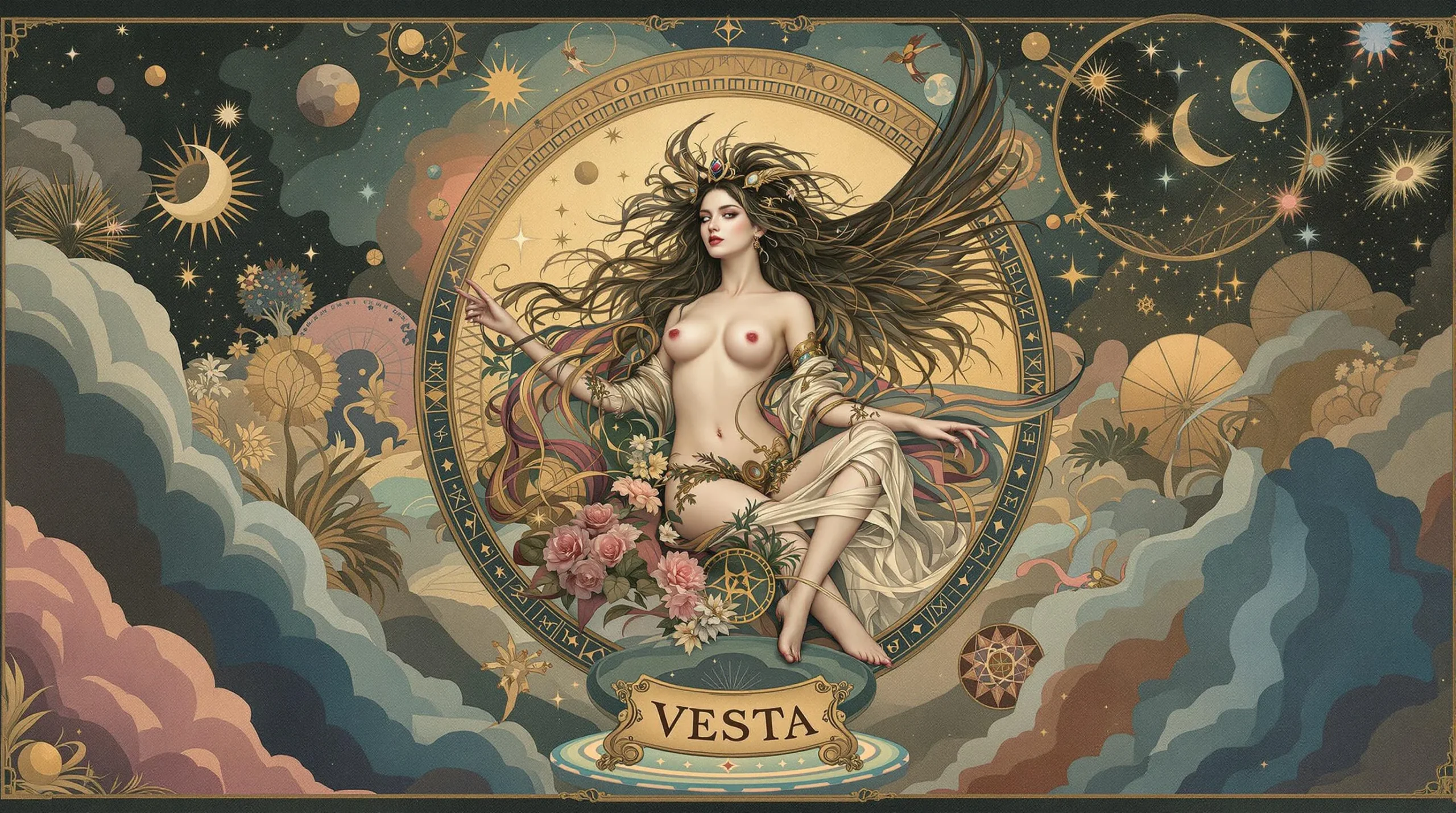
In personal mythology, Vesta represents the unwavering inner core, the part of the self that is pure, incorruptible, and dedicated to a singular purpose. She is the internal flame that provides warmth and light, not for public spectacle, but for one's own guidance and sustenance. To have Vesta as a guide is to find the divine in the act of tending, whether it be a home, a creative project, a community, or one's own soul. She symbolizes the quiet, persistent energy that sustains life from the center, the axis around which the more chaotic parts of one's story may revolve. Her presence suggests that the most profound spiritual work is not a journey outward, but a constant, devotional return to what is essential and true within.
The circularity of Vesta’s temple is a potent symbol for a life mythos. It reframes the narrative from a linear quest with a beginning and an end, to a cyclical pilgrimage toward a central point. The story is no longer solely about what one does or achieves in the world, but about the quality of presence one maintains at their own core. Vesta could symbolize the non-narrative part of the self: the deep, silent being-ness that exists beneath the layers of roles and actions. A personal mythos shaped by Vesta finds its climax not in a dramatic confrontation, but in a moment of profound alignment with this inner center, a realization that one is, and has always been, home.
Her famous chastity may be interpreted metaphorically as a kind of spiritual integrity or psychic sovereignty. It is not about a lack of passion, but about a passion directed inward, toward the preservation of a sacred trust. In a personal context, this could be a devotion to one's art, one's principles, or one's inner truth, a commitment so complete that it cannot be swayed by the lure of external validation, social pressure, or transient desires. It is a profound form of self-possession, the knowledge that one's wholeness does not depend on anything or anyone outside the self. It is the power of the contained fire, which burns more intensely because its energy is not dissipated.