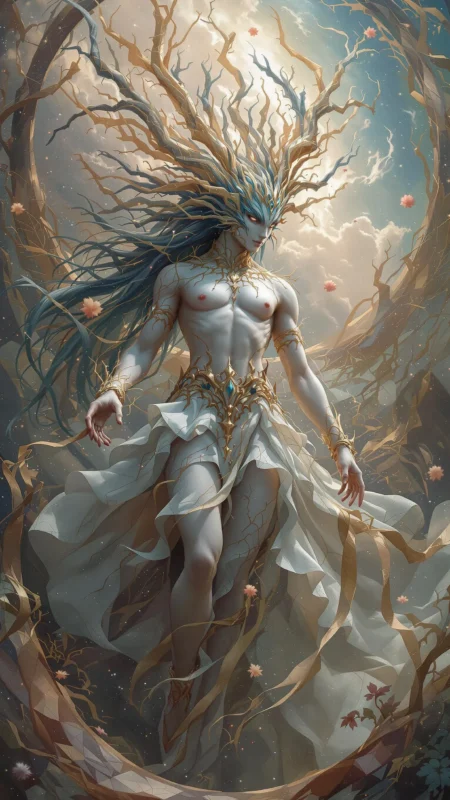
Vertumnus

Archetype Meaning & Symbolism

Shapeshifting, patient, persistent, adaptive, seasonal, fluid, persuasive, surprising, disguised, revelatory, ripening, cyclic

  • So, beware of scorning a lover: and you too, be compliant.

If Vertumnus is part of your personal mythology, you may...

Believe

  • Patience is not passive waiting; it is a form of active, strategic engagement with the world.
  • Your identity is not a monument to be carved in stone, but a garden to be cultivated through seasons of change.
  • The most profound connections are made not by demanding to be seen, but by gently earning the trust that allows for a mutual, timed revelation.

Fear

  • That you will become stuck in one form, losing the ability to change and thus losing your greatest strength.
  • That your many masks are not adaptations but deceptions, and that you have no authentic self left to reveal.
  • That when you finally show your true, radiant form, it will be met not with acceptance, but with the same rejection all your other disguises faced.

Strength

  • An almost supernatural resilience and adaptability, allowing you to thrive in diverse and changing environments.
  • An immense and profound patience, a willingness to let people, projects, and processes ripen in their own time.
  • A gift for narrative and gentle persuasion, the ability to find the right story and the right form to open a closed heart or mind.

Weakness

  • A tendency to be perceived as fickle, inconsistent, or even untrustworthy by those who value stability above all else.
  • A potential for a fragmented sense of self, a feeling of being a collection of roles rather than a coherent being.
  • A deep-seated loneliness that comes from the feeling that while many may know your masks, no one truly knows you.

The Symbolism & Meaning of Vertumnus

In the personal mythology of a modern life, Vertumnus represents the profound wisdom of adaptation. He is the patron saint of the fluid identity, the necessary personas we adopt to navigate the chapters of our lives. He is the understanding that the self is not a static monument but a garden, ever-changing with the seasons. You may feel his presence in the career shift that requires a new vocabulary and wardrobe, in the phase of parenthood that demands a self you never knew you had, or in the quiet evolution of a long-held belief. He symbolizes the ripening process, the trust that what is green and sour now will, with patience and the right conditions, become sweet.

Vertumnus speaks to the art of strategic patience. His myth is not about passive waiting, but about active, creative, and persistent engagement from a place of disguise. It is the wisdom of knowing when to be the grizzled farmer, when to be the stooped old woman, when to be the soldier: all in service of an ultimate goal. In a culture that often demands immediate authenticity and unfiltered revelation, Vertumnus offers a counter-narrative: that true connection sometimes requires a gentle approach, a story, a carefully chosen form that allows another to feel safe enough to receive the truth. He is the archetype of 'becoming,' a reminder that our various selves are not lies, but rehearsals for the final, magnificent reveal.

Above all, Vertumnus is the god of the auspicious moment. He embodies the instinct for right timing, the deep knowledge that revealing one's true, radiant form too early can lead to rejection, but revealing it at the peak of another's readiness can inspire awe and acceptance. He is the courage to be misunderstood in the short term, to inhabit the ambiguity of a persona, all while holding faith in the inherent value of the core self that waits for its season. He is the patron of the 'slow reveal,' suggesting that the most profound truths about ourselves are not shouted from the rooftops, but unveiled quietly, in a sun-drenched garden, when the time is finally, perfectly ripe.


Vertumnus Relationships With Other Archetypes

The Gated Garden

Vertumnus may find its most poignant counterpoint in the Gated Garden, that archetype of cloistered, steadfast beauty. Where the garden cultivates a world unto itself, defended by wall and thorn, Vertumnus is the very principle of the world outside, in all its mutable guises. The relationship, then, is one of a patient and kaleidoscopic siege. Vertumnus does not tear down the wall but instead becomes the wind that whispers through its cracks, the sun that tries a new angle of light each hour, the humble gardener who knows the secret of the latch. It is a testament to the idea that the most fortified heart may not be breached by force, but could, perhaps, be persuaded to open by a suitor willing to become everything—an entire year of changing seasons—just for a chance to be let in.

The River

The River, too, is an avatar of change, yet its relationship with Vertumnus is one of profound philosophical divergence. Where the River is an agent of geologic time, carving a singular, inexorable path with the brute force of its own consistency, Vertumnus is an expression of seasonal time, which revisits the same ground again and again but always in a new costume. The River’s identity is its unceasing momentum forward; it alters the landscape to fit its course. Vertumnus, conversely, alters itself to fit the landscape. It suggests a different kind of power—not the overwhelming force that creates the canyon, but the adaptive intelligence of the vine that finds a way to grow within it, its form a direct and fluid response to the world as it is.

The Mask

One could propose that the Mask is less an accessory to Vertumnus and more its very skin, its method of being. In most archetypal tales, the mask is a tool of concealment, a temporary lie that obscures a static truth. For Vertumnus, however, the series of masks may itself be the truth. The archetype suggests an identity so fluid that it only finds expression through the act of becoming something else. This is not the duplicity of the masquerade ball, where everyone is pretending; it is, perhaps, the sincerity of the consummate actor, for whom the role is a genuine, if fleeting, reality. The relationship is symbiotic, a continuous dialogue between form and essence, leaving us to wonder if there is any face at all beneath the final mask, or simply the shimmering, protean energy of transformation itself.

Using Vertumnus in Every Day Life

On Navigating a Career Transition

When faced with the daunting prospect of a new professional landscape, you do not simply leap. Instead, you may embody Vertumnus, trying on the guise of the student, the intern, the freelancer, the consultant. Each role is a costume, a way to approach the walled garden of a new industry without triggering its defenses. You learn its language, its seasons, its rhythms, not as an invader but as a patient observer, waiting for the moment when you can shed the disguise and reveal the competent, radiant professional you have become, ready to be welcomed.

On Nurturing a Creative Project

A nascent idea is a shy nymph, easily startled. To force it into a final form too soon is to lose it forever. The Vertumnus archetype counsels a different approach: a patient orbit. You may become the meticulous researcher, gathering disparate facts. Then, the freewheeling artist, splashing chaotic colors. Then, the severe editor, pruning back the excess. You shapeshift to serve the work, allowing it to ripen according to its own mysterious schedule, trusting that your final, truest role: the creator of the finished piece: will be revealed when the time is right.

On Deepening Intimate Bonds

You may recognize that love is not a static state but a long, seasonal story. When your partner is in a winter of spirit, you do not approach with the high sun of summer. You may become the quiet listener, the steady presence, a form of love that is muted and deep. When they are in a vibrant spring, you might shift into the playful companion, the adventurer. This is not deception: it is adaptation. It is the wisdom of knowing that to love someone fully is to be willing to change your shape to meet the person they are becoming, creating the trust required for you both to eventually stand revealed in your truest, most vulnerable forms.

Vertumnus is Known For

Shapeshifting

His primary divine power, the ability to assume any form he wished. This was not merely illusion, but a complete transformation, a tool he used for observation, persuasion, and eventually, revelation.

Pursuit of Pomona

His most famous myth involves his patient and creative courtship of the reclusive nymph of fruit trees, Pomona. He adopted numerous disguises to get close to her, finally succeeding when he revealed his true, beautiful form.

Deity of Seasons and Change

As his name, derived from the Latin for 'to turn' or 'to change,' implies, he presided over the turning of the seasons, the transformation of blossoms into fruit, and the very essence of metamorphosis in the natural world.

How Vertumnus Might Affect Your Personal Mythology

How Vertumnus Might Affect Your Mythos

When Vertumnus enters your personal mythos, your life story ceases to be a linear progression and becomes a series of evocative, nested transformations. Past versions of yourself are no longer discarded mistakes but necessary disguises, crucial acts in a longer play. The 'you' of your twenties was not a failure but a clever reaper, gathering experience. The 'you' of a difficult period was the stooped crone, learning the power of cautionary tales. Your narrative gains a layered complexity, where each chapter, each mask, contributes to the final, breathtaking revelation of who you are now. Your mythos becomes a story of ripening, where every sour, unripe season was essential for the eventual sweetness.

You may find your personal story is defined by its turning points. Not by what you were, but by what you became next. Vertumnus sanctifies the pivot. He makes heroes of the adaptable, the resilient, the ones who could shed a skin to survive and thrive. Your mythos is not about a singular, unwavering identity, but about the genius of your own fluidity. It is a tale of a persistent, patient spirit moving through the world, trying every key, every costume, until the right one opens the door to a garden of belonging and purpose, allowing the true self to finally bask in the sun.

How Vertumnus Might Affect Your Sense of Self

With Vertumnus as a guide, you may view your own identity as a verb rather than a noun. The self is not a fixed point to be defended, but a process to be engaged with. This perspective fosters a profound self-compassion, especially during times of confusion or transition. You are not lost: you are simply between forms, in a generative, liminal state. This archetype gives you permission to experiment, to try on selves like costumes, to see what fits the current season of your life without judging the fit of the last. It reframes inconsistency not as a character flaw, but as a sign of intelligent life, of adaptation to an ever-changing environment.

The pressure to have a single, coherent 'personal brand' may dissolve, replaced by a quiet confidence in your own multiplicity. You may understand that your 'true self' is not the mask, but the consciousness that chooses the mask. This core self is patient, observant, and deeply connected to the rhythms of growth. Self-worth, then, is not derived from any single successful performance or identity, but from the courage to undergo metamorphosis itself. It is the esteem that comes from knowing you have the resilience to become whatever the future requires of you, holding a deep faith in the beautiful, divine form that awaits its perfect moment of revelation.

How Vertumnus Might Affect Your Beliefs About The World

Seeing the world through the eyes of Vertumnus, you may perceive reality not as a collection of fixed objects and final truths, but as a dynamic, flowing process of transformation. Everything is in a state of becoming: the political climate, social norms, scientific understanding, even the people you meet. A 'no' today is not a 'no' forever. A closed door is not a permanent barrier but a temporary condition. This worldview cultivates a deep and abiding patience, a trust in the ripening of time. You may become less reactive to immediate events, seeing them as a single phase in a much longer seasonal cycle.

You might also view persuasion and influence differently. The world is not changed by blunt force, but by the subtle art of shapeshifting: by meeting people where they are, speaking their language, and telling them a story that opens them to a new perspective. Truth, you might believe, is most potent when it is not a harsh light but a gradual dawn. This perspective sees potential in everything. A barren field is not a failure but a fallow season. A crisis is not an end but a catalyst for metamorphosis. The world is a garden of possibilities, and your role is to tend it, adapt to its seasons, and wait with patient wisdom for the blossom and the fruit.

How Vertumnus Might Affect Your Relationships

In relationships, the Vertumnus archetype encourages a dance of profound adaptability. You may understand that the person you fell in love with is, like you, a being in constant flux. To love them is to love their many future selves, to adapt your own shape to meet theirs as they evolve. This is not about losing yourself, but about the generous act of becoming what your partner needs in a given season: a steadfast rock, a playful breeze, a quiet shade tree. It replaces the rigid expectation of consistency with a fluid, responsive form of intimacy. It is the patience to stick with someone through their unripe phases, trusting in the sweet fruit they will eventually become.

However, this archetype also informs how you approach connection itself. You may become a master of the gentle approach, knowing that vulnerability cannot be forced. Like Vertumnus with Pomona, you may try different keys, different stories, different versions of your own presentation until you find the one that makes another person feel safe enough to open their own walled garden. This can be a form of deep empathy, a willingness to translate your being into a language another can understand. It transforms courtship, friendship, and connection into a patient art form, a slow reveal built on trust, narrative, and the magic of right timing.

How Vertumnus Might Affect Your Role in Life

Your role in life, informed by Vertumnus, is never singular. You are a shapeshifter, and your purpose is to inhabit the form that the moment requires. There is no one job title, no single social label, that can contain you. You may be the mentor, the trickster, the healer, the builder, the silent observer: sometimes all in the same week. Your perceived role is defined by its function, not its name. This frees you from the anxiety of finding a single 'calling' and instead invites you to embrace a life of varied, meaningful contributions. Your utility is your fluidity.

You may feel a sense of purpose in being the agent of change or transition for others. Like Vertumnus appearing as the old crone, you might be the one who arrives to tell a necessary, transformative story, helping a person, a community, or a project to ripen. Your role is to be the catalyst, the one who understands the seasons of growth and knows what is needed to nudge things along. You are not the unchanging statue in the garden; you are the gardener, the bee, the rain, and the sun, constantly shifting your role to serve the flourishing of the whole ecosystem.

Dream Interpretation of Vertumnus

In a positive context, dreaming of Vertumnus, or of shapeshifting yourself, may be a powerful affirmation from your subconscious. It could suggest that you are successfully navigating a complex period of transition. The dream may be celebrating your adaptability and resilience, signaling that the personas you are adopting in your waking life are effective and serving your growth. To dream of a garden blooming or fruit ripening could be a direct message from this archetype that your patience is about to be rewarded, and a project or relationship is reaching a state of perfect readiness. It is a dream of auspicious transformation, a sign that you are in harmony with your own becoming.

Conversely, a negative or anxious dream involving Vertumnus could point to a crisis of identity. You might dream of being stuck between forms, or of your disguises melting away at inopportune moments, revealing a self you feel is inadequate. This could reflect a waking fear of being an imposter, a sense that your adaptive strategies are merely hollow deceptions. Dreaming of being pursued by a shapeshifter you cannot identify might suggest you feel manipulated or deceived by someone in your life. It can also represent the shadow side of Vertumnus: a warning that your own ambition is leading you toward coercive tactics, or that you have worn a mask for so long you have forgotten the face beneath.

How Vertumnus Archetype Might Affect Your Needs

How Vertumnus Might Affect Your Physiological Needs

The wisdom of Vertumnus may manifest as a deep attunement to the body’s seasonal needs. You might instinctively reject the notion of a single, static diet or exercise regimen, understanding that your physical requirements change. There is a season for intense effort, for building and doing, fueled by hearty meals: the season of the reaper. There is also a season for rest, conservation, and gentle nourishment: the season of the dormant seed. This archetype encourages listening to the body’s subtle cues, treating its changing states not as problems to be fixed but as natural phases in a cycle.

You may find that your physical energy is tied to your creative and emotional cycles. A period of intense social engagement or creative output might require one kind of physical care, while a period of introspection and emotional processing requires another. Vertumnus teaches that the body is not a machine to be optimized, but a landscape to be tended. This means honoring its need for fallow periods as much as its moments of peak production, seeing the wisdom in the ebb as much as the flow, and adapting your physical habits to serve the needs of the whole, integrated self.

How Vertumnus Might Affect Your Ideas of Belonging

Belonging, through a Vertumnian lens, is not about finding a group where you fit in perfectly as you are. It is a more dynamic and patient process. You may find your tribe by first adapting, by learning their language and customs, by presenting a version of yourself that can be understood and accepted. This is not a dishonest act, but an act of empathy, a bridge built so that true connection can eventually cross it. It is the patience to orbit a community, contributing in various forms, until the time is right to reveal more of your core self.

This archetype suggests that true belonging is earned through trust, and trust is built over seasons. You might feel a sense of connection not by being the same as others, but by being useful to them in your many forms. Love and friendship, then, are not about being seen completely all at once. They are about the gradual, consensual unveiling of the self. Belonging is the feeling of safety that emerges when you realize that the garden walls have been lowered, and you are welcome to enter in your true form, having honored the patience it took to get there.

How Vertumnus Might Affect Your Feelings of Safety

For one who carries the Vertumnus myth, safety is not found in walls, routines, or rigid plans. Such things are brittle and shatter in the face of true change. Instead, safety is a function of fluidity. Your greatest security lies in your ability to adapt, to change your shape to meet the demands of an unpredictable world. When one path closes, you have the capacity to become the person who can find or create another. This archetype fosters a deep trust in your own resourcefulness over any external structure. Safety is not a place; it is a skill.

This perspective may also redefine your understanding of risk. A new situation is not a threat but an opportunity to learn a new form. Stability is not the absence of change, but the confident ability to dance with it. You may feel safest not when things are certain, but when you feel most aligned with your own adaptive capabilities. The fear of the unknown is lessened, because you carry within you the god of seasons and change, the ultimate tool for navigating any territory. Your safety is internal, portable, and endlessly renewable.

How Vertumnus Might Affect Your Views of Esteem

Esteem, in the mythos of Vertumnus, is decoupled from the success or failure of any single identity. Your self-worth is not tied to being the 'successful artist' or the 'perfect parent.' Instead, it resides in the core self that is capable of generating these roles. Esteem comes from the courage to be in process, the bravery to be a beginner again and again, and the resilience to shed skins that no longer serve you. It is the quiet pride of the shapeshifter who knows their own power lies not in any one form, but in the magic of transformation itself.

You may derive a profound sense of confidence from your own adaptability. While others might crumble when a cherished identity is threatened, you possess the inner resources to simply become something else. This fosters a deep-seated belief in your own survivability and competence. Your esteem is not built on the shifting sands of external validation for a particular role, but on the bedrock of your own fluid, persistent nature. You respect the person you are, but you have an even deeper reverence for the person you are always in the process of becoming.

Shadow of Vertumnus

The shadow of Vertumnus emerges when adaptation curdles into manipulation. It is the use of shapeshifting not to empathize and connect, but to deceive and coerce. This shadow figure is the ultimate con artist, a being so skilled at mirroring others and adopting personas that they can talk anyone into anything, all for their own gain. They do not seek Pomona's love, but her submission. Here, the art of the slow reveal is lost, replaced by a cynical belief that there is no true self, only a series of useful fictions. This leads to a hollow existence, a chain of successful but meaningless conquests, and a profound inability to engage in a relationship of genuine equals.

Conversely, the shadow can manifest as a terror of change, a petrification of the soul. It is the fear of shedding a skin that has become comfortable, even if it is now a prison. This is the person who clings to an old identity—a past glory, a former relationship, an obsolete worldview—long after its season has passed. They are Pomona threatening to turn to stone rather than risk vulnerability. They reject the call to transform, and in doing so, they reject life itself, choosing the cold safety of stagnation over the terrifying, beautiful risk of becoming.

Pros & Cons of Vertumnus in Your Mythology

Pros

  • You possess an unparalleled ability to reinvent yourself, making you resilient to life's upheavals and endlessly interesting to others.
  • You cultivate deep wisdom and empathy by experiencing life from many different perspectives and roles.
  • Your patience allows you to succeed where others fail, as you are willing to wait for the perfect moment to act or reveal your intentions.

Cons

  • You may struggle with a stable sense of identity, leading to periods of confusion or a feeling of being an imposter.
  • Others may find it difficult to trust you or feel close to you, sensing a core that is always held in reserve.
  • Your reluctance to commit to one form can lead to a life of perpetual potential, always preparing for a future that never fully arrives.