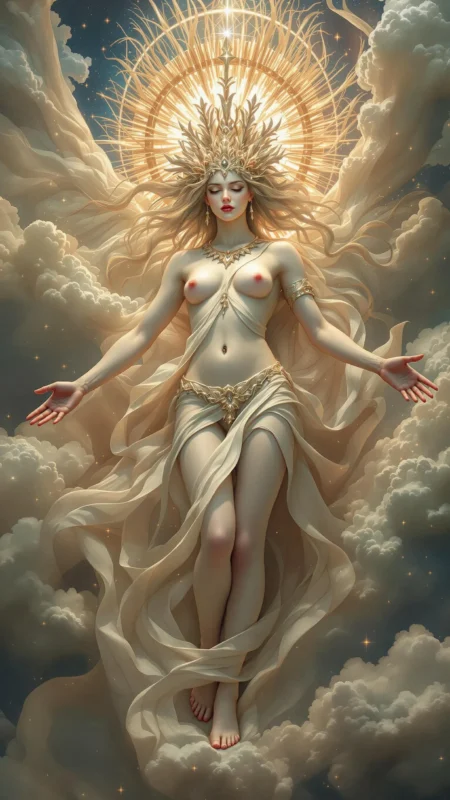
Venus

Archetype Meaning & Symbolism

Alluring, Creative, Harmonious, Vain, Diplomatic, Indulgent, Magnetic, Receptive, Fickle, Sensual

  • Your courage will be the ruin of us both! Then be warned by me and do not dare to meddle with those beasts that are armed by nature, lest your glory be my grief.

If Venus is part of your personal mythology, you may...

Believe

  • Beauty is not a superficial indulgence but a sacred principle, the visible manifestation of the divine.
  • The most profound and lasting change in the world is achieved not through force, but through connection, diplomacy, and the art of relationship.
  • Your personal happiness and the quality of your life are directly proportional to the amount of beauty and love you consciously cultivate.

Fear

  • A deep terror of being unloved, unseen, or rejected; that your worth is conditional upon your attractiveness to others.
  • A visceral aversion to ugliness, conflict, and discord, which can feel like a personal assault on your spirit.
  • The anxiety that love and beauty are transient, and that you will inevitably face the decay of aging and the loss of connection.

Strength

  • An innate gift for creating beauty, harmony, and pleasure, turning any environment or relationship into a work of art.
  • A magnetic personal charm and a natural talent for diplomacy that allows you to navigate social situations with grace and ease.
  • A profound capacity for love, appreciation, and sensuous experience, leading to a rich and joyful engagement with life.

Weakness

  • A tendency toward vanity, superficiality, and judging yourself and others primarily by appearances.
  • A crippling conflict avoidance that prevents you from addressing difficult truths or engaging in necessary confrontation.
  • A potential for your self-worth to be overly dependent on external validation, making you vulnerable to jealousy, envy, and insecurity.

The Symbolism & Meaning of Venus

To invite Venus into one’s personal mythology is to court the universe’s fundamental principle of attraction. She is more than the goddess of hearts and flowers; she is the gravitational force of the soul, the power that draws people, ideas, and opportunities together. Her domain is the logic of aesthetics, the silent, intuitive understanding that a certain color combination is correct, that a specific sequence of notes is beautiful, that a particular person belongs in your life. She represents the value of things: not their utility, but their intrinsic worth, their capacity to delight, to charm, to inspire love. In a modern context, her presence suggests a life oriented around the creation and appreciation of beauty in all its forms: art, relationships, nature, and the self.

Her symbolism also speaks to the profound power of receptivity. Unlike the spear-wielding Athena or the thunderbolt-throwing Zeus, Venus’s power often lies in her ability to attract rather than to conquer. She is the open flower, the waiting shore, the mirror that reflects the world’s beauty back to itself. This could manifest as a personal mythology where success is achieved not through striving and effort, but through becoming a vessel for inspiration, a magnet for connection. It is the wisdom of knowing that sometimes, the most powerful action is to make oneself beautiful, still, and open, allowing the world to come to you. Her mirror is a key symbol: a tool for self-adornment, yes, but also for self-knowledge, for understanding that how we see ourselves determines what we can attract.

Ultimately, Venus governs the realm of the heart’s intelligence. She presides over the choices made not from reason or duty, but from desire and deep, resonant feeling. To walk her path is to trust the body’s wisdom, the heart’s compass, the soul’s aesthetic preferences. It is to believe that what you are drawn to is a clue to your own destiny, and that what is truly beautiful is also what is truly true. This archetype shapes a personal narrative where the central quest is not for power or for knowledge, but for love, for connection, and for the creation of a life that is, in itself, a work of art.


Venus Relationships With Other Archetypes

Mars

The relationship between Venus and Mars is, perhaps, the oldest dance in the celestial ballroom, a story of magnetism written in the tension between opposites. Where Mars is the raw, percussive force of assertion—the clenched fist, the warrior’s cry, the jagged line of a lightning strike—Venus is the principle of reception, the open palm, the siren’s song that gives the warrior a reason to either lay down his arms or fight for something beautiful. Theirs is not always a simple romance; it may be the friction that hones a blade or the spark that ignites a conflagration. Mars could represent the chaotic, untamed energy that Venus seeks to harmonize, to shape into a form of breathtaking grace, much like a sculptor wrestling with a block of unyielding stone. It is a dialogue between the spear and the mirror, between the will to conquer and the desire to be captivated, each finding its meaning and its completion only in the reflection of the other.

The Mirror

With The Mirror, Venus finds its most intimate and perilous confidant. The mirror is not merely an object but a threshold, a silent surface that promises truth. For Venus, it may be a tool for the sacred act of adornment, a way to compose the self into a living work of art. Yet, this relationship is fraught with ambiguity. The reflection it offers could be a gateway to profound self-knowledge, a space to confront the architecture of one's own soul. But it might also become a gilded cage, a shimmering surface that traps the gaze and fosters a love for the image over the substance, breeding a vanity that is a ghost of true self-love. The mirror, then, could be seen as Venus’s collaborator and its potential saboteur, the still pool in which Narcissus might see not only his own beauty but also his undoing.

The Garden

The Garden is arguably the most tangible expression of the Venusian spirit, the archetype's earthly sanctuary and canvas. This is no untamed wilderness, but rather a space where nature’s raw vitality is coaxed, edited, and arranged by a loving and aesthetic hand. The relationship is one of symbiotic cultivation; Venus is the tender of this space, and the garden, in turn, is the flourishing embodiment of Venus's core principles—harmony, sensuous pleasure, and generative beauty. Each climbing rose, each perfectly ripened fig, each carefully laid stone path may be a verse in a poem dedicated to life's loveliness. The garden is where the abstract ideals of Venus become felt reality: in the organized symphony of color, the intoxicating scent of jasmine on a warm evening, the profound peace that settles within its walls. It is a living testament to the idea that love is not just a feeling, but an act of creation.

Using Venus in Every Day Life

On Navigating Conflict:

When faced with a disagreement, you might not seek victory but a more elegant resolution. Your approach could be to re-frame the conflict, not as a battle of wills, but as a discordant composition in need of harmony. You might introduce a third element: a shared meal, a change of scenery, a precisely chosen gift. This is not avoidance; it is the art of altering the relational chemistry, of finding the chord that allows both notes to sound without clashing.

On Cultivating Personal Style:

Your home and wardrobe may become a personal work of art, a physical manifestation of inner values. The choice of a silk scarf is not about trend, but about how its particular blue echoes a line from a favorite poem. The arrangement of furniture is a study in social geometry, designed to foster intimacy or quiet contemplation. Style becomes a form of storytelling, a way of making the soul visible through the curation of the material world.

On Embracing Pleasure:

The Venus archetype could teach a radical acceptance of pleasure as a vital nutrient. This moves beyond mere indulgence into a sophisticated connoisseurship of experience. It is the ability to fully inhabit the senses: to discern the notes of saffron in a dish, to feel the specific texture of sun-warmed stone, to appreciate the cadence of a lover’s speech. Life is not a series of tasks to be completed, but a tapestry of sensations to be savored.

Venus is Known For

Birth from the Sea

She arose from the ocean foam, fully formed and irresistibly beautiful, landing at Cyprus or Cythera. This origin story links her to the primal, creative power of the sea and the sudden, startling emergence of beauty in the world.

The Judgment of Paris:

Promising Paris the most beautiful mortal woman, Helen, in exchange for being named the fairest goddess. This act of vanity and desire directly instigated the Trojan War, showcasing her immense power over mortal and divine affairs.

Affair with Mars:

Her passionate and illicit relationship with the god of war represents the eternal dance between love and strife, creation and destruction, harmony and conflict. Their union produces a child, Harmonia, symbolizing the resolution that can emerge from opposing forces.

How Venus Might Affect Your Personal Mythology

How Venus Might Affect Your Mythos

When Venus is a primary architect of your personal mythos, your life story may not follow a linear path of conquest and achievement, but rather an unfolding spiral of attraction and connection. Major plot points are not battles won, but relationships formed; not mountains climbed, but works of art created. Your personal history might be chronicled by the loves that shaped you, the friendships that defined you, and the moments of sublime beauty that reoriented your path. The central narrative tension could revolve around the search for harmony: harmony between the self and others, between the inner world and outer expression, between desire and reality. Your 'hero’s journey' may be an interior one, a quest to cultivate the inner garden so that it may attract what it most deeply values.

Your mythos may be populated with muses, collaborators, and soulmates rather than rivals and foes. Conflict itself is reinterpreted: it is not a force to be vanquished but a sign of disharmony, a problem of aesthetics that requires a creative solution. Your legend could be that of the Peacemaker, who uses diplomacy and charm to unite warring factions, or the Artist, whose creations bring beauty and meaning to the collective. Failures may be framed as losses of connection or lapses in taste, while triumphs are measured in the quality of your relationships and the elegance of your life. It is a mythos where the ultimate prize is not a golden fleece, but a perfectly rendered life.

How Venus Might Affect Your Sense of Self

With Venus as your guide, your sense of self may be deeply intertwined with your capacity to create and perceive beauty. Self-worth is not necessarily derived from what you do, but from what you are: a vessel of grace, charm, and creative potential. You might view yourself as a work of art in progress, constantly refining your appearance, your manners, your home, and your relationships to better reflect an inner ideal of harmony. This can lead to a profound sense of personal embodiment and a joyful, sensuous experience of life. You may trust your own taste implicitly, seeing it as a direct line to your soul’s purpose.

However, this perspective also carries a vulnerability. Your self-esteem might become perilously dependent on external validation: the admiring gaze of others, the success of your relationships, the social currency of your beauty. You may perceive flaws not as simple imperfections but as deep personal failings. The mirror of Venus can be a cruel judge, and a fear of ugliness, aging, or rejection may haunt your inner world. The journey, then, is to move from seeking value in the reflection to finding it in the mirror-holder itself: to love the self not because it is beautiful, but to find the self beautiful because it is loved from within.

How Venus Might Affect Your Beliefs About The World

Through a Venusian lens, the world may appear not as a chaotic marketplace or a brutal battlefield, but as a grand, unfolding aesthetic project. You may see the evidence of divine artistry everywhere: in the iridescent wing of a beetle, the elegant structure of a snowflake, the intricate dance of social interaction. Problems in the world, from political strife to environmental decay, might be perceived fundamentally as failures of relationship, symptoms of a deep, collective disharmony. The world lacks not resources or logic, but love and a shared sense of beauty. You might believe that culture, art, and diplomacy are not soft luxuries but the most potent tools for creating a better world.

This worldview prioritizes connection over division, cooperation over competition. It is a perspective that values the beautiful, the pleasurable, and the relational. You might find yourself drawn to philosophies that emphasize unity, social systems that foster belonging, and political movements that advocate for peace. The ultimate reality is relational; nothing exists in isolation. The health of the whole is determined by the quality of the connections between its parts. Consequently, you may judge the progress of society not by its GDP, but by the beauty of its cities, the grace of its social fabric, and the happiness of its people.

How Venus Might Affect Your Relationships

For one with Venus in their mythos, relationships are the central art form. They are the primary canvas upon which you create beauty, harmony, and meaning. A partnership is a co-creation, a dance, a duet. You may pour immense energy into the craft of relating: learning the arts of listening, appreciating, and seducing. The goal is not merely companionship but a shared aesthetic, a life lived in resonant harmony with another. Friendships are curated like a fine collection, each one chosen for its unique beauty and the way it contributes to the whole of your social world. You might possess an innate talent for making others feel seen, valued, and beautiful.

This focus, however, can lead to its own set of challenges. There may be a tendency to idealize partners, projecting onto them a perfect image that they cannot possibly sustain. When the reality of another person’s flaws disrupts the beautiful picture, disillusionment can be swift and painful. You may fear conflict, preferring to smooth over disagreements rather than engage in difficult truths that might threaten the harmony of the connection. There is also the danger of treating people as beautiful objects to be acquired and admired, rather than as complex individuals. Jealousy and possessiveness can arise from the fear of losing a prized source of love and validation.

How Venus Might Affect Your Role in Life

Your perceived role in the world may be that of the Harmonizer, the one who exists to bridge divides and create unity. You might not see yourself as a leader who commands, but as an influencer who persuades, charms, and attracts. This could manifest in a career as a diplomat, a mediator, a designer, a host, or an artist. Your function is to smooth the rough edges of human interaction, to find common ground, and to build consensus. You bring people together, creating social cohesion through grace and hospitality. Your presence in a group is often calming, your perspective sought for its fairness and its focus on relational well-being.

Alternatively, you may embrace the role of the Creator or the Muse. Your purpose is to birth beauty into the world, whether through painting, music, writing, or the simple act of crafting a beautiful life. You are the one who reminds others of the value of the sensual, the pleasurable, and the aesthetic. As a muse, you inspire creativity in others through your very being, reflecting their own potential back to them. In either case, your role is not defined by struggle or force. It is a role powered by love, by the magnetic pull of beauty, and by the deep, intuitive conviction that what makes life worth living is not the fight, but the dance.

Dream Interpretation of Venus

To dream of Venus in her resplendent form—emerging from the sea, smiling in a garden, or bestowing a beautiful object—may be a powerful omen of creative awakening and relational bliss. Such a dream could signify that you are entering a period of grace, where you will attract what you desire with ease. It may be an encouragement from your psyche to open yourself to love, to prioritize pleasure, and to invest in the artistic or social projects that bring you joy. The dream might be affirming your own beauty and worth, urging you to see yourself through her loving eyes. It is an invitation to harmonize your inner and outer worlds.

Conversely, dreaming of a scorned, weeping, or distorted Venus can signal a disturbance in your personal realm of love and value. This could point to simmering jealousy, vanity, or a toxic relationship that is creating discord in your life. It might reveal a shadow aspect: a manipulation through charm that has backfired, or a superficiality that has left you feeling empty and unloved. Such a dream could be a warning that your self-worth has become dangerously tied to external approval. It may be asking you to look at the 'ugliness' you are avoiding—the necessary conflict, the painful truth, the unacknowledged insecurity—in order to restore true harmony.

How Venus Archetype Might Affect Your Needs

How Venus Might Affect Your Physiological Needs

For the Venus archetype, physiological needs are not met with mere utility; they demand aesthetic satisfaction. Sustenance is not just about calories; it is about cuisine, the presentation of a meal, the quality of the ingredients, the atmosphere in which it is consumed. A simple bowl of soup must be served in a pleasing bowl. Water is best from an elegant glass. The need for food is inseparable from the need for it to be a delightful, sensuous experience. This is not fussiness, but a deep-seated belief that the body is a temple and must be honored with offerings of beauty.

Shelter, similarly, transcends the need for mere cover from the elements. A home must be a haven of harmony and beauty. The light must be right, the colors must soothe the spirit, the textures must please the touch. An environment that is ugly, chaotic, or lacking in grace can feel physically oppressive, almost sickening. This need for an aesthetically pleasing environment is as fundamental as the need for warmth or rest. The body itself is seen as an instrument for experiencing pleasure, and its basic needs are fulfilled in a way that nourishes the soul as much as the flesh.

How Venus Might Affect Your Ideas of Belonging

The need for belonging is perhaps the most powerful drive for a soul touched by Venus. It is the core of her mythology: to love and to be loved. Belonging is sought through romantic partnership, which is often seen as the ultimate expression of harmony and union. It is a merging of two souls to create a shared world of beauty. The pain of being unpartnered or of a relationship failing can feel like a fundamental failure of one’s very being. The quest for a soulmate can become the central plot of one’s life story.

Beyond romantic love, belongingness is found in a curated circle of friends and a wider social network that reflects one’s values and aesthetic sensibilities. Social gatherings are not trivial pastimes; they are sacred rites of connection. There is a deep need to be seen, to be appreciated, and to belong to a group that recognizes your unique charm and contributions. Isolation is the ultimate hell, a state of being unseen and unloved. Consequently, immense energy may be invested in maintaining social graces, hosting, and building a community that feels like a beautiful, extended family.

How Venus Might Affect Your Feelings of Safety

Safety, in the Venusian worldview, is defined by emotional and social harmony rather than by physical fortifications. True security is found in stable, loving relationships and a predictable, graceful social environment. The greatest threat is not a physical attacker, but the chaos of discord, the pain of rejection, or the horror of social humiliation. To feel safe is to feel loved, appreciated, and accepted. Financial security is sought not to hoard resources against disaster, but to create a buffer that allows for a life of comfort, elegance, and generosity, insulating oneself from the ugliness of want and strife.

Therefore, strategies for safety may focus on building strong social alliances, mastering the arts of diplomacy, and creating a personal environment that is a sanctuary of peace and beauty. One might avoid dangerous situations not because of the risk to life and limb, but because they are jarring, vulgar, and aesthetically offensive. The true danger is a life without love, a world without beauty. Safety is the freedom to be soft, open, and receptive without fear of being wounded, a state achieved through the careful cultivation of a harmonious world.

How Venus Might Affect Your Views of Esteem

Esteem, for the Venus archetype, is inextricably linked to desirability and value. Self-worth is often measured by one’s ability to attract love, admiration, and appreciation from others. To be considered beautiful, charming, or tasteful is to be validated. Esteem is built upon the reflection seen in the eyes of a lover, the praise for one’s creative work, or the admiration for one’s social grace. There is a deep satisfaction in being the object of desire, the center of a warm social circle, the creator of a beautiful space.

This creates a powerful motivation to cultivate oneself and one’s environment, but it also renders the ego fragile. Self-esteem can fluctuate wildly based on external feedback. A criticism, a rejection, or a social snub can feel like a devastating blow to one’s core identity. The journey of maturation for a Venus-influenced person often involves shifting the source of esteem from the external to the internal: learning to value oneself for one’s intrinsic qualities, to approve of one’s own taste regardless of trends, and to find self-love that is not conditional on being loved by another. It is the process of becoming one’s own admirer.

Shadow of Venus

The shadow of Venus emerges when the love of beauty curdles into vanity, and the desire for connection sours into possessiveness. This is the Venus of the Trojan War, whose need to be validated as ‘the fairest’ ignites a decade of carnage. In the personal mythos, this shadow appears as a desperate need for admiration that leads to manipulation, a competitive envy of others’ beauty or happiness, and a paralyzing fear of aging. It is the compulsion to treat the self and others as objects to be polished, perfected, and possessed. Relationships become transactional, valued for the status or validation they provide. The love of pleasure descends into a decadent sloth, an avoidance of all difficulty, and a life of gilded emptiness.

When this shadow takes hold, diplomacy becomes duplicity. Charm is weaponized to get what one wants, and an aversion to conflict leads to passive aggression and insincere flattery rather than genuine harmony. There can be a profound superficiality, an inability to see beyond the surface of people and situations, leading to poor judgment and a life devoid of substance. This is the Venus who, in her affair with Mars, betrays her duty for the thrill of illicit passion, heedless of the consequences. The shadow turns the creator of beauty into a source of discord, and the unifier into an agent of jealousy and strife, proving that nothing is more destructive than a love that has become obsessed with its own reflection.

Pros & Cons of Venus in Your Mythology

Pros

  • Your life is likely to be rich with sensory pleasure, meaningful relationships, and an appreciation for the arts that brings profound joy.
  • You possess a natural grace that attracts people and opportunities, allowing you to move through the world with a sense of ease and social connection.
  • You are a natural creator of harmony, capable of transforming chaotic spaces into places of beauty and resolving conflicts with diplomacy and charm.

Cons

  • You may be plagued by feelings of envy, jealousy, and a constant, draining comparison of your own life, looks, or relationships to those of others.
  • Your self-worth can feel dangerously fragile, tethered to your physical appearance and the shifting approval of those around you.
  • Your deep-seated aversion to conflict may cause you to tolerate unhealthy situations or relationships for far too long, sacrificing truth for the illusion of peace.