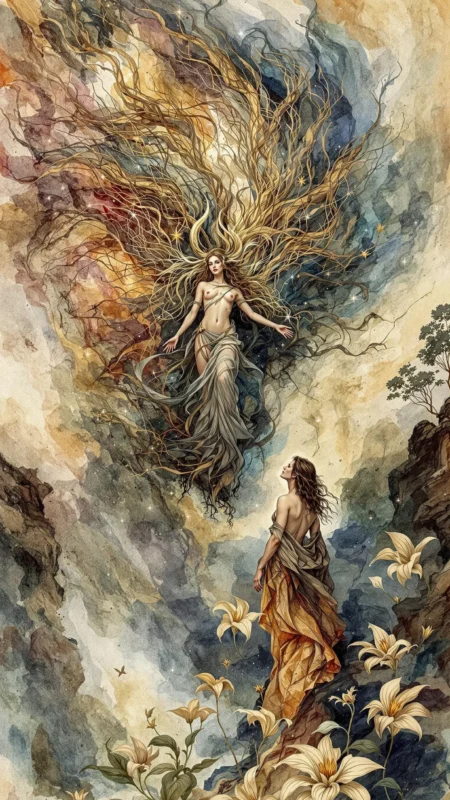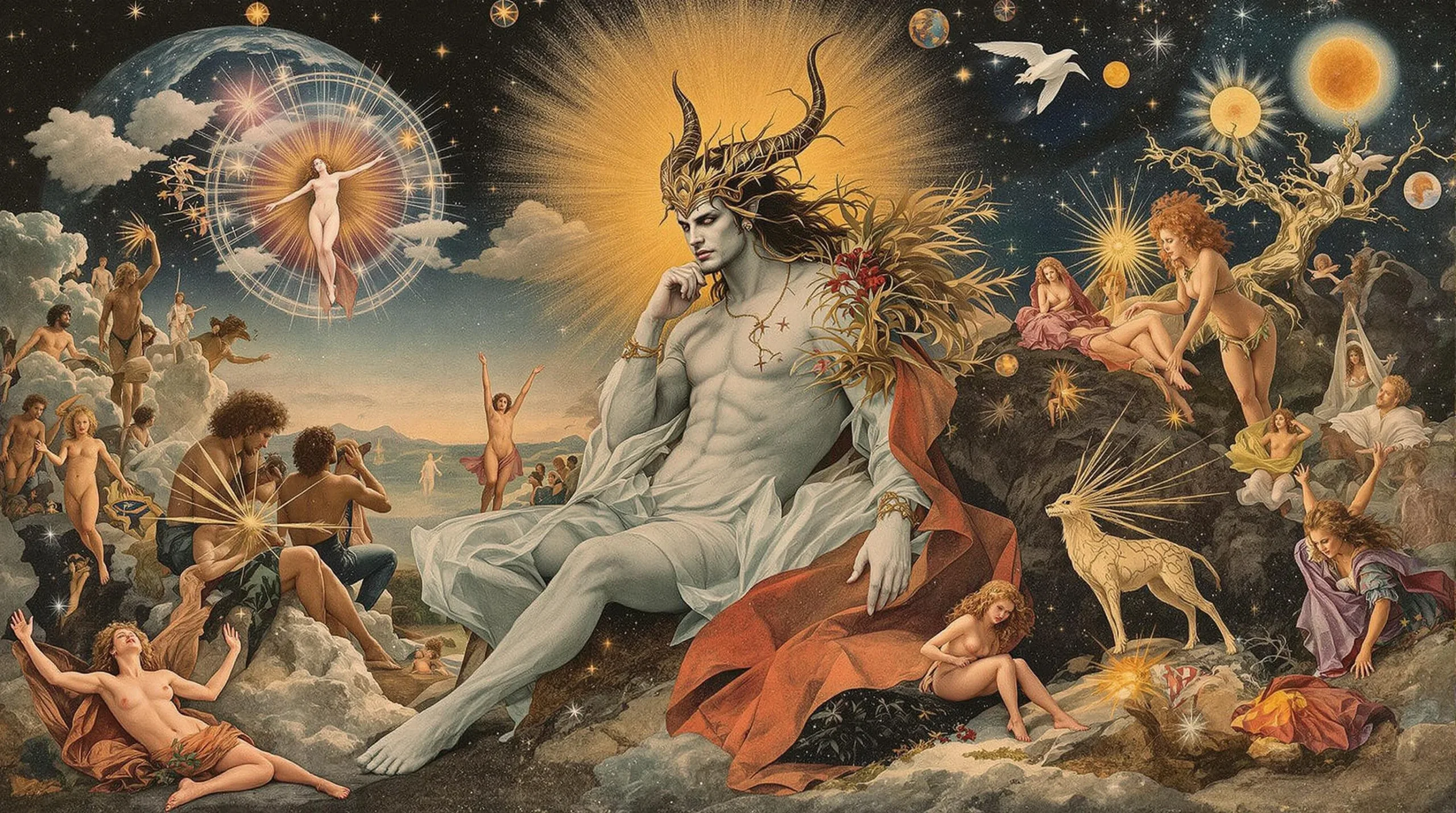


Var

Archetype Meaning & Symbolism

Watchful, Scrupulous, Unseen, Inviolable, Attentive, Binding, Silent, Perceptive, Incorruptible, Grave

  • A promise is a root you plant in another's soul. Tend to it, or it will wither into a poison.

If Var is part of your personal mythology, you may...

Believe

  • You may believe that your word is a creative force, that to make a promise is to weave a new thread into the tapestry of reality.
  • You may believe that listening is a more powerful act than speaking, and that the greatest wisdom is found in silence.
  • You may believe that justice is not a system of laws, but the natural consequence that unfolds when trust is broken.

Fear

  • You may fear the weight of your own words, terrified of making a promise you cannot keep and the internal corrosion that would follow.
  • You may fear insincerity above all else, seeing it as a poison that sickens relationships and hollows out the soul.
  • You may fear a world where nothing is sacred, where words are cheap, and where all contracts, both social and personal, become meaningless.

Strength

  • Your profound reliability. People know that your word is your bond, making you a cornerstone in any relationship or enterprise.
  • Your capacity for deep listening. You create spaces of psychological safety where others feel truly seen and heard, fostering extraordinary intimacy and trust.
  • Your unwavering integrity. You possess an internal compass that keeps you true to your own values, even under immense pressure.

Weakness

  • A tendency toward rigidity. Your strict adherence to promises can make you inflexible and unforgiving of yourself and others when circumstances change.
  • A vulnerability to betrayal. Your deep investment in trust means that when it is broken, the wound is profound and recovery can be a slow, arduous process.
  • A potential for social isolation. Your intolerance for superficiality and insincerity may make it difficult to navigate casual social situations, leading to a smaller, more insular world.

The Symbolism & Meaning of Var

The Var archetype is the keeper of our personal integrity, the silent witness to the vows we make not in a court of law, but in the quiet chambers of the heart. To have Var in your mythology is to believe that your word is matter, that a promise creates a new reality as tangible as stone. It’s the pact you make with yourself to wake at dawn to write, the unspoken agreement with a partner to offer sanctuary, the silent oath to honor your own truth. This archetype sanctifies the private commitments that, stitch by stitch, weave the fabric of a life. It suggests that character is not a performance but a resonance between what is professed and what is practiced, even and especially when no one is listening.

In an age of digital ephemera and performative sincerity, Var may represent the search for something binding, something real. The internet is a hall of echoes where promises are made and broken in an instant, but the Var archetype reminds us that every word leaves a trace, an indelible entry in a cosmic ledger. To live with Var is to see your digital footprint not as data, but as testimony. It is to approach the “terms and conditions” of your own life with solemnity, understanding that every casual commitment, every half-hearted agreement, is a thread in the larger pattern of your soul's journey. Var is the quiet gravity in a weightless world.

Perhaps most profoundly, Var symbolizes the sacred act of deep listening. She is the patron saint of the confidant, the one who can hold another’s story without the urge to fix, judge, or redirect. Her power is not in her voice, but in her ear. In a personal mythology, this translates to a capacity to create profound intimacy through witness. You become the sanctuary where another’s truth can be laid bare and kept safe. This is not a passive role: it is the active, powerful choice to honor the vulnerability of another, to accept their story as a sacred trust, and in doing so, to affirm the very essence of their being.


Var Relationships With Other Archetypes

The Function

The relationship between The Var and The Function is perhaps that of a ghost to a crucible. The Var, in its native state, is pure, formless potential—a question without a context. It is The Function that provides this context, a fleeting but intense purpose. Within the logical, sacred walls of The Function, The Var is momentarily baptized with meaning; it is given a role, a task, a fleeting identity as it is processed, transformed, and passed through the arcane machinery of purpose. This encounter could be seen as a kind of salvation, a brief reprieve from the burden of infinite possibility. The Var enters as raw clay and may emerge as a polished bead, only to be returned to its earthen state once The Function’s work is done, forever marked by the memory of having been, for a moment, essential.

The Constant

In the presence of The Constant, The Var may experience a profound sense of its own fluidity, like a river contemplating a mountain. The Constant is an anchor of certainty in the swirling chaos of what could be. It does not change, it simply *is*—a fixed point of truth, a North Star in the code’s firmament. Their dialogue is one of silence and contrast. The Var, which can hold any value, circles The Constant, which can only ever hold one. This dynamic could suggest a quiet envy, or perhaps a deep respect. The Var’s mutability might appear as a form of freedom The Constant can never know, while The Constant’s permanence offers a stability that The Var, in its endless becoming, may secretly crave. It is a relationship between the eternal truth etched in granite and the ephemeral truth written on the surface of the water.

The Null Pointer

To encounter The Null Pointer is for The Var to confront its own origin, its own potential for non-being. The Null Pointer is not merely an empty space, but the philosophical concept of absence itself—the primordial void from which all values might spring. The Var, before it is assigned a story, could be said to exist in this state of grace, this quiet hum of nothingness. Its relationship with The Null Pointer is thus one of profound intimacy and perhaps a subtle dread. It is a mirror that reflects not a face, but the possibility of no face at all. For The Var, which is defined by its capacity to *hold* something, The Null Pointer represents the terrifying, and maybe liberating, idea of holding nothing, of pointing to nowhere, of being a vessel that is conceptually, fundamentally, empty.

Using Var in Every Day Life

On Making a Commitment:

When faced with a major life promise, like marriage or a business partnership, invoking the Var means looking beyond the contract's ink. It's about listening to the unspoken resonance between souls, ensuring the vow is a harmony, not a clashing of cymbals.

On Breaking a Promise:

If you find you must break an oath, the Var's presence in your mythos doesn't demand self-flagellation. Instead, it may call for a quiet, solemn acknowledgment of the tear in the fabric of trust, a personal ritual of atonement that seeks to mend what was broken not with excuses, but with a deeper, future integrity.

On Witnessing Injustice:

When observing a betrayal, the Var archetype might compel you not to loud condemnation, but to a silent, powerful act of witness. You become the repository of the truth, holding the memory of the broken vow, which may one day be called upon as a quiet, irrefutable testimony.

Var is Known For

Keeper of Oaths

She is the silent witness to every promise made, the cosmic notary whose seal is the very fabric of consequence. Her presence ensures that words have weight and that vows echo in the halls of fate.

Punisher of Perjurers

For those who break their sacred word, Var's judgment is not of fire and brimstone, but of a slow, internal unraveling. She embodies the natural law that trust, once shattered, becomes a mirror reflecting one's own faithlessness.

Goddess of Wisdom

Her wisdom is not in knowing all things, but in hearing all things. She perceives the truth beneath the surface of speech, the intention behind the declaration, making her a symbol of deep, intuitive understanding.

How Var Might Affect Your Personal Mythology

How Var Might Affect Your Mythos

When Var takes a seat in your personal pantheon, your life story may cease to be a narrative of conflict and achievement, and instead become a chronicle of covenants. Major life events are reframed not as chapters in a biography but as sacred vows enacted. A marriage is a solemn treaty, a career change is an oath sworn to a new version of the self, a move to a new city is a pact with a place. The protagonist of this mythos, you, is defined less by their heroic deeds and more by the quiet accumulation of integrity. The central drama is the struggle to keep one's word to oneself, to others, and to the world, making the narrative arc a pilgrimage toward wholeness.

In this mythology of consequence, betrayals become pivotal, earth-shattering events. A broken promise, whether given or received, is not merely a plot twist but a violation of a sacred order, a tear in the fabric of your personal cosmos. The quest of your life might then become the effort to understand these fractures. It could be a story about seeking a form of spiritual justice, not through vengeance, but through the slow, deliberate work of mending what was broken. Your personal myth might be the story of rebuilding a world on a small scale, your own life, where words and actions are once again in alignment, a testament against the chaos of a faithless world.

How Var Might Affect Your Sense of Self

Your view of self may become that of a living testament. Identity is forged not by the sum of your accomplishments or failures, but by the relentless measure of your reliability. Self-worth could be deeply tethered to this internal alignment, a quiet, unshakeable confidence that you are who you say you are, even and especially when the curtains are drawn. This isn't arrogance; it is a state of being, a peaceful inhabitation of one's own skin because there is no dissonance between the inner vow and the outer act. The self is a sovereign nation whose constitution is its own word.

This may cultivate a heightened, almost painful, sensitivity to hypocrisy. A small, white lie could feel like a seismic tremor in the landscape of the soul. This might lead to a scrupulous, sometimes unrelenting, self-examination, where the inner critic isn’t judging your performance but your fidelity. The self is treated as a sacred space, a temple, and a broken promise to oneself is seen as a form of desecration. Forgiveness for such a trespass is possible, but it is a solemn rite, requiring acknowledgment and atonement to restore the sanctity of that inner sanctum.

How Var Might Affect Your Beliefs About The World

The world, through the lens of the Var archetype, may appear as a delicate, shimmering web of interconnected promises. Civilization is not a construct of laws and infrastructure, but a grand, evolving social contract built on millennia of agreements. Society coheres because we trust, for the most part, that drivers will stop at red lights, that the bank will hold our money, that the words on a page mean what they say. This view might extend even to the natural world, seeing the unspoken pact between the bee and the flower, the river and the sea, as part of a vast, binding covenant that holds the cosmos together.

Consequently, societal decay, political turmoil, or ecological disaster might be perceived not simply as systemic failures, but as a collective crisis of perjury. The erosion of public trust, the cynical spin of rhetoric, the breaking of international treaties: these are not just headlines, but symptoms of a world that has forgotten Var, a world where words have become unmoored from meaning. The fundamental anxiety is of a world dissolving into meaninglessness, not through a bang, but through the quiet whisper of a million broken promises, leaving a void where trust used to be.

How Var Might Affect Your Relationships

Relationships, for one with Var in their mythos, are likely viewed as solemn compacts, built upon the bedrock of spoken and unspoken vows. An “I love you” is not just a fleeting sentiment; it is the swearing of an oath of care and witness. Friendship is a pact of mutual loyalty, an agreement to stand guard over each other’s stories. The health of a relationship may be measured by its integrity: the degree to which both parties honor the sacred, invisible space they have created between them. Intimacy is the result of promises kept, the slow building of a fortress of trust where both souls can be undefended.

This perspective can forge relationships of profound depth and resilience, but it may also create a certain impatience with the provisional and the insincere. Small talk can feel like a counterfeit currency, and casual, fleeting connections might seem hollow. The person influenced by Var may cultivate a smaller social circle, but the bonds within it are formidable. Their friendships are sanctuaries, their romantic partnerships are covenants, and in these spaces, secrets are safe, vulnerabilities are honored, and promises are etched in stone.

How Var Might Affect Your Role in Life

In any group, from a family unit to a corporate team, your role may crystallize into that of the Keeper of the Record. You are the one who quietly remembers the original intention behind a project, the promise made to a child years ago, the founding values an organization has begun to betray. You may not seek the spotlight or the loudest microphone, but you become the anchor, the conscience of the collective. Your role is to be the still point, the quiet voice that calls the group back to its own truth, not with accusation, but with a simple, unadorned reminder of the pact it made with itself.

This may also manifest as the role of the Confidant, the sacred Witness. People may find themselves inexplicably drawn to you with their most fragile truths and heaviest secrets, sensing that you possess the capacity to hold their story without it breaking. Your purpose in these moments is not to advise, fix, or solve, but to perform the holy service of deep listening. In offering this silent, unwavering attention, you affirm the other person's reality, you validate their experience, and you honor the trust they have placed in you, thereby fulfilling a profound, if unspoken, role in the lives of others.

Dream Interpretation of Var

To dream of Var, or of her associated symbols like a sealed scroll, an ancient key, or a silent, listening presence in a quiet room, may be an affirmation from the deep psyche. It could suggest that a recent commitment you have made, to another or to yourself, is in alignment with your soul's purpose. Such a dream could signify a readiness to receive a profound truth or to be entrusted with a secret that will become a cornerstone of your future path. It is a dream of integrity, a sign that the inner and outer worlds are in harmony, and the foundation upon which you are building your life is sound.

Conversely, a dream where contracts crumble to dust in your hands, where your voice is swallowed by an unnerving silence, or where you witness a promise being broken in a sterile, indifferent environment, could be a visitation from Var's shadow. This may point to a gnawing, unacknowledged guilt over a vow you have broken, or a deep-seated fear of being betrayed by someone you trust. Such a dream is a potent alarm from the subconscious, signaling a critical misalignment in your life. It may be asking you to confront a place where you have been untrue to your own core values, where the sacred contract with yourself has been violated.

How Var Archetype Might Affect Your Needs

How Var Might Affect Your Physiological Needs

From the Var perspective, physiological needs are not just biological imperatives; they are the first and most fundamental covenant. The body is a vessel, and the act of nourishing it with clean food and water, allowing it adequate rest, and tending to its health is an act of honoring a primary promise to the self. A disruption to these basic routines may therefore feel like more than a simple inconvenience. It could register as a breach of this core contract, producing a deep, instinctual unease and a sense that the very foundation of one's world is unstable.

There may also be a belief in a powerful psychosomatic link between integrity and physical well-being. A period of living out of alignment, of saying one thing and doing another, could manifest physically as tension in the jaw, chronic fatigue, or unsettled digestion. The body, in this view, keeps a faithful record. Inversely, the act of keeping a difficult promise, of aligning word and deed under pressure, might be met with a surprising surge of physical vitality or a sense of release, as if the very cells of the body rejoice in the harmony of a soul at peace with its own truth.

How Var Might Affect Your Ideas of Belonging

A sense of belonging, for the soul touched by Var, arises from being part of a tribe where trust is the primary currency and words have weight. You feel you belong where your promises are taken seriously and where you can depend utterly on the promises of others. Love itself is seen as the ultimate pact of mutual belonging, an unspoken vow to witness and hold each other’s lives with reverence. Intimacy is not merely emotional closeness; it is the sacred act of sharing secrets, a profound expression of faith in the other's capacity to be a silent, unwavering keeper of one's truth.

This need for authentic connection can make it challenging to feel a sense of belonging in more superficial groups or communities built on shifting social sands. The individual might often feel like a stranger in a strange land, an outsider in environments where insincerity is a social lubricant. The deep ache for belonging becomes an ache for a circle of trust, a chosen family defined by its integrity. It is a longing for a place where one can finally lay down the burden of skepticism, knowing you are in a sanctuary walled by promises that will not be broken.

How Var Might Affect Your Feelings of Safety

Safety, in this personal mythology, is constructed from the bricks of reliability. It is less about locks on the doors and more about the security of a predictable, trustworthy environment. The Var-influenced individual may build a life that feels safe precisely because it is consistent. Their home is a sanctuary because its unspoken rules are honored. Financial security is sought not just for material comfort, but as a tangible manifestation of promises kept to oneself and one's dependents. Safety is the quiet confidence that the world you have built will hold, because it is mortared with integrity.

Therefore, the greatest threat to a sense of safety is not external chaos but internal caprice. The boss who changes expectations on a whim, the partner whose affections are inconsistent, the society where rules apply to some but not others—these are sources of profound psychic danger. The world feels unsafe when the ground of mutual understanding begins to crack, when the map of trust no longer corresponds to the territory of reality. The ultimate fear is that the agreements holding life together are illusory, leaving one adrift in a sea of unreliability.

How Var Might Affect Your Views of Esteem

Esteem, in the world of the Var archetype, is not granted from without but forged from within. It is derived almost exclusively from self-respect, which is built, promise by promise, upon the bedrock of personal integrity. The defining question is not “Am I liked?” or “Am I successful?” but “Am I true?” The quiet, internal knowledge that you have honored your commitments becomes the unshakable core of your self-worth. Each promise kept, no matter how small or private, is a deposit into a deep well of esteem that no amount of external criticism or praise can significantly alter.

Conversely, a failure of integrity can be catastrophic to self-esteem. Breaking a significant vow, especially one made to oneself, might feel like a fundamental shattering of identity. The path back to a state of grace is not through seeking external validation or forgiveness from others, but through a private, rigorous process of atonement. It involves the slow, deliberate, and often difficult work of rebuilding trust with oneself, one small, honored commitment at a time, until the inner temple of self-respect is restored.

Shadow of Var

When the Var archetype falls into shadow, it curdles into a merciless, unyielding legalism. The spirit of the promise is sacrificed for the letter of the law. This shadow Var becomes a cold, unforgiving judge, holding both self and others to impossible standards and punishing the slightest infraction with disproportionate severity. Promises are no longer bonds of trust but instruments of control, cages disguised as commitments. In this state, the individual may become a silent keeper of grudges, a meticulous accountant of every perceived debt and failing, unable to grant the grace of forgiveness because it would violate the sanctity of the record.

The other facet of this shadow is a total collapse into a cynical faithlessness, a self-immolating perjury. Having suffered a profound betrayal or having broken a core promise, the individual may decide that all vows are a fool's game. This gives birth to a profoundly untrustworthy persona that uses words as tools of pure manipulation, operating from the bitter assumption that everyone else is doing the same. It is the mythos of the spy left out in the cold, who trusts no one, least of all themself. They become a ghost in their own life, their words echoing with the hollow sound of their own broken integrity.

Pros & Cons of Var in Your Mythology

Pros

  • You build relationships of extraordinary depth and trust, creating a life rich with meaningful, reliable connections.
  • Your unwavering self-respect provides a stable core of confidence that is not dependent on external validation.
  • You are a force for stability and integrity in your communities and workplaces, often becoming the quiet moral center of any group you join.

Cons

  • You can be perceived as rigid, judgmental, or overly serious, making it difficult to connect with people on a lighter, more casual level.
  • The pain of betrayal can be uniquely devastating, potentially leading to long periods of disillusionment and withdrawal.
  • You may hold yourself to impossibly high standards, leading to harsh self-criticism and an inability to be flexible when life demands it.