
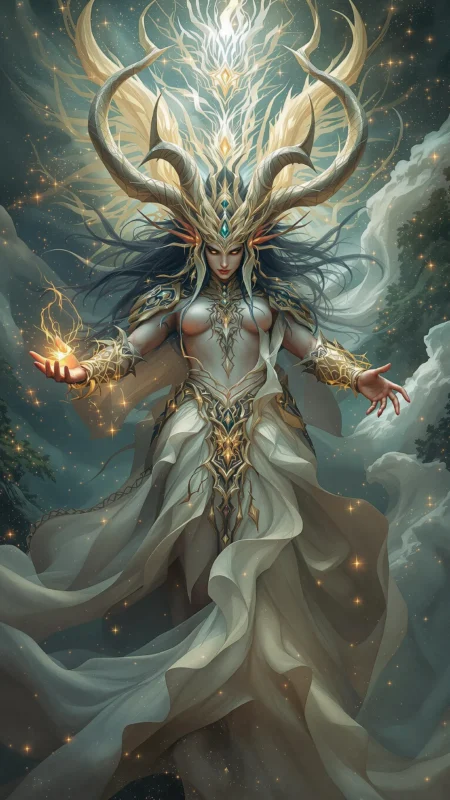
To invite the Vanir into your personal mythology is to court the wild intelligence of the biosphere itself. They are not the gods of the city or the spreadsheet; they are the deities of the mycelial network, the turning tide, the irreducible complexity of a forest floor. Their wisdom is chthonic, rising from the earth and the body, speaking in the language of instinct and intuition rather than linear logic. This archetype challenges the modern schism between mind and body, suggesting that the flesh is not a dumb vessel for the spirit but is, in fact, an oracle. The Vanir represent a homecoming to the organism, a sacred trust in the signals of pleasure, pain, and desire as guides to a well-lived life., The Vanir's association with wealth and prosperity is perhaps their most misunderstood aspect. It is not the prosperity of acquisition but of flow. Their gold is the sunlight on a field of barley, their jewels the glistening roe of a salmon. Within a personal mythos, this reframes success entirely. It ceases to be a static accumulation of assets and becomes a dynamic capacity to participate in cycles of giving and receiving. The Vanir teach that true wealth is ecological: a rich soil of relationships, a vibrant inner life, and a sustainable connection to one's environment. Prosperity becomes a measure of how much life, love, and creativity one can circulate, not how much one can hoard., Their mastery of seidr, the art of seeing and weaving fate, offers a metaphor for a different kind of agency. It is not the heroic, forceful will of the Æsir god who conquers destiny, but the subtle, receptive power of the shaman who listens to it. Seidr is the practice of deep listening, of surrendering the ego to perceive the vast, interconnected web of causality. In one's life, this translates to a trust in intuition's subtle currents, an ability to navigate complex situations not with brute force but with elegant adaptability. It is the power that comes from vulnerability, from being open enough to the world to truly understand its patterns and your place within them.

Vanir
Archetype Meaning & Symbolism
Sensual, intuitive, cyclical, prosperous, wild, chthonic, magical, peaceful, hedonistic, generative
- He made for me a high altar of heaped-up stones; now the gathered rocks have grown glassy, and with the blood of beasts I have reddened them anew.
If Vanir is part of your personal mythology, you may...
 Believe
- You may believe that the most profound truths are felt in the body, not conceived by the mind.
- You may believe that peace and pleasure are not frivolous pursuits, but are essential ingredients for a thriving world.
- You may believe that true wealth is measured in the health of your relationships and the richness of your sensory experience.
 Fear
Fear
- You may fear barrenness above all else—a life devoid of creativity, connection, passion, and growth.
- You may fear being trapped in environments that are sterile, artificial, and disconnected from the natural world, feeling that they will starve your soul.
- You may fear that your inherent sensuality and peace-loving nature will be judged as weak or indulgent by a culture that often prizes aggression and ascetic discipline.
 Strength
- You may possess a deep, resilient intuition, a kind of inner compass that guides you toward nourishing situations and away from toxic ones.
- You may have a natural talent for cultivating beauty, harmony, and abundance, creating pockets of sanctuary for yourself and others.
- You may have an immense capacity for experiencing and sharing pleasure, forging deep, life-affirming bonds with others and the world around you.
 Weakness
- You may have a deep-seated aversion to conflict, sometimes prioritizing a false peace over the necessary confrontation that leads to true resolution and growth.
- You may be prone to over-indulgence or hedonism, a tendency to get lost in pleasure as an escape from responsibility or discomfort.
- You may be particularly vulnerable to the harshness and artificiality of modern systems, leading to burnout, disillusionment, or a retreat from the world.
The Symbolism & Meaning of Vanir
Vanir Relationships With Other Archetypes
The Aesir
The relationship between the Vanir and the Aesir may be seen not as a simple rivalry, but as the eternal dialogue between the untamed wilderness and the walled city. Where the Aesir might represent the architectural impulse—the straight line, the codified law, the unyielding fortress built against chaos—the Vanir are perhaps the chaos itself, in its most fertile and creative guise. They are the ivy that eventually softens and claims the stone, the intuitive wisdom that seeps through the cracks in rigid doctrine. Their eventual, celebrated truce was not a surrender, but a kind of cosmic recognition; a fortress, after all, cannot sustain itself. It needs the wild fields for grain, the deep woods for timber, and the unpredictable seasons for life. Their union could be the ultimate metaphor for a mature consciousness: the necessary and profound integration of the structured with the instinctual, the sky with the soil.
The Beekeeper
In the quiet patience of the Beekeeper, the Vanir may find a mortal echo of their own spirit. The Beekeeper does not command the hive but rather enters into a delicate covenant with it, a stewardship of a fiercely independent and productive force. This dance of respect and understanding, of knowing when to offer shelter and when to simply stand back, could be seen as a reflection of the Vanir's own magical practice—a subtle guidance of natural energies rather than a forceful subjugation. The hive itself, with its golden, life-giving hoard, is a perfect emblem of Vanir prosperity: a sweetness born not of conquest, but of a million small, cooperative acts. The Beekeeper, moving through the humming air, is perhaps a priest in a temple of quiet abundance, tending to a mystery that can be cultivated but never truly owned.
The Harbor
The Harbor is a place that breathes with a Vanir soul. It is a threshold, a liminal space where the wild, formless potential of the sea is met, embraced, and translated into the language of civilization. Like the Vanir themselves, who brokered peace and fostered wealth, the Harbor exists as a site of negotiation. It does not seek to tame the ocean's raw power but provides a sanctuary where its gifts—and its travelers—can safely make landfall. The ceaseless rhythm of its tides, the exchange of foreign treasures for local goods, the scent of salt and far-off lands mingling with the dust of the shore; all of this could be a physical manifestation of the Vanir ethos. It is a space of generative exchange, where the boundary between the known and the unknown is rendered porous, allowing prosperity to flow like the incoming tide.


Using Vanir in Every Day Life
Navigating Creative Blocks:
When inspiration feels like a distant country, the Vanir archetype suggests you are not empty, but merely fallow. This is not a failure of imagination but a necessary season of the soul. The Vanir do not force the spring. Instead, they encourage you to enrich the soil: to read poetry, to walk by the ocean, to savor a meal, to engage in the sensual world without the pressure of production. It's in this state of receptive being, not striving, that the seeds of a new idea may quietly, almost imperceptibly, begin to sprout.
Deepening Relationships:
If a relationship feels transactional or distant, the Vanir ask you to re-sacralize it through shared pleasure and presence. This isn't about grand romantic gestures, but the quiet magic of mutual attunement. It could mean cooking a meal together, feeling the texture of the ingredients, or sharing silence in a beautiful place. The Vanir ethos suggests that the deepest bonds are forged not in conversation alone, but in the non-verbal, sensory experiences that affirm you are two living creatures sharing a small, warm space in a vast world.
Finding Prosperity in Scarcity:
In moments of financial anxiety or material lack, the Vanir archetype offers a radical redefinition of wealth. It prompts you to take an inventory of a different kind of treasure: the richness of your friendships, the health of your body, the taste of clean water, the knowledge in your hands. This is the prosperity of the thriving ecosystem, not the miser's hoard. By focusing on this organic, flowing abundance, you may find a resilience and a sense of security that money alone could never provide.
Vanir is Known For
How Vanir Might Affect Your Personal Mythology
How Vanir Might Affect Your Mythos
When the Vanir archetype takes root in your personal story, the narrative structure itself may begin to change. The linear arc of the hero's journey—a straight line from obscurity to victory—might dissolve into a more cyclical, seasonal saga. Your life story may cease to be about conquering mountains and more about cultivating a garden. Setbacks and fallow periods are no longer plot failures; they are compost, the dark, rich ground from which the next chapter will grow. Your personal myth becomes less of an epic poem and more of a perennial, with seasons of vibrant bloom, fruitful harvest, quiet dormancy, and inevitable rebirth.
Your inner pantheon also finds a new, and sometimes tense, equilibrium. The part of you that plans, strives, and imposes order—your inner Æsir—must now coexist with the part that feels, senses, and flows with nature. Your mythos becomes one of negotiation and integration. It is the story of how the sky god of your ambition learned to listen to the earth goddess of your intuition. The central conflict of your life might shift from Man vs. World to a more intimate drama: the quest to build a lasting peace between the different divine forces that dwell within your own soul.
How Vanir Might Affect Your Sense of Self
Embracing the Vanir may lead you to view yourself less as a rational mind piloting a biological machine and more as a complete, unified ecosystem. Your body, with its aches, pleasures, and instincts, could be elevated to the status of a primary text, a sacred source of wisdom. You may start to listen to your fatigue not as a weakness to be overcome with caffeine, but as a wise call for rest. Your desires may no longer seem like dangerous impulses to be controlled, but as compass needles pointing toward what truly nourishes you. This perspective fosters a profound sense of self-acceptance, a peace with your own creaturely nature.
Consequently, your sense of self-worth may detach from the scaffolding of external validation—titles, accomplishments, social status—and anchor itself in more organic measures. You might find your value in your ability to feel deeply, to create beauty, to nurture life, or to experience simple, profound pleasure. Esteem becomes less about being impressive and more about being vibrantly, unapologetically alive. You are valuable not because of what you have done, but because you are a locus of life, a being through which the world senses and celebrates itself.
How Vanir Might Affect Your Beliefs About The World
With the Vanir as a guide, the world may cease to look like a collection of inert resources waiting for human exploitation. Instead, it could reveal itself as a vast, interconnected, and sentient organism. Ecology becomes a form of theology. The wind is no longer just moving air; it is a breath carrying messages. The economy of a forest, with its intricate exchanges and symbiotic relationships, becomes a model for a healthier human society. You might start to see the sacred not just in temples and on altars, but in the resilience of a weed growing through concrete or the generosity of a fruit tree.
This perspective could also foster a deep distrust of rigid, abstract ideologies and a preference for lived, embodied wisdom. The Vanir worldview is pragmatic and situational. The guiding questions are not “What is the rule?” but rather “What fosters peace? What brings joy? What helps life flourish here and now?” This leads to a more fluid, compassionate, and context-sensitive approach to ethics and decision-making, grounded in the tangible well-being of the collective rather than adherence to inflexible principles.
How Vanir Might Affect Your Relationships
The Vanir archetype transforms relationships from social contracts into sacred ecologies. You may find yourself less interested in partnerships based on utility or shared status, and more drawn to connections that feel like coming home to a wild, familiar landscape. Intimacy becomes an art of mutual flourishing, a dance of sensual attunement and shared pleasure. The health of a relationship is judged by its fruits: the joy, creativity, and peace it generates for both parties. Love is seen not as a finite resource to be hoarded, but as a generative force, like sunlight or rich soil, that multiplies when shared.
This extends beyond romantic partnership to community. You might be driven to cultivate or seek out tribes that function like healthy ecosystems: diverse, interdependent, and focused on collective thriving. Belonging is not about conforming, but about finding your unique niche, the role that only you can play in the health of the whole. Relationships become less about obligation and more about a joyful, instinctual sense of mutual care. You tend to your people as you would a garden, knowing that their well-being is inseparable from your own.
How Vanir Might Affect Your Role in Life
Your perceived role in the world may shift from that of a warrior, builder, or achiever to that of a cultivator. Your life's work might be seen not as the construction of an empire, but as the tending of a sacred grove. This role is subtle, powerful, and deeply necessary. It is the work of creating the conditions for life to thrive: fostering peace in your family, nurturing creativity in your workplace, or literally cultivating a patch of earth. Your purpose becomes less about making a mark and more about leaving the world more fertile, beautiful, and harmonious than you found it.
Alternatively, you may embrace the role of the seer, the one who practices a modern form of seidr. Your contribution might not be through decisive action but through deep listening and intuitive insight. You become the one who can sense the subtle emotional currents in a room, who can divine the hidden needs of a project or a person, who can hold space for healing and transformation to occur. Your power is not in your voice, but in your attention; not in your strength, but in your receptivity. You are the quiet center, the calm harbor where others can find their bearings.
Dream Interpretation of Vanir
In a positive context, a dream of the Vanir—of Freyja's falcon cloak, Freyr's golden boar, or Njörðr's calm shores—is a profound affirmation from the subconscious. It may signal a period of immense fertility, be it creative, emotional, or professional. The dream suggests that your inner soil is rich and that you should trust the seeds you have planted. It is an invitation to embrace pleasure without guilt, to trust your intuitive hunches, and to prepare for a harvest. Such a dream is a blessing from your deepest self, a sign that you are in right relationship with your own nature.
When the Vanir appear in a nightmare or a distressed state—a blighted field, a weeping Freyja, a polluted sea—it often serves as a stark warning. The dream may be pointing to a dangerous disconnect from your own vital life force. It could suggest that you are ignoring your body's wisdom, starving your creative impulses, or living in a way that is emotionally or spiritually barren. It is a distress signal from the ecosystem of your soul, a cry for you to return to the practices and places that truly nourish you before a deeper rot sets in.
How Vanir Archetype Might Affect Your Needs
How Vanir Might Affect Your Physiological Needs
The Vanir archetype sanctifies the physiological. Needs for food, water, rest, and touch are not lowly distractions from a higher purpose; they are the very rituals that ground the sacred in the real. To eat is to commune with the earth's body. To sleep is to journey into the fertile darkness where the soul renews itself. To breathe is to participate in the exchange of life with the world. This perspective dissolves the shame around bodily needs and reframes them as acts of reverence for the gift of life itself.
Living with this archetype could foster a much deeper, more intuitive connection to your body's cycles. You may become less reliant on the clock or external schedules and more attuned to your own internal rhythms of energy and fatigue, hunger and satiation. You might find that honoring these natural cycles, rather than fighting them, leads to a more sustainable and vibrant state of health. Your body becomes less of an object to be disciplined and more of a wise and trusted advisor.
How Vanir Might Affect Your Ideas of Belonging
Belonging, in the world of the Vanir, is not about assimilation but about finding one's essential place within an ecosystem. It is the profound feeling of being not just tolerated but necessary. You belong when your unique talents, perspective, and energy are recognized as vital to the health of your tribe, family, or community. The search for belonging becomes a search for the right environment where your specific form of wildness can flourish and contribute to the whole.
Love and intimacy take on a deeply earthy, sensual quality. The Vanir do not separate love from the body; they are one and the same. Love is expressed through shared pleasure, mutual care, and a celebration of each other's physical being. It is a generative force, a partnership that creates more life, more joy, and more beauty in the world. Connection is not a meeting of minds, but a convergence of two entire worlds, two living beings who create a shared habitat of warmth, trust, and pleasure.
How Vanir Might Affect Your Feelings of Safety
Safety, through the lens of the Vanir, is not a fortress but a forest. It is found not in high walls and locked doors, but in deep roots, resilient networks, and skillful adaptation. True security is the knowledge that you have a community that will support you, the practical skills to provide for yourself, and the inner resources to weather inevitable change. It is the safety of the well-tended farm, which has stores for the winter and healthy soil for the spring, rather than the brittle security of the castle, which can be starved out or stormed.
This archetype teaches that lasting safety comes from becoming more enmeshed with the world, not more insulated from it. It lies in your ability to be flexible, to bend like a reed in the wind rather than breaking like a rigid oak. You may find yourself investing your energy in building social capital, learning practical crafts, and deepening your connection to your local environment. Security becomes a function of your own resilience and your integration into a healthy, thriving community.
How Vanir Might Affect Your Views of Esteem
Esteem, when informed by the Vanir, becomes a measure of fecundity. Your self-worth is derived not from what you conquer or control, but from what you can help to grow. This could be a garden, a work of art, a healthy child, a peaceful home, or a joyful friendship. You feel valuable when you are a source of nourishment, pleasure, and life for yourself and those around you. It is an esteem based on generative power rather than hierarchical power, a quiet confidence in your ability to make the world richer by your presence.
This archetype also nurtures an esteem rooted in profound self-acceptance, particularly of the body, its desires, and its cycles. It dismantles the cultural narratives that frame pleasure as sinful, instinct as base, and the body as something to be transcended. Instead, it offers a radical approval of your own organic nature. Your worth is inherent and unquestionable, as natural and self-evident as the value of a flowing river or a fruit-laden tree.
Shadow of Vanir
When the Vanir archetype falls into shadow, its life-giving waters become a stagnant marsh. The love of pleasure curdles into a desperate hedonism, a chase for the next sensory hit to avoid feeling any discomfort or emptiness. Peace becomes appeasement, a toxic passivity that allows injustice and dysfunction to fester for fear of disturbing the calm. The desire for abundance warps into a lazy entitlement or even a grasping jealousy, focused on what one can get rather than what one can generate. This is the shadow of decay without rebirth: the overripe fruit that rots on the vine, the sensuality that becomes sloth, the deep pool of intuition that turns murky with inaction.
Another shadow aspect is a profound, vegetative melancholy. When the connection to the life force is damaged—by trauma, neglect, or an unnaturally sterile environment—the Vanir archetype can manifest as a deep inertia and anhedonia. The world appears drained of color and meaning. There is no joy in food, no pleasure in touch, no inspiration for creativity. This is the Vanir in a perpetual, frozen winter. It is not the restful fallow of the healthy cycle, but a barren wasteland of the soul, a deep despair born from being fundamentally disconnected from the pulsing, vibrant, and sacred rhythms of life.
Pros & Cons of Vanir in Your Mythology
Pros
- Your life is likely rich with sensory pleasure, deep connection, and a feeling of being grounded in the natural world.
- You are a natural peacemaker and nurturer, with an ability to create harmony and foster growth in your relationships and communities.
- Your powerful intuition serves as a reliable guide, helping you navigate life with a wisdom that transcends rational analysis.
Cons
- Your aversion to conflict can make it difficult to set firm boundaries or advocate for yourself in aggressive environments.
- You can be easily overwhelmed or depleted by the fast-paced, inorganic, and often confrontational nature of modern corporate or urban life.
- A tendency to prioritize immediate comfort and pleasure can sometimes sabotage long-term goals that require sustained periods of effort and discomfort.