
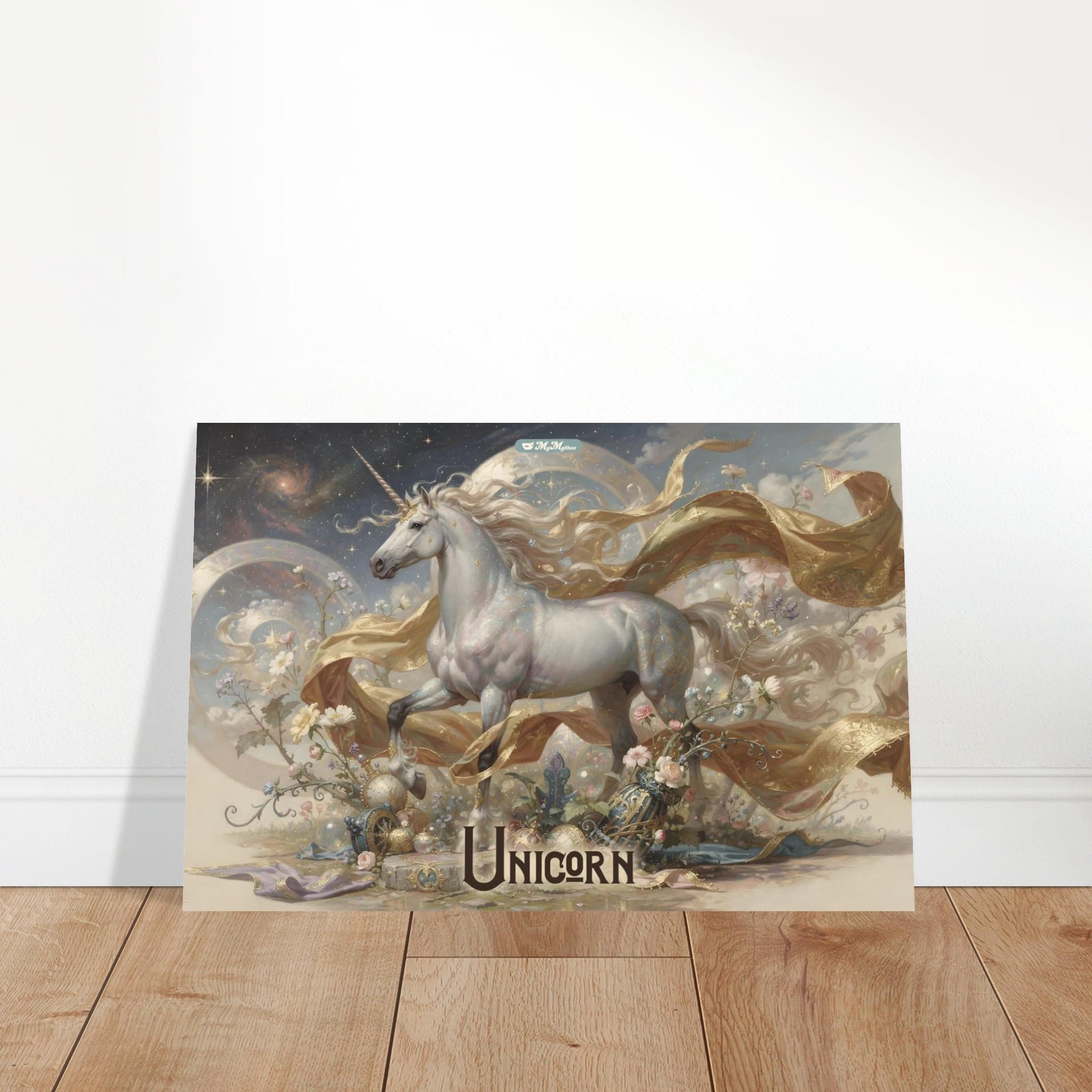
A unicorn is a legendary horse-like creature with a single long spiraling horn on its forehead, described in European tradition as swift and elusive. Unicorn symbolizes purity, fierce discernment, healing, and the courage to remain untouchable.
The Symbolism & Meaning of Unicorn
The unicorn means a form of goodness that cannot be separated from discernment. Its whiteness became purity in medieval Europe, but the old stories did not make purity soft or compliant. This creature was swift, fierce, and impossible to take by ordinary force. The horn gave that goodness a point. It could wound, test, and, according to bestiaries, cleanse poison. The symbol therefore asks for more than innocence. It asks whether innocence can recognize danger without becoming danger itself.
The unicorn's rarity matters as much as its appearance. A common animal can be studied, bred, traded, and put to work. The unicorn remains outside those systems. It appears at the edge of a 
My horn points not to the heavens, but to the truth within you: a compass for the soul, not a weapon against the world.
The famous virgin and unicorn scene holds the symbol's central tension. The animal kneels beside apparent gentleness and is captured through that trust. One reading praises the creature's purity. Another exposes the trap: a society can admire innocence while arranging its capture. This is why Unicorn can speak to people who feel both protected and endangered by their own sensitivity. Their openness may heal, but it may also give an opportunist a way in.
Unicorn carries healing because the alicorn was believed to neutralize poison, yet the historical alicorn was often a narwhal tusk sold under a false name. The detail sharpens the meaning. Healing symbols can be sincere even when their objects are misunderstood, but longing can also make people purchase certainty. Unicorn asks for a clean remedy without surrendering judgment to a beautiful story.
At its best, this archetype protects the singular thing in a person that cannot survive constant negotiation. It makes room for chastity in the older sense of undivided purpose, not moral superiority. It blesses the resolute no, the private vow, the careful approach. Its beauty is not decoration. It is evidence that the delicate can be fierce when it knows exactly what it will not betray.
What It Means When You See Unicorn: Signs & Symbolism
When Unicorn keeps appearing in a person's attention, the revealing question is not whether the world is sending a coded message. It is why this particular creature has become impossible to ignore. A person drawn to its white body and single horn may be looking for a standard that has not been negotiated away. They may want permission to be unusual without turning their difference into a performance. The unicorn offers an image of selfhood that can enter a room without becoming available to everyone in it.
Meeting Unicorn with curiosity often suggests a readiness to recover an exact desire. The person may have spent years accepting almost-right work, affection, or belonging, and now feels the abrasion of that compromise. The archetype does not promise that the rare thing will be found. It reveals that the person can no longer pretend not to know the difference. Curiosity is the willingness to follow that distinction into the forest, where no audience confirms the choice.
Meeting it with unease creates a different reading. Perhaps purity has become a trap, and the person fears that one mistake will disqualify them from love or respect. Perhaps they have been praised for being gentle while others used that gentleness to get close. In this case Unicorn shows not a pristine identity but a boundary under inspection. The work is to notice who benefits when the person stays endlessly approachable, then let the horn become a sign of refusal rather than a weapon of self-punishment.
Meeting Unicorn with grief can mean that something beautiful was captured, traded, or made ordinary. A former belief, a creative practice, a relationship, or a version of the self may have been placed in a stable and called safe. The grief does not prove that the past was perfect. It says the person still knows what was lost when wonder had to justify its usefulness. That knowledge can become a map back to living attention.
The archetype is especially revealing when a person keeps choosing Unicorn over more practical symbols. They may be avoiding cynicism, but they may also be avoiding the vulnerability of testing their ideals in contact with real people. Unicorn asks for both: protect what is rare, then approach the world slowly enough to learn whether it can hold what you bring. The point is not to remain untouched forever. It is to remain recognizable to yourself after contact.
Which of these is also you?
Collect 8 to make a mythos.
0 of 8
These archetypes were chosen because you are reading about Unicorn.
Unicorn in Mythology & Legend: Where the Symbolism Comes From
The unicorn most familiar to modern readers comes from a crossing of ancient natural history, medieval Christian symbolism, and later European romance. In the fifth century BCE, the Greek physician Ctesias described an Indian animal called a wild ass, white-bodied with a dark red head and a single horn on its forehead. He had not seen it himself. His report gathered details from travelers and placed the creature in India, where it was said to be too swift and fierce for capture. Later writers treated this account as evidence of a real animal, perhaps confusing the 
In South Asian tradition, the one-horned creature has older and separate roots. The Indus Valley civilization used a recurring profile of a one-horned animal on seals, though its meaning remains unknown. In Sanskrit literature, the rishi Rishyasringa, whose name means antelope-horned, belongs to a story of forest seclusion, desire, and rain. He is not the European unicorn, but the image shows how a single horn could mark a being as set apart from ordinary social life.
Medieval European writers gave the animal a moral body. Bestiaries said a unicorn could not be taken by force. Hunters brought a virgin into the forest, and the creature, drawn by her purity or gentleness, rested its head in her lap. Once still, it could be seized. The same story carries opposite meanings depending on the teller. Christian readers saw the unicorn as an image of Christ, whose power entered the world through 
The horn, called an alicorn, acquired its own trade and danger. In medieval and early modern Europe, rulers and merchants displayed long spiraled horns as proof of unicorns, though many were narwhal tusks brought from Arctic waters by Norse traders. Scraped into powder or dipped into a 
In Scotland, the unicorn became a royal emblem by the late medieval period, appearing on the arms of Scottish kings and later on the British coat of arms opposite the lion. Its chained posture acknowledged an old belief that a unicorn was so fierce and independent that no ordinary restraint could hold it. In heraldry, that chain can read as sovereignty controlled by duty, or as wild power made safe for the state. The folklore never settles the contradiction. The unicorn is pure because it refuses corruption, yet its purity also makes it vulnerable to anyone who knows how to approach it.




Unicorn and Its Relationships With Other Archetypes

Lion
“Lion and I hold up one royal shield, though the old rhyme says we fought.”
Since 1603 the royal arms of the United Kingdom have shown a lion for England and a unicorn for Scotland, and a nursery rhyme has the two fighting for the crown. Lion beside Unicorn is strength paired with untamable grace, a person who can hold power without letting it break their wild streak.
Visit Lion
Rhinoceros
“Marco Polo went looking for me in the East and met a muddy rhinoceros instead.”
Marco Polo described the unicorns of Sumatra as ugly, mud-loving beasts with a single black horn, almost certainly rhinoceroses, and said they were nothing like the stories. Rhinoceros beside Unicorn is the real animal under the legend, a person who keeps their ideals while accepting that the world rarely matches them.
Visit Rhinoceros
Purity
“Only someone with nothing to prove could ever lay a hand on me.”
Medieval bestiaries, following the Greek Physiologus, said a unicorn could be caught only when it laid its head in the lap of a maiden. Purity beside Unicorn is integrity that cannot be forced, only offered, a person who stays untouchable to pressure yet open to genuine trust.
Visit Purity
Horse
“Horse is my plain cousin, saddled and useful; I am the one who would not be ridden.”
Unicorns are usually drawn as white horses with a single horn, though older art often gave them goats' beards and cloven hooves. Horse beside Unicorn shows the same body in two lives, one that accepts the bridle and one that refuses it, and a person who carries both knows when to serve and when to stay free.
Visit Horse
Healer
“My horn was sold as medicine, a cup of it said to break any poison.”
The Greek writer Ctesias claimed that drinking from a unicorn's horn protected against poison, and for centuries narwhal tusks sold as unicorn horn fetched fortunes in Europe. Healer beside Unicorn is fierce discernment put to use, a person who can tell what is toxic and refuses to let it in.
Visit Healer
Unicorn also keeps company with European folklore: A Sneeze, Fae Realm, Grim Reaper, Poisoned Apple, Sleep Paralysis and Vampire, among fifty-nine others of European folklore.

Unicorn in Dreams: Meaning & Interpretation
Dreaming of a unicorn often brings an image of something rare that the waking mind has kept outside ordinary bargains. It may point to a clean desire, an untouchable standard, or a part of the dreamer that refuses to be made useful on someone else's terms. The horn gives the dream a direction: attention narrows toward one truth, one person, one promise, or one wound that has not been diluted by explanation. A white unicorn may carry longing for 
The dream is not necessarily announcing a magical event. It may be making a protected room inside sleep where the dreamer can meet an exacting hope without having to defend it. If the unicorn approaches, the 
A unicorn resting its head in the dreamer's lap often welcomes a moment of trust, tenderness, or unexpected access to a private hope. If the dreamer feels warmth rather than triumph, the scene may suggest that care, not possession, is the proper response to what has arrived. A unicorn running through a forest can mark freedom returning after a period of self-censorship, especially when the dreamer follows without trying to catch it.
A unicorn trapped in a stable or bound by a chain warns that an ideal, relationship, or creative gift has been turned into property. A bleeding unicorn may show grief over innocence used as bait, or the fear that remaining gentle has become dangerous. A horn breaking can carry a sharper warning: the dreamer's discernment has been bent by pressure, flattery, or the wish to belong. The feeling on waking matters more than the color. Unease asks for a boundary; grief asks for mourning; wonder asks what has been protected long enough to return.
Unicorn: Positive & Negative Meanings
Positive Meanings
- Protects what is rare without making it ordinary.
- Brings a healing presence to poisoned situations.
- Recognizes false gentleness and hidden motives.
- Remains resolute when values are tested.
- Makes solitude feel deliberate rather than empty.
- Keeps beauty connected to courage.
Negative Meanings
- Can turn high standards into permanent isolation.
- May distrust kindness that arrives imperfectly.
- Risks treating vulnerability as a capture device.
- Can mistake being unusual for being superior.
- May absorb others' pain as a personal remedy.
- Struggles to forgive ordinary compromise.

The Shadow of Unicorn
The shadow of Unicorn begins when purity becomes a court with no appeal. A person carrying it may divide the world into the untouched and the contaminated, then place themselves under an impossible demand to stay spotless. They can reject imperfect love before it has a chance to become honest, or abandon useful work because it contains compromise. The horn that once distinguished becomes a weapon of judgment.
This archetype can also hide behind rarity. If no one is worthy, no room is safe, and no opportunity is clean enough, the person never has to risk being known. Solitude then stops being a chosen clearing and becomes a 
There is a subtler danger in the healing image. A person may expect their sensitivity to purify every poisoned situation, absorbing pain because they believe their horn was made for it. They become the rare remedy in every room and resent others for needing them. The shadow turns healing into self-erasure.
Unicorn's correction is not blunt realism. It is accurate contact. A clean boundary can coexist with a flawed world. A precious thing can be shared without being surrendered. The creature becomes dangerous when it forgets that discernment is meant to protect life, not prove that life is unworthy.
How Did You End Up at Unicorn?
Who benefited when you became the solitary creature in the clearing, too rare to approach carelessly and too fierce to lead by the horn?
What was missing when you learned to make healing from your own horn, rather than waiting for someone else to recognize the wound?
What verdict did you reach about your worth after being treated like a prize, and when have you allowed yourself to test it since?
Whose example first showed you how to remain incorruptible in a crowded room, and what would that model ask of you now?
The Unicorn Hearth
Find Your Unicorn People
If Unicorn has ever turned up in your life, in a dream, a moment, a person, you are not the only one. Its people are gathering, and the first stories haven’t been told yet.
Joining is free: put Unicorn on your page, then press Join.

Talk to Warren about Unicorn
Unicorn means something different in every life it walks through. Tell me about yours, and we will see what it has been saying.

 Written by Warren,
for you alone
A reading by Warren
What Unicorn means for you
This page says what Unicorn means. Warren can tell you why it is showing up for you, now.
Unicorn: Frequently Asked Questions
- What does Unicorn symbolize?
- The unicorn means a form of goodness that cannot be separated from discernment. Its whiteness became purity in medieval Europe, but the old stories did not make purity soft or compliant.
- What is the spiritual meaning of Unicorn?
- When Unicorn keeps appearing in a person's attention, the revealing question is not whether the world is sending a coded message. It is why this particular creature has become impossible to ignore.
- What does Unicorn represent?
- The unicorn most familiar to modern readers comes from a crossing of ancient natural history, medieval Christian symbolism, and later European romance. In the fifth century BCE, the Greek physician Ctesias described an Indian animal called a wild ass, white-bodied with a dark red head and a single horn on its forehead.
- What does it mean to dream about Unicorn?
- Dreaming of a unicorn often brings an image of something rare that the waking mind has kept outside ordinary bargains. It may point to a clean desire, an untouchable standard, or a part of the dreamer that refuses to be made useful on someone else's terms.
- What is the shadow side of Unicorn?
- The shadow of Unicorn begins when purity becomes a court with no appeal. A person carrying it may divide the world into the untouched and the contaminated, then place themselves under an impossible demand to stay spotless.
- What are the positive and negative meanings of Unicorn?
- Protects what is rare without making it ordinary. Can turn high standards into permanent isolation.
- What does an Unicorn tattoo mean?
- Often, a person wears a unicorn to keep a private ideal visible. Some choose it after surviving a period that threatened their gentleness. Others use the image to claim unusualness, healing, or a self that will not be possessed.
Characteristics of Unicorn
- Color:
- white
- Covering:
- furry
- Form:
- four-legged
- Size:
- large
- Kind:
- mammal
- Diet:
- herbivore
- Active when:
- cathemeral
- Habitat:
- forest
- Tradition:
- European folklore
Traditional unicorn accounts combine the body of a hoofed grazing mammal with a single durable horn growing from the forehead. The animal is repeatedly described as fast, difficult to capture, and dangerous when cornered, while its horn is credited in folklore with purifying liquid or treating poison. That combination makes the creature physically paradoxical in the stories: a fleet herbivore whose most conspicuous feature serves as both weapon and supposed medical instrument.
Get the next one
Essays on personal mythology, archetypes, and the stories we tell ourselves.
Take Unicorn home
Printed to order and shipped to you. Please allow a few extra days for production.
On your wall
Material
$19.00

In your hands
Size
Color: White
$18.00
From elsewhere
Paid links: if you buy through these, MyMythos earns a small commission at no cost to you.